The final letter arrived almost a year later.
This time, there was no mystery about the sender.
It came from the archive director.
The envelope contained a certificate.
The collection had been formally completed.
The archive was now permanent.
I read the document slowly.
Then I placed it beside my father's letter.
For years, I had imagined the end of this story as a courtroom.
A judge.
A sentence.
A door closing behind someone who had hurt children.
But the real ending was quieter.
A room filled with records.
Families finding names.
Children growing older.
Parents learning the truth.
People deciding what to remember.
I understood that justice and closure were not identical.
Justice could happen in a courtroom.
Closure happened in people's lives.
Sometimes years later.
Sometimes not at all.
Renata called that evening.
“Mom, are you home?”
“Yes.”
“Can I come over?”
“Of course.”
She arrived with Maya.
Maya was carrying a small notebook.
“What are you writing?”
“A story.”
I smiled.
“About what?”
“A girl who finds an old letter.”
Renata looked at me.
I raised an eyebrow.
“That's not suspicious at all.”
Maya giggled.
“Mom says it's not about you.”
“Your mother is very wise.”
Renata rolled her eyes.
We sat at the table.
Maya opened her notebook.
She had written three pages.
The story was about a girl who discovered that her family had kept a secret.
But the secret wasn't a crime.
It was a letter from someone who had died before the girl was born.
The girl wanted to know why the letter had been hidden.
At the end, she learned that the person who wrote it had been afraid.
Not of punishment.
Of losing the people he loved.
I looked at Renata.
“Did you write this?”
“No.”
Maya smiled.
“I did.”
“What happens next?”
“I don't know.”
I nodded.
“That might be the best part.”
Maya frowned.
“Why?”
“Because you haven't decided yet.”
She seemed to like that answer.
After dinner, Renata helped her daughter with her coat.
Before leaving, she turned to me.
“Can we talk?”
“Of course.”
She waited until Maya was in the car.
Then she said:
“I've been thinking about Grandpa.”
“So have I.”
“I used to be angry that he hid everything.”
“You were right to be.”
“But now I think I understand.”
I waited.
“He was trying to protect people.”
“Yes.”
“He just didn't understand that protection without honesty can become another kind of danger.”
I nodded.
“That took me years to understand too.”
She looked toward the car.
“I don't want to repeat that.”
“You won't.”
“I hope not.”
We stood in the driveway.
The evening was cool.
There was a faint smell of rain.
Renata looked at the house.
“Do you still keep the box?”
“Yes.”
“Can I see it?”
We went inside.
I brought the wooden box from the shelf.
She opened it.
The cassette recorder was still there.
The photograph.
The letter.
The old notebook.
She touched each item carefully.
“Do you ever wish you had never found the first letter?”
I thought about it.
“Yes.”
She looked surprised.
“Really?”
“Sometimes.”
“Why?”
“Because ignorance is easier.”
She nodded.
“But would you choose it?”
“No.”
“Neither would I.”
She closed the box.
Then she asked:
“Do you think Grandpa knew I would be the one to find it?”
“I don't know.”
“He left my name in the records.”
“Yes.”
“But he couldn't have known what would happen.”
“No.”
“Then maybe he wasn't choosing me.”
I looked at her.
“He was leaving evidence for whoever came next.”
She smiled.
“Exactly.”
That distinction mattered.
My father had not written the future.
He had prepared for uncertainty.
The person who found the evidence would decide what to do.
That person had been me.
And later, Renata.
The responsibility had passed without being demanded.
But it had also ended with us.
We did not need to keep every secret alive.
We did not need to spend our lives investigating ghosts.
We could remember.
We could preserve.
We could teach.
Then we could live.
Renata stood.
“I think I want to give the box to Maya someday.”
“When she's older.”
“Yes.”
“What will you tell her?”
“The truth.”
“All of it?”
“When she's ready.”
I smiled.
“Then you've learned the most important thing.”
“What?”
“The difference between a secret and a private truth.”
She thought about that.
“A secret is something you hide because you're afraid.”
“And a private truth?”
“Something you protect until the right person is ready to hear it.”
I nodded.
“That sounds right.”
She hugged me.
Longer than usual.
Then she left.
I watched her car disappear.
The house became quiet.
I returned to the kitchen.
For a moment, I remembered that first night.
Renata standing by the door.
Her hair wet.
The gray blanket around her shoulders.
Her hand cold in mine.
I remembered the coordinator's smile.
The missing backpack.
The words about an accident.
I remembered the moment my daughter said an adult had told her not to speak.
And I remembered the decision.
I hadn't known what had happened.
I hadn't known who was responsible.
I hadn't known Daniela was still alive.
I hadn't known about the archive.
I hadn't known about my father.
I hadn't known how far the truth would reach.
I knew only one thing.
My daughter was afraid.
That was enough.
The rest came afterward.
The police.
The hospital.
The records.
The witnesses.
The trials.
The families.
The memorial.
The archive.
The years of rebuilding.
People often ask where a story begins.
They look for the first crime.
The first missing person.
The first document.
The first secret.
But for me, it began with listening.
And perhaps that's where it ended too.
Not with a conviction.
Not with a demolished building.
Not with a memorial plaque.
With a child knowing that when she speaks, someone will stop what they're doing and listen.
Outside, rain began tapping against the windows.
I turned off the kitchen light.
The house was quiet.
Safe.
Ordinary.
I went upstairs.
Before closing my bedroom door, I looked down the hallway.
No hidden rooms.
No locked cabinets.
No shadows.
Just photographs on the wall.
One showed my father.
Another showed Renata as a child.
Another showed Renata with Maya.
Three generations.
Three versions of a family.
Each carrying something different.
My father's generation had carried fear.
Mine had carried truth.
Renata's would carry choice.
I closed the door.
For years, I had believed the most important thing I could give my daughter was protection.
I was wrong.
Protection mattered.
But so did trust.
So did honesty.
So did the freedom to say, “Something is wrong,” without first having to prove it.
That was what Renata had needed.
And that was what I had finally learned.
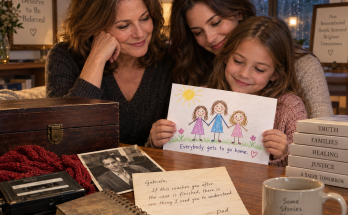
The next morning, Maya left a drawing on the refrigerator.
It showed three people holding hands beneath a yellow sun.
At the bottom she had written:
“Everybody gets to go home.”
I stood there for a long time.
Then I smiled.
Because that was the ending I had wanted all along.
Not revenge.
Not fear.
Not another hidden door.
Home.
The place where a child should be believed.
The place where a frightened girl could finally sleep.
The place where a mother could stop watching the driveway.
The place where the past could be remembered without being allowed to decide the future.
I took the drawing down carefully.
I placed it beside my father's letter.
Then I put both back on the shelf.
Nothing was hidden.
Nothing was forgotten.
And nothing needed to be solved.
For the first time, the story was exactly where it belonged.
Behind us.
The End
Read more original stories on Feel Every Story.
The Bus Arrived Late, and One Small Detail Made Me Realize My Daughter Had Come Home Carrying Something No Child Should Have
Part 27 of 27