I did not die immediately after writing the note.
This disappointed the dramatic instincts of several people who eventually read these notebooks.
Life rarely respects structure.
I lived.
For years.
Long enough to complain about another presidential election without allowing politics at dinner.
Long enough to see Sophie marry a pediatric nurse named Aaron who understood her heart condition better than she did and still could not convince her to reduce coffee sufficiently.
Long enough to hold their daughter.
They named her Margaret Denise.
I objected.
Strongly.
Nobody cared.
“Two names?” I asked Sophie from my chair in the hospital room.
“One first name. One middle.”
“You know what I mean.”
She smiled.
“You told us memories weren’t commandments.”
I stared at her.
“This is an abuse of my own philosophy.”
“Probably.”
I held the baby.
Tiny fingers.
Dark hair.
A face that looked like nobody yet.
I thought of David.
A baby surrendered at birth.
Richard and Elaine eighteen and terrified.
A decision made by adults who believed they were arranging the safest future.
I wondered whether anyone had held David afterward and understood how far one decision would travel.
I kissed Margaret Denise’s forehead.
No family begins clean.
We inherit decisions made before we understand them.
The work is deciding what to continue.
Years passed.
My health changed gradually.
Another small stroke came.
Less dramatic than the first.
Recovery incomplete.
I began using a walker.
Then, eventually, I moved from independent living into assisted living within the same community.
My children hated the transition more than I did.
Michael especially.
He inspected the room as if searching for structural defects.
“Stop.”
“The bathroom grab bar is loose.”
“That one you may fix.”
He looked triumphant.
I should have been more specific.
Jennifer organized my clothing until I told her I could still choose which drawer held socks.
She apologized.
Lisa sat with me during the first night.
I asked whether she wanted to stay.
She said yes.
Choice.
Still.
David’s visits became less frequent because Ellen’s MS worsened.
We spoke by video.
Then Ellen died.
David changed afterward.
Grief does that.
He became quieter.
Older almost overnight.
I wanted to go to Pennsylvania for the funeral.
My doctors advised against the travel.
For two days, I fought everyone.
Then I stopped.
Not every limit is oppression.
Sometimes the body says no.
I joined by video.
It felt inadequate.
It was still something.
Afterward, David and I spoke privately.
“I’m sorry I couldn’t come.”
“I know.”
“I wanted to.”
“I know.”
“That doesn’t feel like enough.”
He looked exhausted.
“Maggie, you taught me intention isn’t action.”
I flinched.
“Terrible time to quote me.”
“But you also taught me reality matters.”
“Yes.”
“You couldn’t come.”
“No.”
“That is different from choosing not to.”
I nodded.
Another distinction.
Another mercy.
David died three years later.
A stroke.
Fast.
His daughter Rachel called me.
By then my hearing was poor enough that I used speakerphone.
“I’m sorry,” she said.
I stared out the window.
At eighty-something, grief no longer shocked me.
It accumulated.
Denise.
Richard.
Friends.
Ellen.
Now David.
People disappearing from the map.
“What happened?” I asked.
Rachel explained.
Then she said, “He kept the key.”
I closed my eyes.
Richard’s brass key.
“To the old house?”
“Yes.”
“It was in his desk.”
I smiled.
“Good.”
“He left a note with it.”
Of course.
This family could not resist notes.
“What did it say?”
Rachel read it.
This never opened the house for me, but it opened something anyway.
I cried.
Not violently.
Age had changed even that.
Tears came slowly.
Rachel asked whether I wanted the key.
“No.”
“Are you sure?”
“Yes.”
“What should I do with it?”
“Your decision.”
There was a long silence.
Then she laughed softly.
“I should have known.”
I never learned what she did with it.
That pleased me.
Not every object needed to return to me for closure.
My own life narrowed physically.
The world came to me more often than I went to it.
But it did not become empty.
Michael visited Tuesday afternoons.
Not every Tuesday.
Enough.
Jennifer called Wednesdays and visited monthly.
Lisa came Sundays when she could.
Sometimes nobody came.
I survived those days too.
That mattered.
I had learned the difference between solitude and abandonment.
Sophie brought Margaret Denise, who eventually became Maggie D. because two Margarets in one room caused chaos.
The little girl liked my watercolors.
Finally, an audience with standards low enough.
She once held up a painting of a tree.
“Is this Grandpa Richard’s tree?”
“No.”
“What tree is it?”
“I don’t know.”
She considered.
“Then it can be his.”
So it became Richard’s tree.
History is like that too.
People inherit fragments and attach names.
I no longer tried to control every interpretation.
My cognitive abilities remained good longer than anyone expected.
Then they did not.
Slowly.
Names became harder.
Dates slipped.
I occasionally repeated questions.
The first time Lisa suggested an evaluation, I became furious.
Truly furious.
Not graceful.
Not wise.
I accused her of waiting for this.
The words hurt her.
I saw it immediately.
Still, I did not apologize that day.
Fear had taken the wheel.
Two days later, Jennifer visited.
She did not mention evaluation for the first hour.
Then she said, “Mom, you asked me four times this morning whether Sophie is still in college.”
I stared at her.
Sophie had been out of college for years.
“I was tired.”
“Maybe.”
“I had a stroke.”
“Yes.”
“You’re all overreacting.”
“Maybe.”
That stopped me.
She did not argue.
“We want the doctors to tell us whether we are.”
The plan.
My plan.
Permission given years earlier for exactly this moment.
I hated my younger self for being so sensible.
“Fine.”
The evaluation showed mild cognitive impairment.
Not incapacity.
Not yet.
I remained the decision-maker.
My children respected that.
Even when I forgot.
Especially when I forgot.
Over the following years, the impairment progressed.
There is no way for me to narrate all of that reliably.
That is why parts of this final section come from notes I wrote earlier, from recordings, and eventually from the people who helped me preserve what I wanted preserved.
I had anticipated that.
For once, planning and reality cooperated.
There came a day when medical evaluation concluded I could no longer manage complex financial decisions independently.
Daniel’s successor stepped in under the structure I had created.
No child seized accounts.
No family vote.
No accusation.
The professional system worked.
There came another day when I stopped making medical decisions entirely alone.
Lisa and the others used the directive.
They asked me when I could answer.
They followed what I had written when I could not.
Nobody treated the documents as permission to stop seeing me as a person.
That had been my greatest fear.
It did not happen.
Michael still asked before moving my chair.
Jennifer still told me before reorganizing drawers.
Lisa still explained appointments even when I forgot them afterward.
Sometimes I became angry.
Sometimes they became impatient.
We were not saints simply because the stakes increased.
But the structure held.
So did the relationships.
One spring afternoon, when I was still clear enough to understand the occasion, the hospital invited me to a ceremony.
The emergency-family support program had expanded again.
The endowment now carried Denise’s name alongside mine.
I had resisted that.
Marisol ignored me.
The hospital arranged transportation.
My children came.
Sophie came with Aaron and Maggie D.
Several volunteers I no longer knew attended.
A plaque was unveiled.
I disliked it immediately.
Too shiny.
Too many words.
Marisol leaned toward me.
“You hate it.”
“Yes.”
“Good.”
I laughed.
The program director spoke about thousands of families helped over the years.
Transportation.
Temporary lodging.
Meals.
Emergency supplies.
Navigation support.
Small interventions during terrible days.
I thought of my first hospital ride home.
Alone in an Uber.
Three children absent.
That moment had once felt like proof of what my life had become.
It was not.
It was a moment.
Consequential.
Painful.
But not final.
After the ceremony, a young woman approached.
“My mother got help from this program.”
I smiled.
“I’m glad.”
“She was here with my dad after his accident. Someone paid for her hotel.”
“That’s what it’s for.”
“She always remembered.”
The woman touched the edge of the plaque.
“Thank you.”
I almost said the money came from many people.
That was true.
I almost explained Denise.
Also true.
Instead I said, “You’re welcome.”
A gift accepted.
No performance.
On the ride home, Michael sat beside me.
He had gray hair now.
That seemed rude.
“You okay?”
“Yes.”
“Real yes?”
I smiled.
“Real.”
He looked out the window.
After a while he said, “I still think about what I told you.”
I knew.
Even before he said it.
Figure it out yourself.
“Yes.”
“I wish I hadn’t.”
“I know.”
“Do you forgive me?”
Years earlier, I might have delivered a speech.
Instead I said, “Yes.”
He turned.
“Just yes?”
“Don’t ruin it.”
He laughed.
Then cried.
I took his hand.
His fingers were older too.
That bothered me more than my own.
“I figured it out,” I said.
“I know.”
“But not myself.”
Michael looked at me.
There was the final correction.
I had not done any of it alone.
Thomas.
Karen.
Daniel.
Elena.
Dr. Shaw.
Marisol.
Denise.
David.
My children.
My grandchildren.
Professionals.
Friends.
Even Richard, through his good choices and his failures.
Independence had never meant isolation.
Protecting my future had never required proving I needed nobody.
It required making sure nobody’s help became ownership.
That was all.
Simple.
Difficult.
Worth learning.
My last fully lucid Christmas came without announcement.
We did not know it was the last.
That is probably why it was good.
The family gathered in the community’s private dining room because my apartment could no longer hold everyone.
Jennifer arrived first.
Naturally.
Lisa brought too much food.
Michael complained about parking.
Sophie brought Maggie D., who was old enough to roll her eyes at adults.
Rachel came from Pennsylvania.
Elaine was gone by then.
David too.
But Rachel came.
That mattered.
Someone placed Richard’s photograph near the dessert table.
Not as an altar.
Just a photograph.
Denise’s picture stood beside it because Sophie insisted.
I objected that Denise would hate being sentimentalized.
Sophie said, “She’s dead. She can complain to you later.”
I laughed until I coughed.
At dinner, everyone talked at once.
No speeches.
No estate discussion.
No one asked me to explain the past.
At some point, I looked around and understood that this family no longer resembled the one I had once been desperate to preserve.
It was larger.
Stranger.
More honest.
Some people were missing.
Others had appeared.
Relationships had broken and repaired.
Children became caregivers without becoming owners.
Secrets became history.
Money became useful instead of symbolic.
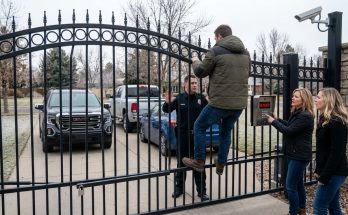
The gate had long since belonged to strangers.
The old house belonged to another family.
Richard’s maple was gone.
None of those losses destroyed us.
After dinner, Maggie D. climbed into the chair beside me.
“Grandma Maggie?”
Technically I was her great-grandmother.
Nobody bothered correcting her.
“Yes?”
“Mom says you used to have a big house.”
“I did.”
“Bigger than this?”
“Much.”
“Why did you leave?”
I looked at Sophie.
She did not answer for me.
Good girl.
“Because I wanted a different life.”
“Did you like it?”
“The house?”
“The different life.”
I smiled.
“Yes.”
She considered.
“Was it scary?”
“Yes.”
“Why’d you do it?”
Children have an extraordinary talent for reducing decades into one question.
I looked around the room.
Jennifer laughing with Rachel.
Michael arguing with Aaron.
Lisa cutting cake.
Sophie watching me.
The photographs.
The people.
The absences.
“Because being scared isn’t always a reason to stay where you are.”
Maggie D. nodded as if this were obvious.
Then asked for cake.
Much healthier.
Later, after everyone left, Lisa stayed to help me to my room.
I was tired.
Very tired.
She tucked a blanket around my legs.
“Need anything?”
“No.”
“Sure?”
“Yes.”
She kissed my forehead.
“I’ll call tomorrow.”
“Okay.”
At the door, she stopped.
“Mom?”
“Yes?”
“I love you.”
“I love you too.”
She left.
No dramatic final exchange.
No knowledge of what was coming.
Just a daughter saying she would call.
And she did.
Eventually, as my memory faded further, there were days I did not know which child had visited.
There were days I confused Jennifer with my sister.
Days I asked where Richard was.
Those were hard for everyone.
They followed the instructions.
Nobody corrected me cruelly.
Nobody invented elaborate lies either.
They met me where I was.
Sometimes that meant saying Richard had died years ago.
Sometimes it meant saying simply, “You’re safe.”
Near the end, I spoke less.
But I still responded to music.
To sunlight.
To Maggie D.’s drawings.
To familiar hands.
Lisa later told the others that on one of my final clear mornings, she asked whether I was comfortable.
I said yes.
She asked whether I wanted anything.
Apparently I thought for a long time.
Then I said, “Open the curtains.”
So she did.
That detail became everyone’s favorite.
Not because it was profound.
Because it sounded like me.
Light first.
Always.
When I died, the children followed the plan.
There was grief.
Paperwork.
Arguments.
Food nobody wanted.
Professional administration.
The hospital received its gift.
David’s gift had already passed to his estate because he died before me, according to the provision Rebecca had prepared.
The grandchildren received what was intended.
Jennifer, Michael, and Lisa received the remainder.
No one became rich enough to stop working.
Good.
The notebooks remained together.
Sophie took responsibility for scanning them after all.
She complained constantly.
Also good.
Richard’s letters went with them.
So did the photograph of Denise and me in Italy.
The old hospital bracelet.
A copy of the capacity evaluation.
The ridiculous family medical-history spreadsheet Jennifer eventually created with everyone’s permission.
And the final handwritten page.
You do not owe me a monument.
Use what I leave.
Love whom you love.
Tell the truth sooner than we did.
When someone you love says no, believe them.
When they ask for help, come if you can.
Months after the funeral, my three children met at Lisa’s house.
Not because the estate required it.
Because they wanted to.
Michael brought the old metal box.
Jennifer brought the notebooks.
Lisa brought food.
They read pieces aloud.
They argued about details.
They laughed.
They cried.
At some point Michael found the page describing that first terrible phone call.
He stopped reading.
Jennifer knew immediately.
Lisa too.
“You have money. Figure it out yourself.”
The sentence that had once cracked something open.
Michael closed the notebook.
“I hate this part.”
Lisa reached for his hand.
Jennifer said, “Keep reading.”
So he did.
Because the sentence was not the ending.
It had never been the ending.
The ending was everything that came after.
The gate.
The lawyer.
The plans.
The apologies.
The trips.
The hidden brother.
The hospital.
The strokes.
The ordinary Sundays.
The years of choosing and being chosen.
I had once believed protecting my future meant withdrawing my trust from the people who disappointed me.
For a while, some withdrawal was necessary.
Distance gave me room to see clearly.
Boundaries taught us what love was not allowed to demand.
Professional planning ensured affection would never again be mistaken for competence or entitlement.
But protection was only the beginning.
A protected life still had to be lived.
So I spent the money.
Accepted help.
Gave help.
Traveled.
Moved.
Forgave.
Stayed angry about some things.
Changed my mind about others.
Allowed people to repair what they could.
Stopped demanding that they repair what they could not.
And learned that figuring it out myself had never meant doing it alone.
My children did not save me.
I did not punish them.
Money did not prove who loved whom.
Richard’s secrets did not become the only truth about him.
David did not remain outside the family simply because he began there.
The house did not remain mine simply because I once loved it.
Nothing stayed fixed.
That was not failure.
That was life.
And in the end, the future I protected was not the inheritance sitting in accounts after I was gone.
It was all those years before.
The mornings.
The trips.
The hospital corridors.
The dinners.
The arguments.
The grandchildren.
The ordinary phone calls.
The sunlight through curtains someone else opened when I could no longer do it myself.
That was where the money went.
That was where the love went.
That was what remained.
The End
Read more original stories on Feel Every Story.