Daniel Mercer was found at home.
He did not run.
He opened the door for police and asked whether Caroline was safe before they asked him anything.
Ortiz brought him to Horizon voluntarily.
He was thirty-nine, an architect by profession, quieter than Caroline, and visibly terrified when he entered the same conference room where the board had nearly replaced Samuel.
Christopher stared at him.
Daniel stopped.
“Granddad.”
“You took my token.”
Daniel closed his eyes.
“Yes.”
Samuel leaned forward.
“Why?”
Daniel looked toward Caroline’s empty chair.
“Because they threatened her.”
“Who?”
“Evelyn.”
Christopher’s face hardened.
“Start at the beginning.”
Daniel had learned about Horizon’s hidden family stake years earlier.
Christopher told him only enough to explain that someday the shares might need to block a hostile sale.
Nothing about Calder fraud.
Nothing about Thomas’s files.
Nothing about Robert Vale.
Three weeks earlier, Caroline told Daniel that Sloan had approached her about becoming interim CEO.
Daniel called Christopher.
Christopher contacted Pierce.
Then Evelyn contacted Daniel directly.
“How?” Ortiz asked.
“Private number.”
“What did she say?”
“That Horizon was going to collapse.”
“Why?”
“She said Samuel’s debt strategy had made it inevitable.”
Samuel showed no reaction.
“She told me Caroline would be blamed if she stayed CFO.”
“Blamed for what?”
“Financial misstatements. Material records. Payments.”
Caroline’s credentials had already been used in the fraud package.
Evelyn was telling Daniel about crimes she intended to manufacture or expose.
“She offered to protect Caroline,” Daniel said.
“In exchange?” Christopher asked.
“My cooperation.”
“What did she want?”
“At first, information about you.”
Christopher looked away.
“Then?”
“The trust token.”
“When did you take it?”
“This morning.”
“Before or after Caroline was attacked?”
“Before.”
Samuel asked, “Did you know she would be attacked?”
“No.”
His answer came sharply.
“I thought Evelyn was trying to keep her out of the blast radius.”
“Did you assign the proxy?”
Daniel looked sick.
“Yes.”
Christopher closed his eyes.
“You knew those were my shares.”
“Yes.”
“You knew I never authorized Caroline to vote them.”
“I thought you would once you understood.”
“Understood what?”
“That Samuel had to go.”
The room went still.
Samuel finally reacted.
Not anger.
Something quieter.
“Why?”
Daniel looked at him.
“Because everybody around Horizon thinks you’re the company.”
Christopher said his name softly.
“Daniel.”
“No.”
Daniel turned toward his grandfather.
“You all keep talking about protecting Horizon, but none of you ever ask what it’s like for the people who work here.”
Samuel’s face tightened.
Daniel continued.
“Caroline has spent years fixing cash problems after expansion decisions she warned against.”
Samuel started to speak.
Daniel kept going.
“You bought equipment before contracts were final. You expanded the annex. You took on debt because you believed growth would solve leverage.”
Samuel looked toward the table.
Some of that was true.
“Caroline disagreed?”
Daniel laughed bitterly.
“Constantly.”
Samuel looked toward the hospital link.
Caroline was not currently connected.
“Why didn’t she tell the board?”
“She did.”
“Then?”
“Martin reframed it as excessive conservatism.”
Martin again.
But Samuel had accepted that framing.
Daniel continued.
“Evelyn showed me projections. Some were real.”
“How do you know?”
“Caroline had discussed the same risks at home.”
“So Evelyn mixed truth with manipulation.”
“Yes.”
The family technique.
Again.
“She said if Samuel stayed, Horizon would run out of cash within a year even if Meridian was won.”
Samuel looked at Christopher.
“Is that true?”
Christopher shrugged.
“I haven’t seen the current books.”
Nadia said, “Caroline’s six-week liquidity estimate was based on emergency cuts. Long-term leverage is still significant.”
Samuel sat back.
There it was.
A truth that did not excuse sabotage.
But also could not be dismissed because criminals had used it.
Daniel looked at Samuel.
“I thought removing you might actually save the company.”
Samuel remained quiet.
Ortiz asked, “Did Evelyn tell you about the machine sabotage?”
“No.”
“Tyler?”
“No.”
“Framing Ethan?”
“No.”
“Calder material fraud?”
“No.”
“Northfield?”
“No.”
“What did she tell you the crisis would be?”
“Meridian delay and lender pressure.”
A controlled corporate transition.
The version Evelyn had also told Martin she wanted.
Martin escalated beyond it.
Pierce escalated beyond Martin.
Each actor believed they controlled the next.
“When did you realize something else was happening?” I asked.
“When Caroline stopped answering.”
“What did you do?”
“I called Evelyn.”
“And?”
“She told me Caroline was safe.”
“Was she?”
“No.”
“What did you do then?”
“Nothing.”
The shame in that answer was real.
“Why?”
“I was afraid that calling police would expose what I had done.”
Again.
The machinery of compromise.
One bad act created fear.
Fear created silence.
Silence made the next crime easier.
Christopher stared at his grandson.
“You could have called me.”
“I had already stolen from you.”
“You think that matters more than Caroline’s life?”
“At the time?”
Daniel’s eyes filled.
“Yes.”
Nobody spoke.
It was one of the few honest explanations that day that required no system diagram.
Samuel looked toward the factory windows.
“How long has Caroline been warning about the debt?”
Daniel answered.
“Three years.”
That surprised even Christopher.
Samuel looked at Claire.
“Did she raise it formally?”
Claire checked board packets.
“Yes.”
“How often?”
“Seven times.”
Samuel closed his eyes.
“And what happened?”
Claire read the minutes.
Each time, discussion.
No action.
Once Martin recommended proceeding with expansion because “strategic scale outweighed temporary leverage concerns.”
Samuel had approved it.
I watched him absorb that.
This was not corruption.
Not forgery.
Not sabotage.
It was a legitimate decision.
Possibly a bad one.
And nobody else could carry it for him.
Samuel looked at me.
“Say it.”
“No.”
“Ethan.”
“You don’t need me to.”
“Yes, I do.”
I shook my head.
“You’ve spent twenty-four hours finding out what everyone else did behind your back. Don’t use me to tell you what you did in front of everyone.”
That stopped him.
He nodded slowly.
Fair.
Christopher looked at Samuel.
“Thomas would have hated the debt.”
Samuel laughed bitterly.
“Thomas ran a forty-person machine shop. Horizon has four hundred employees.”
“And?”
“And scale costs money.”
Christopher shrugged.
“Then own that.”
Samuel looked at him.
“What?”
“Don’t invoke growth as though it forced you. You chose it.”
The same lesson Robert left Martin.
Choice.
Pierce applied pressure.
Martin chose the bypass.
Calder applied pressure.
Arthur chose bribery.
Evelyn applied pressure.
Daniel chose the theft.
Samuel faced opportunity.
He chose debt.
None of those choices carried equal moral weight.
But they remained choices.
Ortiz returned to the proxy.
“Can Daniel revoke it?”
Nadia checked the document.
“He authenticated it, but the proxy names Caroline as holder. Caroline may be able to disclaim it.”
“From the hospital?”
“Yes.”
We connected her.
Caroline appeared tired but alert.
Daniel could barely look at her.
She saw him.
“Daniel?”
He broke before she did.
“I’m sorry.”
“What did you do?”
He explained.
Not elegantly.
Not defensively.
When he finished, Caroline remained silent for a long time.
Then:
“You used my name.”
“Yes.”
“Without asking me.”
“Yes.”
“You made me part of a board action I never agreed to.”
“Yes.”
“Because Evelyn told you it would protect me.”
“Yes.”
Caroline closed her eyes.
When she opened them, she looked at Samuel.
“I disclaim the proxy.”
Nadia sent the digital instrument.
Caroline signed.
Christopher’s four-point-eight percent returned to neutral pending fraud review.
The immediate governance threat weakened again.
Then Caroline said, “Samuel.”
He looked at the screen.
“When this is over, we need to talk.”
“About the debt.”
“Yes.”
“I know.”
“No.”
She shook her head.
“You know there is debt.”
Samuel remained still.
“That is not the same as understanding what it has done to how this company makes decisions.”
He nodded.
No argument.
Caroline disconnected.
Daniel stared at the blank screen.
Ortiz told him he would still need formal questioning and that charges were possible.
He nodded.
Christopher looked older than he had three hours earlier.
“Family,” he said quietly.
Samuel gave him a look.
“Don’t romanticize it.”
Christopher almost smiled.
“No danger of that.”
At 5:02 p.m., Horizon’s board convened again.
This time live identities were verified.
Physical locations confirmed.
Devices authenticated independently.
No prerecorded directors.
No borrowed tokens.
No hidden proxies.
Arthur’s voting rights were suspended pending investigation.
Sloan was absent under custody.
Bellamy recused himself from acquisition matters.
Christopher disclosed his hidden stake.
The board voted unanimously to halt any Calder transaction.
Then came Samuel.
Linda Perez spoke first.
“We need to address leadership.”
The room tightened.
Samuel nodded.
“Yes.”
James Bellamy, far less confident than the previous night, said, “Given the circumstances—”
Samuel raised a hand.
“No speeches.”
He stood.
“I will step aside temporarily as chief executive.”
Caroline’s image, reconnected remotely, changed.
Samuel continued.
“Not because Evelyn demanded it.”
He looked around the room.
“Not because Calder manipulated us.”
Then:
“Because Horizon needs an independent review of decisions made under my leadership, including debt, governance, supplier oversight, and executive controls.”
Nobody spoke.
“I will remain available to investigators and the board.”
Linda asked, “Who do you recommend as interim CEO?”
Samuel looked toward Caroline.
She shook her head immediately.
“No.”
A few people almost smiled.
Samuel did.
“Fair.”
Then he looked at me.
I pointed at him.
“Don’t.”
That got an actual laugh from Walter outside the boardroom.
Samuel shook his head.
“I wasn’t going to.”
“Good.”
The board appointed Linda Perez as interim executive chair and brought in an external turnaround executive for ninety days.
For the first time in seventeen years, no Langford, Vale, Wynn, Rourke, Sloan, or compromised executive would control Horizon’s daily decisions.
The company looked suddenly less personal.
That might save it.
After the meeting, Samuel and I walked down to Bay Three.
The Meridian machine remained under evidence controls.
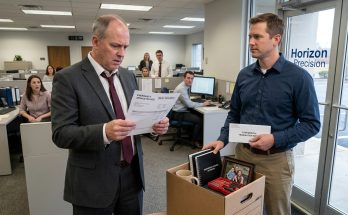
The cardboard box from my desk still sat near security.
Nobody had moved it.
Samuel looked at it.
“Your entire career fit in there.”
“No.”
“What didn’t?”
I pointed toward the machine.
“That didn’t.”
Walter’s notebooks.
Mason’s training.
Processes I had written.
Fixes no one remembered who created.
The real record of work was rarely in the box.
Samuel nodded.
Then he said, “Martin was right.”
“About?”
“I am going to offer you your job back.”
I laughed.
“At least everyone agrees on something.”
“Senior engineering director.”
“No.”
“You haven’t heard the package.”
“No.”
“Consulting?”
“Maybe.”
His eyebrows rose.
“Six hundred thousand an hour?”
“That was emergency pricing.”
“I’m relieved.”
We stood quietly.
Then Nadia called from the forensic room.
Her voice was sharp.
“Ethan.”
“What?”
“We found the last missing six certificates.”
“What about them?”
“They weren’t destroyed.”
“Where were they?”
“Martin’s clean archive.”
Of course.
“Do they show more fraud?”
“Yes.”
“Anything new?”
A pause.
“One of the parts went into service.”
My stomach tightened.
“Where?”
“Meridian predecessor program.”
“How many aircraft?”
“We don’t know yet.”
Samuel went still.
The historical fraud had reached beyond contracts and ownership.
Possibly into operating equipment.
Nadia continued.
“And there’s something else.”
“What?”
“The questionable lot was processed at Northfield.”
“Yes.”
“Certified by VLT.”
“Yes.”
“Released by Arthur’s stolen Thomas credential.”
“Yes.”
“But the final shipment approval came from Horizon.”
“Whose?”
Silence.
Then Nadia answered.
“Samuel’s.”
He stared at the phone.
This time the approval was dated while Samuel was already chief executive.
And unlike the earlier stolen credentials, the system showed a physical signature.
His.
Click here to continue reading: PART 24: The Final Signature Forced Samuel to Reveal His Oldest Mistake, and Horizon Survived Only After Everyone Stopped Protecting Its Name
Five Minutes After Losing My Job, the Machine Only I Truly Understood Failed at the Worst Possible Moment
Part 23 of 24