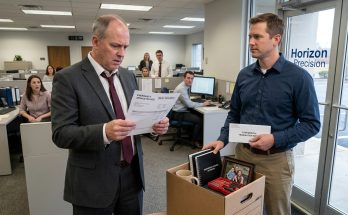
Richard sat with both hands clasped between his knees.
For years I had watched him command meetings by speaking more quietly whenever everyone else became louder. He liked control. He cultivated it.
Now he looked like a man discovering that the authority he had borrowed from someone else could be taken back.
Samuel stood opposite him.
“Who contacted you?”
Richard looked toward Claire.
“Get her out.”
Claire stiffened.
“No,” Samuel said.
“She doesn’t need to hear this.”
“She prepared Ethan’s termination packet. She’s already part of it.”
Richard closed his eyes briefly.
I leaned against the workstation.
“Start with Tyler.”
Richard looked at me.
“He came to me about two months ago.”
“About what?”
“Money.”
Walter gave a humorless laugh.
“That narrows it down.”
Richard ignored him.
“Tyler had debts. More than I realized.”
“Calder knew?”
Richard nodded.
“He said someone from his old company had contacted him. They offered him money for harmless information.”
“What kind?”
“Production schedules. Equipment status. Nothing customer-specific at first.”
“And you knew?”
“Not then.”
“When did you learn?”
“Three weeks ago.”
The timing matched the first appearance of my cloned credential.
I glanced at Nadia.
She noticed too.
Richard continued.
“Tyler panicked after they started asking for more. He came to me because he thought I could protect him.”
“Could you?”
Richard laughed without humor.
“I thought so.”
Samuel’s voice hardened.
“What did they ask him to steal?”
“Machine configuration information. Meridian readiness data. Engineering documents.”
“Did he give it to them?”
“Some.”
Walter swore.
Richard looked down.
“I told him to stop.”
“Yet yesterday you emailed him the exact parameters that destabilized the machine,” I said.
“I know.”
“That isn’t stopping.”
“They already had leverage.”
“On Tyler?”
“On both of us.”
Samuel stared at him.
“What leverage did they have on you?”
Richard hesitated.
That hesitation was different.
Shame rather than fear.
“I had been speaking with Calder.”
The room became still.
Samuel’s expression did not move.
“How long?”
“Six months.”
“Before or after their acquisition offer?”
“Before.”
Samuel took one slow step closer.
“You were negotiating with the company trying to buy mine.”
“They approached me about a position.”
“What position?”
“Regional operations president after acquisition.”
Walter muttered, “There it is.”
Richard snapped toward him.
“You think this is simple?”
Walter stared back.
“I think you were planning your new office while the rest of us were planning production.”
Samuel raised a hand.
“Continue.”
Richard looked exhausted.
“I believed the sale would happen. The board was receptive. Calder wanted continuity in operations.”
“And when I rejected them?” Samuel asked.
“They kept talking to me.”
“You kept answering.”
“Yes.”
“Did you give them confidential information?”
“No.”
Samuel’s stare did not change.
Richard corrected himself.
“Not intentionally.”
I almost laughed.
“What does that mean?”
“I discussed capacity. Labor. Capital spending. Things they could have estimated anyway.”
“Pricing?”
“No.”
“Customer bids?”
“No.”
“Meridian?”
Richard hesitated.
Samuel saw it.
“You told them about Meridian.”
“I confirmed Horizon was pursuing it.”
Samuel’s jaw tightened.
“That alone could violate your obligations.”
“I know.”
“No,” Samuel said. “You know now.”
Richard looked away.
The factory continued around us.
Somewhere beyond Bay Three, a forklift reversed with three electronic beeps. A compressor started. Ordinary noises made the conversation feel stranger.
I asked, “When did Calder start giving orders instead of asking questions?”
“About three weeks ago.”
Again that date.
“What changed?”
“They sent me material proving they knew about the confidential investigation.”
Samuel went still.
“What material?”
“Photographs. Access records. Messages between you and the outside firm.”
Samuel’s face hardened.
“They knew about the investigation.”
“Yes.”
“How?”
“I don’t know.”
“You expect me to believe that?”
“I never knew who their source was.”
Nadia spoke.
“They knew enough to identify the cloned credential.”
Richard looked at her.
“Yes.”
That mattered.
Samuel’s investigators had created the duplicate identity.
Somebody had discovered it.
Then somebody had reproduced or hijacked it and handed it to Tyler.
The investigation had not merely failed to remain secret.
It had been turned into a weapon.
“Why frame me?” I asked.
Richard looked at me.
“Because you were convenient.”
The answer irritated me more than something dramatic would have.
“Convenient.”
“You knew the machine. You had access. Your credential already had a duplicate. And…”
He stopped.
“And what?”
“You were becoming a problem.”
I straightened.
“For whom?”
“For the Meridian plan.”
“What problem?”
“You kept documenting inconsistencies.”
I thought back over the previous month.
Missing tooling records.
Changed maintenance entries.
A purchasing discrepancy I had emailed Richard about.
An unusual controller login I had dismissed as commissioning activity.
Pieces I had noticed without seeing the picture.
“You were told to remove me.”
“Yes.”
“By Calder?”
“Through an intermediary.”
“Name.”
Richard shook his head.
“I never met them.”
“How were you contacted?”
“Encrypted messages. Temporary numbers. Occasionally instructions routed through committee documents.”
I looked toward Claire.
“The board-office request.”
Richard nodded.
“That wasn’t from the real board office.”
Claire’s face drained.
“You knew?”
“I suspected.”
“And you let me process Ethan’s termination anyway?”
Richard did not answer.
Claire stepped away from him as though physical distance could separate her from what he had done.
Samuel asked, “Who had the ability to spoof board credentials?”
“Nadia?” I said.
She was already working.
“Executive accounts use stronger authentication.”
“Meaning?”
“Someone would need either an authorized device or administrative access.”
“Daniel?”
“Possibly.”
The missing security supervisor had suddenly become more important.
“Find his access history,” Samuel said.
Nadia opened another window.
Richard stood.
“Wait.”
Everyone looked at him.
“If Daniel disappeared, whoever is controlling this may know we’re checking.”
“That’s the idea,” Walter said.
“No. You don’t understand.”
Richard looked genuinely frightened again.
“They monitor reactions.”
I frowned.
“What does that mean?”
“When they send instructions, they watch who moves. Who calls whom. Which doors open. Which systems get accessed.”
Samuel stared at him.
“How?”
“I don’t know.”
“You keep saying that.”
“Because I don’t know.”
Nadia suddenly stopped typing.
“I may.”
We moved toward her.
She had opened network traffic for several internal cameras.
“These shouldn’t be sending anything outside the security subnet.”
“Are they?”
“One is.”
“Which?”
She enlarged the device ID.
A camera overlooking Bay Three.
The same bay where we had spent most of the afternoon.
Someone had been watching.
“Disconnect it,” Samuel said.
“No,” I said.
Everyone looked at me.
“If they’re watching, let them.”
Samuel frowned.
“Why?”
“Because right now they think they know what we know.”
I looked at Richard.
“We can use that.”
Richard shook his head.
“You have no idea who you’re dealing with.”
“Neither do you.”
“That’s exactly my point.”
I turned to Nadia.
“Can you feed the camera normally while blocking its audio?”
“There shouldn’t be audio.”
“Shouldn’t?”
She checked.
Her expression changed.
“There’s an unauthorized stream.”
Walter stared upward.
“Microphone?”
“Looks like it.”
Samuel’s face became hard.
“Inside my facility.”
I pointed toward the camera.
“Don’t look at it.”
Too late for Walter, but everyone else kept their movements natural.
Nadia quietly disabled the audio channel while leaving video active.
I lowered my voice.
“Now whoever is watching can see us talking but can’t hear what we’re saying.”
Samuel understood.
“What do you propose?”
“We make them react.”
Richard stood abruptly.
“No.”
I looked at him.
“You’ve been reacting all day. How has that worked?”
“They have Tyler.”
“Which means Tyler matters to them.”
“He matters because he can talk.”
“Exactly.”
Richard stared at me.
I continued.
“They sabotaged the machine to kill Meridian qualification and frame me. That plan failed. Their remote attempt failed. Now they’re improvising.”
Samuel nodded slowly.
“So we make them believe Meridian qualification is proceeding normally.”
“It is proceeding normally,” I said.
Walter looked at me.
“You still want to run it?”
“More than ever.”
Richard stepped closer.
“You’re insane.”
“No. If we cancel qualification, they get what they wanted.”
“And if they compromise the machine again?”
“Nadia isolates it.”
“I can physically disconnect external access,” she said.
I nodded.
“Walter and I verify every parameter again.”
Mason spoke for the first time in several minutes.
“I’ll check the PLC image against yesterday’s backup.”
I looked at him.
“You sure?”
His jaw tightened.
“Yes.”
Richard looked from one of us to another.
Samuel made the decision.
“Qualification proceeds.”
Richard shook his head.
“They’ll try something else.”
“I’m counting on it,” I said.
For the next hour, Bay Three became the most carefully watched machine cell I had ever seen.
Nadia physically isolated unnecessary network connections.
Mason compared controller and PLC files.
Walter inspected hydraulic, pneumatic, lubrication, and coolant systems.
I checked every parameter capable of affecting motion or spindle stability.
Nothing else had been altered.
At 5:37, Meridian’s representatives arrived.
Samuel met them personally.
Nobody told them about the sabotage.
They were informed there had been a commissioning issue that had been corrected.
Technically true.
Painfully incomplete.
The qualification began shortly after six.
The first cycle ran cleanly.
Then the second.
Dimensional inspection passed.
Spindle vibration remained stable.
Axis loads looked normal.
I stood near the controller watching every value.
At 6:48, Nadia approached without looking directly at me.
“Movement.”
“Where?”
“Daniel’s credential.”
I kept my face neutral.
“Where?”
“Engineering Records.”
My pulse accelerated.
Daniel was supposedly gone.
“Camera?”
“Someone just entered.”
“Who?”
“I haven’t opened the feed.”
“Do it somewhere private.”
She walked away.
I continued watching the machine.
Two minutes later, my phone vibrated.
Nadia had sent a still image.
The person entering Engineering Records was not Daniel.
It was Claire.
I looked across the bay.
Claire was nowhere in sight.
For a moment suspicion hit hard.
Then another message arrived.
NOT HER BADGE.
DANIEL’S CREDENTIAL.
I understood.
Claire had entered using Daniel’s identity.
Or somebody wanted the system to say she had.
The same trick used against me.
I found Samuel.
“Claire is in Engineering Records.”
His expression changed.
“Why?”
“I don’t know.”
“Did you send her?”
“No.”
We moved upstairs without attracting attention.
The Engineering Records door was closed.
Samuel reached for the handle.
I stopped him.
“Listen.”
A voice came from inside.
Claire.
“I did what you asked.”
Another voice answered.
Male.
Too low to identify.
Samuel and I exchanged a look.
Claire spoke again.
“No. Richard told them too much.”
Silence.
Then:
“I can’t fix that.”
The male voice became clearer.
“You don’t have to.”
I recognized it.
Not immediately.
But Samuel did.
His face changed.
He reached for the door.
I caught his arm.
“Wait.”
Inside, papers moved.
Claire said, “What happens to Tyler?”
The answer came calmly.
“Tyler was always temporary.”
My skin went cold.
Then footsteps approached the door.
Samuel and I moved back.
The door opened.
Claire stepped into the corridor.
She saw us.
Her face went white.
“Sam.”
Samuel looked past her.
The room appeared empty.
I entered.
“No,” Claire said.
I ignored her.
The rear records door was open.
Most employees did not even know it existed. It connected to an old document-storage corridor used before the second-floor expansion.
I ran through it.
At the far end, another door was closing.
I reached it seconds too late.
The stairwell beyond was empty.
Samuel came behind me.
“Who was that?”
Claire stood at the corridor entrance.
She looked terrified.
“I can explain.”
I had heard that sentence too many times that day.
“Then start.”
She shook her head.
“I wasn’t helping them.”
“You were meeting someone secretly while using Daniel’s credential.”
“I was told to.”
“By whom?”
“To find out what they wanted.”
Samuel frowned.
“Who told you to do that?”
Claire looked at him.
“You did.”
Samuel stared.
“I did no such thing.”
Her confusion looked genuine.
“Yes, you did.”
“When?”
“Twenty minutes ago.”
Samuel took out his phone.
“I was downstairs with Meridian.”
Claire’s breathing changed.
“The message came from your executive account.”
Nadia arrived moments later.
She checked Claire’s phone.
The message appeared authentic.
Samuel’s internal account.
Instructions to enter Engineering Records using a security credential left in her desk drawer.
Meet the contact.
Say as little as possible.
Report back privately.
“It’s spoofed,” Nadia said after examining the routing.
Claire looked sick.
“They used me.”
“Yes,” I said.
Samuel looked toward the empty stairwell.
“Who did you meet?”
“I couldn’t see him clearly at first.”
“But you heard him.”
“Yes.”
“Did you recognize the voice?”
Claire hesitated.
Then nodded.
Samuel’s expression hardened.
“Who?”
Before she answered, my phone rang.
Unknown number.
Everyone looked at it.
I answered.
No one spoke for several seconds.
Then Tyler’s voice came through.
“Ethan?”
I put the call on speaker.
“Tyler. Where are you?”
“I can’t tell you.”
“Are you safe?”
“No.”
Richard arrived at the corridor entrance and froze when he heard Tyler.
Tyler continued.
“They know qualification is still running.”
“Who?”
“You have to stop it.”
“No.”
“Ethan, listen to me. The parameter changes weren’t the real sabotage.”
Every muscle in my body tightened.
“What does that mean?”
“The machine failure was supposed to make you repair it.”
I looked toward Samuel.
Tyler’s breathing was ragged.
“They needed you to restore the system from the baseline.”
“Why?”
“Because the baseline is compromised.”
Walter’s inspection had verified the visible parameters.
Mason had verified the PLC image.
But the machine contained other layers.
Firmware.
Macros.
Hidden service routines.
I started moving toward the stairs.
“What did they change?”
“I don’t know exactly.”
“Tyler.”
“I swear. I only changed what Richard sent me.”
“Who changed the baseline?”
“I never saw him.”
“Who?”
“I heard them call him—”
A noise interrupted him.
Tyler stopped speaking.
Then whispered, “They found me.”
The call ended.
I ran.
Downstairs, the Meridian machine was beginning its next qualification cycle.
Walter looked up as I entered Bay Three.
“Ethan?”
“Stop the machine.”
“What?”
“Stop it now.”
He hit cycle hold.
The spindle slowed.
The Meridian representatives looked confused.
I went to the service menu.
Nadia reached me.
“What are we looking for?”
“Anything that survived restoration.”
Mason joined us.
“The PLC matched.”
“I know.”
I opened protected macro storage.
Normal.
Firmware checksum.
Normal.
Then Walter pointed at the screen.
“What’s that?”
A service process was scheduled to execute after a specific spindle-hour threshold.
It had not triggered yet.
I opened the routine.
Nadia leaned closer.
“What does it do?”
I read the commands twice.
Then a third time.
It would disable lubrication monitoring during a high-speed spindle operation while continuing to report normal sensor status to the controller.
The machine would believe lubrication was flowing.
It would continue running.
Until the spindle bearings overheated.
At qualification speed, failure could destroy the spindle.
Possibly much more.
Walter whispered, “That could wreck the machine.”
“Yes.”
“When does it trigger?”
Mason checked the runtime counter.
His face changed.
“Seven minutes.”
Seven minutes.
If Tyler had not called, we would have restarted the cycle.
The sabotage had been designed in layers.
The first failure brought me back.
My restoration returned the machine to a trusted baseline.
The hidden routine then used that trust against us.
Whoever planned this understood more than machine controls.
They understood how I worked.
Samuel reached Bay Three with Claire and Richard.
“What did you find?”
I showed him.
Richard stared at the routine.
“I never saw that.”
“I believe you.”
He looked surprised.
That frightened him more than accusation would have.
Because it meant I now believed somebody far more capable was directing him.
Nadia traced the routine’s creation metadata.
“Timestamp is three weeks old.”
The same period when the cloned credentials appeared.
Samuel looked at Claire.
“You were about to tell us who you met.”
Claire nodded slowly.
Richard turned toward her.
“Who?”
She looked at him.
Then at Samuel.
Finally at me.
“It was someone from the Meridian program review committee.”
Richard’s face tightened.
“Name.”
Claire swallowed.
Before she could speak, the overhead lights flickered.
Once.
Twice.
Then Bay Three went dark.
Emergency lights came on a second later.
The Meridian machine remained silent.
Across the factory, alarms began sounding as equipment lost power.
Nadia looked at her laptop.
“Network just went down.”
Samuel pulled out his phone.
“No service.”
Walter moved toward the aisle.
“Main power?”
“No,” Mason said. “Emergency circuits are still live.”
I looked toward the second-floor offices.
One section still had full lighting.
The executive conference wing.
Then a figure appeared behind the glass.
Standing alone.
Watching Bay Three.
Claire saw him too.
Her breath caught.
“That’s him.”
The man turned away from the window.
Samuel started toward the stairs.
I caught his arm.
“Who is it?”
Claire answered before he could.
And the name she gave us finally connected the board-office orders, Calder’s interest in Horizon, the compromised investigation, and the plan to destroy Meridian qualification.
The person above Richard had not been hiding outside the company.
He had been inside Horizon’s highest-level meetings from the beginning.
And now he knew we had found the second layer of sabotage.
Click here to continue reading: PART 5: The Man Behind the Glass Had Signed Off on Meridian for Months, and Now Every Failure Pointed Back Toward His Office
Five Minutes After Losing My Job, the Machine Only I Truly Understood Failed at the Worst Possible Moment
Part 4 of 24