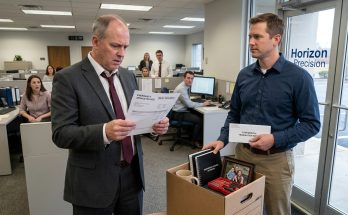
David Rourke’s office was searched at 1:14 in the morning.
Police found no David.
They found paper.
A great deal of it.
Most law firms digitized everything.
Rourke kept originals.
That habit saved us.
Ortiz sent photographs as officers cataloged the files.
Trust amendments.
Board proxies.
Debt covenants.
Legacy share instruments.
Several documents bore Thomas Langford’s signature.
Some genuine.
Some obviously assembled from copied pages.
The difference was subtle enough that a registrar seeing only one document might never question it.
Rourke had not merely exploited Thomas’s estate.
He had slowly converted it into a toolbox.
I stood in Samuel’s office while Nadia compared scans.
Samuel remained silent.
“What are you thinking?” I asked.
“That David handled my mother’s estate.”
I said nothing.
“My divorce.”
Nothing.
“My children’s trusts.”
That was worse.
“How long have you known him?”
“Thirty-one years.”
Another trusted identity.
Another old door.
Samuel looked toward the factory.
“Martin didn’t infiltrate Horizon.”
“No.”
“He inherited people already inside it.”
That felt closer.
Margaret’s old role.
Rourke.
Arthur’s financial network.
Thomas’s compromised suppliers.
The Vales had not built a conspiracy in three weeks.
They had activated pieces already embedded over decades.
The three-week period was simply when the Meridian plan accelerated.
Ortiz entered.
“Rourke’s partner says he left the office around six.”
“Peter Sloan?” Samuel asked.
“No. Another partner.”
“Where was Rourke going?”
“Said he had a client emergency.”
“Client?”
“Wouldn’t say.”
“Vehicle?”
“Company sedan.”
Police found traffic-camera footage.
Rourke driving toward Horizon at 6:32.
Same time as the blackout preparations.
“Did he enter?” I asked.
Nadia checked external cameras.
No Rourke vehicle.
“Could have parked elsewhere.”
Then Walter called.
“Ethan.”
His tone was controlled.
“What?”
“You need to come to Bay Two.”
“What happened?”
“Found something.”
I went downstairs with Ortiz.
Walter stood beside an old utility tunnel.
The same network of maintenance passages Caroline had been found near.
He pointed at the floor.
A shoe.
Men’s.
Expensive leather.
Blood on the heel.
“Caroline’s?”
“Different blood type if the quick kit’s right.”
Ortiz looked down the passage.
Officers entered first.
Twenty yards in, the tunnel divided.
One branch toward the boiler room.
One toward an obsolete loading dock.
Near the split lay a broken pair of glasses.
Samuel recognized them when he arrived.
“David.”
Further in, police found him.
Alive.
Barely.
He was unconscious behind an old pump cabinet with blunt-force trauma to the head and a deep cut on his forearm.
His wallet remained.
Phone missing.
Briefcase missing.
Someone had attacked him inside Horizon.
Like Caroline.
The pattern was changing.
The apparent conspirators were being discarded.
Tyler dumped.
Arthur framed.
Richard exposed.
Caroline attacked.
Rourke attacked.
Martin missing.
Whoever stood above the operation was cleaning the board.
Ortiz ordered Rourke transported under guard.
Samuel watched the stretcher disappear.
“He came here voluntarily.”
“Probably.”
“To meet whom?”
“That’s what we need.”
Nadia checked cameras near the old loading dock.
The blackout erased some footage.
But an analog auxiliary camera had continued recording locally.
Walter found its recorder.
The image was poor.
At 6:41, Rourke entered the service dock.
At 6:44, another person arrived.
Peter Sloan.
No surprise.
They argued.
No audio.
At 6:51, a third person entered frame.
Tall.
Coat.
Face turned away.
Rourke reacted strongly.
Sloan did not.
Meaning Sloan expected the person.
Rourke did not.
Then the third person struck Rourke.
Sloan helped drag him out of view.
“Martin?” Samuel asked.
The build fit.
Then the person turned slightly.
Claire, watching over my shoulder, shook her head.
“That’s not Martin.”
“How can you tell?”
“Martin favors his right leg.”
I had noticed it before.
Old ski injury.
The man in the footage moved evenly.
“What about Evelyn?” Ortiz asked.
Too tall.
Male frame.
Arthur watched by video.
He leaned forward.
“Play it again.”
We did.
The man reached into his coat.
A watch flashed.
Arthur’s face changed.
“What?”
“That watch.”
“Recognize it?”
“Yes.”
“Whose?”
Arthur hesitated.
Then:
“Jonathan Pierce.”
Calder’s chief executive officer.
At last, a Calder executive physically inside Horizon.
We had spent hours circling proxies.
Now one appeared on camera.
Samuel stared.
“Pierce was here tonight.”
Arthur nodded.
“That explains Martin saying ‘your company.’”
If Martin was speaking to Jonathan Pierce, that phrase fit.
But Tyler said Martin sounded afraid.
Why would Martin fear the executive of a company he had manipulated for years?
Because Pierce controlled the next layer.
Nadia searched visitor records.
No Pierce entry.
Private flight records showed his aircraft landing nearby that afternoon.
Publicly, he was supposed to be in Chicago.
Another false location.
Ortiz’s phone rang.
She listened.
“State police located Martin’s car.”
“Where?”
“Near the river industrial district.”
“Martin?”
“No.”
“Anything inside?”
“Phone.”
That was wrong.
Martin valued communication too much to abandon his phone accidentally.
“Powered?”
“Off.”
“Other evidence?”
“Blood in the trunk.”
Samuel closed his eyes.
“Tyler?”
Ortiz shook her head.
“Unknown.”
The entire operation was consuming its own participants.
I looked at Arthur.
“Would Pierce kill Martin?”
Arthur’s face tightened.
“Pierce would remove any risk he couldn’t control.”
“Was Martin a risk?”
“Martin had copies of everything.”
There.
Insurance.
Of course he did.
A man like Martin would never depend entirely on Calder, Evelyn, or anyone else.
“Where?” I asked.
Arthur shook his head.
“I don’t know.”
“Think.”
“He once told me the only safe evidence was evidence nobody could seize all at once.”
Distributed.
Like Thomas.
Same logic again.
Martin may have hated Thomas, but he had learned from him.
Nadia said, “The portable drive from Martin’s safe.”
“What about it?”
“We only opened one encrypted container.”
“How many?”
“Three.”
“Open the next.”
Bell, the federal investigator, approved.
The second container required a password.
We tried obvious paths.
No.
Then I thought of Martin’s architecture.
Not personal memory.
Leverage.
“What did he fear most?”
Arthur answered.
“Being controlled.”
I looked at the old Thomas recording.
One line:
Your son will borrow until ownership stops mattering.
Martin had kept that for seventeen years.
I entered:
OWNERSHIPSTOPSMATTERING
Wrong.
Then:
OWNERSHIPDOESNTMATTER
Wrong.
Samuel said, “Try Thomas.”
“Why?”
“Martin kept that recording because he never forgot him.”
Password:
THOMAS
Wrong.
Then I remembered the final insult.
He doesn’t know. Then he’s easier to use.
EASIERTOUSE.
The container opened.
Arthur whispered, “Of course.”
Inside were insurance files.
Martin’s leverage against everyone.
Richard’s Calder communications.
Arthur’s payment trail.
Evelyn’s debt strategy.
Rourke’s forged estate documents.
Sloan’s board coordination.
Jonathan Pierce’s instructions.
And one file named:
EVELYN_EXIT.
Samuel looked at me.
Martin had a contingency against his own sister.
We opened it.
The document outlined a scenario where Evelyn would absorb blame for improper debt pressure and unauthorized ownership manipulation if regulators intervened.
Supporting materials were ready.
Emails.
Transfer instructions.
Recorded calls.
Some genuine.
Some altered.
Even Evelyn Vale was disposable.
Arthur stared.
“He planned to take Horizon himself.”
Maybe.
The next file answered.
POST-RESTRUCTURE OWNERSHIP.
A chain of holding companies led from Calder’s proposed acquisition through offshore entities.
Final beneficial owner:
M. VALE FAMILY TRUST.
Not Evelyn.
Martin.
He had manipulated Calder into buying Horizon, then intended to position himself to take effective ownership later.
Samuel laughed once.
“He was robbing the people helping him rob me.”
That sounded exactly like Martin.
But the final file changed everything again.
PIERCE OVERRIDE.
Instructions if Jonathan Pierce discovered the post-acquisition scheme.
Evidence package to be transmitted to federal authorities showing Calder’s involvement in historical material fraud.
Martin could destroy Pierce.
Pierce now had reason to eliminate Martin before Martin used it.
“Where does the package transmit from?” Bell asked.
Nadia checked.
“Distributed nodes.”
“How many?”
“Six.”
“Locations?”
She decoded them.
One was Horizon.
One Sterling.
One Calder.
One unknown cloud host.
One personal device.
And one physical release terminal.
“Where?”
Nadia stared.
“Northfield Thermal Processing.”
My old facility.
The place where I had first discovered the furnace manipulation.
A plant now owned by Calder.
Arthur leaned back.
“Martin went there.”
“How do you know?”
“It’s where this began for him too.”
“What began?”
Arthur looked at Samuel.
“His father died there.”
I froze.
Margaret had never mentioned that.
“When?” I asked.
“Twelve years ago.”
Around the time I worked there.
“Cause?”
Arthur hesitated.
“Industrial accident.”
“What kind?”
“Furnace explosion.”
My memory sharpened.
I remembered it.
Not directly.
A section of the plant had been closed for weeks.
Workers were told a burner malfunction caused a pressure event.
One contractor died.
I had never known his name.
“Robert Vale,” Arthur said.
Martin’s father.
Margaret’s husband.
The man tied to Calder material operations.
I stared at the screen.
“Twelve years ago I was working in that plant.”
“Yes.”
“And three months later I was recruited to Horizon.”
“Yes.”
The timeline was no longer abstract.
Robert Vale died.
I found the hidden furnace-history bypass.
Margaret profiled me.
I was moved into Horizon.
Martin learned about me.
Everything connected.
Samuel asked the obvious question.
“Was Robert’s death an accident?”
Arthur looked toward the camera.
“No one ever proved otherwise.”
Which meant someone suspected otherwise.
“Who?”
“Martin.”
“Who did he blame?”
Arthur did not want to answer.
I forced it.
“Who?”
“You.”
I stared at him.
“That’s impossible.”
“Martin believed the retrofit you performed disabled a safety override.”
“That’s false.”
“I’m telling you what he believed.”
My chest tightened.
The system I modified had been months before the explosion.
I removed a data-history manipulation function.
I did not alter burner safeties.
But Martin may have been told otherwise.
Or chosen to believe otherwise.
“Did Margaret know he blamed me?”
Arthur shook his head.
“Maybe.”
If she did, recruiting me to Horizon had placed me where Martin could someday reach me.
Or where she could protect me.
I no longer knew which.
Then Nadia’s screen lit up.
One of Martin’s six distributed nodes had activated.
Northfield.
The physical release terminal.
Someone was there.
“Can you tell who?”
“No.”
“Camera?”
“External system.”
Bell contacted authorities.
Too slow.
Then the node sent a message.
Not to police.
To me.
One sentence.
COME BACK TO WHERE YOU STARTED.
Under it:
COME ALONE OR MARGARET DIES.
Samuel stared at the screen.
Margaret was supposed to be under police protection.
Ortiz called Cedar Falls immediately.
The response came thirty seconds later.
Her room was empty.
Two officers outside her door had been found unconscious in a service corridor.
No one knew how Margaret Vale had been removed from the facility.
Martin’s mother was gone.
And someone wanted me at Northfield.
Click here to continue reading: PART 16: Returning to Northfield Exposed the Furnace Secret Martin Blamed Me For, but the Person Holding Margaret Was Not Martin Vale
Five Minutes After Losing My Job, the Machine Only I Truly Understood Failed at the Worst Possible Moment
Part 15 of 24