Then I looked at Raymond. My oldest. The practical son. The boy who used to take apart radios and leave the screws in careful small piles on the kitchen table. He had learned somewhere in adulthood to take apart situations the same way, identifying the useful components and setting aside whatever did not serve a function.
“You called me twice in thirteen days,” I said. “Both times you asked about documents.”
“I was trying to be helpful.”
“You did not ask if I had clean clothes. You did not ask if I needed someone to speak with the doctor on my behalf. You did not ask whether I was sleeping.”
“I thought Bella was handling the visits.”
Bella’s head turned sharply. “Do not put this on me.”
I turned to her. “You promised six times.”
Her eyes filled quickly, the way they had when she was eight and broke something of her mother’s. Bella’s tears were real. Her follow-through was the problem.
“Dad, I wanted to come. Everything got so complicated.”
“Thirteen days,” I said. “Not one morning was clear?”
She looked at her plate.
I looked at Nora.
My youngest. Elaine used to say she had a heart too large for her chest, which was true, but large hearts without discipline can absorb everything from the people around them without noticing what they are taking.
“Before surgery, you called me and asked for rent,” I said.
“I didn’t know it was serious.”
“I told you I was nervous.”
“You always say things like that.” Her voice carried the specific frustration of a person who has decided the speaker is the problem. “You’re old, Dad. You worry about everything.”
Raymond closed his eyes. Bella whispered her sister’s name.
I only nodded.
There it was. Not shouted in anger but said as simple fact. I was old. I worried. I gave. And in the logic she had constructed, those three facts had come to mean that my needs existed at a lower register than hers.
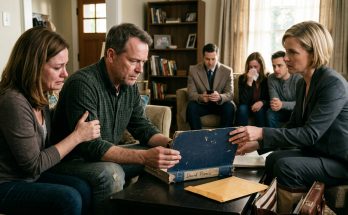
Michael opened the folder.
“The house on Sycamore Lane will no longer pass equally to Raymond, Bella, and Nora,” he said.
Raymond’s head came up. “What?”
“Albert has placed the property into the Elaine Walker Community Trust. Following his death, the house will be converted into transitional housing for elderly patients discharged from hospital care without adequate family support.”
The silence in the room had a different quality from the silence before. That silence had been uncertainty. This one was comprehension.
“You’re giving our house to strangers,” Nora said.
“Our house,” I said.
She looked away.
“You hadn’t visited this house in five months before tonight.”
Raymond’s voice sharpened with the edge of a man who believes emotional engagement can be framed as irrational. “Dad, you’re making a permanent decision because we missed some hospital visits. This is grief talking.”
“No,” I said. “This is the blueprint.”
I looked around the room I had built and repaired and paid for and waited in. The shelves I had made for Elaine’s books. The floors I had refinished with my own hands. The window where the plant was still recovering from thirteen days of no one coming.
“For years I carried weight that belonged to you,” I said. “Rent, emergencies, down payments, tuition gaps, car repairs, business loans, vacations you called family trips after I paid the deposit. I carried it because I wanted to. And because I believed that when my weight got heavy, someone would carry some of it back.”
Raymond pushed his chair back. “This is punishment.”
“This is design,” I said. “A well-designed structure distributes load proportionally. I did not design this. I let the load pile up in one place and called it love. Michael helped me correct the design.”
Nora’s voice cracked. “Mom would never have done this.”
“Your mother,” I said carefully, “would have done it sooner.”
That reached her in a way my words had not. Her eyes changed.
Bella stood then. For a moment I thought she was leaving. Instead she walked around the table and knelt beside my chair, the way she used to when she was small and had done something wrong and could not figure out any other physical position that matched the feeling.
“I’m sorry,” she said. It was the first sentence all evening that did not have anything behind it.
I looked at my daughter’s bent head. I wanted to touch her hair. I wanted to tell her it was all right.
It was not all right.
“Thank you,” I said.
She cried harder, and I did not reach down to stop it. Some things need to run their course without rescue.
Raymond left first, taking his wine, then remembering and coming back with a flush to set it on the counter. He said he hoped I would reconsider. He said he would call to discuss it more rationally when everyone had slept on it. I thanked him for coming.
Nora left angry, telling me I had changed, telling me this was not how family was supposed to work. She said Mom would be disappointed.
She was wrong about that. But I let it go, because telling her so would not have been for her benefit.
Bella stayed and helped with the dishes. She did not mention the will or the trust or the allocation numbers. She dried the plates and put them back in exactly the places Elaine had kept them, the way she always had when she visited, muscle memory from growing up in this kitchen.
When she left, she kissed my cheek.
“Can I come by next week?”
“You can,” I said. “Come because you want to see me. Not because you want to fix the papers.”
She nodded with the shame of someone who had just understood a distinction they should have understood years ago.
After the door closed, Michael and I sat in the quiet for a while.
“You handled that well,” he said.
I looked at Elaine’s empty chair.
“I handled it late,” I said.
The years that followed were not what I would have arranged if I had been designing them from the start, but nothing is. Bella came almost every Sunday. Sometimes she brought soup. Sometimes she brought nothing and simply sat with me while I had tea, which turned out to be worth more than any of the soups. Raymond called more often, with a stiffness between his words that he was working at, I could tell, honestly working at. That was something. Nora disappeared for eight months. She sent a birthday card with no return address. I kept it in my desk drawer because it was still a card.
I did not change the trust back.
When I died, the house on Sycamore Lane was not quiet anymore.
The Elaine Walker House opened the following spring, on the first warm day of April, when the rose bushes along the south fence were beginning to put out their first color. They had widened the doorways for walkers and wheelchairs. They had converted my study into an intake office where a care coordinator helped new residents understand their medication schedules and their rights. They had put six chairs in the recovery room, soft and warm, nothing like the blue vinyl of room 114.
Bella came to the opening. She stood under the maple tree that was now almost forty years old and cried quietly while a man with a walker was helped through the front door by a volunteer who held the door and waited until he was clear before releasing it.
Raymond came too, late and with his suit slightly wrinkled and his eyes wet in the guarded way of a man who has not yet fully made peace with the feeling but is no longer fighting it as hard as he was.
Nora did not come.
But the house was full.
Full of nurses and volunteers and people being helped from cars, elderly men and women who had come from hospitals to a place that kept the lights on and had someone available to answer a question at two in the morning. People whose families were far away, or overextended, or broken, or simply absent in the particular way that absence takes when it is not malicious but is no less real.
The first thing a resident named Dorothy said when she came through the door was that it smelled like a home.
Michael had arranged for a small brass plaque near the entrance. I had not designed the language myself. He had offered to write it and I had told him to use his judgment, because he had been doing that on my behalf for twenty-six years and had never been wrong about anything that mattered.
The plaque said:
The Elaine Walker House. For those who still deserve someone waiting.
In the front room, beside the window where I used to drink my morning tea, one chair sat empty. Not because no one had claimed it. Because in a house built for people who had been forgotten, there was always a chair waiting for the next person who needed it.
This was the structure I had spent thirteen days in a hospital room designing.