My Children Promised to Visit Me After Surgery Until I Came Home Alone and Discovered the Truth
My name is Albert Walker. I am seventy-eight years old, and I have spent most of my adult life building things designed to hold under pressure.
Water heaters. Roof frames. Engine mounts. Kitchen floors. A bridge once, early in my career, that I still drive over when I visit my sister in Murfreesboro because I want to see it holding. The satisfaction of that has not diminished in forty years. A structure bears weight or it does not, and you know the difference long before anything fails.
I thought I understood weight.
Then I had surgery.
Six weeks before the operation, I told all three of my children the date. Six full weeks. Forty-two days. I gave them that much time deliberately, the way I would schedule a major construction phase, enough lead time for a person to make reasonable arrangements. Enough to move a meeting, shift a carpool, request one Friday off work. Enough to drive down I-65 to Bowling Green and sit beside their father while he went under anesthesia.
Raymond, my oldest, said not to worry. He said they would all be there. He said this with the easy confidence of a man who has learned that reassurance is cheaper than commitment.
Bella left a long voice message full of promises. Of course, Dad. Of course, of course. The phrase appeared so many times it started to sound like a song rather than a plan.
Nora called three weeks before the surgery while I was making a sandwich. She asked how I was feeling. I told her I was nervous. Then she asked if I could help with rent. I said yes. I always said yes. After we hung up, I stood in my kitchen for a moment looking at the sandwich. I thought about what she had asked, and what I had said, and what the order of those two things might mean about how she understood me.
On the morning of surgery, my house on Sycamore Lane was quiet in the way a large house becomes quiet when only one person lives in it. I made coffee I was not allowed to drink. I sat by the window and looked at the rose bushes along the south fence, at the bench I built twenty years ago from cedar I milled myself, at the maple tree in the front yard that my late wife Elaine had planted as a sapling the year Raymond was born. I thought about all of it for a while. Then I ordered a ride to the hospital.
The surgeon told me the procedure was routine. People love that word when it is not their body being opened.
When I woke up, there was pain and bright light and a nurse checking my vitals with the efficient gentleness of someone who has done this ten thousand times. And beside the bed, placed at the angle that suggests someone placed it there for a reason, there was a blue vinyl chair. Empty.
I told myself they would come later. Afternoon, maybe, or evening after the work day. I told myself there was a reasonable explanation already in motion.
Day one, no one came.
Day two, Raymond called. He asked how I was feeling. I told him the surgery went well and that I was in some pain but expected to improve. He said good, that was good, and then before hanging up he mentioned casually that I might want to think about organizing my financial documents at some point. Just something to consider. I looked at the empty chair after we hung up and thought about what he had chosen to say with the minutes he had.
Day three, Bella called. She felt terrible, she said. Work was impossible right now. The children had school commitments. Her husband had a work obligation. Something had come up that she could not properly explain over the phone, but she was absolutely coming soon. I thanked her and told her I understood.
Day four, the chair was still empty.
Day five, Raymond called again. Day six, Bella promised again, more elaborate this time, more apologetic, more insistent that soon was real. Nora did not call.
By day seven, I had memorized the chair. Blue vinyl, slightly crooked on the left leg, positioned a little close to the bed as though someone had moved it in anticipation of a visitor already on their way. Nurse Gloria came in that afternoon to check my blood pressure. She was the kind of woman who had seen enough of life to stop pretending that empty chairs were just furniture. She looked at mine for a moment, then looked at me, and asked gently whether I had family.
I smiled. That smile cost me something I did not realize I was paying until later.
“Yes,” I said.
She nodded slowly, squeezed my hand once, and told me to press the call button anytime. She did not ask a follow-up question. She did not need to.
No one came on day eight. No one on day nine. Bella sent a text saying she was sorry, that something had come up, and that she would explain everything. I did not ask for the explanation.
Day ten, the chair was still empty.
Day eleven, I stopped looking at the door.
Day twelve, I understood something I had spent seventy-eight years arranging my life to avoid understanding. Love can be real and still not show up. The presence of genuine feeling, the kind that is sincere when expressed, does not guarantee the presence of the person who feels it. You can love someone and still fail to arrange your week around them when it costs you something. And what that means about the love, what weight it can actually bear, is a thing I had been slow to calculate.
On day thirteen, Dr. Leonard signed my discharge papers. A hospital volunteer wheeled me to the entrance because that was policy. Outside, cars pulled up and families leaned out and doors opened and hands reached for bags and walkers and people were helped into vehicles with the ordinary tenderness of people who showed up. I watched this from the curb and ordered a ride on my phone.
The driver was a young man named Tyler. When we arrived at Sycamore Lane, he helped me to the porch with my bag and asked if I was okay getting inside. I thanked him. He waited until I had my key in the lock before he pulled away, which I noted.
I stood for a moment looking at the brass handle I had replaced twice, the crack in the upper panel I had been meaning to fix for two seasons. Then I went inside.
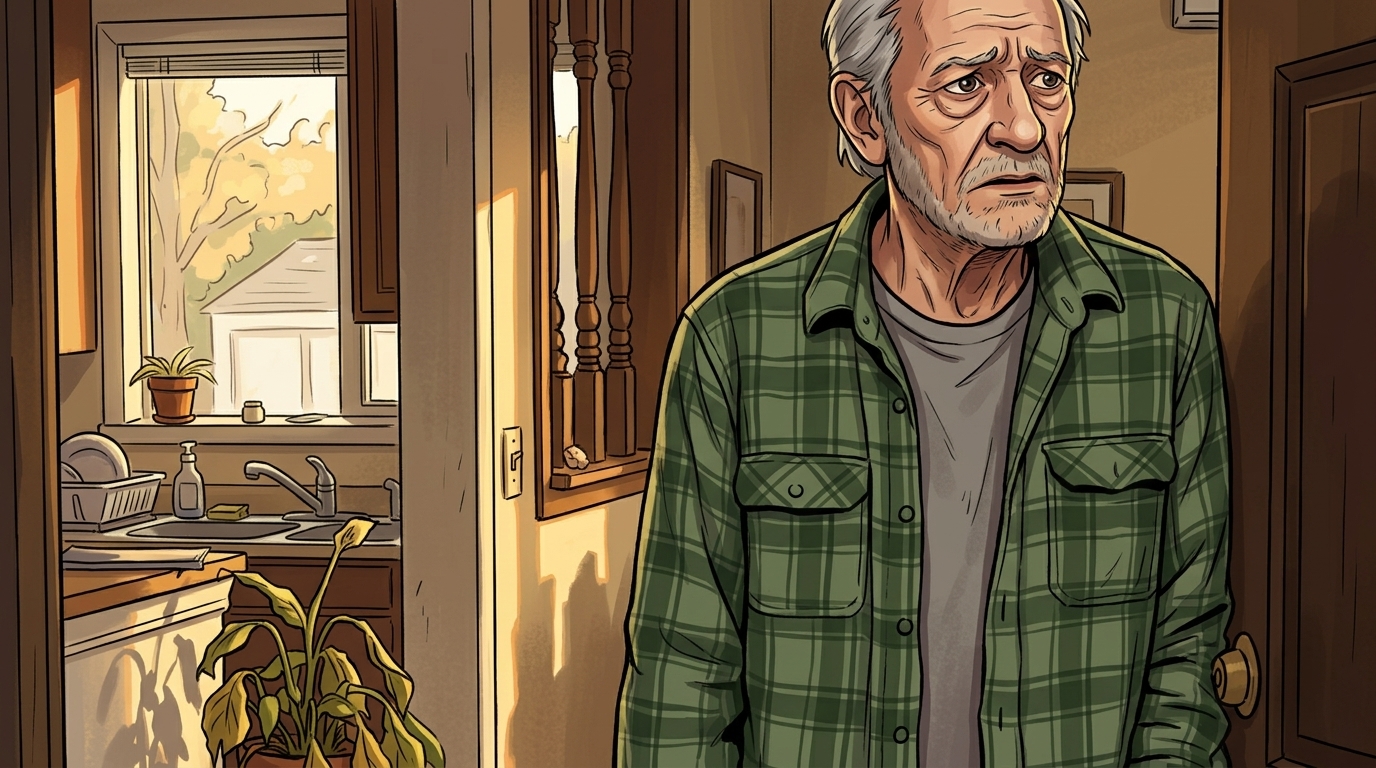
The house was exactly as I had left it thirteen days earlier.
The mail had stacked into a substantial pile behind the slot. The plant by the kitchen window was dry, past dry, starting to brown. The air had the specific stillness of a space that has not been entered for an extended period, nothing moved, nothing touched, nothing checked.
When you live alone and come home from a hospital after thirteen days to find everything exactly where you left it, it means no one came. Not to collect the mail. Not to water the plant. Not to stand in your kitchen and confirm that you still existed in someone’s daily awareness.
I set my pharmacy bag on the counter and put the kettle on and sat in my chair by the window, the one with the worn right armrest where my elbow has rested for thirty years. I looked at the yard. I thought about the blue vinyl chair in room 114. I thought about Gloria’s hand on mine. I thought about we’ll take turns staying with you.
Then I picked up the phone.
Not to call my children. I called Michael Simmons, my attorney of twenty-six years.
Michael is a precise man. Patient in the way of people who understand that important structures take time to build correctly and that rushing produces failures you discover too late. He listened while I told him what I had spent thirteen days thinking about and what I wanted to do about it. When I finished, he was quiet for a moment.
“Albert,” he said. “Are you certain?”
I looked out at the rose bushes along the south fence. Elaine had planted most of them. I had kept them alive for eleven years since she died.
“I have been certain since day seven,” I said.
Six weeks later, I invited all three of my children to dinner.
Raymond arrived first with a bottle of red wine and the particular smile he wore when he was assessing a room before committing to a mood. His eyes moved across the crown molding with a quick appreciation that had never quite been about aesthetics. Bella came with a store-bought cobbler and apologies arranged over excuses in careful layers, like geological strata. Nora arrived thirty-eight minutes late and did not mention the hospital at all, not the surgery, not the thirteen days, not the empty chair.
I made cornbread from scratch. I put Coltrane on low. I set the table the way I set it when I want a meal to feel like something being said.
I was glad to see them. That is the part that gets misunderstood when people hear stories like this. You can love your children and still learn from them. You can pass the cornbread and still remember the empty chair. Both things are true at the same table.
Halfway through dinner, I set down my fork.
“Since the surgery,” I said, “I’ve been thinking it might be wise to get my affairs in order.”
The table changed. Not with sound or drama, but with the shift in load that an engineer feels before anything visible changes. Raymond sat straighter. Bella’s smile tightened at the corners. Nora finally looked up from her plate.
Raymond said, carefully, that this sounded sensible.
Bella said it was very responsible.
I asked if anyone wanted more cornbread.
They had no idea Michael already had the papers. They had no idea the house on Sycamore Lane, the rose bushes, the hardwood floors I had refinished twice, the shelves I built myself for Elaine’s books and never moved after she died, every document in my study, and the cedar bench in the yard had already been reconsidered against thirteen days of silence.
They thought they were sitting at dinner with an old man who had forgotten how empty a hospital room feels.
But I had not forgotten.
I had simply stopped reacting and started designing.
The doorbell rang at exactly seven-thirty.
Raymond looked toward the hallway first, the instinctive assessment of someone calculating whether an unexpected thing involves money or inconvenience.
“Expecting someone?” Bella asked.
“I am,” I said.
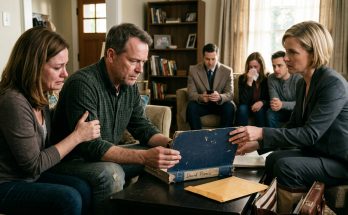
I walked to the door on my own. My hip complained but I had decided I did not need the walker for this particular entrance. Michael stood on the porch in a navy suit with the leather folder held against his chest.
“Albert,” he said.
“Come in, Michael.”
Behind me, the dining room went very quiet in the way a room does when people who believed they understood a situation suddenly understand that they did not.
Michael entered, nodded to my children with the neutral courtesy of a man who has no personal stake in their feelings, and took the empty chair beside me. The same chair where Elaine used to sit when the children were small and the house still held the sound of running feet and arguments over the last biscuit.
Raymond forced a smile. “Mr. Simmons.”
Michael returned the nod. “Raymond.”
Bella looked between us with the expression of a woman calculating the distance between where she thought she was and where she had just found herself. “Dad, what is this?”
“This is me getting my affairs in order,” I said. “As I mentioned.”
Nora gave a small nervous laugh. “You invited your lawyer to dinner?”
“I invited my children to dinner,” I said. “Michael came for a different reason.”
That closed her mouth.
Michael set the folder on the table and did not open it immediately. He had been doing this for twenty-six years and he understood that certain things needed a moment of preparation.
“Albert asked me to be present while he explained some changes he has made to his estate plan,” Michael said.
Raymond leaned forward. “Dad, you didn’t need to do this formally. We’re your family.”
“Yes,” I said. “You are.”
I let that sit for a moment.
Click Here to continuous Read Full Ending Story👉PART2: After 13 Days Alone in the Hospital, I Changed My Will and Shocked My Children Forever
After 13 Days Alone in the Hospital, I Changed My Will and Shocked My Children Forever
Part 1 of 2