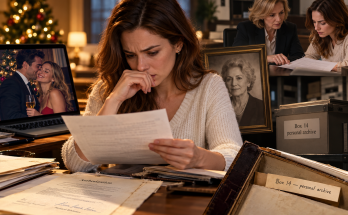
Beatrice started to cry, but her tears held no real pain. Only calculation. “We were just kids.” The lawyer looked at her coldly. “You were twenty-two years old when Ana was born.” Beatrice shut her mouth. I felt sick. My siblings. That word was an insult. Mrs. Thompson had given birth to wolves before she gave birth to me.
The lawyer handed me the small key. “This opens the back room.” I remembered the three locks, the untouched dust, the way she touched the metal box whenever the door knocked. “Your mother requested that you enter first.”
Ernesto let out a scream. “That house is ours!” The lawyer opened another folder. “That house no longer belongs to you. Mrs. Thompson changed her will six months ago.” Beatrice turned white. “She couldn’t do that.” “She certainly could.” “We are her children!” The lawyer looked at me. “So is Ana.”
We went to the house in Greenwich Village with the police behind us. The siblings had to follow because the lawyer called them for the formal reading of the will. I sat in the back of a taxi, holding the key and the photograph.
I thought of my sick mom, the only mother I knew. I thought about how to tell her my life had another root. I thought of Mrs. Thompson asking me if I’d go to her funeral. I didn’t want to inherit a house. I just wanted one more afternoon to ask her why she didn’t hug me when she found out who I was.
The door creaked just like always. But this time, the house didn’t welcome me as an employee. It welcomed me as a daughter returning late to a locked room.
I walked to the back. The three locks shined. The small key opened the first. The second. The third. As I pushed the door open, the smell of old wood, baby powder, and stored clothes drifted out.
Inside, there was no gold. No boxes of cash. There was a white crib. An untouched crib. It had yellowed sheets, a mobile of stars, and a rag doll sitting on the pillow.
I covered my mouth. On the walls were photos of me. There were photos cut out from social media, and photos taken from far away—at my dessert stand, at my school, and at the hospital. Mrs. Thompson had created an altar of her search for me. On a dresser were notebooks filled with dates.
“Today Ana arrived with a cough.” “Today Ana didn’t want the bread, but she put it in her bag.” “Today Ana cried in the kitchen and wouldn’t tell me why.” “Today I almost called her daughter.”
I collapsed over the crib. The woman who gave birth to me had gotten to know me while I scrubbed her floors because she didn’t know how to speak to me without breaking me. And yet, she broke me anyway. Because there are truths that save you, but they arrive like broken glass in your hand.
The lawyer entered behind me and handed me another box. “This was meant only for you.” Inside was a lock of baby hair, a hospital bracelet, a tiny pink dress, and an old tape recorder. There was also a USB drive. “Your mother recorded a message.”
We played it on the living room TV, right in front of everyone. Mrs. Thompson appeared sitting in her armchair, rosary in hand, her hair styled just like last Thursday. She looked tired, but not weak.
“If you are watching this, Ana, it’s because you came to say goodbye.” Her voice filled the house. Her children stared at the floor. “Forgive me for not telling you the truth when you first walked in with your torn sneakers and your borrowed bucket.” I cried silently. “I wanted to scream your name, daughter, but I was afraid you would run away. I was also afraid they would finish what they started.”
Ernesto stood up. “Turn that thing off!” An officer forced him back down into his seat.
“When you were born, your brother Ernesto was supposed to manage an account your biological father left for me.” My heart jumped. Biological father. “Your father was Julian Morales. He wasn’t a rich man, but he was honorable.” I looked at the lawyer. My last name. Morales. The name I thought belonged to the man who left me. “Julian died before you were born, and his money and property were left for me and for you. My children couldn’t stand that. They sedated me, forged papers, bribed a nurse, and took you from the hospital.”
I looked at Ernesto. He no longer looked proud. He looked trapped. “They handed you to a man in debt, Luis Morales, who agreed to register you as his daughter in exchange for money.”
My supposed father. The man who left when I was eleven. The man who left us with debts and a broken photo. He didn’t abandon me because he was a coward; he abandoned me because I had never been his.
Mrs. Thompson continued, “Your mother who raised you didn’t know the truth at first. When she found out, she already loved you more than her own life and was afraid of losing you. That’s why I asked her to let me get close to you slowly.”
I put my hands to my face. My mom knew. The torn bread. The money advances. The extra hours. It had all been an agreement between two women sick with guilt.
“Ana, I’m not giving you a fortune to buy your love. I’m giving you back what was stolen.”
The recording ended with a sentence that made her children pull back in fear: “And to you, my first children, I leave you the only thing you earned with your own hands: the opportunity to tell the truth before a judge says it for you.”
The screen went dark. Beatrice fainted. No one ran to help her. Matthew started crying, saying he only signed the papers because Ernesto threatened him. Ernesto screamed that they had all lived off that money. The lawyer stayed calm. “All of those statements are being recorded as well.”
They were taken in for questioning that same afternoon. I stayed in the house with the lawyer, the crib, and a life I didn’t know what to do with. “What did she leave me?” I asked, almost with shame. “The house, the recovered bank accounts, a property in the Hamptons, money from rented stores, and Julian Morales’s fund, updated for inflation.”
I laughed. Not out of happiness, but because it was so absurd. That morning I didn’t have money for dinner, and that night they were telling me my poverty had been manufactured by thieves of my own blood. “I don’t know how to be rich.” The lawyer closed the folder. “First, just be a daughter.”
I went to the hospital. I walked in with the photograph. My mom saw me and knew immediately. “Ana,” she whispered. “Since when?” She cried before answering. “For eight months.” I sat by her bed. “And before that?” “Before that, I only knew that Luis brought you home one morning and said your mother had died. I couldn’t have children, Ana, and you looked at me with such wide eyes… I became selfish in a second.”
I couldn’t hate her. That made me angry. It would have been easier to break away from everyone. “When Clara found me,” she said, “I thought she was coming to take you away.” “Why didn’t you tell me?” “Because she asked for time. She was dying. Cancer.”
She didn’t want me to care for her out of obligation, or inheritance, or pity. She wanted to gift herself a few months of having a daughter before she died. I hugged my mom. Not because she was forgiven—I wasn’t ready for that—but because she was the woman who raised me, and I had already lost too many mothers that night.
The following months were a blur of DNA tests and court hearings. The tests confirmed it. Clara Arriaga was my mother. Julian Morales was my father. My brothers were charged with kidnapping and fraud.
I sold the Hamptons property to pay for my mom’s medical treatment and opened a small foundation for domestic workers. I didn’t sell the house in the Village. I painted it. I fixed the flower pots. I turned the back room into a community kitchen.
Every Thursday, I serve sugar-free oatmeal, coffee, and sweet bread torn in half. I charge whatever people can pay. Sometimes, nothing. On the wall, I put the photo of young Clara with the baby. Underneath, I wrote: “Clara and Ana, found late.”
A year later, I took flowers to her grave. I went with my mom in her wheelchair. I pulled the original letter from my purse. “I don’t know if I forgive you for keeping quiet,” I told the headstone, “but thank you for looking for me.”
I pulled out two old, folded ten-dollar bills—the ones Ernesto had thrown at me at the funeral. I placed them on the grave. “My last payment, Mrs. Thompson.” Then I picked them up. “No, actually… let’s use these to buy lunch.” And for the first time, I laughed.
That afternoon, a woman came to the house and asked how much I charged for cleaning. I looked at her soap-stained hands and the eyes of someone who has asked for very little in life. “Twenty dollars,” I said. She looked down. “I don’t have any more than that.” I put a whole piece of bread on the table. “I didn’t ask.”
I finally understood Clara’s harsh way of loving. She didn’t know how to be tender without giving orders. She didn’t know how to say “daughter” without putting a broom between us first. But she found me. And although she left me a truth too heavy to carry all at once, she also left me a house where no hungry girl would ever feel like trash for needing a job.
I still clean today. I clean tables, pots, floors, and memories. But I don’t lower my head anymore. Because that mop led me to a door that should have opened the day I was born. And every Thursday, I feel Mrs. Thompson sitting across from me, serious as ever, while I finally find the courage to call her Mom.
When my husband told me he was going to “work in Canada for two years,” I sobbed as I drove him to the airport. However, as soon as I got home, I moved the $720,000 into my account and filed for divorce.
Part 2 of 2