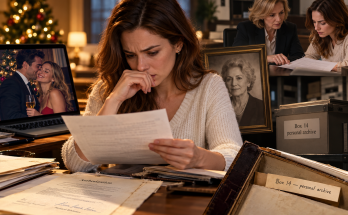
I agreed to clean an old woman’s house for just $20 because that night, I didn’t even have enough money for dinner. But the day she died and left a single letter for me, her children stopped calling me “the cleaning girl” and started to shake with fear.
My eyes stayed locked on that one single word. Daughter. Not granddaughter, not housegirl, and not some poor child she gave work to out of pity. Daughter.
Mrs. Thompson’s children all started talking at the same time, but their voices sounded like they were miles away. The lawyer raised his hand, asking for silence with a calmness that seemed practiced over many years. I kept reading, even though the letters blurred through my tears.
“When you were born, your siblings were already adults. They hated me because your arrival changed everything.”
I looked at the youngest daughter—the one who had searched my backpack as if I’d been born with dirty hands. She opened her mouth, but nothing came out. The letter shook in my fingers.
“Your father didn’t abandon you, Ana, because the man you knew as your father wasn’t your father at all.”
I felt the ground of the cemetery sinking beneath my worn-out shoes.
“He was a driver who accepted money to take you far away, register you with a different last name, and make you disappear from my life.”
Ernesto, the eldest son, took a step toward me. “That’s a lie.” The lawyer stepped between us. “Mr. Sterling, I suggest you listen until the very end.” Ernesto turned pale at the warning in the lawyer’s voice.
I didn’t know whether to breathe or tear the letter to pieces. The photograph burned my palm. There was a young Mrs. Thompson holding a baby, and that baby had a small birthmark near her left ear. I had the exact same mark. I touched my neck as if discovering my own body for the first time.
The letter continued, the handwriting growing more messy. “They told me you died at the hospital.” “They showed me a small, wrapped body, and I buried it without looking, because I was sedated and broken.”
I gasped, covering my mouth. Mrs. Thompson had also buried a lie. She had lived with a dead daughter who was actually breathing just a few neighborhoods away.
The middle son, Matthew, began to sweat. “Mom was out of her mind.” The lawyer opened his black folder. “Your mother was more lucid than all of you combined.” The daughter, Beatrice, let out a sharp laugh. “You can’t prove anything.”
I looked at her. For the first time, I didn’t feel like the cleaning girl. I felt like a question that had arrived late, but arrived with a key.
The lawyer pulled out a second sheet of paper. “Mrs. Thompson left evidence, private DNA tests, and a sealed legal complaint to be delivered today.”
The cemetery fell silent. Even the wind seemed to stop between the cheap wreaths. I kept reading.
“I found you eight months ago, Ana, because of a scar your adoptive mother showed in a social media photo while asking for help with medical bills.”
My mom. The sick woman who taught me never to steal, even when my stomach ached. The woman who never had money, but always had hands to comb my hair when I cried. The letter said “adoptive mother,” but my heart couldn’t accept that word.
“I went to see you from a distance.” “I saw you selling desserts, carrying bags, laughing with street kids, and giving water to a stray dog.” “That’s when I knew they hadn’t stolen everything from me.”
I sobbed. Not for the house. Not for the money that suddenly flew around like hungry flies. I sobbed because Mrs. Thompson had seen me before she ever touched my life. She had tested me with a broom, with oatmeal, with torn bread and hard silences. And without knowing it, I had walked in every Thursday to clean my own mother’s house.
Ernesto snatched the letter from my hands. The lawyer reacted, but Matthew shoved him back. “Let’s see what nonsense that old woman wrote!”
I didn’t think. I slapped Ernesto so hard the envelope fell to the ground. Everyone froze. Including me. I had never hit anyone in my life. But my hand didn’t regret it. “Don’t you ever call the woman you just buried without a single tear ‘that old woman’ again.”
Beatrice rushed at me. “You starving brat!” “Yes,” I replied, “and even so, I didn’t steal anyone’s life.”
The lawyer called out to two men standing by the cemetery gate. They weren’t mourners. They were investigators from the District Attorney’s office. The siblings stopped acting. Fear changed their faces completely.
The lawyer picked up the letter, returned it to me carefully, and said, “Mrs. Thompson knew they might act this way.” I couldn’t take my eyes off the officers. “What is happening?” “Your mother didn’t just leave a will, Ana.” That word pierced me again. Mother. “She also left a formal statement for kidnapping, forging documents, and a possible faked death.”