“That depends on how they react,” he replied. “But Liberty—prepare yourself. People like your parents don’t respond well to consequences.”
He didn’t need to tell me.
I already knew.
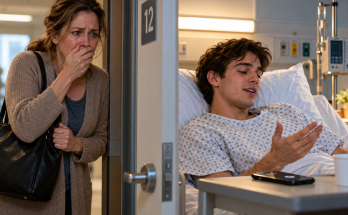
That afternoon, I was sitting on Amelia’s hospital bed reading her a picture book about a mischievous dolphin when someone knocked on the door. Ethan went to open it and then froze.
Standing in the hallway were my parents—and my brother Gavin.
My mother’s hair was unbrushed. My father looked deflated. Gavin’s face twisted into something between anger and discomfort.
For a moment, no one spoke. It was as if the hallway itself was holding its breath.
Finally, my dad cleared his throat.
“We came to visit Amelia.”
The words hung in the air like smoke.
Visit Amelia.
After ignoring our calls. After watching her collapse on camera. After leaving her alone with chemicals. After calling her a freeloader. After receiving a legal demand letter.
A slow, bitter laugh escaped me before I could stop it.
“Cut the act,” I said, standing up. “You didn’t come here for Amelia.”
My mother flinched. Gavin scowled.
“You think we’d only show up because of some stupid letter?” Gavin snapped.
I turned to him, my voice cold.
“This isn’t your business.”
He opened his mouth to argue again, but I raised a hand.
“No. You don’t get to come here and pretend you care.”
My mother’s voice broke, soft and pleading.
“Liberty, sweetie, we’re still family.”
“No family calls their granddaughter a freeloader,” I interrupted sharply.
Her lip quivered.
“I didn’t mean it.”
“You meant every word,” I said. “And now you’re dealing with the consequences.”
My dad stepped forward.
“Look, Liberty, let’s all calm down. We can work something out.”
“Oh, we will,” I said, icy. “In court.”
Their faces went pale.
“You’re being unreasonable,” Gavin snapped. “They’re old. They don’t deserve—”
I didn’t let him finish. I reached over to the nurse call button and pressed it.
A few seconds later, a nurse poked her head in. I gestured calmly.
“There are people here disturbing my daughter’s rest. Please call security.”
My parents froze. Gavin sputtered.
“You wouldn’t—”
But I already had.
Within minutes, two hospital security guards approached.
“I’m going to ask you all to leave,” one said firmly. “This is a restricted medical area.”
My mother turned her eyes to me one last time, searching for softness.
I had none left to give.
They left, and for the first time in my life, I didn’t feel guilty.
I felt free.
A month passed—both quickly and unbearably slowly.
Amelia recovered physically faster than I expected. Kids are resilient in ways adults aren’t. But emotionally, she still startled when someone raised their voice, even if it was just a nurse calling down the hall. She clung to me more, slept pressed against my side some nights, and hesitated whenever we talked about family.
But she never once asked about my parents. Not once.
Maybe that silence was its own kind of answer.
Meanwhile, the legal wheels kept turning. CPS conducted multiple interviews—one with me and Ethan, one with Amelia, one with the hospital staff, and several with the police department. They reviewed the footage from the pool camera again and again. They took notes. They took statements. They documented every blister on Amelia’s hands and every inch of redness from heat exposure.
And finally, they filed their recommendation: full prosecution for child cruelty. The temporary restraining order converted into a long-term protective order. Mandatory no-contact provisions for at least five years.
When I received the notice, my hands trembled only slightly. Ethan hugged me from behind and whispered in my ear.
“This is justice, Lib. This is what accountability looks like.”
I nodded.
Maybe he was right. But this wasn’t triumph. It wasn’t victory. It was the morning of something that had already died long before the law stepped in.
The courthouse smelled like paper and old wood—sterile, impersonal, a place designed to strip everything down to facts.
My parents sat on the defense side with an attorney they clearly couldn’t afford. Gavin sat behind them, shoulders tense, jaw tight, refusing to look at me.
Ethan sat beside me. David sat on my other side. His presence alone made me steadier.
When the judge entered, the room fell silent.
This wasn’t a small matter. This wasn’t a misunderstanding. This was child endangerment with physical harm.
The prosecutor played the security footage on a large screen.
There was my daughter—tiny, sweating, kneeling inside the empty pool, scrubbing with a stiff brush, barely strong enough to lift it. Every few minutes she paused to wipe her forehead, swaying on her knees.
My mother stood by the edge, pointing, lecturing. My father walked away, unconcerned.
The footage then showed my parents leaving their home with Ashley and Anna while Amelia remained alone in a hundred-degree heat with toxic chemicals.
Then came the medical report. The doctor testified to her core temperature of 107.6, her chemical burns, her risk of organ failure, and how close she’d come to a very different outcome.
CPS testified next. Then the police officers. Then I did.
I spoke calmly—almost too calmly. Trauma has a way of smoothing emotions into something flat.
The judge adjusted her glasses, looked down at the papers before her, then lifted her gaze toward my parents.
“In my courtroom,” she began, her voice cool but sharp, “we prioritize the safety of children above the pride of adults.”
My parents shifted nervously.
“What happened to your granddaughter was not an accident. It was not a misunderstanding. It was a willful act of punishment and neglect that could have resulted in her death.”
My mother began to cry softly. My father straightened stiffly, trying to mask the tremor in his hands.
“For child cruelty and endangerment,” the judge continued, “this court sentences you both to three years in state prison.”
A gasp rippled through the courtroom, but the judge wasn’t finished.
“You are also ordered to pay all medical and psychological treatment costs for Amelia Armstrong.”
My parents’ faces drained of color.
“And per the civil case presented by Attorney Morrison, you are required to repay the $15,750 documented as personal loans from your daughter.”
My father finally broke.
“Your Honor, please. We’re old. This is too harsh—”
Before he could finish, a woman from the audience—someone I didn’t know—stood up abruptly.
“Your Honor,” she shouted, “this punishment is still too light! They should get ten years!”
Several people nodded. A murmur of agreement moved through the courtroom. Even the judge paused, surprised.
David leaned toward me and whispered, “Public outrage is definitely not on their side.”
The judge struck her gavel firmly.
“Order.”
When silence returned, she looked at my parents with cold finality.
“You are fortunate your daughter chose the legal route,” she said. “If this were handled outside a courtroom, you might have suffered far worse consequences. Count yourselves lucky.”
My parents bowed their heads. For the first time, they looked small to me—small and unfamiliar.
As people filed out, Gavin stormed up to me, his face red and trembling.
“You’re unbelievable,” he spat. “They’re old. They’re our parents. How could you do this to them?”
I met his rage with an eerie calm.
“How could they do this to Amelia?” I asked simply. “She’s a kid.”
“Kids survive worse,” he snapped.
Behind me, Ethan inhaled sharply, ready to jump in, but I held up a hand.
“No,” I said quietly. “You don’t get to minimize what happened. Not anymore.”
Gavin scoffed.
“Three years in prison. You want them to die in there?”
“I wanted them to not leave my child alone to collapse in a drained pool,” I replied. “We don’t always get what we want, do we?”
He clenched his fists.
“You’re cruel.”
“No,” I said, stepping closer. “Cruelty is what happens when power goes unchecked. What I did was accountability.”
For a moment, he looked like he wanted to strike me. Then something in his expression crumbled—fear, realization, exhaustion. I didn’t know which.
He muttered something under his breath and walked away.
I didn’t watch him go. Some chapters deserve to close without ceremony.
Amelia is eleven now. She laughs freely again. She started therapy after the incident, and her therapist told us something that stuck with me: children know who loves them not by blood, but by behavior.
She hasn’t asked about my parents in two years—not once—and I haven’t volunteered any details.
Ethan and I built a peaceful home for her. We cook together. We play silly games. We take short weekend trips when work allows. Our family is small, but it’s safe.
And safe is enough.
As for my parents, they are serving their sentence. They send letters sometimes. I don’t open them. Maybe when Amelia is grown, maybe when enough time has passed, I’ll decide what to do with those letters.
But for now, the boundary stands.
Protecting my daughter was never cruelty. It was love in its fiercest form.
People assume that after the court case, after the sentencing, after the debt repayment order, everything must have felt resolved—clean, simple, a victory.
But real life doesn’t end with a gavel strike. Family doesn’t untangle itself neatly just because a judge signs a document.
In the quiet months that followed the trial, I learned something no one ever warns you about: justice and healing are two different paths. Justice is a destination. Healing is a process.
And that process was not linear.
One night, a few weeks after the sentencing, I woke up to the sound of soft footsteps. Amelia was standing by our bedroom door, hugging her stuffed dolphin—the same one we’d been reading stories about in the hospital.
“Mom,” she whispered, “can I sleep with you and Ethan tonight?”
Ethan lifted the blanket before I could answer.
“Of course, kiddo.”
She crawled in between us and curled into my side. As I wrapped my arm around her, I felt her little heartbeat against my ribs—fast, then slowing as she relaxed.
And suddenly the image of her kneeling in that empty pool flashed behind my eyes: her small body, her trembling hands, her cracked voice saying she almost finished scrubbing.
My throat tightened so abruptly I had to turn away so she wouldn’t see the expression on my face. Ethan brushed a hand over my back.
“Liberty, you okay?”
I nodded even though I wasn’t.
Sometimes healing looks like moving forward. Sometimes it looks like trying not to drown in memories.
A few days later, I was making breakfast—eggs and toast, simple things—when Amelia walked into the kitchen, sat at the counter, and asked without looking up:
“Are Grandma and Grandpa still mad at me?”
My hand froze mid-stir.
She wasn’t asking out of longing. She wasn’t asking because she missed them. She was asking because part of her still feared she’d done something wrong.
I put the pan down and came around the counter to kneel beside her.
“No, baby,” I said softly. “They’re not mad at you.”
She lifted her eyes, cautious.
“Then why don’t they call?”
I took her hands in mine.
“Because they made choices that hurt you,” I said. “And when adults hurt children, sometimes they’re not allowed to see them anymore. That’s not your fault. That’s theirs.”
She nodded, absorbing every word with a seriousness far too old for her age. Then she whispered:
“I don’t want them to call.”
Something inside me relaxed, like a knot slowly loosening.
“That’s okay,” I told her. “You don’t have to want them to.”
She hugged me then with an intensity that caught me off guard, and in that moment I realized Amelia’s silence about my parents hadn’t been avoidance.
It had been self-protection.
She wasn’t forgetting them.
She was choosing herself, just like I finally had.
When the story eventually reached extended family, neighbors, coworkers, and strangers online, reactions were predictably mixed. Some people called me brave. Some called me cold. Some said I went too far. Some said I didn’t go far enough.
A woman at the grocery store once pulled me aside and whispered:
“I would never call the police on my parents. Blood is blood.”
I smiled politely, but inside I thought: blood is not a free pass to harm a child.
Another man emailed me saying I ruined my parents’ lives. I didn’t reply, but the truth is simple. They ruined their own lives the moment they chose cruelty over compassion.
I chose to protect my daughter, and I’d choose that again every single time.
Two years after everything happened, Amelia turned ten. At her birthday party, she ran around the backyard laughing with her friends, hair bouncing, cheeks flushed with joy. Ethan grilled burgers. I set out cupcakes with little star-shaped toppers.
At one point, Amelia ran up to me, breathless.
“Mom, Mom, look—I can do a cartwheel now!”
She flipped sideways on the grass, landing with a triumphant grin.
“That was amazing!” I cheered.
She giggled and ran back to her friends.
I watched her—bright, safe, unburdened. Not the fragile child lying in a hospital bed. Not the scared girl scrubbing a pool under the sun.
Just Amelia—whole, happy.
Ethan slid an arm around my waist.
“You okay?” he asked softly.
I leaned into him.
“Yeah,” I said. “I think I finally am.”
We watched Amelia together, the afternoon sunlight catching in her hair. She had no idea how close she came to losing her childhood that day.
And she’ll never need to know—not in full detail—because it’s my job to carry the weight she shouldn’t have to.
Looking back, the most painful part wasn’t losing my parents. It was realizing they were never the people I thought they were.
But sometimes life forces you to see the truth.
Family is not defined by DNA, but by safety. Love without protection is not love at all. Silence in the face of harm is complicity. A parent’s job is to listen first, defend their child second, and never apologize for choosing their child over anyone else.
If I had chosen my parents over Amelia, I would have regretted it for the rest of my life. If I had chosen Amelia over my parents, I would only lose people who were willing to hurt her.
The decision wasn’t easy, but it was clear to anyone listening to this story.
If your child tells you they were hurt, believe them first. Investigate second. They don’t have the vocabulary to lie about things that break their spirit.
If someone in your family endangers your child, cut them out like the infection they are. The wound will sting at first, but it will heal. And your child will grow up knowing you always, always chose them.
And if people judge you, let them. They weren’t there when your child cried. They didn’t see the hospital bed. They didn’t hear the doctor say, “We got to her just in time.”
Only you did.
If your parents treated your child as mine treated Amelia, would you do the same as I did? Or would you try to keep the peace and stay silent?
Tell me in the comments. I genuinely want to know.
Thank you for listening to my story. If it touched you, don’t forget to subscribe so you won’t miss the next one.
Only you live with the consequences of your choices.
When I finished, the courtroom was silent. Even Gavin wasn’t breathing loudly anymore. My parents whispered frantically to their attorney, but whatever they said no longer mattered.
The evidence spoke for itself.
An operator shouted:
Part 2 of 2