What I’m about to tell you happened two years ago, in June 2023.
Two years sounds like a long time, but some days I still wake up with the sound of my mother’s voice in my ears, calling me and my daughter freeloaders. Some wounds don’t care about calendars.
That Sunday started like any other hectic grown-up day. My boyfriend, Ethan, and I got an unexpected email about an important meeting we both had to attend for work. It was the kind of meeting you don’t reschedule and you don’t miss—not if you want to keep your job.
Our eight-year-old daughter, Amelia, was on summer break. Normally we’d ask our regular babysitter, but she was on vacation. We called around, checked every app, every backup sitter we knew. Everyone was booked.
I remember staring at my phone, biting my lip, and finally saying the thing I’d been avoiding for years.
“I’ll call my parents,” I told Ethan.
He hesitated. He knows my history with them—the subtle digs, the favoritism toward my younger brother, the way they treated money like a scorecard. But we were out of options, and when it came to Amelia’s safety, I still believed, naively, that her grandparents would at least be decent.
When I called, my dad didn’t sound thrilled at first.
“Amelia. On Sunday?” he grumbled. “We had plans.”
I swallowed my pride.
“It’s just for a few hours, Dad. We have an urgent meeting. We’ll pick her up by 5:00 p.m.”
There was a pause, then a sigh.
“All right, Liberty. Bring her over.”
In the background, I heard my mom’s voice jump in, overly sweet.
“We’ll take great care of her. Don’t worry about work.”
Those words echoed later in ways I never imagined.
We dropped Amelia off at their house late Sunday morning. She was excited, actually. She always tried so hard to see the good in them. She waved at us from the driveway, clutching her favorite backpack, and I told her we’d be back before dinner.
“Okay, be good. Listen to Grandma and Grandpa.”
She nodded seriously, like I’d just given her a mission.
The meeting ended earlier than expected. Instead of 5:00 p.m., we were free by 1:30. On the drive back, Ethan offered to come with me.
“I’ll go with you to pick her up.”
I shook my head.
“It’s okay. You finish your emails in the car. I’ll just grab her and we’ll have a lazy Sunday afternoon.”
I remember thinking how nice that sounded.
I pulled up to my parents’ house a little before 2 p.m. The California sun was brutal that day, the kind that makes the air shimmer above the pavement. I parked neatly by the curb, stepped out, and started toward the front door.
That’s when I heard it—a scraping sound, hard and repetitive, and something else: strangled breathing, like someone was forcing themselves to keep going. The sounds were coming from the backyard, near the family pool.
At first, I thought maybe my dad was cleaning it, or my brother’s kids were playing some weird game. But as I walked across the yard, every step felt heavier, like my body was already bracing for something my mind hadn’t caught up to yet.
When I turned the corner and saw the pool, my heart stopped.
The pool was completely drained—a dry, sunbaked shell, about three feet deep. And there, on her knees at the bottom, was my daughter.
Amelia was scrubbing algae off the concrete with a stiff brush. Her little arms moved in jerky, exhausted strokes. Sweat drenched her hair, plastering it to her forehead. Her T-shirt clung to her back, soaked through.
Next to her sat an open bottle of strong pool-cleaning chemicals. No gloves. No mask. Nothing to protect her.
For a second, I couldn’t move. My brain refused to connect the image with reality.
Then something inside me snapped.
“Amelia!” I screamed, running to the edge of the pool.
I jumped down, my shoes hitting the hard concrete with a thud that echoed. She turned her head slowly, like it physically hurt to move. Her lips were cracked. Her cheeks were flushed a dangerous red.
When she saw me, she tried to smile.
“Mom,” she whispered, her voice barely a thread. “I… I almost finished scrubbing.”
Her hands were red and raw, some fingers already blistered.
“Baby, stop. Stop.”
My voice shook so badly I hardly recognized it. I dropped to my knees and pulled her into my arms.
The moment my skin touched hers, I realized how wrong everything was. She was burning. Her whole body trembled against me.
“Ethan!” I screamed toward the front of the house, my voice cracking. “Ethan, get out here now!”
But before the words were fully out, Amelia’s eyes rolled back and she went limp in my arms.
Right then, the world narrowed to a thin tunnel of sound and panic.
I scrambled out of the pool with her, clutching her small body against my chest. I don’t even remember how I climbed out. I just remember her head lolling against my shoulder.
By the time I reached the driveway, Ethan had already stepped out of the car, phone in his hand—confusion turning to horror.
“What happened?” he shouted, rushing toward us.
“She fainted,” I sputtered. “She’s burning up. I think it’s heatstroke. Call 911 now.”
We got her onto the front porch, the only shade in sight. Ethan dialed 911 with shaking hands while I tried to cool Amelia down, dabbing her forehead and wrists with water from the garden hose, my mind racing with the worst possibilities.
The 911 operator kept asking questions.
“How old is she? What happened? Is she breathing?”
“Eight,” I answered mechanically. “She’s eight. She was cleaning the empty pool with chemicals in the sun. She fainted. She’s breathing, but it’s shallow.”
They promised an ambulance within ten minutes. Those ten minutes felt like a lifetime.
As Ethan stayed with Amelia, I ran to the front door and started pounding on it with my fists.
“Mom! Dad! Open the door!” I shouted. “Amelia’s unconscious! Open the door!”
Nothing. No footsteps, no voices, no movement. I rang the doorbell over and over. I knew they were home. Their cars were in the driveway, but the house was silent—like it had decided to side with them.
I don’t know how long I kept pounding. Five minutes. Ten. My knuckles started to ache, but I didn’t stop. By the time I heard the distant wail of sirens, my throat was raw from yelling.
When the ambulance finally pulled up, paramedics rushed over, lifting Amelia onto a stretcher. One of them—a middle-aged man with tired eyes and a steady voice—glanced at her hands.
“Chemical burns,” he muttered. “And heatstroke. Let’s move.”
“Can I go with her?” I asked, barely holding it together.
“You ride with her,” Ethan said immediately. “I’ll follow in the car.”
On the way to the hospital, I held Amelia’s hand, watching the heart monitor, listening to the paramedics talk in calm, clinical phrases that did nothing to calm me.
At the hospital, they rushed her into the emergency room. Ethan and I were left in the waiting area, surrounded by sterile walls and humming machines.
Ten minutes passed. Then twenty. Then thirty.
A young nurse finally came out and sat with us, asking what happened. I told her everything—finding Amelia in the empty pool, the chemicals, the heat, her collapsing in my arms. She wrote everything down, her face growing more serious with each detail.
When she left, I pulled out my phone, my hands still shaking, and did what any mother would do. I called my parents once, twice, three times. Then I called my dad, then my mom again. I went back and forth between their numbers like some desperate pendulum.
Ring. Ring. Ring. Voicemail.
Ring. Ring. Ring. Voicemail.
Each unanswered call felt like another door slamming in my face.
“Where are they?” I whispered, more to myself than to Ethan. “Do they not see the police, the ambulance, anything? Do they not care?”
After almost ten unanswered calls, a dark thought slipped in—cold, heavy, and final.
They’re avoiding me. They know exactly what happened, and they don’t want to face it.
Something inside me hardened.
I called 911 again, not for an ambulance.
“This is Liberty Armstrong,” I said, forcing my voice to stay steady. “My eight-year-old daughter is in the ER with heatstroke and chemical burns after being left alone at my parents’ house. They’re not answering their phones. I need someone to investigate what happened.”
Fifteen minutes later, two police officers arrived—a middle-aged man with a serious face and a younger woman whose eyes were unexpectedly kind. I told them everything from dropping Amelia off to finding her in that empty pool. They wrote it all down. They spoke to the doctors.
They mentioned child protective services.
The phrase made my stomach twist, but at the same time I felt a strange, fragile relief. Someone else was finally seeing what my parents had done.
Not long after, the ER doctor came out and told us Amelia was stable. Her temperature had been dangerously high—107.6—but we’d brought her in just in time. She’d need days to recover, but she was out of immediate danger.
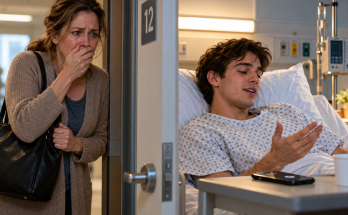
When we were allowed into her room, I saw my daughter lying there small and fragile, wires attached to her chest, an IV in her arm. I took her hand and whispered into her damp hair.
“I’m here. I won’t let anyone hurt you again. I promise.”
Twenty minutes later, I turned to Ethan.
“I have to go to my parents’ house,” I said quietly. “Someone needs to be with her, and you’re better at staying calm than I am.”
Ethan searched my face, seeing the storm behind my eyes.
“Liberty, don’t let them drag you down. Remember why you’re doing this.”
“I remember,” I said. “I’m doing it for her.”
On the drive to my parents’ house, I felt something I’d never felt toward them before. Not disappointment. Not hurt.
Pure, focused rage.
When I rang their doorbell this time, I heard hurried footsteps. The door opened and my dad stood there, eyes widening in surprise. My mom appeared behind him, her expression flickering with confusion—and then something harder.
What shocked me most wasn’t what they said.
It was what they didn’t say.
No “How’s Amelia?” No “Is she okay?” No “What happened?”
Just silence.
I stared at them, waiting. When nothing came, I heard my own voice crack the air.
“Why isn’t anyone asking about Amelia?” I demanded. “Aren’t you worried your granddaughter could have been kidnapped—or worse?”
My mother met my eyes, her face cold.
“I checked the cameras,” she said flatly. “We saw you take her.”
I felt my stomach drop.
“You saw the ambulance,” I said slowly. “And you didn’t think to call to ask if she was okay?”
“The doctors were handling it,” my dad replied, his voice dry, as if we were discussing a missed delivery. “Why should we worry?”
Something inside me fractured.
The argument that followed felt like a dam bursting—accusations, justifications, dismissals. I demanded to know why they’d left my daughter alone.
They admitted they’d taken my younger brother Gavin’s kids, Ashley and Anna, to the supermarket while leaving Amelia behind.
My mother’s voice grew shrill, annoyed at my audacity to question her in her own house.
“Every time Gavin drops his kids off,” she snapped, “he gives us an extra hundred, two hundred bucks. Not just dropping kids off to mooch like you.”
For a moment, the world went silent. My ears rang.
“I’m sorry,” I said softly, my voice trembling. “What did you just say?”
She didn’t hesitate. She screamed it, all the venom she’d been holding back finally spilling out.
“You and your kid are just freeloaders!”
The word slammed into me like a physical blow.
Freeloaders. Me. And my child—lying in a hospital bed because of their care.
I laughed then, a short, broken sound that didn’t feel like it belonged to me.
“Fine,” I said quietly, feeling the last thread between us snap. “Let’s see what this freeloader can do.”
That’s when I saw it—the small metal box mounted on the wall in the hallway. Their security camera drive. The proof.
Without asking, I walked over, opened the box, and took the hard drive out.
My mother shrieked.
“What do you think you’re doing? That’s our property! I’ll call the police!”
My dad stepped toward me, face dark.
“You have no right to take things from my house.”
I held the hard drive tightly, meeting their eyes with a calmness that scared even me.
“I’m taking it,” I said. “For the police.”
For the first time that day, they both looked genuinely afraid.
“You… you called the police?” my dad stammered.
“Yes,” I replied. “And CPS, too. They’ll decide what happens next.”
I walked out of the house I grew up in without looking back.
When I stepped outside, a patrol car was just pulling up to the curb. The two officers who had been at the hospital got out. I handed the hard drive to the male officer.
He frowned slightly.
“Ms. Armstrong,” he said, “technically, taking equipment from someone else’s home without their consent isn’t allowed.”
His partner, the female officer, added carefully, “But since this appears to be evidence in a case involving a child’s safety, we’ll accept it for now. Please step aside so we can speak with your family.”
I nodded. I’d done everything I could.
As I got into my car, one thought settled into my chest like a stone. This was the point of no return. I had just chosen my daughter over my parents, and I would choose her again every single time.
I didn’t cry in the car on the way back to the hospital. It wasn’t because I was strong. It was because there was nothing left in me to spill. The tears were there, but they’d turned into something heavier, thicker—like tar in my chest.
Rage. Shock. A grief that hadn’t even had time to realize what it was grieving yet.
When I walked back into Amelia’s hospital room, the first thing I saw was her tiny chest rising and falling in a slow, steady rhythm. Machines hummed softly. The room smelled like antiseptic and plastic and fear.
Ethan was sitting in the chair beside her bed, elbows on his knees, hands clasped like he was praying, even though he’s never been religious. He looked up the moment he heard me.
“How did it go?” he asked, voice low.
I closed the door carefully, as if any sudden movement might crack me open.
“They called us freeloaders,” I said flatly. “Me and Amelia. That’s what my mother thinks of us.”
Ethan’s jaw tightened. He didn’t say he was surprised. He didn’t say they didn’t mean it. He knew better.
Instead, he looked at Amelia, then back at me.
“Come here.”
I shook my head, needing to keep standing. If I sat down, I wasn’t sure I’d get back up.
“The police are with them now,” I continued. “They have the camera footage. CPS is involved. There’s no going back from this.”
He studied my face quietly.
“Do you regret calling them?”
I thought of Amelia kneeling in that empty pool, sweat dripping from her nose, whispering that she almost finished scrubbing.
“No,” I said, my voice steady. “I regret trusting them in the first place.”
A soft rustling sound broke through the thick silence.
“Mom.”
Amelia’s voice was faint, fuzzy around the edges like she was talking in her sleep. Her eyelids fluttered, and those big brown eyes she got from Ethan blinked up at us.
I was by her side in a second.
“Hey, sweetheart,” I whispered, brushing damp hair away from her forehead. “Hey. I’m here.”
She squinted, disoriented.
“Did I finish the pool?”
The question stabbed me right in the heart.
“You don’t ever have to finish that pool,” I said. “Not now. Not ever.”
Her gaze drifted down to her own hands, wrapped in light bandages. Her fingers twitched, and a tiny wince crossed her face.
“They said it was my punishment,” she murmured. “Because I wasn’t nice enough.”
I bit down on the inside of my cheek so hard I tasted iron.
“Who said that?” Ethan asked gently, pulling his chair closer.
“Grandma and Grandpa,” Amelia whispered. “Ashley and Anna wanted the teddy bear. It was the one on the shelf in the guest room. We all grabbed it at the same time, and I held on too tight. They said I should’ve let my cousins have it.”
Her voice shook on the last words, mimicking my mother’s tone so perfectly it made my skin crawl.
“They’re older than you,” she whispered, repeating it. “Grandma said, ‘You need to learn to give in.’”
“What happened after that?” I asked, keeping my voice as soft as I could.
Amelia swallowed.
“They yelled at me. Said I was selfish. Grandpa said, ‘If you want to be part of this family, you need to help, not cause problems.’ Then they made Ashley and Anna put on their shoes. Grandma said she was taking them for pizza. I asked if I could come.”
Her eyes filled with tears that clung stubbornly to her lashes.
“Grandma said, ‘No. You’re the one causing trouble today, so you stay and clean up the mess.’ Then she pointed at the pool and put the brush in my hand.”
“And they left you there?” Ethan asked quietly.
Amelia nodded.
“They said if I finished before they got back, maybe I wouldn’t be in trouble anymore.”
I felt something splitting inside me—an old familiar tear in my chest where my parents used to live, ripping wider.
“You did nothing wrong,” I said, each word deliberate. “Do you hear me, Amelia? Nothing. Kids fight over toys all the time. That doesn’t make you bad. That doesn’t make you selfish.”
Her eyes searched my face like she was trying to decide whether she was allowed to believe me.
“But Grandma said—”
“I don’t care what Grandma said,” I cut in gently but firmly. “Grandma was wrong.”
There it was—the line that once would’ve scared me to cross. As a kid, my parents were the sun and the moon. What they said was law. To contradict them felt like blasphemy.
Now, sitting beside my daughter’s hospital bed, it felt like oxygen.
Ethan reached over and placed a hand on my back, steady and warm.
“We’ve got you, kiddo,” he told Amelia. “We’re on your side. Always.”
Amelia nodded slowly, her eyelids already growing heavy again. Morphine and exhaustion tugged her back under.
“I’m tired,” she whispered.
“Then sleep,” I said softly, stroking her hair. “We’ll be right here.”
We watched her drift off, her small chest once again rising and falling in a steady rhythm.
When her breathing evened out, Ethan straightened up.
“You should rest too,” he said.
“I can’t,” I replied. “If I close my eyes, all I see is her in that pool.”
He knew there was no point arguing. Instead, he leaned back in the chair, eyes on Amelia, and we sat in silence for a long time.
As the monitors beeped quietly, my mind slid backward, uninvited, to another living room in another time. I remembered being Amelia’s age, sitting cross-legged on the carpet while my mom brought out a tray of roasted chicken—my favorite—calling my brother Gavin in a voice that always sounded just a little warmer when it was for him.
I remembered fishing trips with my dad on Sundays. The way he’d ruffle my hair when I caught something small and tell me, “Not bad for a girl.” Back then, I took that as praise.
Now, in the fluorescent light of my daughter’s hospital room, those memories were stained. Not erased—just revealed for what they really were. Moments of affection always measured against what I could provide, how much I complied, how little trouble I caused.
My mother’s voice echoed in my head again.
“You and your kid are just freeloaders.”
I thought of all the times my phone had lit up with their names over the past few years. Liberty, the AC broke. Can you help us out this month? The roof is leaking, sweetheart. We don’t know what to do. Your father’s medical bills piled up. We’re just a little short, honey.
Every time I’d said yes—without lectures, without conditions.
Three thousand for the roof. Two thousand for the heating system. A thousand here, three hundred there, five hundred there. Gas money, just until next week, just until the check comes. Just until we get back on our feet.
I never kept score. I told myself that’s what children do. You help. You don’t tally.
But now, sitting beside my unconscious daughter, I realized something brutal and simple.
They had been keeping score. I just wasn’t in the lead.
Gavin, my little brother—the golden child—bought them a flat-screen TV, took them on weekend trips, handed them envelopes of cash on holidays. That made him a good son.
I was the one they texted at midnight for emergency help. That made me a freeloader.
I pulled out my phone and opened my banking app. One by one, I started scrolling through old transfers, notes I’d written without thinking. Roof repair. Dad’s medication. Emergency dental. AC replacement.
I started jotting them down on a blank Notes page—dates, amounts, little reminders of every time I’d come through.
By the time I finished a rough list, the total in front of me made my throat tighten.
$15,750.
That was just the amount clearly labeled as borrowed. It didn’t include the smaller don’t-worry-about-it bits, the groceries, the gas, the countless quiet little rescues.
I stared at that number, the coldness of it.
$15,750.
I could hear my mother’s voice layered over it.
“You and your kid are just freeloaders.”
For a moment, I considered deleting the list, pretending I hadn’t added it up, going back to being the daughter who doesn’t count, who forgives everything because that’s what good children do.
Then I looked at Amelia—her bandaged hands, the faint redness still lingering on her cheeks, the IV taped to her arm—and something clicked into place.
If they saw me as a burden, I would show them what it really meant for me to step away. Not out of spite, but out of self-respect, and for my daughter’s sake.
“This isn’t about the money,” I whispered, more to myself than to Ethan.
“What is it about?” he asked.
“It’s about the story they tell themselves,” I said slowly. “They get to hurt my daughter, call us freeloaders, and still think they’re the victims. I won’t let them keep that narrative.”
He nodded, understanding.
“So what are you going to do?”
I took a breath.
“I’m going to call David.”
David Morrison—my old college friend who’d gone into law while I went into accounting. We’d stayed in touch: holiday messages, the occasional coffee when our schedules lined up. I thought about his last text from a year ago.
If you ever need help with anything legal—property, family stuff, whatever—just call me, Lib. No questions asked.
At the time, I’d replied with a laughing emoji and a joke about hoping I’d never need him.
Now my thumb hovered over his name, and a strange calm washed over me. Not happiness. Not relief.
Direction.
For the first time since this nightmare started, I knew exactly what my next step was.
“I’m going to get back every dollar I lent them,” I said quietly. “Every documented cent. They don’t get to call me a freeloader while holding my money.”
“And after that?” Ethan asked.
I looked at Amelia.
“After that,” I said, “they’re just strangers who used to be my parents.”
Later that night, when the hospital quieted and the hallway lights dimmed, I stepped outside Amelia’s room to make the call.
David answered on the second ring, his voice warm and casual.
“Liberty. Wow, it’s been a while. What’s up?”
I stared through the small hospital window at my daughter’s sleeping form.
“I need a lawyer,” I said. “And I need you to help me make sure my parents never get to pretend they did nothing wrong.”
There was a beat of silence on the other end. Then David’s tone shifted—professional, focused.
“Tell me everything.”
And I did—every word dripping with the knowledge that from this point on, this wasn’t just a family tragedy.
It was a case.
And I was done being the quiet daughter who forgave everything and asked for nothing.
David didn’t interrupt me once. He listened as I relived every moment—from the moment we dropped Amelia off, to seeing her collapsed in the empty pool, to my mother screaming that word at me.
When I finally stopped talking, the only sound on the line was David’s slow, controlled exhale.
“Liberty,” he said carefully, “this isn’t just neglect. What they did to Amelia crosses into criminal territory. Heatstroke, chemical exposure, abandonment. Any one of those is bad. All of them together…”
He paused.
“You did the right thing calling the police and CPS.”
Hearing that from a lawyer—a friend, but a professional—felt like someone finally validated the screaming voice inside me.
“I have documented transfers,” I told him. “Messages, emails—everything I lent them.”
“Good,” he said, already shifting into legal mode. “Send me everything you have. I’ll review it before morning. Based on what you described, I can file a formal demand letter within forty-eight hours.”
“A demand letter?” I asked.
“It’s a legal request for repayment,” he explained. “Once delivered, they’ll have thirty days to pay you back. If they refuse, we move to civil court. And trust me—given the police investigation, they won’t want another legal case hanging over them.”
“And the amount… it’s $15,750,” I said, feeling strangely embarrassed by the precision.
“Every dollar counts,” David replied firmly, “especially when someone has the nerve to call you a freeloader.”
His tone sharpened on the last word. It made me feel seen in a way my own parents never had.
“I’ll take care of this,” he added. “You focus on your daughter.”
When the call ended, I stood in the empty hallway for a long moment, staring at the cold glow of the hospital lights.
For the first time in forty years, I wasn’t trying to protect my parents’ feelings. I wasn’t smoothing anything over. I wasn’t swallowing my pain.
I was choosing myself—choosing Amelia—and it felt like breathing for the first time.
The next morning, as sunlight crept through the blinds of Amelia’s room, two police officers returned—this time with more paperwork, more questions, and a tone that suggested things had shifted overnight.
The female officer, the one with the kind eyes, spoke gently.
“We reviewed the footage on the hard drive,” she said. “We’re also coordinating with child protective services. We want to make sure Amelia receives every protection she needs.”
My chest tightened.
“What did the footage show?”
She exchanged a glance with her partner.
“It shows everything,” the male officer said bluntly. “The argument over the teddy bear. The scolding. Your parents giving instructions for her punishment. The pool cleaning, the chemicals, them leaving the property with the other two children.”
I felt the room tilt slightly, like gravity was shifting under my feet.
“They left her alone with toxic pool cleaner?” Ethan asked, disbelief shaking his voice.
“Yes,” the officer confirmed. “And the footage matches your daughter’s account exactly.”
The female officer added, “We’ve issued a request that your parents remain at their residence until further notice. CPS is filing for a temporary restraining order to protect Amelia during the investigation.”
A restraining order.
It was surreal to hear the law say, in formal terms: your parents are dangerous to your child.
“Can they come to the hospital?” I asked, though the idea made the hair on my arms rise.
“No,” she replied. “And they won’t be allowed to approach Amelia once the restraining order is approved.”
I nodded slowly. Part of me expected to feel sadness. But what I felt was relief.
A clean cut is better than a festering wound.
Later that day, after Amelia fell asleep again, I left Ethan in the room and drove to David’s law office. My hands shook slightly as I passed him the stack of printed bank transfers, text messages, and emails.
He spread everything across his desk, his face tightening more with each page.
“Your documentation is solid,” he said. “They can’t claim these weren’t loans. You made it clear every time.”
He circled the total with a pen.
“$15,750,” he repeated. “They’ll have thirty days to pay. If they don’t, I’ll file a civil lawsuit. The court won’t be sympathetic toward them. Not after CPS gets involved.”
“What about the criminal investigation?” I asked.
David sighed.
“That’s separate, but from what you described, prosecutors won’t take this lightly.”
A strange heaviness settled in my rib cage. They were my parents, but they were also the people who left my daughter to collapse alone in the sun with toxic chemicals.
For once, both things were true at the same time.
Two days later, David called me.
“It’s done,” he said. “The letter has been delivered. Certified mail. They’ll receive it today.”
I thanked him, but my voice felt thin.
“What happens next?” I asked.
Click Here to continuous Read Full Ending Story👉 Part2: My daughter was s!ck, cleaning a pool alone while my family part!ed. The moment my mother insulted us, I showed the pr00f they prayed I didn’t have…
My daughter was s!ck, cleaning a pool alone while my family part!ed. The moment my mother insulted us, I showed the pr00f they prayed I didn’t have…
Part 1 of 2