
I sat in the back.
Vanessa wore tailored black, minimal jewelry, perfectly arranged hair. Her grief looked curated. When she noticed me, her expression flickered—not sorrow, but calculation.
After the service, she approached.
“Emily,” she said gently, resting a manicured hand on my arm. “I know this must be hard for you.”
Her perfume was heavy.
“I’ll make sure you’re taken care of,” she added. “I’m generous like that.”
I didn’t argue. I didn’t remind her how quickly she’d replaced me.
I simply said, “You always did like the spotlight.”
Her smile thinned.
A week later, we gathered at Daniel’s longtime law firm overlooking Central Park.
Vanessa sat at the head of the conference table as if she already chaired the board.
“Let’s begin,” she said when the lawyer entered. “I have meetings.”
Routine bequests came first.
Millions to charity. Bonuses to staff.
Vanessa barely paid attention.
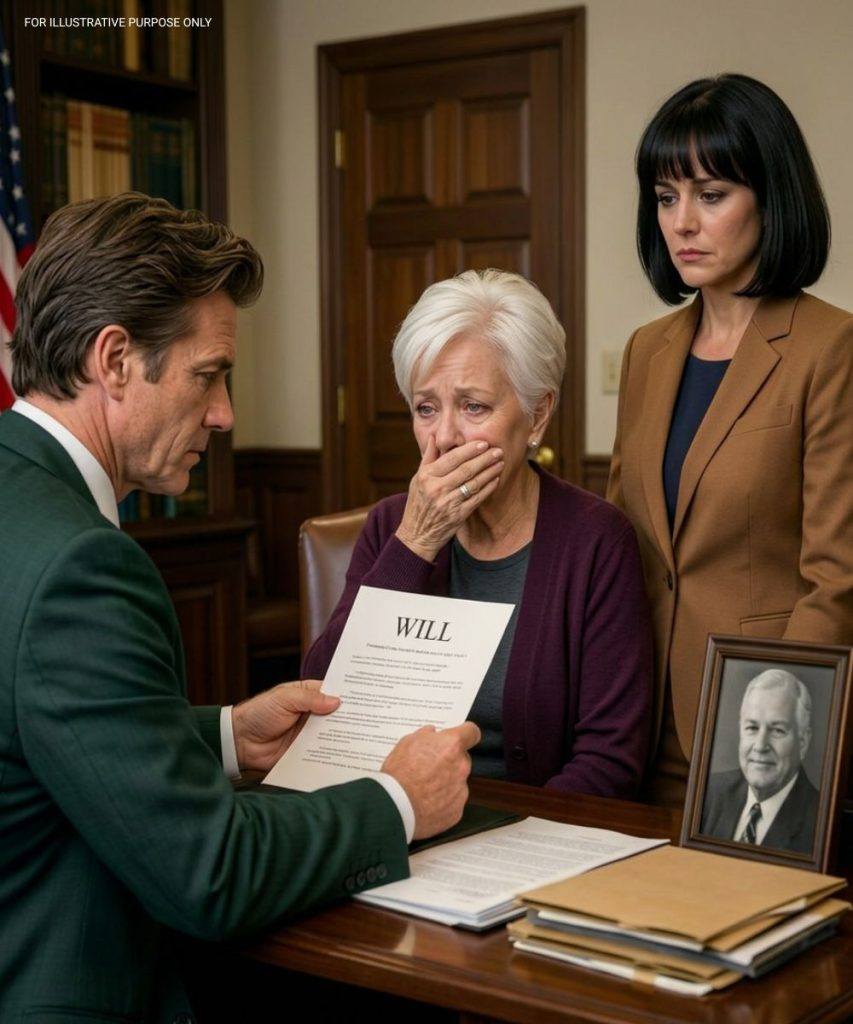
Then the lawyer unfolded a letter.
“To my wife—yes, my wife, though the law may disagree—”
Vanessa stiffened.
“My marriage at the end of my life was a mistake recognized too late. It was entered under deception, pressure, and greed.”
Her hand struck the table.
“To my former wife, the only person who loved me when I had nothing—”
Vanessa’s head turned sharply toward me.
“The entirety of my estate has been placed into a protected trust,” the lawyer said evenly. “The beneficiary is Ms. Emily Hartwell.”
My former name.
Vanessa stared in disbelief.
“I’m his legal wife.”
“You will receive what the law requires,” the lawyer replied.
He turned a page.
“One dollar.”
The silence was absolute.
“There is also a condition,” he added. “If the current spouse contests the will, all remaining legal entitlements are forfeited, and documentation in Appendix C will be released to the appropriate authorities.”
Vanessa went pale.
She knew something.
She left without another word.
When the room cleared, the lawyer handed me a smaller envelope Daniel had requested I receive privately.
Inside, a note.
I betrayed you. I can’t undo that. But I can prevent my final mistake from destroying what decency I have left.
I felt no triumph.
Only closure.
Vanessa never contested the will.
She couldn’t.
Within months, the penthouse was gone. The SUV disappeared. Invitations stopped.
The headlines faded.
I returned to Connecticut for a while. Sat on my parents’ porch. Listened to cicadas at dusk. Remembered who I had been before money complicated everything.
Two months later, Vanessa called.
Her voice no longer sounded bold.
She came to Connecticut. Drove herself.
Her designer clothes looked worn. Her eyes were tired.
She wanted to know what was in Appendix C.
“I’ve never opened it,” I told her.
Fear crossed her face.
Gradually, the truth emerged.
She had moved twenty-two million dollars from Daniel’s personal accounts. Framed as investments. Tax positioning. He discovered it. He planned to annul the marriage on grounds of fraud.
She claimed she hadn’t meant harm. That she’d introduced him to questionable “health consultants.” That she hadn’t known about his minor heart condition.
Whether ignorance or recklessness, the damage was real.
“I need protection,” she said finally.
“I won’t open Appendix C,” I told her. “But I won’t shield you either.”
She left smaller than she had ever seemed.
I later confirmed with the lawyer: Appendix C contained documentation of the financial transfers and investigative reports. No evidence of foul play in Daniel’s death. Only proof of manipulation.
I kept it sealed.
Instead of revenge, I built forward.
The Hartwell Innovation Grant funded scholarships and cardiac research. The money became a tool, not a symbol.
Months later, authorities began investigating Vanessa over offshore accounts. Not because of Appendix C—but because her own associates were careless.
She avoided prison through restitution, but the money was gone.
Debt replaced luxury.
Years passed.
I saw her once in a grocery store in Connecticut. No couture. No sunglasses.
“Why didn’t you open it?” she asked.
“Because I didn’t need to.”
“You would have ruined me.”
“You ruined yourself.”
She nodded.
“I always thought winning meant taking,” she said.
“That was the mistake,” I replied.
On the anniversary of Daniel’s death, I visited his grave. I told him I hadn’t expected him to choose me in the end.
But he had.
Not with affection.
With preparation.
Four hundred million dollars felt less like victory and more like responsibility.
Daniel’s final act wasn’t revenge.
It was foresight.
Vanessa eventually left the state. No headlines. No dramatic comeback.
Just quiet.
Appendix C remains sealed in a Manhattan vault.
Unopened.
Because sometimes the strongest move isn’t exposure.
It’s restraint.
What was never hers
was never truly lost.
And I sleep well knowing that.
My ambitious sister married my ex, convinced she’d inherit his $400 million empire. Days later, he di:ed unexpectedly. After the funeral, she claimed everything as his widow until the will was read. What he’d arranged sh0cked the room and left her utterly speechless.
Part 2 of 2


One Comment on “Part2: My ambitious sister married my ex, convinced she’d inherit his $400 million empire. Days later, he di:ed unexpectedly. After the funeral, she claimed everything as his widow until the will was read. What he’d arranged sh0cked the room and left her utterly speechless.”