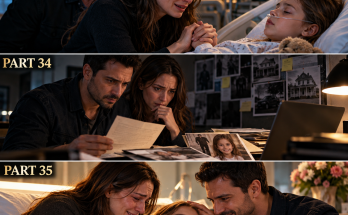
I leaned into her and hugged her. For the first time in six years, I could smell her hair without the smell of glass, metal, or distance. It smelled like cheap prison soap. And yet, it smelled like home.
Freedom arrived on a gray Tuesday. There was no music. No giant door opening with divine light. There was a judge reading for forty-seven minutes. He spoke of due process violations, fabricated evidence, withholding of proof, coerced testimony of a minor, deficient forensics, and nullity of the conviction. I was only waiting for two words. Finally, he said them: —”Immediate release.”
Matthew jumped up. —”Now?” The judge looked at him over his glasses. For a second, I thought he was going to scold him. But he only said: —”Yes, kid. Now.”
My mom didn’t move. As if she didn’t understand. As if the word “freedom” was a language she had forgotten. The guard approached to take off her handcuffs. She looked at her bare wrists. Then she looked at me. Then at Matthew. And she broke. She fell to her knees right there, in front of everyone. —”Ernest,” she whispered. “It’s done.” She didn’t say “I won.” She didn’t say “I’m free.” She spoke to my dad. As if for six years she had lived promising him she wouldn’t die before clearing his name.
Matthew ran to her. I did too. We hugged on the courtroom floor, the three of us crying, while cameras flashed outside and lawyers gathered folders. Justice, when it arrived, didn’t make a glorious noise. It made the noise of a mother breathing without handcuffs.
Going home was harder than seeing her come out. Because the house was no longer ours. Legally it was in dispute, secured by the prosecutor’s office as a reopened scene. Ray had changed floors, sold my mom’s wardrobe, painted the kitchen a horrible color, removed my dad’s photos, and turned my room into a storage space. But on the hallway wall, there were still pencil marks where my dad measured our height. Valerie, 10 years. Valerie, 12. Matthew, 1 year.
My mom touched the marks with her fingers. —”I thought I’d never see this again.” Matthew pointed to the kitchen. —”Is that where Dad died?” My mom closed her eyes. —”Yes.” —”Can we put a plant there?” The question disarmed us. —”A plant?” I said. —”Yes. So it’s not just where he died. So it’s where something grows.” My mom hugged him. —”Yes, my love. We’ll put a plant.”
We couldn’t move in right away. During that time we lived in a borrowed apartment. My mom had nightmares. She would wake up screaming when she heard keys. She couldn’t sleep with the door closed, but couldn’t sleep with it open either. She saved food in napkins like in prison. She asked permission to bathe. One day I found her sitting in front of a cup of cold coffee.
—”Mom, what’s wrong?” —”I don’t know what to do with the mornings,” she said. —”How so?” —”In prison, everything had a time. Waking up. Eating. Counting. Sleeping. Here the morning is loose. I’m afraid of wasting it.” I sat with her. —”We can start with something small. Like making eggs.” —”What if I burn them?” —”Then we eat bread.” She laughed for the first time. Not a big laugh, but a real one. That day she burned the eggs. We ate bread. And it tasted like freedom.
Matthew changed too. He stopped wetting the bed, but he started getting angry at everything. If someone touched his bear, he’d scream. If a man raised his voice near Mom, he’d stand in front of her like a guard. In therapy, he said his job was to prevent the people he loved from being killed. He was eight. No child should have that job.
One afternoon, after a crisis, Mom knelt in front of him. —”Matthew, look at me. You saved me, but you are not my guard. You are my son. Your job is to get your shoes dirty, do your homework reluctantly, and ask for double ice cream.” Matthew cried. —”What if my uncle comes back?” —”He’s not coming back.” —”But I’m the man of the house.” My mom took his face. —”No. You are the child of the house. And that is much more important.”
I listened from the door and understood that freedom wasn’t just getting Mom out of prison. It was getting Matthew out of the fear. It was getting me out of the guilt. It was getting my dad out of the file where they had left him as a husband murdered by a jealous wife.
The trial against Ray started a year later. By then, my mom no longer wore the white uniform, but she still walked with tense shoulders. She cut her hair, started wearing colorful blouses, and got a job helping in a school kitchen. She said she liked hearing kids fighting over jello because it reminded her the world was still alive.
I studied law at night. I didn’t plan it. But after seeing how poorly made papers almost killed my mother, I wanted to learn to read every word that could save or sink someone. The day I testified against Ray, he tried to smile at me. —”Val, niece…” —”Don’t call me that.”
The judge asked him to remain silent. I spoke about the night of the murder, the years under my uncle’s guardianship, the veiled threats, the money he managed, the times he tried to convince me not to visit Mom because “it only reopened wounds.” I spoke. This time I told everything. Then Matthew testified via video recording. My little brother told what he saw, what he heard, the knife, the closet, the drawer, the dog Bruno.
When he finished, the judge called a recess. Even he needed air. My mom testified last. Ray wouldn’t look at her. She looked at him. —”You killed your brother,” she said. “You buried me alive. You stole Matthew’s childhood. You put guilt into Valerie. You used Ernest’s last name to keep what belonged to his children. I don’t know what punishment is enough for that, but I do know one thing: I am not afraid of you.”
Ray looked up for the first time. —”Teresa, I lost my brother too.” My mom leaned toward the microphone. —”You didn’t lose him. You left him bleeding in the kitchen.”
She said no more. She didn’t need to. The evidence was overwhelming. Ray was found guilty. First-degree murder, fabrication of evidence, threats, obstruction of justice, financial theft. Ray listened without moving. Salazar received another sentence in a parallel process. Several police officers were investigated. Some fell. Others, as happens so often, just retired early. That part left me angry. Justice was never complete. But at least it was no longer standing on my mother’s body.
When we left the court, a reporter asked Mom: —”Can you forgive your brother-in-law?” Mom looked at her with weariness. —”I didn’t come to forgive. I came to live.”
Recovering the house took more time. When they finally handed us the keys, the three of us went alone. The door creaked as it opened. The air smelled of dust, moisture, and abandonment. In the kitchen, there was still a dark stain in a corner of the floor that no one could completely remove, though they said it was no longer blood—it was just moisture, it was old.
Matthew entered with a pot. A rue plant he chose himself. —”For Dad,” he said. He put it by the kitchen window. My mom lit a candle. I placed a photo of my dad on the shelf. Not the one from the funeral. One where he was laughing, with engine grease on his cheek and baby Matthew on his shoulders. —”Forgive me,” I whispered in front of the photo. My mom hugged me from behind. —”Enough now, sweetheart.” —”I don’t know how.” —”Then we do it together. Every time you blame yourself, you help me remember I’m here. And every time I feel dead, you remind me I’m out.” Matthew raised his hand. —”And me?” Mom smiled. —”You remind us to water the plant.”
We started with a plant. With empty walls. With a kitchen that ached. With a new wardrobe, because the old one had been sold, but with the secret drawer rebuilt by a carpenter friend of my dad’s. Not to hide evidence. To keep letters. Mom put all the letters she wrote from prison in there. I put in the ones I never answered, because even though they were blank, they also said something. Matthew put in the plastic bag where he had kept the key. —”So the truth doesn’t get lost again,” he said.
Sundays became sacred. Not for church, though Mom went sometimes. Sacred for food. Mom cooked soup, rice, enchiladas, whatever she could. At first, she burned things or cried mid-recipe. Then she started remembering flavors. One afternoon she made the mole my dad loved and we all went quiet when we tasted it. —”It needs salt,” Matthew said. I looked at him horrified. Mom let out a laugh. A loud, open, almost scandalous laugh. —”Your dad used to say the same thing.” The three of us laughed until we cried. That was the day the house stopped feeling like a crime scene and started feeling like a wounded home.
Life didn’t settle all at once. My mom never got the six years back. Matthew never went back to being a child without shadows. I never stopped feeling a sting when I saw news about unjust convictions. But we learned to live with the truth without it crushing us.
Mom sued the State. Not out of ambition, but because Lucy told her something that stuck with us: “An apology without reparation is just a pretty phrase.” The process was long. Finally, there was a public hearing. The Attorney General read an institutional apology. He spoke of failures, omissions, irreparable harm. He didn’t say “we wanted to kill her while she was innocent,” but we all understood.
Mom stood up. —”I accept the apology,” she said, “but I do not accept that you call ‘failures’ what was abandonment. You convicted me because it was easier to believe a wife killed her husband than to investigate men with power. You let my children grow up with fear. You denied my husband justice. If my son hadn’t spoken minutes before, today you would be apologizing in front of a grave.” No one applauded at first. Then a woman in the back stood up. Then another. Then the whole room. Mom didn’t smile. She just took Matthew’s hand and mine. Sometimes dignity doesn’t need to smile.
With part of the reparation money, Mom opened a small diner next to Dad’s old shop. She called it “The Second Life.” I told her it sounded dramatic. She replied: “Dramatic was almost dying. This is marketing.” Matthew designed the sign: a blue key, a pot, and a spoon. On the wall we hung a phrase: “Food served here to those still learning how to return.”
Neighbors, workers, students, and journalists came by occasionally. Mom hated interviews but loved feeding people. She said in prison one learns that a hot plate of food can keep a person alive. One day an older man in a hat walked in. He stared at my dad’s photo on the wall. —”I knew Ernest,” he said. “He fixed a truck for me without charging me full price. Good man.” Mom came out of the kitchen. —”He was.” The man took off his hat. —”I’m sorry for believing what they said.” Mom took a deep breath. —”Everyone believed.” —”Not everyone should have.” She served him coffee. —”Sit down. Coffee helps with the shame, too.”
That was my mom now. Not soft. Not bitter. Something stronger. Like clay that breaks, gets wet, and hardens again into another shape.
Matthew turned ten at the diner. We invited his classmates, Lucy, Lawyer Escobedo, the psychologist, and neighbors who were there and others who wanted to make up for their absence. Mom made him a chocolate cake. Before blowing out the candles, Matthew asked us to turn off all the lights. —”Like when the power went out at home and Dad lit candles,” he said. I didn’t remember that. Mom did. Her eyes filled with tears. We turned off the lights. The candles lit up his face. Matthew closed his eyes. —”I wish that no one ever hides knives under beds again,” he said. Everyone went still. Then he added: —”And an Xbox.” The tension broke. We laughed. Mom hugged him. —”We’ll look into the Xbox. The knife thing, promised.”
That night, after the party, I found Mom in the diner kitchen, washing dishes alone. —”I’ll help you.” —”No. Sit down a bit.” I sat. She kept washing. —”I dreamed of your dad today,” she said. —”Nightmare?” —”No. He was in the shop. He was telling me to stop fighting with the blender because I was never going to win.” I smiled. —”That sounds like him.” —”Then he said: ‘You guys are okay now.’” Her voice cracked. —”And are we?” I asked. Mom turned off the faucet. —”Not like before. But yes, in another way.” She dried her hands and looked at me. “Valerie, I want you to stop visiting me in your guilt.” —”I don’t know if I can.” —”You can start by visiting me in the kitchen. In the diner. In the mornings. In living things. I don’t want to get back a daughter who looks at me like a pending sentence. I want my daughter.” I cried. —”I was afraid of believing in you and being wrong.” —”And I was afraid of them killing me knowing you doubted.” That sentence hurt. But she didn’t say it to wound me. She said it because there was no room for lies between us anymore. —”How do you heal that?” I asked. Mom sat in front of me. —”With time. With truth. With beans if necessary.” I laughed through my tears. —”You fix everything with food.” —”Not everything. But it helps.”
Three years passed. I finished my law degree with a thesis on fabricated convictions and contaminated evidence. I dedicated it to my mom, my dad, and Matthew. On the day of my bar exam, Mom arrived in a yellow dress. Yellow. After years of seeing her in gray, beige, prison white, and mourning black, seeing her in yellow almost made me cry before I even started. Matthew wore a blue tie and had the bear in his backpack, even though he said he was too old for that. When I passed, Mom screamed: “That’s my girl!” In the room, everyone turned around. I laughed.
After the exam, we went to the cemetery. I took my diploma and placed it for a moment on Dad’s grave. —”We did it,” I said. Mom arranged flowers. Matthew placed a small wooden key he had carved himself. —”So you don’t have to hide anything anymore, Dad.” The wind moved the trees. I don’t believe the dead answer like in movies, but that day the air felt less heavy. Mom stayed in front of the grave for a long time. —”Ernest,” she said, “I promise you I’m not going to live just defending your death anymore. I’m going to live what we missed out on, too.”
The next month she signed up for dance classes. Matthew almost died of embarrassment. —”Mom, please, don’t do TikToks.” —”I don’t even know what that is.” —”Better.”
The first time she danced at a neighborhood party, everyone watched her carefully, as if she were made of glass. She realized it, stopped the music, and said: “Don’t look at me like a martyr. Get a partner or get out of the way.” She danced three songs. Then she got tired and sat down laughing. That image stuck with me more than the white uniform. My mom, alive, sweaty, hair messy, bossy. My mom returning to herself.
The last chapter with Ray came five years after the stay of execution. He died in prison. A heart attack. The news reached us through Escobedo. Mom was making rice. She went still with the spoon in her hand. —”Do you want to sit down?” I asked. She shook her head. —”No.” Matthew, now a teenager, asked from the table: —”How does it feel?” Mom thought. —”Not pleasant.” —”Sadness?” —”I don’t know if it’s sadness. Not joy either. It’s strange when someone who hurt you so much dies. You expect to feel peace, but sometimes you just feel tired.” I asked: —”Do you want to go to the funeral?” Mom looked at me like I’d said something crazy. —”No.” Then she added, “But I don’t want anyone to celebrate either.” Matthew lowered his head. —”I thought about celebrating.” Mom went to him. —”It’s normal. But let’s not give that man any more parties, not even out of hate.”
Ray was buried with almost no one there. Salazar was still in prison. Dad’s shop, after years of litigation, finally returned legally to our name. We rented it to a young mechanic who had been my dad’s apprentice. At the entrance we put a plaque: “Ernest Mendoza. Honorable man. Beloved father. The truth arrived late, but it arrived.” Mom cried when she saw it. Matthew didn’t. He touched it with his fingers and said: “Dad finally has his sign.” Children sometimes simplify the sacred.
Now ten years have passed since that night at the prison. Matthew is eighteen. He’s taller than me, studying psychology, and says he wants to work with children who keep secrets that are too big. He still keeps the blue teddy bear, though it’s on a shelf, not the bed. Sometimes he looks at it before sleeping. Not with fear anymore. With respect.
Mom has gray hair, wrinkles, and a laugh that sounds like a boiling pot. The diner is still open. On Thursdays she gives away food to relatives of prisoners waiting outside the prison, because she says she knows what it’s like to sit on a sidewalk not knowing if the world remembers you.
I work with Lucy in the defense of wrongfully convicted people. Every time I review a file and see a proof that’s too perfect, a confession that’s too convenient, a relative who gains too much from the tragedy, I remember the knife under the bed. I remember my sin. And my reparation.
One December afternoon, Mom gathered us at the house. She had set the table with mole, rice, tortillas, and hibiscus tea. In the center was the rue plant Matthew brought to the kitchen the day we got the house back. it was huge now, overflowing the pot. —”We have to transplant it,” Matthew said. “It doesn’t fit anymore.” Mom smiled. —”That’s what I wanted to tell you.” —”That the plant got fat?” I asked. —”That we don’t fit in the fear anymore either.”
She took us to the yard. She had prepared a spot in the dirt. —”We’re going to put it here. Where it gets sun.” Matthew carried the pot. I moved the dirt. Mom held the roots carefully. Together we planted it. When we finished, Mom reached into her apron pocket and pulled out something wrapped in cloth. It was the old key. The key to the secret drawer. The one that saved her life minutes before they took it away. —”I think it shouldn’t be kept away anymore,” she said. Matthew looked at her. —”Are you going to throw it away?” —”No. I’m going to bury it here. So it remembers it opened a truth, but we don’t need to live locked inside it anymore.”
It seemed perfect. We made a small hole next to the rue. Mom put the key inside. Matthew covered it with dirt. I put a white stone on top. The three of us stood in silence. It wasn’t a funeral. It wasn’t a celebration. It was something else. A rest.
Mom took our hands. —”I was going to die,” she said. “You were going to be left with a lie for a last name. Your dad was going to be left without justice. But we are here.” Matthew swallowed hard. —”Sorry for being late, Mom.” She hugged him. —”You arrived in time.” I started to cry. —”Sorry for doubting.” Mom pulled me into the hug. —”You came back in time.” —”And Dad?” Matthew asked. Mom looked toward the kitchen, where his photo was. —”He waited for us in time.”
We laughed while crying. Because it didn’t make much sense, and at the same time, it had everything. That night we ate dinner in the yard. The newly planted rue swayed in the wind. Mom served Matthew’s plate first, then mine, then hers. Then, as she had done since we got the house back, she put a small empty plate in the center of the table. Not for sadness. For memory. Dad’s plate. At first it seemed painful to me. Now it was part of us. A way of saying death doesn’t take someone’s place when the truth keeps naming them.
Matthew raised his glass. —”To Mom.” I raised mine. —”To Dad.” Mom raised hers. —”To the children who gave me my life back.” —”You gave it back to us first,” I said. Mom shook her head. —”No. Life isn’t given back like a loan. It’s shared.”
After dinner, Matthew stayed to wash dishes. I helped Mom put away the mole. —”Are you happy?” I asked her suddenly. She looked at me surprised. —”What a big question for someone who’s sleepy.” —”Answer me.” She leaned on the table. —”I am free. Sometimes that looks a lot like happiness. Sometimes not. But it’s mine.” —”What if you could erase everything?” Her face changed. —”I would erase your dad’s death. I would erase Matthew’s fear. I would erase your years of guilt. But I would not erase the truth. Because without it, we would still be living a life Ray wrote for us.” She looked toward the yard. “I prefer this one. Broken, but ours.”
That night I stayed in my old room. The same one where my dad kissed my forehead for the last time. Before sleeping, I opened my nightstand drawer and pulled out a letter. It was one of the first ones Mom wrote me from prison. I had read it so many times the paper was soft.
“Valerie: If one day you doubt me, don’t punish yourself. Doubting is human when everyone pushes you toward the lie. I only ask that you don’t close the door forever. Leave it a little bit open. The truth can enter through there. Love, Mom.”
For years that letter gave me shame. Now it gave me strength. I folded it and put it away. From the window I saw Mom in the yard, covering the rue with a blanket because it had started to get cold. Matthew was by her side, saying something that made her laugh. The scene was simple. A mother. A son. A plant. A house. Nothing extraordinary. And yet, after everything, it was a miracle.
I thought of that afternoon at the prison. Of the white uniform. Of the clock running. Of Matthew saying in a trembling voice that he knew who hid the knife. Of the warden raising his hand. Of the execution stopped by a child who finally was able to speak.
People think truth arrives like a lightning bolt. Sometimes it arrives as a whisper in the ear of a condemned mother. Sometimes it brings an old key in a plastic bag. Sometimes it trembles, cries, takes six years, and still manages to knock on the door before it’s too late.
I turned off the light. For the first time in a long time, I didn’t dream of knives. I dreamed of a kitchen full of sun. My dad was cutting lemons. My mom was making rice. Matthew was running with the blue bear. And I, younger, was walking in asking if the food was ready. My dad looked at me and said: “Almost, Val. But wash your hands first.”
I woke up crying. But it wasn’t a bad cry. It was one of those that cleanses. I went down to the kitchen. Mom was already awake, making coffee. —”Did you have another bad dream?” she asked. I shook my head. —”I dreamed of Dad.” She served me a cup. —”Then it wasn’t bad.”
We sat by the window. The rue in the yard was waking up covered in droplets. Matthew came down with messy hair, dragging his feet. —”Is there breakfast?” Mom smiled. —”There’s always breakfast.”
And that phrase, so small, so homey, made me understand that we had survived. Not because justice was good. Not because the pain was gone. Not because the past was fixed. We survived because a hidden key opened a drawer, because a child spoke, because a mother resisted, because a daughter returned, because a father left proof before dying, and because, in the end, the biggest lie couldn’t beat a broken family that decided to tell each other the truth.
Mom put three plates on the table. This time none was left empty. Outside, the morning entered slowly. And I thought that maybe freedom was just that. Not a judge. Not an apology. Not a news story. But an innocent woman serving coffee in her own kitchen, while her children, finally, could call her mom without being afraid to say goodbye.
bcdu My new husband’s daughter disrespected me right in front of my family. When I spoke up, he immediately shut me down: “She’s not your daughter. Don’t parent her.” I just smiled… and the next morning, I quietly pulled back every bit of support — college, the car, and everything else.
Part 2 of 2