Also a strange sense of satisfaction.
Two weeks later, Ernesto summoned me to a discreet café in Chamberí. He arrived in his dark suit with a folder thicker than the previous one.
“This is enough,” he said, without even asking me to sit down. “My lawyers are already working. There will be a surprise inspection from the tax authorities and another from the Economic Crimes Unit.”
“And me?” I asked. “What will happen to me when everything explodes?”
Ernesto looked at me the way one looks at a tool that has worked even better than expected.
“When this is over, you’ll be free,” he replied. “You’ll have enough money to never go back to a bridge. And if you’re smart, no one will ever know who you really are.”
I nodded, but didn’t move.
“I want one more thing,” I said.
He raised an eyebrow.
“I want to be there,” I added. “I want to see when they find out.”
There was a moment of silence.
Then Ernesto smiled for the first time since we had reunited.
“You’re more like me than I thought,” he murmured. “Fine. I’ll arrange it.”
The fall came quickly.
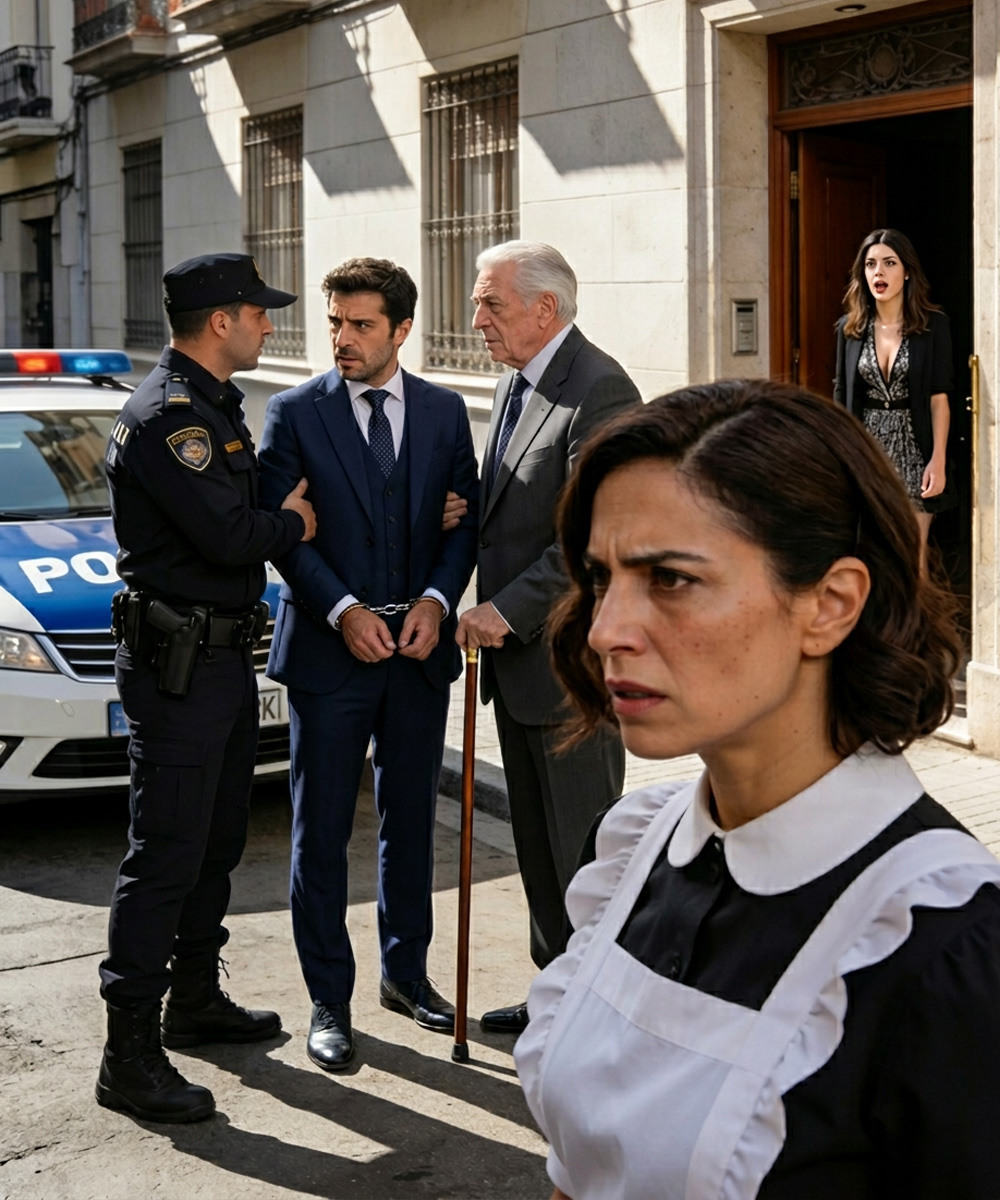
One morning at eight, the apartment doorbell rang. When I opened it, six people were standing there: two tax inspectors, two plainclothes police officers, and two officials. They asked for Javier. I led them into the living room, my hands trembling just enough to make everything seem natural.
From the kitchen I heard raised voices, papers hitting the table, Javier’s incredulous tone, Lucía’s calculated indignation.
Then hurried footsteps toward the office.
Drawers opening.
More voices.
By noon, Javier came out in handcuffs.
Lucía shouted that it was a mistake, that everything was in order, that they would speak to their lawyer. The neighbors watched from half-open doors.
Ernesto appeared then, impeccable, leaning on his cane, as if he had just happened to pass by.
“Javier,” he said when their eyes met. “I’m sorry.”
There was no surprise in his eyes.
Only cold calm.
I stood behind them, wearing my apron, watching the scene. No one noticed the maid “Ana.” No one saw how, for a second, my gaze met Lucía’s.
There was a flash of recognition—a doubt in her eyes.
“Do I know you from…?” she began.
But the police car took Javier away and the moment broke.
Two months later, Javier was in pretrial detention. The media spoke of the “De la Torre scandal,” of the son who tried to empty his father’s company. Lucía, also under investigation, fought to avoid going down with him. Ernesto, meanwhile, appeared in the news as the veteran businessman cooperating with authorities to “clean up his company.”
I lived in a small apartment in Carabanchel, this time under my real name. I had money in the bank, new clothes, and a job contract with another cleaning company that I almost never visited because Ernesto paid me for my “availability.”
We met one last time in his office at the company headquarters overlooking the Castellana.
“It’s done,” he said, signing a document. “My new will. Javier is effectively disinherited. Lucía… no longer exists for me.”
“And me?” I asked.
He handed me an envelope.
“Inside is what I promised you,” he said. “And something more. Shares in one of my subsidiaries. You won’t be as rich as I am, but you’ll never sleep under a bridge again.”
I put the envelope away without opening it.
“Do you regret it?” I asked then, without quite knowing why.
Ernesto rested his hands on the desk.
“I did what I had to do,” he said. “Just like you.”
I walked out into the street, the Madrid sun hitting my face. I opened the envelope on a stone bench. Bills, documents, numbers.
An entire future folded into papers.
I thought about Javier in his cold cell. About Lucía trapped in lawyers and trials. About the María from two years earlier, crying with a suitcase in her hand while her husband told her he had fallen in love with her best friend. About the María under the bridge, invisible.
None of that existed anymore.
I had chosen a dangerous role and played it to the end. I didn’t feel like a hero or a victim.
Just someone who had learned to use the place where others believed she was dead.
I put the envelope away, stood up, and began walking along the Castellana among executives and tourists. No one knew who I was.
No one knew what I had done.
And for the first time, that invisibility belonged to me.