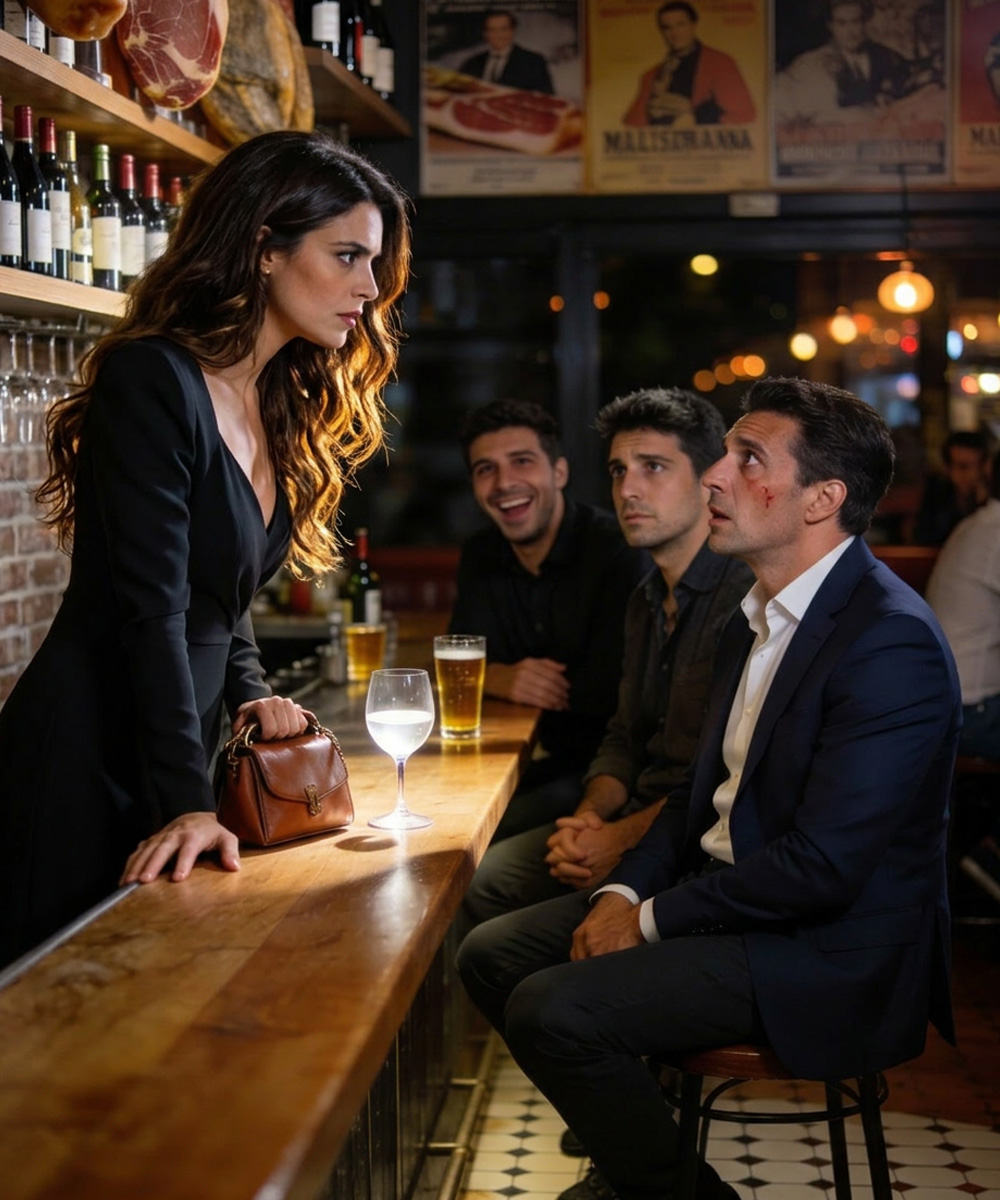
His eyes locked onto mine, for the first time without arrogance.
“Diego?” he asked, barely moving his lips.
I didn’t answer. I didn’t need to.
The final agreement was better than I had imagined: I kept the apartment in Lavapiés, received reasonable financial compensation, and—most importantly—a document in which Javier renounced any future claims. His firm didn’t fire him, but the Barcelona project went to another architect, and his name stopped coming up in important meetings.
The last time I saw him was when we signed the papers before a notary in an old building on Alcalá Street. He seemed about to say something, but swallowed the words. He signed. I signed too. The notary looked up, recited the formal phrases, and with that, the “joke of a marriage” officially ended.
Outside, Diego was waiting for me, leaning against a streetlamp with a takeaway coffee in each hand.
“So… what now?” he asked, handing me one.
I looked at the traffic, the people crossing the street, the overcast Madrid sky. Javier still existed—with his wounded ego and his career on pause. The world hadn’t collapsed. But he no longer had power over mine.
“Now there are no bets,” I said. “Only decisions.”
Diego smiled, for the first time without guilt in his eyes. We walked down Alcalá without touching, like two people who knew the future wasn’t written—but at least it was no longer a joke told in a bar full of other people’s laughter.
And for the first time in a long time, when I thought about my life, I didn’t feel shame or fear. Only a clear silence—like a blank page waiting to be written by me, and by no one else.
When I heard my husband telling his friends, between bursts of laughter, that he doubted “this joke of a marriage” would last another year because I “wasn’t even on his level,” something inside me broke—but not in my voice. I smiled, raised my glass, and with a calm that froze the table, replied, “Why wait a year? Let’s end it today.” I left the ring on the bar and walked away without looking back. That night, a message from his best friend left me breathless.
“I doubt this joke of a marriage will survive another year. She’s nowhere near my level.”
Javier’s words fell into the bar like a glass shattering, but the only ones who seemed to hear it were me and the bartender, who pretended to keep drying glasses. His friends burst out laughing, slapping him on the back as if he had just scored a goal for Real Madrid.
I was holding a glass of white wine. I noticed my fingers trembling, so I tightened my grip on the glass. I wasn’t going to give them the satisfaction of seeing me break.
I smiled. That cold smile you only bring out when there’s nothing left to lose.
“Why wait a year?” I said, looking straight at him. “Let’s end it today.”
The table fell silent for a second—the kind of awkward silence that not even the music in the Malasaña bar could cover. Sergio let out a nervous chuckle. Diego, Javier’s best friend since high school, looked away uncomfortably.
Javier raised an eyebrow, drunk on ego and beer.
“Don’t be dramatic, Lucía, it was a joke,” he said, lifting his hand. “See? She’s sensitive. That’s what I mean—she doesn’t match my pace.”
“Perfect,” I replied, setting my glass on the table. “Then each of us can follow our own.”
I stood up slowly, put on my leather jacket, and picked up my bag. No one moved. No one said a word. I only heard a muffled cough and the murmur of a couple at the bar.
“Lucía, come on, sit down, don’t make a scene,” Javier added, not even bothering to stand.
I looked at him one more time. The man who had been my husband for seven years—the brilliant architect, the boy from a wealthy family in Salamanca, the one who always said that with me he had “married beneath his level.” Suddenly I saw him with strange clarity: small, ridiculous, surrounded by hollow laughter.
“This isn’t a show,” I replied. “It’s your ending.”
And I left.
I stepped out into the cold Madrid night in February, with the lights of Gran Vía a couple of blocks away and a knot in my throat that burned more than the wine. I called a taxi, gave my address in Lavapiés, and didn’t look at my phone during the entire ride.
At home—the apartment we shared and that suddenly felt foreign—I packed a suitcase with the basics. Pajamas, a couple of pairs of jeans, my literature teacher’s notebooks, my laptop. The silence in the living room, with the gray sofa and our wedding photos from Formentera, felt almost aggressive.
I left my gold ring on the marble kitchen counter. It made a small metallic sound when it landed. That was the moment I realized it was real.
Later, in the guest room of my sister’s apartment in Embajadores, I finally checked my phone. Fourteen missed calls from Javier, six unheard voice messages, and texts I could only partly read from the notifications: “Lucía, come back, you’re exaggerating…” “We can talk…”
I ignored all of it. I got into bed without removing my makeup, still wearing my clothes. Exhaustion and anger pressed against my head. I was about to turn on airplane mode when a new notification appeared on the screen.
“Message from Diego.”
I opened the chat. There was only one sentence. A single line that made me hold my breath:
“I’m sorry about tonight, but there’s something about Javier you need to know… and it can’t wait.”
I almost turned the phone face down and pretended I hadn’t read it. But Diego’s words stayed lodged in my mind, like someone had left a door half-open in a dark room.
There’s something about Javier you need to know.
I typed with clumsy fingers:
“Tell me.”