The flowers lasted longer than I expected.
By the end of the week, two were still standing straight.
The third had bent toward the window, its petals thinning at the edges.
Tommy noticed every change.
He checked the cup when he arrived.
He checked it after lunch.
He checked it again before Helen came to collect him.
I began to think he was waiting for the flowers to tell him something.
But he never asked me what would happen when they died.
He already knew.
Flowers didn't last forever.
Neither did afternoons.
And some people we loved couldn't come back, no matter how carefully we remembered them.
Still, the flowers had given him something to care for.
That mattered.
On Friday, Tommy arrived carrying his notebook under one arm.
His shoes were still too big, and the laces had come loose on one side.
He sat in his chair and opened the notebook to a clean page.
I saw him write a few words.
Then he closed it and tucked it beside him.
“What are you working on?” I asked.
“Nothing yet.”
“That's allowed.”
He smiled.
“I know.”
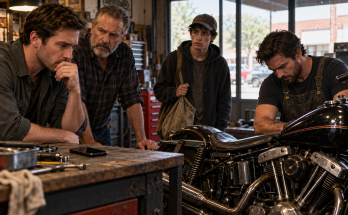
Tank was repairing a motorcycle near the back wall.
Wheels was sweeping the floor, which he claimed was an unfair assignment.
Tiny was outside with Buddy.
The shop sounded like itself.
Tommy sat quietly for a while.
Then he stood and walked to the shelf.
He studied the drawings one by one.
The four bikers and Tommy.
The old house with the yellow sun.
The shop with the open door.
The chair where he sat when he was sad.
He looked at the last drawing for a long time.
“Bear?”
“Yeah?”
“I think I want to make another picture.”
I handed him a clean sheet of paper and a pencil.
He carried them back to his chair.
He didn't ask for help.
I didn't offer any.
For nearly half an hour, he drew without speaking.
Sometimes he pressed hard enough to leave marks on the table.
Sometimes he stopped and stared out the window.
Once, he looked at the yellow flowers.
Then he returned to his drawing.
When he finished, he brought it to me.
The picture showed the shop.
There was the workbench.
There was the crooked chair.
There were four men, a small boy, and a dog with one white paw.
Beside the window sat a paper cup with three flowers.
One flower was bent.
Above the shop, Tommy had drawn a yellow sun.
I studied the picture.
“You put everything in here.”
“Not everything.”
“What did you leave out?”
He pointed to the corner.
A small square sat beside the chair.
It was his notebook.
I looked at him.
“That's a good detail.”
“I bring it when I want to write.”
“I've noticed.”
He pointed at the flowers.
“Those are going to go away.”
“They probably will.”
“But I can draw them.”
I nodded.
“You sure can.”
He looked at the drawing again.
“Then I can still remember them.”
“That's right.”
He held the paper against his chest.
“Can it go on the shelf?”
“There's room.”
I found another piece of cardboard and taped the drawing carefully at the corners.
We placed it beside the others.
Tommy stepped back.
Five drawings now filled the shelf.
They weren't perfect.
Some lines wandered, and the proportions were different from one picture to the next.
But together, they told the story of a boy learning that he could bring his memories into a new place without leaving the people he missed behind.
Tommy stood quietly in front of them.
Then he returned to his chair.
That afternoon, he didn't help with the motorcycle.
He didn't sort bolts.
He didn't make Wheels laugh.
He simply sat and listened while the rest of us worked.
And nobody asked him to do more.
Near closing time, Helen arrived.
Tommy went to meet her at the door.
“Aunt Helen, I made another picture.”
“I'd love to see it.”
He took her hand and led her to the shelf.
Helen looked at the newest drawing.
She studied the crooked chair, the men, the dog, the flowers, and the small notebook.
Then she smiled.
“You remembered everything.”
“Not everything,” Tommy said.
He pointed at the little square beside the chair.
“That's my notebook.”
“I see it.”
“And the flowers won't last.”
Helen's face softened.
“No, sweetheart. They won't.”
“But I can remember them.”
She looked at the drawing again.
“Yes, you can.”
Tommy pointed at the sun.
“And yellow stays yellow.”
Helen crouched beside him.
“I think I understand what you mean.”
He leaned against her shoulder.
“Yellow makes me think of Mom.”
“I know.”
“Sometimes I feel sad when I think of her.”
Helen wrapped an arm around him.
“Me, too.”
“Sometimes I feel happy.”
“That's okay.”
“Sometimes both.”
Helen closed her eyes briefly.
“That's okay, too.”
Tommy looked up at her.
“It's not wrong?”
“No. You can miss someone and still have happy moments. You can laugh and still love the person you miss.”
He seemed relieved.
“I thought maybe I had to be sad all the time.”
Helen held him a little closer.
“You don't have to be sad all the time to show how much you love her.”
Tommy rested his head against her shoulder.
For a moment, nobody spoke.
I turned back to the workbench and pretended to check a wrench that didn't need checking.
Some moments belonged to the people living them.
After a while, Tommy straightened.
“Can I come next week?”
Helen smiled.
“Yes. We'll keep our afternoons.”
“Even if I have a bad day?”
“Even if you have a bad day.”
“Even if I don't draw?”
“Even then.”
He looked toward me.
“Bear says the chair stays.”
“It does,” Helen said. “And you don't have to earn it.”
Tommy seemed pleased to hear the words repeated.
He took his notebook from the chair and slipped it into his jacket pocket.
Then he said goodbye to Tank, Tiny, and Wheels.
Wheels had swept the floor badly enough that Tank had started doing it again behind him.
Tommy noticed.
“Wheels, you missed a spot.”
Wheels stared at him.
“I have been betrayed by a child.”
“You missed two spots,” Tommy said.
Tiny laughed so hard he had to lean against the wall.
Even Helen laughed.
Tommy laughed, too.
Then he took his aunt's hand, and they left the shop together.
I watched them cross Riverside Avenue.
Helen wasn't rushing him.
Tommy wasn't dragging his feet.
They were simply walking home.
The yellow flowers remained by the window.
By Monday, the petals had begun to fall.
I cleaned the cup and set the flowers aside before Tommy arrived.
I wondered whether he would be upset.
I wondered whether I should tell him first.
When he came in, he looked at the empty place beside the coffee pot.
“The flowers are gone.”
“They had a good run,” I said.
He examined the clean cup.
“Did you throw them away?”
“They were finished. I kept the cup.”
He thought about that.
“Can I have the cup?”
“Sure.”
He carried it to his chair and placed it beside his notebook.
Then he took out his pencil.
I waited.
He drew three yellow flowers inside the cup.
One stood straight.
One leaned to the side.
The third bent toward the window.
He added a small sun above them.
When he finished, he showed me.
“Now they're here again.”
I looked at the drawing.
“They sure are.”
He placed it on the table beside his notebook.
Then he sat back in the crooked chair.
He didn't look completely happy.
He didn't need to.
There were still mornings when he missed his mother before he had even gotten out of bed.
There were still evenings when Helen struggled to know what to say.
There would be other hard days, and there would be days when all of us got tired or impatient or said the wrong thing.
Nothing about the shop could change those facts.
But Tommy had learned a few things.
He had learned that he could sit quietly without losing his place.
He had learned that he could remember his mother without being sad every second.
He had learned that people could get tired and still love him, and that saying sorry was part of learning how to care for one another.
Most of all, he had learned that he didn't have to bring us a drawing, a joke, or a helping hand to be welcome.
The chair was there.
The drawings were there.
Buddy's white paw still left muddy marks on the floor.
Tank still talked about baseball.
Tiny still fed a dog that had never once paid for a meal.
Wheels still needed reminders to sweep properly.
And I was still Bear, working at the same bench in the same old shop.
Tommy had not found a family that replaced the one he had lost.
He had found more people who could make room for him while he carried that loss.
That was different.
And it was enough to begin with.
Later that afternoon, he sat with his notebook open on his knees.
He wrote one line, carefully sounding out the words under his breath.
Then he turned the page toward me.
It said:
I CAN BE SAD HERE.
I read it and handed the notebook back.
“That's right, Tommy.”
He tucked it away.
Then he leaned into the old chair, listened to the familiar sounds of the shop, and let the afternoon carry on around him.
For once, he didn't ask whether he could stay.
He already knew.
The End
Read more original stories on Feel Every Story.
The Little Boy Behind the Window Had Lost His Mother, and None of Us Knew What He Was Waiting to Ask
Part 20 of 20