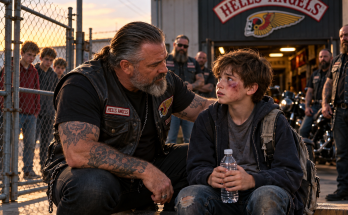
I didn't see Tommy the following morning.
Or the morning after that.
At first, I told myself he was busy.
Maybe Helen had taken him somewhere.
Maybe he was sleeping late.
Maybe he had simply lost interest in watching us work.
Children changed their minds.
I knew that.
Still, I found myself looking toward his window more often than I cared to admit.
I checked before opening the shop.
I checked while waiting for a delivery.
I checked whenever the sound of footsteps outside made me think someone might be approaching.
Nothing.
The empty window bothered me.
I didn't know what that said about me.
Perhaps I had become too invested in a situation that wasn't mine to manage.
Perhaps I wanted to believe I could make a difference because it was easier than admitting that I had no idea what the boy was going through.
I had spent years helping people in ways I understood.
A broken motorcycle could be repaired.
A stranded rider could be given a ride.
A man who needed money could be helped without making him explain every detail of his life.
But grief was different.
It didn't have a loose bolt I could tighten.
It didn't have a part I could replace.
And I couldn't look at a grieving child and tell him everything would be all right when I had no way of knowing that.
So I worked.
I kept busy.
I told myself that respecting a family's privacy was the right thing to do.
Then I heard Helen's voice again.
It happened one afternoon when I was closing a toolbox near the open shop door.
She was talking on the telephone.
I didn't mean to listen, but her voice carried clearly across the street.
She sounded frustrated.
She talked about the difficulty of caring for Tommy.
She mentioned the time he needed and the interruptions to her work.
Then she said she was trying to find a place for him.
I stopped moving.
The words were ordinary.
The meaning wasn't.
I imagined Tommy sitting in the next room, hearing his aunt discuss his future as if he were a box that needed to be moved somewhere else.
I wondered whether she knew he could hear her.
I wondered whether she cared.
Then I caught myself.
I didn't know what Tommy heard.
I didn't know what Helen had been dealing with since her sister's death.
I didn't know whether she had asked anyone for help or whether anyone had offered it.
I only knew what her words sounded like from where I stood.
And from where I stood, they hurt.
I put the toolbox away and went inside.
Tank was cleaning a work surface.
He glanced at me.
"You're doing it again."
"Doing what?"
"Looking like somebody just told you the world is broken."
I leaned against the bench.
"Maybe it is."
Tank stopped wiping.
He didn't smile.
"What's going on?"
I told him what I'd heard.
When I finished, he folded the rag and set it down.
"That boy needs somebody in his corner."
"I know."
"Then somebody ought to be in his corner."
I looked at him.
"That's easy to say."
"Sure is."
He picked up the rag again.
"Doesn't make it wrong."
I didn't answer.
Tank wasn't a man who believed every problem could be solved by a speech.
He believed in showing up.
He believed that if you said you would do something, you should do it.
And he believed that being a decent man meant more than keeping your own hands clean.
I had known him for years.
I should have understood what he was telling me.
Instead, I kept looking for a reason to wait.
That evening, Wheels found me sitting outside the shop after closing.
The streetlights had come on.
Most of the motorcycles were gone, and the pavement was quiet.
I was staring at the house across the road.
Wheels sat beside me.
For once, he didn't make a joke.
"You're worried about him," he said.
"Yes."
"Then why haven't you done anything?"
I rubbed my hands together.
"Because I don't know what to do."
He nodded.
That answer seemed to satisfy him more than any excuse I could have offered.
"Fair enough."
He looked toward the house.
"But you can start by being there."
I thought about that.
Being there.
It sounded simple until I considered how much it might mean to a child who had lost the person he depended on most.
A familiar face.
A place where nobody complained when he appeared.
A room where adults didn't discuss sending him somewhere else.
I couldn't promise him a family.
I couldn't promise him a future.
I couldn't even promise that Helen would allow him to visit our shop.
But I could make sure he didn't have to wonder whether we wanted him around.
That much was within my reach.
The next morning, I arrived earlier than usual.
I unlocked the shop and swept the entrance.
I checked the workbench.
I started the coffee.
Then I stepped outside.
Tommy's window was empty.
I looked away and waited.
A few minutes later, I saw movement behind the glass.
Tommy appeared.
He stood farther back than he usually did, as if he weren't sure whether he was allowed to look.
I raised my hand.
"Good morning."
He stared at me.
I pointed toward the motorcycles.
"Working on a few today."
I didn't expect him to answer.
I didn't expect him to understand why I was telling him.
I simply wanted him to know that he could speak to me if he wanted.
Tommy looked at the motorcycles.
Then he looked at me.
His lips moved, but I couldn't hear what he said.
I leaned forward slightly.
He didn't repeat himself.
I gave him another smile.
Then I went inside.
I was learning that not every invitation needed to be answered immediately.
Sometimes the invitation itself was the important part.
Later that morning, Tiny came out of the shop carrying a small container of water.
The stray dog had returned.
Tiny placed the container near the wall and stepped back.
The dog approached.
Tommy was watching from the window.
Tiny noticed him and lifted his hand.
This time, Tommy raised his own.
It was a small movement.
A brief greeting through glass.
But Tiny came back inside with a different expression on his face.
"Well," he said, "we've made progress."
I looked at him.
"What kind?"
"The boy waved."
Tank glanced up.
Wheels stopped what he was doing.
For a moment, the three of us looked at one another.
Then Wheels grinned.
"Careful, Bear. At this rate, he'll be asking for a motorcycle by Friday."
Tank shook his head.
Tiny laughed.
I laughed, too.
It felt good.
Then I looked toward the window again.
The boy had disappeared.
I wondered whether he was smiling somewhere inside the house.
I hoped so.
I wanted him to have a reason to smile that didn't depend on whether an adult was having a good day.
I wanted him to understand that kindness wasn't something he had to earn by being quiet.
But wanting those things wasn't the same as knowing how to provide them.
I was still learning.
And I had a feeling Tommy was, too.
That afternoon, I saw Helen through the window.
She was moving around the room with a telephone pressed to her ear.
Tommy sat nearby.
I couldn't hear the conversation, but I saw him look up whenever she spoke.
He watched her face carefully.
Then he lowered his eyes.
It was such a small thing that I might have missed it a week earlier.
Now I couldn't stop thinking about it.
Children learn what adults expect from them.
They learn which questions cause irritation.
They learn when to speak and when to remain silent.
They learn whether their presence makes someone smile or sigh.
Tommy seemed to be learning that asking for attention was dangerous.
That was why his silence bothered me.
I had mistaken it for shyness.
Maybe some of it was shyness.
But I suspected there was more.
He had lost his mother.
He was living in a house where his future was being discussed without him.
And across the street, he had found a group of men who seemed comfortable being around one another.
We didn't demand that anyone explain why they were having a bad day.
We didn't insist that a man smile before he was allowed to sit with us.
We didn't treat every inconvenience as an offense.
We simply made room.
I had never thought of those things as extraordinary.
They were ordinary habits among friends.
But perhaps ordinary kindness looked extraordinary to a child who had begun to expect very little.
I didn't know how much Tommy understood about Rolling Thunder.
He couldn't have known the histories behind our faces.
He didn't know which of us had served in the military, which had lost loved ones, or which had spent years trying to become better men than we had once been.
He only knew what he could see.
A group of people who worked together.
A giant man who was gentle with animals.
A mechanic who could fix a broken engine.
A younger man who made everyone laugh.
And me, standing outside the door, greeting him every morning.
Perhaps that was enough for him to begin trusting us.
Perhaps it wasn't.
I couldn't force the answer.
I could only keep showing up.
That night, I went home and found myself thinking about the word family.
I had always understood it as something given to you.
People connected by blood, history, or marriage.
People whose names appeared together on documents.
People who were expected to care for one another because that was what families did.
But I had also seen families fail.
I had watched people share a house while refusing to share compassion.
I had seen strangers offer more comfort than relatives.
I knew that being related to someone didn't automatically make you good to them.
Still, I hadn't thought much about what that meant for a child like Tommy.
His mother had been the center of his world.
Now she was gone, and the person caring for him seemed to be struggling to accept the responsibility.
He had no control over any of it.
He couldn't choose a different aunt.
He couldn't bring his mother back.
He couldn't make the adults in his life understand what he needed.
But he could watch a motorcycle shop.
He could notice who smiled at him.
He could raise a hand through a window.
And maybe, one day, he could ask a question.
I didn't know what that question would be.
I only knew I wanted to be ready when it came.
The next morning, I arrived at the shop with coffee in one hand and my keys in the other.
I unlocked the door.
I turned toward the house.
Tommy was already there.
He wasn't hiding behind the curtain.
He stood close to the window, looking directly at me.
I lifted my hand.
He lifted his.
Then he stayed where he was, watching as I opened the shop and switched on the lights.
For the first time, I didn't feel as if I was watching a lonely child from a distance.
I felt as if we had begun a conversation.
Neither of us knew what it would become.
But the silence between us was no longer completely empty.
Click here to continue reading: PART 4: We Had Offered the Boy Nothing More Than a Smile, Yet He Looked at Us as Though We Held the Answer to His Loneliness
The Little Boy Behind the Window Had Lost His Mother, and None of Us Knew What He Was Waiting to Ask
Part 3 of 20