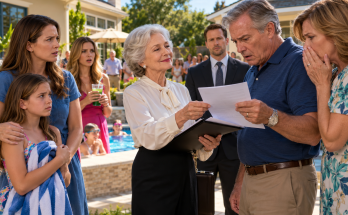
Thanksgiving at my house had once been simple.
Arthur carved the turkey badly.
David complained that cranberry sauce did not count as food.
My mother brought pies until she became too tired to bake them.
After she died, I took over.
After Arthur died, David began carving.
That was how traditions survived.
Not unchanged.
Adjusted.
This Thanksgiving required three folding tables.
Brenda came early.
Naturally.
She arrived with two pies, one bottle of wine, and an unreasonable number of serving dishes.
“You said bring dessert.”
“I did.”
“So why are you reorganizing my kitchen?”
“Because your serving spoons make no sense.”
“They are spoons.”
“Exactly the problem.”
I considered throwing her out.
Instead, I gave her the potatoes.
Progress.
David arrived with his wife, Laura, and their grown daughter, Emily.
Lucas came with Richard.
Tommy brought Claire.
Patricia Dorsey arrived carrying rolls.
Martin Alvarez declined because he was spending the holiday with his daughter, but he sent pecan pie and strict instructions not to discuss quarry litigation at dinner.
Catherine Beaumont came later than everyone else because she had driven from the city.
Even Maria Santos stopped by for coffee after eating with her own family.
At one point, I stood in the kitchen doorway looking at them.
Vances.
Mercers.
Dorseys.
Beaumont.
Caldwell.
Higgins.
Families connected for sixty years by fraud, fear, land, money, death, apology, work, and an astonishing amount of paper.
Now they were arguing about whether the turkey was dry.
Human beings were impossible.
Richard entered last.
Not through the kitchen.
The front door opened, and Lucas called:
“Grandpa needs help.”
I found Richard standing in the hallway holding something wrapped in an old blanket.
Long.
Flat.
Awkward.
“What is that?”
“You’ll see.”
“I dislike surprises.”
“I know.”
Lucas smiled.
“He’s been unbearable about this for three weeks.”
Richard ignored him.
“Where can I put it?”
“The dining room.”
“No.”
“Then why did you bring it?”
“It’s for you.”
That answer made me suspicious.
We carried it into the living room.
Everyone followed.
Brenda wiped her hands on a towel.
“What did you do?”
“Nothing.”
“That has never been true in our family.”
Richard leaned the object against the wall.
Then removed the blanket.
A drawing.
Large.
Architectural pencil rendering.
The original Grand Oak Hotel.
Not the Fairmont.
Grand Oak as it might have looked from the quarry road before later renovations.
Detailed.
Careful.
Beautiful.
I stared.
“You drew this.”
Richard looked embarrassed.
“Yes.”
Brenda covered her mouth.
Lucas grinned.
“He stayed up nights.”
“Lucas.”
“What?”
“You did.”
Richard looked at me.
“I used the original plans from the archive.”
“It’s good.”
That was inadequate.
“It’s very good.”
He looked down.
“Thank you.”
Then I noticed figures near the bottom.
Workers.
Not wealthy founders posed ceremonially.
People carrying lumber.
Pushing carts.
Driving trucks.
Installing windows.
Near one edge, a man stood beside a delivery truck.
My father.
Edward.
On another scaffold, James Caldwell worked with electrical conduit.
Samuel Dorsey stood near a grading line.
Leonard Mercer held papers.
Not idealized.
Working.
“What is this?”
Richard touched the edge of the frame.
“Grandpa’s company brochure showed Daddy and Beaumont standing in front.”
“Yes.”
“I thought the building should look like it belonged to everyone who built it.”
Brenda began crying.
“Stop,” Richard said.
“I’m not doing anything.”
“You’re crying.”
“I’m old.”
“So am I.”
Tommy leaned closer.
“Is that Dad?”
“Yes.”
“He never wore a hat like that.”
Richard frowned.
“He does in the payroll photo.”
“That was a bad hat.”
“I’m not redrawing him.”
The room laughed.
Then I found another figure.
A woman at the side entrance.
Work coat.
Paper bag.
My mother.
“Why is Mom there?”
Richard looked at me.
“Because she cleaned the offices.”
“She was not part of construction.”
“No.”
“But she was part of the story.”
Yes.
He had drawn Eleanor too.
At a doorway.
Anna Beaumont beside her.
Not because they worked on the hotel physically.
Because they worked against what happened inside it.
“I wasn’t sure whether to include them.”
“I’m glad you did.”
Richard nodded.
Then Brenda pointed.
“Where am I?”
“You’re not.”
Her face fell.
“Why not?”
“Because you were a child.”
“So was Martha.”
“She’s not there either.”
Good.
Richard had resisted turning history into destiny.
We had inherited the consequences.
We had not caused the beginning.
That mattered.
“What do you want me to do with this?” I asked.
“Keep it.”
“Why me?”
He looked irritated.
“Because it’s a gift, Martha.”
I smiled.
“Thank you.”
Then he added:
“And because if I keep it, I’ll continue correcting it.”
That I understood.
“Then I accept.”
We hung it temporarily above the fireplace.
Not because that would be its permanent place.
Because dinner was ready.
We sat.
Three tables.
People squeezing between chairs.
Brenda insisted on saying grace.
I nearly objected out of habit.
Then let her.
She did not mention forgiveness.
Or healing.
Or history.
She thanked God for food, work, family, people who told us the truth, and people who tried again after failing.
Simple.
Good.
We ate.
Richard and Tommy argued about the worker fund.
Catherine and Patricia discussed the archive.
Lucas asked Emily about graduate school.
David complained I had overcooked the green beans.
He was wrong.
Brenda defended me.
She was also wrong, because I had overcooked them.
At dessert, Tommy raised his glass.
“No speeches,” I said.
“I wasn’t going to.”
“You raised a glass.”
“I was reaching for water.”
“Oh.”
Everyone laughed.
I had become suspicious of symbolism.
Good.
Then Catherine asked about the dress.
“What dress?”
Richard asked.
Brenda groaned.
“Please do not.”
“The prom dress,” Catherine said.
Lucas looked interested.
“I’ve heard about that.”
“From whom?”
“Grandpa.”
I stared at Richard.
“You discussed my prom dress with your grandson?”
“It’s relevant history.”
“It is gossip.”
“Same thing in Oakridge.”
Fair.
The conversation became unbearable within seconds.
Tommy admitted he had repaired the hem.
Claire mocked his stitching.
Brenda claimed the dress was actually attractive.
I reminded her that took fifty-five years to say.
Lucas wanted to see it.
“No.”
Emily joined him.
“No.”
Eventually six people asked.
I gave up.
The dress came downstairs.
I spread it across the old kitchen table.
Everyone crowded around.
Catherine examined the fabric-covered buttons.
Patricia looked at the hidden pocket.
Laura touched my mother’s stitches.
Nobody laughed.
Then Lucas asked:
“Who gets it when you die?”
The room went silent.
Teenagers and young adults had a gift for asking questions everyone else avoided.
“I haven’t thought about that.”
“You should.”
“Thank you, attorney Lucas.”
“I’m an electrician.”
“Then stop discussing my estate.”
He smiled.
But the question remained.
What happened to the dress?
Museum?
Family?
Archive?
Open Door Fund display?
David?
Emily?
I had spent a year deciding what should become public.
Perhaps this did not.
“It stays in the family.”
David looked surprised.
“With me?”
“Eventually.”
“Why?”
“Because it isn’t evidence anymore.”
The documents were copied.
Buttons recorded.
Fabric analyzed.
History preserved.
The dress could return to being a dress.
A family object.
My mother’s work.
“My grandmother made this with you,” David said.
“Yes.”
“Then I want it.”
That answered the question.
“Fine.”
“Not soon.”
“I hope not.”
Brenda leaned over.
“What about the apron?”
“What apron?”
“The reunion apron.”
“I don’t own it.”
“The Fairmont kept it.”
I stared.
“Why?”
“Robert thought it was funny.”
“I hate everyone.”
Richard laughed.
Thanksgiving continued.
After dinner, people left slowly.
Catherine first.
Patricia next.
Tommy and Claire after helping with dishes.
Lucas drove Richard.
At the door, Richard looked toward the drawing.
“You really like it?”
“Yes.”
“You don’t have to say that.”
“I know.”
He nodded.
“Good.”
Then, awkwardly:
“Thank you.”
“For what?”
“The drafting grant.”
“You created it.”
“You could have said no.”
“So could you.”
He smiled.
“We’re both difficult.”
“Yes.”
After everyone left, Brenda remained.
Of course.
She sat at the table with one last piece of pie.
“You stayed long enough to help clean.”
“I did help.”
“You dried three plates.”
“I am elderly.”
“You carried six serving dishes into my house.”
“That was before dinner.”
I sat opposite her.
The blue dress lay folded nearby.
Richard’s drawing hung above the fireplace.
“You think this is the ending?” Brenda asked.
“What?”
“All this.”
“Life?”
“No.”
She rolled her eyes.
“The Grand Oak story.”
I considered.
“Probably not.”
She groaned.
“I knew it.”
“I mean history never ends cleanly.”
“That sounds ominous.”
“It isn’t.”
I looked around my kitchen.
“The big questions are answered.”
Dad.
Harold.
Charles.
The fraud.
The land.
The trust.
The dress.
Arthur.
Our mothers.
Enough.
“But?”
“No but.”
She waited.
I smiled.
“I think we stop digging.”
Brenda raised her fork.
“I support this motion.”
“Unanimous.”
Good.
Then the doorbell rang.
We both stared.
“No,” Brenda said.
“I agree.”
Another ring.
I opened the door.
Robert Sterling stood there.
He held a white banquet apron.
I closed my eyes.
“No.”
He laughed.
“I thought you’d want this.”
“I do not.”
Brenda appeared behind me and began laughing so hard she had to hold the doorframe.
Robert handed me the apron.
There was writing across the front.
The Fairmont banquet staff had signed it.
Elena Ruiz.
Servers.
Cooks.
Managers.
Chloe Jenkins.
Robert.
Messages covered the fabric.
One said:
Thanks for filling waters when you definitely did not need to.
Another:
Best unpaid banquet server we ever had.
Another:
Aprons are for work, not hierarchy.
That one made me stop.
Elena.
Of course.
At the bottom, Chloe had written:
Nine o’clock changed everything.
I looked at Brenda.
She had stopped laughing.
Robert said:
“The staff wanted you to have it.”
I took the apron.
This time willingly.
“Thank you.”
He left.
Brenda touched the signatures.
“I’m sorry.”
“I know.”
“What will you do with it?”
I folded it.
“Keep it.”
She looked surprised.
“The dress and the apron?”
“Yes.”
“Both?”
“Yes.”
One had once represented shame.
The other attempted humiliation.
Now both belonged to different stories.
Mine.
That evening, after Brenda finally left, I placed the apron beside the blue dress.
Two pieces of fabric.
Two moments separated by fifty-five years.
Neither owned me anymore.