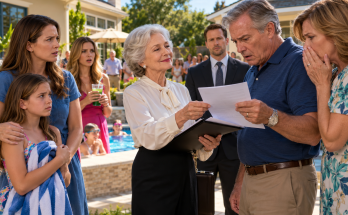
Brenda and I sat at my kitchen table with Eleanor’s photograph between us.
Prom night.
Blue-check dress.
Margaret and Eleanor in the background.
Two mothers who knew far more than either daughter.
On the back:
I hope our daughters do better with the truth than we did.
For several minutes, neither of us spoke.
Then Brenda leaned closer.
“Wait.”
“What?”
She picked up the photograph.
Her eyes narrowed.
“What are you looking at?”
“The angle.”
“That sounds promisingly vague.”
“No. Look.”
She pointed to Eleanor.
Her mother was not looking at us.
Not exactly.
Her face was turned several degrees toward the right edge of the picture.
“Someone is standing over there,” Brenda said.
“You remember?”
“Maybe.”
“That word has become dangerous.”
“I know.”
She closed her eyes.
“I remember Mother being angry before the dance.”
“With you?”
“No.”
“With Harold?”
“Possibly.”
I waited.
Then Brenda opened her eyes.
“Charles Beaumont.”
The name chilled the room.
“You saw him?”
“I think so.”
“At the prom?”
“Outside the gym.”
“Why?”
“I don’t know.”
“Try.”
She stared at the photograph.
“I remember a dark car.”
“Beaumont?”
“Maybe his.”
“And your mother?”
“She told him to leave.”
My pulse increased.
“What exactly did she say?”
Brenda shook her head.
“Something like, ‘You’ve done enough.’”
That was not small.
“Did Mom hear?”
“I don’t know.”
“Was Harold there?”
“No. Not then.”
“Charles came to the school alone?”
“I think.”
I stood.
The prom.
The dress.
The night Brenda humiliated me.
All these years, I had believed the adult story surrounding that evening happened elsewhere.
Now Charles Beaumont had apparently stood outside the gym while our mothers watched.
“Why would Charles Beaumont come to a high-school dance?”
Brenda looked at me.
“To talk to one of them.”
“Which?”
“Your mother.”
Of course.
I almost laughed.
Everyone had wanted something from Margaret Higgins.
Proof.
Silence.
Documents.
Forgiveness.
Control.
“What could he still want in 1974?”
“The trust existed.”
“Yes.”
“Daddy was angry about Arthur.”
“Yes.”
“Maybe Beaumont was too.”
“Why would he care about Arthur?”
Brenda thought.
“Because Arthur had the copied records.”
That made sense.
But eleven years had passed since Dad died.
Grand Oak had opened.
The fraud had never been prosecuted.
The trust was operating quietly.
Why suddenly approach Mom the night of my prom?
Then the answer appeared.
“Tommy.”
Brenda frowned.
“What about him?”
“Leonard’s son had started asking questions.”
Eleanor’s diary said exactly that.
Harold furious today. Says Leonard’s boy has started asking questions.
Tommy had found the G.O. key.
Asked Richard.
The old records cage existed.
If Tommy found Leonard’s hidden copies, everything might surface.
Charles could have panicked.
“Call Tommy.”
He arrived twenty minutes later because retirement had apparently turned all of us into members of an unofficial emergency committee.
I showed him the photograph.
“Do you remember Charles Beaumont at prom?”
“No.”
“Did you see Harold?”
“No.”
“Did anything happen before you picked me up?”
Tommy thought.
“My mother was upset.”
“Why?”
“I assumed because Dad.”
Leonard had died two years earlier.
“What did she say?”
“She asked where we were going after the dance.”
“That sounds normal.”
“No.”
Tommy frowned.
“She asked whether Brenda would be there.”
Brenda stared.
“Why me?”
“I don’t know.”
“What else?”
“She told me not to go near the Vances if anyone started asking about Dad.”
I felt cold.
“So your mother knew you had been asking questions.”
“Yes.”
“Did you tell her about the G.O. key?”
“Maybe.”
He looked ashamed.
“I genuinely don’t remember.”
“That’s all right.”
“No, it isn’t.”
“It has been fifty-five years. Memory is not a filing cabinet.”
Brenda gave me a look.
“That sounds suspiciously reasonable.”
“Do not get used to it.”
Tommy continued.
“There was something else that night.”
“What?”
“Someone followed us.”
My heartbeat increased.
“From my house?”
“No. From the restaurant.”
Tommy had taken me to a diner before prom because we could not afford a formal dinner.
I remembered fries.
A milkshake.
His hands shaking when he paid.
“What kind of car?”
“Black sedan.”
Brenda whispered, “Charles drove one.”
“So did half of Oakridge.”
True.
“Did it follow us to school?”
“Yes.”
“Did you see the driver?”
“No.”
“Why didn’t you mention this before?”
“Because I forgot until now.”
He looked frustrated.
“I thought it was some older kids messing around.”
Again.
Ordinary explanations covering extraordinary things.
“What happened when we arrived?”
Tommy closed his eyes.
“I dropped you near the entrance.”
“Yes.”
“You went inside.”
“I remember.”
“I parked.”
“And?”
“There was a man near the side doors.”
“Who?”
“I don’t know.”
“What did he do?”
“He asked my name.”
We stared.
“You answered?”
“Yes.”
“What did he say?”
Tommy’s face tightened.
“He said, ‘Leonard’s boy.’”
Brenda whispered, “Charles.”
“You know?”
“No. But Daddy called him that.”
Of course.
Not Tommy.
Leonard’s boy.
Children identified through fathers.
Inheritance before identity.
“Then what?”
“He asked if I had found anything interesting in old hotel records.”
My hands tightened.
“What did you say?”
“I said I didn’t know what he meant.”
“Did you?”
“Not really.”
“The G.O. key.”
“Yes.”
“Did he threaten you?”
“No.”
“Did he mention your father?”
“Yes.”
Tommy opened his eyes.
“He said Dad made enough mistakes while he was alive and I shouldn’t make more after he was gone.”
Brenda inhaled.
“That sounds like Beaumont.”
“You knew him?”
“Everyone in my family knew him.”
“What was he like?”
“Polite.”
She almost laughed.
“That was what made him frightening.”
I understood.
Harold used anger.
Charles apparently used calm.
“What happened after that?”
“I went inside.”
“And told nobody.”
“I was seventeen.”
“So were we all,” Brenda said quietly.
Tommy looked at her.
There was no accusation in his expression now.
Only exhaustion.
“I know.”
We contacted Catherine Beaumont.
She came the following afternoon.
When I showed her the photograph, she recognized the profile at the edge.
“My grandfather.”
“You’re sure?”
“Yes.”
“How?”
“The cane.”
I looked again.
Only the curved handle was visible beyond the frame.
Charles had begun using a cane after a riding accident.
“Why was he there?”
“I may know.”
Of course.
Catherine had found more papers.
She brought a folder.
One letter from Harold to Charles dated two days before prom.
Mercer boy has the key. Margaret may know. Caldwell interfering again. Handle quietly.
My throat tightened.
“Handle quietly.”
Catherine nodded.
“That phrase appears several times in my grandfather’s papers.”
“What did it mean?”
“Usually intimidation without public conflict.”
Tommy gave a bitter laugh.
“So polite threats.”
“Yes.”
The next letter was Charles’s own note after prom.
M. refuses discussion. Eleanor hostile. Boy appears ignorant. No immediate risk.
I stared.
M.
Margaret.
Mom had refused.
Eleanor had defended her.
Tommy appeared ignorant.
And Charles left.
“The night Brenda humiliated me, Charles was outside trying to protect the fraud.”
Brenda looked sick.
“And I helped.”
“No.”
She looked at me.
“I did.”
“You did not know what he was doing.”
“I knew something was wrong between our families.”
“Yes.”
“And I turned that fear against you.”
“Yes.”
I would not erase it.
That was not kindness.
She nodded.
Then Catherine found another page.
“Look at this.”
A note written several days after prom.
H.V. furious B. created scene. Says girls may attract questions.
Brenda stared.
“What?”
“Your father was angry at you.”
“For humiliating Martha?”
“Not for cruelty.”
Catherine read further.
Because Brenda made people notice the fabric.
The blue-check material had come partly from Eleanor’s curtains.
If someone recognized it, they might ask why Margaret and Eleanor were sharing fabric.
Why the Vances had any relationship with the Higgins family.
Why women from opposite sides of Oakridge society knew one another at all.
Brenda’s attempt to hide the connection had made it more visible.
“That’s why Daddy was furious after prom,” she whispered.
“What happened?”
“He screamed at me.”
I looked at her.
“You never told me.”
“Why would I?”
Fair.
“What did he say?”
“That I couldn’t leave anything alone.”
“Anything else?”
“He said I had no idea what I had almost done.”
The memory returned more strongly now.
I could see it happening across her face.
“He told Mother to stop seeing your mother.”
“Did she?”
“No.”
Of course not.
Eleanor and Margaret continued writing, meeting, hiding documents, preserving evidence.
Our mothers had their own alliance.
Not friendship exactly.
Something tougher.
Shared responsibility.
“Was that the last time Charles approached Mom?”
I asked Catherine.
She searched.
“No.”
My pulse increased.
“When?”
“1976.”
Two years after prom.
After Arthur and I began dating.
“What did he want?”
Catherine’s expression changed.
“He offered Margaret money.”
“For what?”
“To remove Arthur Caldwell as trustee.”
I went still.
“Why?”
“He considered Arthur dangerous.”
“That sounds flattering.”
“Grandfather did not mean it that way.”
“What did Mom say?”
Catherine handed me a copy of Charles’s note.
M. laughed.
I did too.
Of course she laughed.
Charles offered money to the woman who had already forced Harold Vance into a decades-long restitution agreement.
He had misunderstood her completely.
The next line said:
She says Caldwell stays because unlike us he knows what poverty costs.
My throat tightened.
Arthur.
Young.
Working-class.
Mechanic.
Trustee because my mother believed he understood that money was never abstract to people without it.
Catherine looked at me.
“My grandfather wrote that she was impossible.”
“That has become a family compliment.”
“Yes.”
She smiled.
Then turned serious.
“There is more.”
There was always more.
Charles had tried to buy Arthur out directly.
Arthur refused.
Then Charles investigated him.
That report existed.
I hated the idea immediately.
“What did he find?”
“Nothing criminal.”
“Then?”
“Debt.”
Arthur’s mother had medical bills.
His father had died.
Arthur was helping support her.
Charles offered to pay everything.
“In exchange for resigning as trustee.”
“Yes.”
“What did Arthur do?”
Catherine handed me the response.
Three lines.
Mr. Beaumont,
If you can afford to pay strangers to disappear, you can afford to repay what your family took.
Do not contact my mother again.
Arthur Caldwell
I laughed through tears.
David would love that.
“Did Charles stop?”
“No.”
“Of course.”
“He contacted Margaret.”
“And?”
“She threatened to release records.”
Catherine nodded.
“Then he stopped.”
The pattern repeated.
Not because the truth became less dangerous.
Because Mom and Arthur made concealment expensive.
I looked at Brenda.
“We thought our mothers were powerless.”
“Yes.”
“They were running half the moral infrastructure of Oakridge.”
Brenda laughed.
“That sounds like something Eleanor would hate.”
“Mom too.”
We spent the afternoon cataloging the Beaumont papers.
Then Evelyn called.
The historical society had received an anonymous package.
No return address.
Inside was a photograph.
Different from anything we had seen.
Prom night.
Outside the gym.
Charles Beaumont facing Margaret and Eleanor.
Arthur stood behind my mother.
And one additional person stood beside Charles.
A woman.
Elegant.
Dark hair.
Perhaps forty.
On the back, someone had written:
Ask who Anna Beaumont was protecting.
Catherine stared at the name.
“My grandmother.”
Charles’s wife.
“What was she protecting?”
Catherine went pale.
“I don’t know.”
“Why?”
“My grandmother died in 1975.”
A year after prom.
“How?”
“Car accident.”
Every person in the room became still.
I hated the coincidence immediately.
Not because it proved anything.
Because we had learned what roads could hide.
“Where?”
Catherine answered.
“North Quarry Road.”