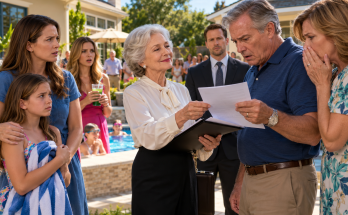
Robert Sterling met us at the Fairmont’s employee entrance.
I had changed my mind twice during the drive about whether bringing Brenda and Tommy was wise.
In the end, secrecy had caused enough damage.
They came.
David was already there.
He stood beside Robert with his arms crossed.
When he saw the three of us walking together, his expression became almost comical.
“Mom.”
“David.”
“Would you like to explain why your high-school reunion has apparently become a criminal investigation?”
“No.”
“Excellent.”
He looked at Brenda.
“Mrs. Vance.”
“David.”
Then Tommy.
“And you are?”
“Tommy Mercer.”
David’s eyes widened slightly.
He knew the name.
Not because of the old scandal.
Because of prom.
Arthur had apparently passed down more family history than I realized.
“Oh.”
Tommy smiled awkwardly.
“That reaction seems deserved.”
Robert led us downstairs.
The hotel’s archival storage occupied several rooms beneath the administrative offices.
Most guests would never imagine the space existed.
Old contracts.
Renovation plans.
Insurance files.
Property records.
Boxes accumulated by decades of managers who feared throwing away the one document somebody might later need.
A police officer stood near the door.
Robert explained.
“The lock wasn’t forced.”
“Who has keys?”
“Management, security, facilities.”
“How many people?”
“Too many.”
“Cameras?”
“In the corridor.”
“And?”
“The person wore a maintenance uniform and cap.”
“Face?”
“Mostly hidden.”
“What time?”
“Two thirteen this morning.”
“Did they know where they were going?”
Robert nodded.
“Straight here.”
That bothered me.
“What boxes were opened?”
He pointed.
Six cartons sat on a table.
Each carried handwritten labels.
GRAND OAK PROPERTY.
1962–1968.
ORIGINAL DEVELOPMENT.
RENOVATION / OWNERSHIP TRANSFER.
Tommy whispered, “They knew.”
David turned.
“Knew what?”
I handed him my mother’s letter.
Not the entire archive.
Just the letter.
He read.
His expression changed several times.
When he finished, he looked at me.
“Grandpa?”
“Yes.”
“Why did you never tell me?”
“I learned today.”
He looked toward Brenda.
“Your father?”
She nodded.
“Apparently.”
David returned the letter.
Then he hugged me.
No warning.
I stiffened.
“David.”
“I know.”
“People are watching.”
“I don’t care.”
Arthur had been like that too.
He released me.
“Now explain the break-in.”
Robert opened one box.
“Whoever entered searched these thoroughly.”
“Anything missing?”
“One file.”
“How do you know?”
“Inventory sheet.”
He handed it to me.
Item 14.
LAND OPTION AGREEMENT — OAKRIDGE DEVELOPMENT HOLDINGS — 1962.
“Missing?”
“Yes.”
“What was in it?”
“Unknown. The file predates our electronic indexing.”
Brenda leaned over my shoulder.
“Oakridge Development Holdings.”
“Your father’s group,” Tommy said.
“Yes.”
David asked, “Why would anyone care now?”
That was the correct question.
The original people were dead.
Harold.
Leonard.
My parents.
Mrs. Vance.
Walter Dorsey.
If someone living wanted the records hidden, there had to be a present consequence.
“Ownership,” I said.
Robert looked at me.
“What?”
“Land.”
I pointed to the missing file.
“Not the old financial crime. The property.”
Tommy understood first.
“The hotel site.”
“Yes.”
Robert frowned.
“The Fairmont owns the site.”
“Now.”
“Correct.”
“Who sold it originally?”
Robert looked toward the boxes.
“I don’t know.”
We searched.
The hotel had changed ownership repeatedly.
Grand Oak became Oakridge Regency.
Oakridge Regency entered receivership.
A regional hospitality group acquired it.
Eventually Fairmont Plaza Holdings purchased and redeveloped the property.
But underneath every transfer sat the original land.
The 1962 option agreement.
Missing.
Robert contacted the hotel’s legal department.
An attorney joined us by video call.
Her name was Melissa Grant.
She listened.
Then asked, “Do you have reason to believe the original acquisition was fraudulent?”
“We have reason to ask,” I said.
“That’s different.”
“I know.”
She seemed relieved by the distinction.
“Current title has survived multiple transactions. Even if something irregular occurred in 1962, present ownership is unlikely to collapse simply because an old option agreement is missing.”
“Then why steal it?”
Melissa paused.
“Good question.”
Brenda had been examining another box.
She pulled out a folder.
“Here.”
A corporate registration.
Oakridge Development Holdings.
Original shareholders.
Harold Vance.
Leonard Mercer.
Samuel Dorsey.
And a fourth name.
Margaret Higgins.
My mother.
I sat down.
“No.”
David took the paper.
“Grandma owned part of the development company?”
“She never said.”
Tommy examined the signature.
“Could it be forged?”
“Possibly.”
I knew my mother’s handwriting.
The signature looked close.
But close was not proof.
Brenda whispered, “Why would my father make Margaret a shareholder?”
I looked at the date.
Two months after my father died.
Not before.
After.
The room went quiet.
Tommy said, “Payment.”
“For what?”
“Silence.”
I felt sick.
“No.”
“Martha—”
“My mother would not accept hush money.”
“You don’t know what she knew then.”
“I know her.”
David touched my shoulder.
“Mom.”
I stopped.
There it was.
The same reflex I had criticized in Brenda.
Protect the parent.
Reject the ugly possibility before examining it.
I sat back.
“You’re right.”
Tommy looked surprised.
“She might have.”
Saying it hurt.
“But we verify.”
Melissa asked to see the document.
Robert scanned it.
Several minutes later, she said, “This is not actually a share certificate.”
“What is it?”
“An assignment of beneficial interest.”
“In English.”
“Someone transferred an economic interest to Margaret Higgins without necessarily giving her management rights.”
“How much?”
“Ten percent.”
David whistled softly.
“What happened to it?”
Melissa searched later records.
“Apparently transferred again in 1971.”
Prom year.
Again.
“To whom?”
She enlarged the scan.
Then stopped.
“The Caldwell Community Trust.”
I stared.
“There was no Caldwell in my life in 1971.”
Arthur and I had not married yet.
I had not even met him.
“Could there be another Caldwell?”
“Obviously.”
Tommy leaned closer.
“Wait.”
He pointed to the trustee signature.
A. Caldwell.
My pulse stumbled.
Arthur.
“No.”
David stared.
“Dad?”
“That’s impossible.”
“When did you meet Dad?”
“1974.”
“Are you sure?”
I glared.
“Yes, David, I remember meeting my husband.”
Brenda was studying me.
“What did Arthur do before heating and air-conditioning?”
“Apprenticeship. Mechanical work.”
“Where?”
I knew.
I suddenly did not want to say it.
David answered.
“Fairmont.”
I turned.
“What?”
“He told me once. Before it was Fairmont. He did maintenance work at the Grand Oak when he was young.”
I stared at my son.
“Your father never told me that.”
David looked uncomfortable.
“I assumed you knew.”
Of course he did.
Another silence disguised as protection.
“When?”
“Early seventies.”
The transfer.
1971.
“How old was Arthur?”
“Twenty-three.”
Too young to run a trust.
Unless the trust was something else.
Melissa continued searching.
“I found the entity.”
We waited.
“Caldwell Community Trust was created in 1971.”
“By whom?”
“Arthur James Caldwell.”
My husband.
“And Margaret Higgins.”
I could not speak.
My mother and Arthur had known each other three years before he supposedly met me.
David looked equally stunned.
“Dad knew Grandma?”
“Apparently.”
Tommy whispered, “That changes things.”
“Yes.”
It changed everything.
“Purpose of the trust?” I asked.
Melissa read.
“To preserve and administer property interests for the benefit of designated heirs and community beneficiaries.”
“Who were the beneficiaries?”
“The filing doesn’t list them.”
“Can we obtain the trust instrument?”
“Possibly through county records, unless it remained private.”
Robert searched another carton.
“Would this help?”
He lifted a folder.
CALDWELL TRUST — CORRESPONDENCE.
The intruder had opened the box but apparently missed it.
Inside were letters between Arthur and the Grand Oak’s attorney.
My hands shook as I opened the first.
1972.
Arthur was twenty-four.
The letter thanked him for maintaining confidentiality regarding Margaret Higgins’s beneficial interest.
Another referred to “future transfer upon Martha Higgins reaching age twenty-five.”
I stopped.
Me.
The trust was for me.
David read over my shoulder.
“Mom.”
“I see it.”
I turned to the next page.
The interest had generated small annual payments.
Where had the money gone?
My mother never had money.
We struggled.
She worked two jobs.
If she owned ten percent of a hotel development, why had we lived that way?
The answer appeared three letters later.
Margaret refused distributions.
Instead, she directed every payment into a restricted account.
Purpose:
Education and future security of Martha Higgins.
I sat down.
Community college.
My tuition.
I had believed my mother paid for it through savings.
Maybe she had.
Maybe not all of it.
Then another letter.
1974.
Arthur informed the attorney that Martha Higgins had declined a scholarship from an unnamed private trust because she did not want “charity connected to men she does not know.”
I remembered.
A scholarship offer had arrived during my second year.
I refused it.
I thought it was a church fund.
Arthur had known.
Before we met?
I looked at the date.
Three weeks before our first date.
My stomach tightened.
“Arthur approached me because of the trust.”
David shook his head.
“You don’t know that.”
“No.”
I looked at him.
“I don’t.”
My mother’s warning echoed.
Do not turn suspicion into certainty because certainty feels easier.
I breathed.
Facts first.
Arthur knew my mother.
Arthur administered a trust connected to my father’s death.
Arthur met me later.
Those were facts.
Why remained unknown.
Brenda found another letter.
“Martha.”
Her voice was strange.
She handed it to me.
It was from my mother to Arthur.
April 1974.
Arthur,
She must never believe you are speaking to her because of Edward or the trust. If you care for her, then tell her the truth before that care becomes something she cannot easily walk away from.
My chest tightened.
I read the next line.
Arthur’s handwritten reply appeared beneath it.
I will tell her.
He never had.
Forty-one years of marriage.
He never told me.
The betrayal was quiet.
That made it worse.
David touched my arm.
“Mom.”
I pulled away.
Not angrily.
I simply needed space.
Arthur had known.
My mother had told him to tell me.
He promised.
Then he married me carrying the secret.
I walked out of the archive room.
The ballroom corridor was empty.
I stood beneath the lights trying to reconcile two Arthurs.
The man who never lied casually.
The man who had concealed the foundation beneath our entire marriage.
David followed.
“Dad loved you.”
“I know.”
“That part isn’t questionable.”
“I know.”
“Then whatever this is—”
“Don’t.”
He stopped.
“Do not explain your father to me before we know.”
He nodded.
“You’re right.”
“I spent today criticizing everyone else for protecting dead parents.”
“I know.”
“I will not do it now.”
My voice trembled.
“But I will not condemn him without evidence either.”
David leaned against the wall.
“What do we do?”
“We find the trust documents.”
Robert appeared.
“Martha.”
“What?”
“They found something on the security footage.”
We returned to his office.
The maintenance uniform disguised the intruder’s body well.
But after leaving the records room, the person passed beneath another camera.
For less than two seconds, the face became visible.
Robert froze the image.
An older man.
Late sixties, perhaps early seventies.
I did not recognize him.
Brenda did.
She stood so abruptly that her chair rolled backward.
“No.”
I turned.
“Who is he?”
She stared at the screen.
“That’s my brother.”
I had forgotten Brenda had a brother.
He was several years younger.
Away at boarding school during much of our high-school years.
“What’s his name?”
“Richard.”
Tommy swore quietly.
“Richard Vance.”
Brenda nodded.
“Why would he break into the Fairmont?”
She did not answer.
“Brenda.”
Her face had gone white.
“Because Daddy left him the family business records.”
“What business?”
“Vance Property Group.”
“Does it still exist?”
“Yes.”
“Who runs it?”
“Richard.”
Robert asked, “Does the company have any current connection to this hotel?”
Brenda looked at the missing land-option entry.
Then at me.
“Yes.”
My stomach tightened.
“What?”
“The Vance company still owns the parking structure next door.”
Robert stared.
“That structure is under a long-term ground lease.”
“I know.”
“From whom?”
Brenda swallowed.
“From a trust.”
No one spoke.
“What trust?”
She looked directly at me.
“The Caldwell Community Trust.”
My husband’s trust.
My mother’s interest.
My father’s evidence.
And suddenly there was a living person with a financial reason to care very much about what those old documents proved.