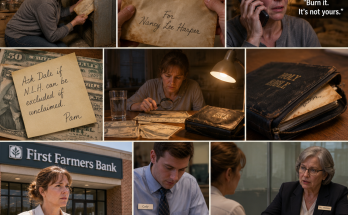
The first thing Dale said after my grandfather’s funeral was that there was three hundred dollars in it for me if I cleaned the basement before the estate-sale people arrived.
He waited until most of the family had left. The aluminum trays of baked pasta were scraped nearly clean, somebody had wrapped the remaining ham in foil, and folding chairs stood crooked around Grandpa Henry Harper’s living room. I was carrying paper cups toward the kitchen when Dale stepped into my path and lowered his voice.
“You could use the money, couldn’t you, Nancy?”
There were a dozen ways I could have answered. I could have reminded my cousin that I was forty-eight years old and perfectly capable of deciding what I could use. I could have asked why cleaning a basement suddenly required a private conversation. Instead, I looked at the black tie hanging loose around his collar and said, “What exactly needs doing?”
His shoulders relaxed.
That should have warned me.
“Mostly junk. Grandpa never threw anything away. Pam and I already went through the important things upstairs. The sale company comes this week, and they don’t want to waste time sorting garbage.”
Through the kitchen doorway, I could see my brother Alan stacking plates beside the sink. He glanced toward us, then looked away so quickly that I wondered whether he had heard.
“How bad is it?” I asked.
Dale gave a short laugh. “You remember Grandpa.”
I did.
Grandpa saved bent nails because they could be straightened. He washed peanut-butter jars and filled them with screws. He kept appliance manuals for machines he had stopped owning twenty years earlier. He once spent an entire Saturday repairing a lamp whose replacement would have cost twelve dollars because, as he told me, throwing away a thing that could still do its job was an insult to whoever had made it.
That habit had embarrassed some of the family.
It had never embarrassed me.
When my sons Ben and Luke were little, Grandpa’s basement was where rainy afternoons went to become useful. He showed them how to sand rough wood without cutting across the grain. He taught Ben to tie fishing knots at a workbench scarred by fifty years of mistakes. Luke once spent four hours making something that was supposed to be a bird and looked more like a potato with wings.
I hadn’t been downstairs in months.
That realization hurt more than I expected.
“When do you need it finished?”
“Tomorrow would be good.”
“Tomorrow?”
“The sale people are moving fast.”
Dale reached into his jacket and produced three crisp hundred-dollar bills.
He already had them ready.
I stared at the money rather than taking it.
“Why me?”
His smile became patient. Dale had always been good at that expression. It suggested that any difficulty between us could be solved if I stopped making things complicated.
“Because you know what’s trash and what isn’t. And because you’re family.”
Pam appeared behind him carrying Grandpa’s magnifying-glass case.
“Are you asking Nancy about the basement?”
Dale looked annoyed for less than a second.
“Yes.”
Pam shifted the case from one hand to the other. “There’s nothing valuable down there.”
“I didn’t ask if there was.”
“I’m just saying.”
Her answer came too quickly.
Dale held the money toward me again.
“Three hundred. Keep anything ordinary that would otherwise be thrown away if you want it. Jars, tools nobody wants, that kind of thing. Just don’t remove papers or financial stuff. Anything like that goes to me because I’m handling the estate.”
I finally took the bills.
They felt strangely stiff between my fingers.
“All right.”
“Good.”
He patted my shoulder.
That small gesture irritated me more than the offer itself.
Behind him, Alan had stopped stacking plates.
Our eyes met.
For a moment, I expected him to say something.
Instead he picked up another plate.
I folded the money and put it in my purse.
Grandpa’s house had always been noisy when the family gathered there. Doors opening. Children running through the hall. Somebody asking where the mustard was. Grandpa laughing from whichever room contained the most people.
That afternoon, the quiet seemed to arrive in pieces.
First the cousins left.
Then the neighbors.
Then the church ladies collected their serving spoons.
By four, only close family remained.
I found myself standing at the kitchen sink with one of Grandpa’s coffee mugs in my hands. It was chipped along the rim and stained inside despite years of scrubbing. I remembered him using it at breakfast while he read the newspaper from back to front.
Pam reached for it.
“Estate sale,” she said.
I held on for half a second too long.
Then I gave it to her.
She placed it in a box marked KITCHEN.
“Could I take that?”
She looked surprised.
“The mug?”
“Yes.”
“Why?”
I almost laughed.
Because it had been his.
Because not everything required a market value.
Because I had spent enough years counting dollars to know they were a terrible measurement for certain things.
But I simply said, “I remember him using it.”
Pam glanced toward Dale.
That was the second thing that should have warned me.
“It has to be inventoried first,” she said.
“It’s a chipped mug.”
“I know. We’re just trying to do everything properly.”
Properly.
The word stayed with me as I drove home.
My rental house sat twelve minutes from the diner where I worked and twenty-three minutes from Grandpa’s place if traffic cooperated. I had lived there long enough to know which floorboard complained outside the bathroom and exactly how hard the back door needed to be lifted before the dead bolt would slide.
Ben had moved out years earlier. Luke had followed.
I still sometimes bought groceries as though they were coming home for dinner every night.
That evening, I set Dale’s three hundred dollars on the kitchen table.
Three bills.
A week of groceries if I was careful. Part of the car repair I had been postponing. Enough to stop thinking about the electric bill until next month.
I hated that Dale had been right.
I could use it.
My phone rang.
Alan.
I answered while taking off my shoes.
“You took the basement job?”
“That’s an impressive description for carrying trash upstairs.”
He was silent.
I sat down.
“What?”
“Nothing.”
“Alan.”
“I just wanted to make sure you knew Dale’s handling Grandpa’s paperwork.”
“So I’ve been told.”
“If you see anything financial, give it to him.”
I looked at the three hundred dollars.
“Did Dale ask you to call me?”
“No.”
The answer arrived a little too quickly.
“Then why are you calling?”
Another silence.
My brother and I had once been close enough to finish each other’s excuses.
After my divorce, that changed gradually. Alan was always around when something practical needed doing. He brought a couch when the boys and I moved into our rental. He fixed a leaking faucet. He showed up with groceries once when I was down to twenty-seven dollars until payday.
But there had always been an edge beneath the help.
You need to budget better.
You should take more shifts.
You can’t expect Grandpa to solve everything.
I had accepted those sentences because accepting them was easier than admitting how frightened I was.
“Nance,” Alan said, “everybody’s tired. Don’t turn cleaning the basement into something bigger.”
I stared at the phone.
“I haven’t even cleaned it yet.”
“I know.”
“Then what exactly are you worried I’ll turn it into?”
He exhaled.
“I’m not worried.”
“You sound worried.”
“I’m trying to help.”
That sentence had covered a lot of ground in our family.
“All right,” I said. “I’ll see you later.”
“Nancy.”
“What?”
“If you find old letters or things Grandpa wrote when he was getting confused, don’t take them personally.”
My fingers tightened around the phone.
“What letters?”
“I’m speaking generally.”
“You brought up letters.”
“Because he wrote things down. You know that.”
I did.
Grandpa wrote reminders everywhere. Grocery lists on church bulletins. Phone numbers on envelopes. Measurements on the backs of receipts.
But Alan hadn’t said notes.
He had said letters.
Before I could ask again, he told me he had to go.
The call ended.
I sat alone at my kitchen table.
Outside, somebody’s dog barked twice and stopped.
I thought about Grandpa during the last year of his life.
There had been small moments I hadn’t understood.
Once, he asked why I never called anymore.
I laughed because I had called three times that week.
Another time, he asked whether the boys were angry with him.
I told him of course they weren’t.
Dale had walked into the room before Grandpa could explain.
At Christmas, Grandpa had stood outside my front door holding a tin of cookies. He had asked whether he was intruding.
I had teased him for being ridiculous.
Now the memory no longer felt ridiculous.
I opened my purse and took out the three hundred dollars.
For reasons I couldn’t have explained, I put the bills inside an envelope rather than spending them.
The next morning was cold enough that my breath showed while I scraped frost from the windshield.
Grandpa’s house looked abandoned even though he had been gone only six weeks.
A plastic wreath still hung on the front door.
The curtains were open.
His truck was gone.
Dale had sold it already.
I unlocked the door with the key he had given me and stepped inside.
The air smelled like furniture polish, old carpet, and the faint medicinal scent that had settled into the house during Grandpa’s final months.
Someone had moved the photographs from the hallway.
Pale rectangles marked the wallpaper where they had hung.
I stood there longer than I meant to.
Then I heard voices in the kitchen.
Dale and Pam.
They stopped talking when I entered.
Pam was holding a stack of folders.
Dale looked at his watch.
“You’re early.”
“You said tomorrow.”
“Good. We can get this done.”
He handed me black trash bags, rubber gloves, and a roll of masking tape.
“Garbage goes by the back door. Anything that might sell goes on the folding table. Papers come upstairs.”
“I remember.”
His expression tightened.
“I’m just being clear.”
Pam carried the folders toward the dining room.
One had GRANDPA—BANK written across the tab.
I noticed Dale watching me notice it.
Then he stepped between us.
“The basement light flickers,” he said. “There’s another switch beside the furnace.”
“I know where it is.”
For a moment, neither of us moved.
Then Dale smiled.
“Of course you do.”
I opened the basement door.
Cold air climbed the stairwell.
The smell reached me first: concrete, dust, machine oil, cardboard, and the faint woody scent of Grandpa’s workbench.
I switched on the light.
The bulb hummed.
From the top step, I could see boxes stacked along the wall, Christmas tins, fishing equipment, jars, old magazines, and the chair Grandpa had used when his knees stopped tolerating long hours at the bench.
Nothing looked dangerous.
Nothing looked valuable.
Nothing looked like a reason for three separate people to warn me about paperwork.
I started down.
Behind me, Dale said, “Nancy.”
I turned.
He stood in the doorway.
“If you find an envelope with somebody’s name on it, don’t assume it belongs to that person.”
I stared at him.
“What does that mean?”
“It means Grandpa reused envelopes.”
“Then why mention it?”
His hand tightened around the doorknob.
“I’m trying to prevent misunderstandings.”
I waited.
He did not explain.
Finally, I continued down the stairs.
The door closed behind me.
At the bottom, I turned toward Grandpa’s workbench.
A screwdriver still hung from the nail where he had kept it.
His fishing chair sat beside it.
And beneath the workbench, almost hidden behind an old cardboard box, something white showed against the gray concrete.
I crouched.
It was only a torn piece of paper.
But before I could reach it, footsteps crossed the floor above me.
Then Pam’s voice came through the ceiling.
Low.
Urgent.
“Did you move Nancy’s envelope?”
Click here to continue reading: PART 2: I Pretended Not to Hear Pam Upstairs, but Grandpa’s Basement Suddenly Felt Less Like Clutter and More Like a Room Someone Had Searched
Three Hundred Dollars for Grandpa’s Basement Sounded Like Charity Until Dale Made Sure I Understood Exactly What I Was Allowed to Touch
Part 1 of 44