Dale arrived Monday morning in a charcoal suit I had never seen before.
Not funeral black.
Not church clothes.
Something expensive enough to look ordinary only if you were accustomed to expensive things.
Martin Vale walked beside him carrying two leather folders.
Rebecca had arranged the interview at a neutral court-reporting office rather than Mr. Creighton’s building. Pam, Alan, and I waited in a separate conference room because Rebecca did not want our reactions affecting Dale’s answers.
I hated that arrangement.
I also knew she was right.
Through the glass wall I could see Dale take his seat.
A court reporter positioned herself near the end of the table. Another camera faced him from a tripod.
Martin spoke quietly to his client.
Dale nodded once.
He did not look frightened.
That bothered me more than fear would have.
“What if he has an explanation?” Alan asked.
“Then we hear it.”
“You really believe that?”
“I have to.”
He studied me.
Six days earlier, I would have wanted Dale cornered.
Now I wanted accuracy more.
If Robert had signed that form, I needed to know even if the answer cost me four hundred seventeen thousand dollars and whatever the money had become.
Rebecca entered our room before starting.
“Remember, this is not a deposition ordered by a court.”
“What does that change?” I asked.
“Dale is appearing voluntarily. Martin may end the interview. Dale may decline questions.”
“Then why do it?”
“Because both sides need to assess facts before litigation expands.”
“And because of the lender?”
“Likely part of the context.”
There it was.
Monday still mattered.
The financing had been postponed, not abandoned.
Rebecca returned to the interview room.
We could not hear live audio. That had been deliberate too.
Instead, we waited.
At eleven-ten, Martin requested a break.
Rebecca came to us carrying a yellow legal pad.
“Well?”
“Dale maintains Robert signed.”
“Who witnessed it?”
“He says he did.”
“Elaine?”
“He now says Elaine was not physically present at the moment of signature.”
Alan laughed without humor.
“So the dead woman’s affidavit was false.”
“Dale says it was an inaccurate reconstruction.”
“What does that even mean?”
“It means we will not use his terminology as a substitute for facts.”
I asked, “How does he explain the stored signature image?”
“He says HPS maintained scanned signatures for administrative use and he accidentally attached Elaine’s while preparing a chronology for counsel.”
“Accidentally wrote in first person that she personally watched Robert sign?”
Rebecca’s expression did not change.
“That is a problem.”
A large one.
“What about Robert’s condition?”
“Dale says Robert had a lucid period shortly before noon.”
“Martha was there morning and evening.”
“Yes.”
“Pam’s texts said he barely woke.”
“Yes.”
“Grandpa said he couldn’t consent.”
“Yes.”
“But Dale says he suddenly woke up and signed.”
“Yes.”
“Any witness?”
“No independent witness identified so far.”
The phrase so far chilled me.
“What does Dale say happened?”
Rebecca consulted her notes.
“According to him, Robert woke around eleven. Dale gave him water. Robert asked about company matters. Dale brought the beneficiary form because Robert had previously decided to change the policy.”
“Previously when?”
“Dale says several weeks earlier.”
“Before Robert called Teresa?”
“He says Robert changed his mind more than once.”
Possible.
I hated that word.
“Then?”
“Dale says Robert read the form, asked for a pen, and signed.”
“With his right hand?”
“Dale says left.”
I frowned.
“The signature looks like his old right-handed signature.”
“That question has been asked.”
“And?”
“Dale says Robert practiced signing left-handed during illness.”
“Any examples?”
“Martin says they are looking.”
Of course.
Alan stood and paced.
“What about Grandpa?”
“Dale says Henry arrived later, saw the form, became angry, and accused him of manipulating Robert.”
“That part matches Martha.”
“Broadly.”
“What did Robert say during the argument?”
“According to Dale, Robert was asleep by then.”
So Grandpa could not ask him.
Convenient.
I caught myself.
“Sorry.”
Rebecca understood.
“Questioning convenience is reasonable. Treating it as proof is not.”
I nodded.
“What about the fax after Robert died?”
“Dale says he delayed faxing because Robert became unresponsive and he focused on hospice care. After Robert died, he found the signed form and sent it because those were Robert’s wishes.”
It was coherent.
Ugly, but coherent.
A dying man signs.
Son delays paperwork.
Father dies.
Son sends signed form.
Nothing impossible.
“Then what are the forty-seven missing minutes?”
Rebecca looked at me.
I had heard her mention none.
“We have discovered something during the interview.”
My pulse increased.
“What?”
“Dale produced phone records to support his claim that he was at Robert’s house continuously that morning.”
“And?”
“The records created a problem.”
Of course.
“What problem?”
“His phone left the house.”
“How do you know?”
“Location records from HPS fleet software.”
Pam had told us the company used vehicle tracking.
Dale’s company Tahoe was logged leaving Cedar Grove at 10:46 a.m.
Returning at 11:33.
Forty-seven minutes.
Exactly during the period he claimed Robert signed.
“Where did he go?”
“Dale says he does not remember.”
Alan stopped pacing.
“You’re kidding.”
“No.”
“His father supposedly signs a four-hundred-thousand-dollar beneficiary form around eleven, but Dale’s vehicle is somewhere else.”
“The vehicle is.”
“Was anyone else driving?”
“That is what we asked.”
“What did he say?”
“He may have loaned the Tahoe to an employee.”
“Which employee?”
“He doesn’t remember.”
I felt the first hard click of something aligning.
Not proof.
But a contradiction tied to time.
“Where did the Tahoe go?”
Rebecca turned the page.
“HPS office.”
I stared.
The office where stored signatures were kept.
The office from which the disputed reserve transfer originated.
The office that faxed Robert’s beneficiary change the following morning.
“What happened there?”
“Tracking only shows the vehicle.”
“Cameras?”
“Twelve years ago.”
“Right.”
“Office access records?”
“Possibly.”
Pam had mentioned key-card entry years ago.
“Did HPS use cards then?”
“Yes.”
“Do records survive?”
“We don’t know.”
Rebecca looked at the clock.
“The break ends in five minutes.”
“What are you asking next?”
“Who drove.”
“And if he says he doesn’t know?”
“We move on.”
“That’s it?”
“For today.”
I wanted pressure.
Rebecca wanted record.
Record won.
She returned.
At twelve-twenty, Martin asked for another break.
This time he came with her.
He looked ten years older than he had Friday.
“Nancy,” he said.
I stood.
We had never properly met.
“Martin.”
“I want to make something clear.”
“Okay.”
“I represent Dale. I am not endorsing every factual statement he has made historically.”
“I understand.”
“And I did not knowingly transmit a false affidavit.”
“I understand that too.”
He seemed relieved I was not going to attack him.
Then he said, “Your counsel asked about a company access archive.”
Pam leaned forward.
“Yes?”
“Do you know whether HPS used Branton Security in that period?”
“Yes.”
Martin looked at Rebecca.
“My client remembered during questioning.”
Of course he did.
“What did he remember?”
“Branton installed the original access system.”
“Do they retain records twelve years?”
“No idea.”
Rebecca was already writing the name.
Martin continued.
“Dale also identified someone who may have driven the Tahoe.”
“Who?”
“Elaine Porter.”
Silence.
The dead bookkeeper again.
“He says Elaine took his vehicle to the office?”
“That is his current recollection.”
“During the exact period Robert supposedly signed?”
“Yes.”
“Why?”
“To retrieve insurance paperwork.”
I stared at him.
“Then Elaine was at the office while Robert signed at Cedar Grove?”
“According to Dale.”
“That would explain why she didn’t witness the signature.”
“Yes.”
It would.
For the first time, a new detail actually reconciled one contradiction in Dale’s favor.
Maybe Elaine left to get paperwork.
Maybe she returned after Robert signed.
Maybe she refused to say she witnessed something she had not seen.
That fit her notebook.
“Did Elaine bring the form?”
“Dale says no. Robert already had it.”
“What insurance paperwork did she retrieve?”
“He doesn’t remember.”
Martin looked embarrassed saying it.
I sat again.
Every answer produced another question.
Rebecca asked, “Why did Dale initially say he could not remember who drove?”
“He says the memory returned when we discussed Elaine.”
That was possible too.
Human memory was terrible.
Especially twelve years later.
We resumed waiting.
At one-forty, the interview ended.
Dale passed our conference room.
For half a second, he looked through the glass at me.
No smirk.
No anger.
He looked exhausted.
I wondered if I looked the same.
Rebecca returned with the court reporter’s rough notes.
“Last question was important.”
“What?”
“I asked Dale what Robert said immediately after signing.”
My stomach tightened.
“What did he say?”
“Dale answered that Robert said, ‘Now it stays with my boy.’”
Pam frowned.
“What?”
“What’s wrong?”
“That doesn’t sound like Robert.”
Alan nodded.
“He called Dale ‘son,’ not ‘my boy.’”
“That alone means nothing,” Rebecca said.
Pam shook her head.
“No. There’s something else.”
She pulled out her phone.
“Robert used that phrase about someone else.”
“Who?”
She searched old messages.
Then found one from Robert to Grandpa.
Years before his illness.
A photograph attached.
Robert and my father standing beside an old fishing boat.
Caption:
Henry says the boat stays with my boy if I go first.
Grandpa’s words.
Not Robert’s.
“Dale may have remembered Grandpa’s phrase,” I said.
“Or repeated something he heard.”
“Or Robert could have used it too,” Rebecca said.
Right.
No leaps.
At three, Branton Security called.
Their old system had been acquired by another company.
Most access logs had been deleted after seven years.
Most.
One archive remained because Harper Property Solutions had been involved in a burglary insurance claim twelve years ago.
The insurer had requested a full month of access logs.
The month Robert died.
My hands went cold.
Rebecca obtained authorization from Martin to share the archive voluntarily.
Dale apparently believed it would support him.
At four-twenty, the file arrived.
We searched the morning of the alleged signature.
HPS OFFICE—10:58 a.m.
Entry card:
DRH-01.
Dale.
Not Elaine.
Nobody spoke.
Dale’s access card entered the office while his Tahoe was there.
Exit:
11:21.
Vehicle returned to Cedar Grove at 11:33.
Forty-seven minutes.
The exact window in which Dale claimed he sat beside his father and watched him sign.
Martin called almost immediately.
“My client says Elaine may have had his card.”
Rebecca replied, “Did she?”
“He does not know.”
“Why would Elaine have both his vehicle and his personal access card?”
“I’m asking.”
I stared at the log.
Then another entry appeared.
11:07 a.m.
Document server access.
User:
DRH.
Folder:
INSURANCE / ROBERT / BENEFICIARY.
File opened.
RHarper_Beneficiary_1999.pdf.
My beneficiary form.
The legitimate one naming me.
Then:
11:09 a.m.
File exported.
11:14 a.m.
Another file created.
RHarper_Beneficiary_Current.pdf.
Pam whispered, “Oh my God.”
Rebecca did not move.
“Do we have the file?”
The server archive listed metadata only.
The actual document was not included.
But timestamps survived.
At the exact time Dale said Robert was signing a form at home, Dale’s access card entered his office and Dale’s server credentials opened Robert’s old beneficiary designation naming me.
Five minutes later, a new beneficiary file was created.
I looked at Rebecca.
“Now can we say it?”
“Say what?”
“That he made the form.”
Her face remained careful.
“We can say the records strongly contradict his account of where he was and show his credentials accessing and creating beneficiary files during the relevant period.”
It was enough.
More than enough for this moment.
Martin went silent when Rebecca read the server log.
Then he said something I did not expect.
“I am terminating the interview process.”
“Understood.”
“And I need time to assess my representation.”
Pam looked at me.
Even I understood that phrase.
Dale’s own attorney was considering whether he could continue.
Martin added, “Please send me the complete Branton archive immediately.”
Rebecca did.
The call ended.
At five-ten, Dale texted me directly.
One sentence.
Grandpa was the one who told me to fix it.
I stared.
Not Robert.
Grandpa.
The story had shifted again.
I showed Rebecca.
She photographed the screen.
“Do not respond.”
I didn’t.
Three minutes later, another message.
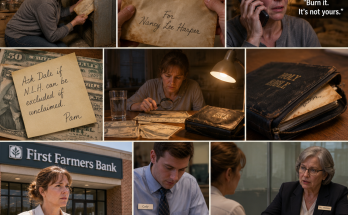
Ask Alan what happened the night before Dad died.
Alan read it over my shoulder.
His face drained of color.
I turned.
“What happened?”
He sat down.
“Nancy.”
“What happened?”
He looked toward the window.
Then at me.
“I was at Robert’s house.”
My heart dropped.
“When?”
“The night before he died.”
“You never told us.”
“No.”
“Why?”
“Because Dale asked me to sign something.”
The room went completely silent.
“What?”
Alan swallowed.
“A witness statement.”
My voice barely came out.
“For Robert’s beneficiary form?”
He nodded.
“And did you sign?”
His eyes filled.
“Yes.”
Click here to continue reading: PART 26: Alan Finally Admitted He Signed a Witness Page the Night Before Robert Died, but the Document He Remembered Was Not the One Dale Filed
Three Hundred Dollars for Grandpa’s Basement Sounded Like Charity Until Dale Made Sure I Understood Exactly What I Was Allowed to Touch
Part 25 of 44