Ben did exactly what I asked.
He did not open the door.
He did not touch the box.
He did not go outside until Rebecca had spoken with local law enforcement and arranged for an officer to be present while the package was collected.
That sentence alone would have sounded ridiculous a week earlier.
Now it felt like common sense.
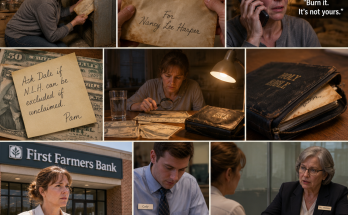
By the time we reached Ben’s house, the afternoon light had turned flat and gray. The cardboard box sat beneath the porch light exactly where Dale had left it. Ordinary brown packing tape crossed the top. Grandpa’s handwriting covered one side in thick black marker.
FOR NANCY—IF I FAIL TO FINISH.
I knew the handwriting immediately.
So did Alan.
He stood two steps behind me and whispered, “That’s his.”
Officer Landry had somehow become our unofficial family witness.
He looked at the box.
Then at me.
“I’m starting to recognize the handwriting.”
“That is not a sentence either of us should be saying.”
“No.”
He almost smiled.
The box was photographed before anyone moved it.
Rebecca noted that Dale had delivered it voluntarily and that Ben had not handled it.
Ben stood inside the doorway with his arms folded.
He was thirty years old.
Still, I had the absurd urge to tell him to stay back as though the box might explode.
Maybe it could.
Just not physically.
“Did Dale say anything?” Rebecca asked.
Ben nodded.
“He rang twice. I talked through the door.”
“What exactly?”
“He said, ‘This belongs to your mother. Tell her I’m done carrying dead men’s secrets.’”
I closed my eyes.
That sounded like Dale.
Part accusation.
Part excuse.
Part theatrical exit.
“What did you say?”
“That he should call Mom.”
Good.
The rule again.
No intermediaries.
“Did he seem angry?”
Ben thought.
“Tired.”
That answer bothered me more.
Anger meant Dale still thought he could control the direction of things.
Tired suggested something had broken.
We took the box to Rebecca’s office.
Not my house.
Not Grandpa’s.
Not Mr. Creighton’s.
A neutral room with a camera running and enough witnesses to prevent anyone from later arguing about what had been inside.
The tape came away slowly.
Grandpa had reinforced the corners with strips cut from old grocery bags.
Of course he had.
Inside were nine envelopes, a binder, two checkbooks, three flash drives, and one small wooden box.
Nothing was loose.
Everything had labels.
The first envelope said:
NANCY—SETTLEMENT.
The second:
ALAN—HOUSE MONEY.
The third:
ROBERT—INSURANCE.
The fourth:
DALE—RESERVE.
The fifth:
PAM—WHAT SHE TOLD ME.
The sixth:
CEDAR GROVE.
The seventh:
BONDS.
The eighth:
MY MISTAKES.
The ninth had no subject.
Only:
SAMUEL.
Mr. Creighton stared at it.
“That one is mine.”
I looked at him.
“Grandpa expected you to be here.”
“Apparently.”
Rebecca documented each item.
We started with the binder.
Front label:
RECONCILIATION—NOT FINAL.
Grandpa had built a complete ledger in typed form.
Not beautiful.
Not professional.
But detailed.
Every known source of money tied to me, Dad, Alan, Robert, Dale, and the reserve.
Dates.
Amounts.
What he believed each transaction meant.
What he could prove.
What he could not.
He had even created columns.
DOCUMENTED.
MEMORY ONLY.
DISPUTED.
OWED.
REPAID.
UNKNOWN.
I stared at the headings.
“He was trying to separate facts.”
Mr. Creighton nodded.
“Very deliberately.”
Grandpa had learned the same lesson Rebecca kept teaching me.
Not every memory deserved equal weight.
Not every suspicion belonged in the same column as a bank statement.
The first section covered Dad’s wrongful-death settlement.
My original fifty-thousand-dollar allocation.
Authorized expenses while I was a minor.
Court-approved withdrawals.
Then the eighteen-thousand-dollar business loan to Robert.
Grandpa marked it:
IMPROPER DECISION BY HENRY. NANCY NOT INFORMED.
No excuse.
No softened language.
Next to it, he traced Robert’s repayments over years.
Not a single lump sum.
Multiple transfers.
Some into family accounts.
Some directly to Grandpa.
Some designated for me.
By the time Robert purchased the life-insurance policy, Grandpa estimated Robert had repaid principal but believed he still owed growth and opportunity value.
That was why Robert had kept the policy.
Not because a court ordered him.
Because he thought he still had a debt.
I turned the page.
Grandpa’s handwritten note had been photocopied beside the typed accounting.
Robert says money made company possible. Says paying principal alone not enough.
I felt my throat tighten.
Dad’s small business loan.
My settlement money.
Two separate obligations merged in Robert’s mind.
He wanted to settle both.
The binder moved to Alan’s thirty-two thousand.
Grandpa documented the original check.
Alan’s diversion.
The seven-year delay.
The eventual repayment to the reserve account.
Then:
ALAN RESPONSIBLE FOR TAKING FUNDS AND HIDING IT.
DALE RESPONSIBLE FOR REDIRECTING REPAYMENT AFTER RECEIPT.
HENRY RESPONSIBLE FOR NOT TELLING NANCY WHEN DISCOVERED.
Three responsibilities.
Not one villain.
Exactly what I needed.
I looked at Alan.
He read the lines without defending himself.
“That’s fair.”
“Yes.”
He nodded.
It hurt both of us.
Still fair.
Then Cedar Grove.
Authorized advance:
$40,000.
Unauthorized excess:
$36,420.
Later movement:
$36,420 into Dale brokerage.
Acquisition:
Rear parcel.
Grandpa had traced everything we already found.
But then he added something new.
The twenty-eight-thousand-dollar cashier’s check Dale had offered him on Friday was not simply a settlement.
Grandpa believed the money came from selling part of the brokerage position purchased with the disputed thirty-six thousand.
Meaning Dale was offering back proceeds from the same money.
Not his own repayment.
A partial return.
In exchange for a release.
Alan read over my shoulder.
“That’s why the amount was twenty-eight.”
“Maybe.”
Grandpa marked it DISPUTED.
Good.
Even he had not claimed certainty.
I turned farther.
Another section:
NANCY LOANS AND HELP.
There it was.
Every check Dale had used in his exhibits.
Grandpa listed them too.
But beside each he categorized it.
GIFT.
LOAN.
REIMBURSEMENT.
SUPPORT WHILE MINOR.
MONEY FROM NANCY’S OWN FUNDS.
My twelve-thousand-dollar car loan appeared.
Original loan:
$12,000.
Documented repayments:
$6,250.
Balance:
$5,750.
Exactly near his ledger estimate.
I swallowed.
“I owe that.”
Rebecca said, “Probably subject to any applicable legal accounting, but yes, Henry considered it outstanding.”
“Then keep it in.”
She looked at me.
“It stays.”
That mattered.
If I was asking for an accounting, I did not get to erase my column.
Grandpa had another note below the loan section.
Do not let Nancy refuse legitimate debt because she learns others cheated her. Fair is fair both directions.
I almost laughed.
“Still bossing me around.”
Mr. Creighton smiled.
“Sounds like Henry.”
I looked at the note again.
Fair both directions.
It was exactly the lesson I had reached on my own.
Maybe we were finally speaking the same language.
Too late.
Still speaking.
The next section covered the reserve.
Grandpa’s calculated balance before disputed transfers:
$112,834.
Less my loan:
$5,750.
Net beneficial balance:
$107,084.
Then Cedar Grove authorized advance:
$40,000 still due back plus agreed interest.
Unauthorized excess:
$36,420 disputed.
Additional deposits from Grandpa after discovery:
$20,000.
Alan repayment already included.
By Grandpa’s final estimate, before insurance:
Amount potentially due Nancy:
$169,000 to $183,000 depending on interest, tracing, and whether Cedar Grove excess recoverable separately.
I stared.
Not millions.
Not fantasy.
A large, painful, believable number built from decades.
Rebecca looked over the math.
“His estimate is not a legal determination.”
“I know.”
“But it gives us a roadmap.”
Mr. Creighton added, “And he identified sources.”
The binder cross-referenced bank statements in the box.
Grandpa had done more than apologize.
He had reconstructed.
Then we reached Robert’s insurance.
Grandpa summarized the evidence:
1999 designation to Nancy.
Later reaffirmation.
Robert’s letters.
Teresa’s call.
Elaine’s notebook reference.
Martha’s witness.
The bluebird documents.
The final disputed form.
Grandpa wrote:
I BELIEVE DALE FILED A CHANGE ROBERT DID NOT AUTHORIZE.
Not:
Dale forged.
Not:
Dale stole.
Believe.
Again, distinction.
Below it:
IF PROVEN, INSURANCE IS SEPARATE FROM WHAT I OWE NANCY.
I stared at that sentence.
Separate.
Grandpa would not allow his own debt to be hidden behind Robert’s.
Even though Dale had accused him of using the insurance to cover his guilt.
He had explicitly rejected that.
“Keep going,” Rebecca said.
The binder included a page titled:
WHY I WAITED.
My chest tightened.
Grandpa wrote that after Robert died, he suspected something was wrong with the beneficiary but did not tell me because I was newly divorced and financially unstable.
He told himself he would investigate first.
Then his own improper use of my settlement funds became relevant.
Shame delayed him.
Alan’s theft surfaced.
More shame.
Then Dale began handling more paperwork.
Grandpa grew older.
The story became harder to confess.
He wrote:
Every year I waited made the next year harder.
I read it twice.
That was how families accumulated secrets.
Not one grand conspiracy.
One delayed truth at a time.
Grandpa continued:
By the time I decided Nancy had to know all of it, I no longer controlled who answered my phone, brought my mail, drove me, or knew where my papers were.
I looked at Pam.
She stared at the table.
Dale’s control had grown through practicality.
Rides.
Bills.
Paperwork.
Keys.
Passwords.
The things families hand to one responsible person because it is easier.
Until one person knows everything.
“Access,” I whispered.
Mr. Creighton nodded.
“Does not mean ownership.”
We reached the checkbooks.
Grandpa’s last personal account.
Nothing dramatic.
Routine expenses.
But several checks had been voided and preserved.
One payable to me for fifty thousand dollars.
Never delivered.
Memo:
PARTIAL RESTORE RESERVE.
Date:
Two months before death.
Another payable to Alan.
$0.00.
Memo:
TELL HER YOURSELF.
Alan laughed through tears.
“That old man.”
I touched the check.
Grandpa had been angry enough to write a zero-dollar check just to make a point.
Then the flash drives.
Rebecca had them forensically copied before anyone opened them.
One held scanned bank statements.
One held photographs of ledger pages.
The third was labeled:
CALLS.
Audio files.
Grandpa had recorded conversations.
Not secretly in states where that might create issues, according to Mr. Creighton.
He had apparently used voicemail recordings and messages saved from speakerphone with Marjorie present.
We did not listen immediately.
Too much already.
Then the wooden box.
Inside:
My chipped coffee mug.
The one Pam had told me needed to be inventoried.
I laughed.
Could not stop.
Grandpa had hidden the stupid mug inside the most important box of records.
A note was tucked inside.
Nancy likes this ugly thing. Let her have it.
I cried harder than I had over the money.
Because there were still ordinary memories under everything.
Coffee.
Breakfast.
A chip in a mug.
Not every object was evidence.
Some things were just ours.
After a break, we opened the labeled envelopes.
ALAN—HOUSE MONEY contained copies of the check and Grandpa’s notes.
PAM—WHAT SHE TOLD ME contained a written chronology of information Pam quietly shared with Grandpa last year.
She had told him about the metal case.
The company declarations folder.
Dale using stored signatures with permission in some contexts.
The demolition plans.
Pam stared.
“I told him more than I remembered.”
“You were trying,” I said.
She looked at me.
“Badly.”
“Yes.”
That was allowed.
Both.
CEDAR GROVE contained the deed, maps, archive-use clause, and correspondence with planning officials.
BONDS contained purchase records for all seventeen bonds and a statement of why Grandpa bought them.
One each at milestones.
Birthdays.
Graduation.
Marriage.
Birth of my sons.
Divorce.
Job changes.
Not all happy events.
Moments he thought I might need something later.
Then MY MISTAKES.
I almost could not open it.
Inside was only one page.
Typed.
Signed.
Grandpa listed five decisions he believed were his responsibility.
Using settlement money without telling me.
Failing to ensure Alan delivered the house down payment.
Accepting Alan’s repayment into the reserve instead of requiring direct repayment to me.
Authorizing the first forty thousand to Cedar Grove without my knowledge even though the reserve was for my benefit.
Waiting too long to tell me about Robert’s policy.
At the bottom:
Anything Dale did after my mistakes does not erase my mistakes. Anything I did does not excuse him.
I sat very still.
There it was again.
Separation.
Truth without substitution.
I folded the page carefully.
Then we reached the unlabeled envelope addressed to Samuel.
Mr. Creighton opened it.
His face changed.
“What?”
He read silently.
Then looked at me.
“This is an amendment instruction.”
“To the will?”
“Not exactly.”
“What?”
“A request concerning estate administration and potential restitution.”
Grandpa instructed Mr. Creighton that if serious discrepancies were confirmed after death, no family member involved in disputed transactions should control the estate.
Independent fiduciary.
That we expected.
Then:
Any property otherwise passing to Dale from Henry’s estate was to be held pending accounting of the reserve.
Pam inhaled.
“How much property?”
Mr. Creighton looked uncomfortable.
“The main house.”
Grandpa’s house.
The basement.
Workbench.
Kitchen mug.
Everything.
I stared.
“Dale inherits Grandpa’s house?”
“Under the older will, yes.”
Of course.
Dale had acted like the house belonged to him because eventually it might.
“But this letter changes that?”
“Not necessarily legally. It expresses instruction, but effect depends on formalities.”
Another messy issue.
“What else?”
Mr. Creighton turned the page.
“If Dale is found to have intentionally diverted Nancy’s reserve or Robert’s records, Henry asks that any discretionary inheritance otherwise passing to Dale be redirected first toward making Nancy whole.”
Silence.
Not punishment for punishment’s sake.
Setoff.
Restitution.
Then one last sentence:
Do not give Nancy more than she is owed because I feel guilty. That would be another way of deciding for her.
I smiled through tears.
Even Grandpa’s final correction resisted overcorrection.
No grand fortune dumped into my lap to erase shame.
Just accounting.
Then Rebecca opened the final packet.
It was not labeled in Grandpa’s handwriting.
Different writing.
Block letters.
FOR DALE ONLY AFTER NANCY HAS EVERYTHING.
We all stared.
“That one is sealed,” Alan said.
It was.
Wax.
Grandpa’s initials.
And another set.
R.H.
Robert.
Impossible.
Robert had been dead twelve years.
The packet had been prepared before his death.
Grandpa had kept it all that time.
Mr. Creighton looked at me.
“This is addressed to Dale.”
“Then it belongs to Dale.”
Every person in the room looked at me.
I almost laughed.
“What?”
Alan said, “After everything?”
“That doesn’t make his mail mine.”
Rebecca’s expression softened.
“Correct.”
We documented it unopened.
Martin Vale was contacted.
He agreed to accept custody for Dale.
Before the packet left, I looked at it once more.
Robert and Grandpa had prepared something together.
Something meant for Dale only after I received the full record.
Whatever it contained, they had not intended me to use it against him.
That mattered.
I thought the day was finished.
Then the forensic technician called about Grandpa’s CALLS drive.
One audio file had a title:
DALE—LAST OFFER—WEEK BEFORE HOSPITAL.
Rebecca played only the first thirty seconds.
Grandpa’s voice.
Then Dale.
Grandpa said:
“You can still fix the money without fixing the lie.”
Dale answered:
“If Nancy gets the truth, she gets the company too.”
Everyone in the room went silent.
Company.
Not a check.
Not a parcel.
The company.
I looked at Rebecca.
“What did he mean?”
She stopped the recording.
“We listen to the entire call before interpreting.”
But for the first time, I wondered whether Grandpa’s accounting still contained a missing piece.
Something about Harper Property Solutions itself.
Something large enough that Dale believed telling me the truth could threaten not merely his money—
but ownership of the business he had spent twelve years building.
Click here to continue reading: PART 30: Grandpa’s Last Recorded Call Revealed Why Dale Feared I Could Claim Part of Harper Property Solutions, but the Company Records Told a Different Story
Three Hundred Dollars for Grandpa’s Basement Sounded Like Charity Until Dale Made Sure I Understood Exactly What I Was Allowed to Touch
Part 29 of 44