The video had no sound.
That did not make it harmless.
Martin stood beside Samuel near the curb outside my house.
Three days before Thomas died.
Samuel held something small.
Folded.
White.
The packet he later said contained crushed medication looked exactly like it.
Martin pointed toward our garage.
Then toward the side gate.
Samuel nodded.
They spoke for less than two minutes.
Martin left first.
Samuel remained in his vehicle.
The video ended.
Rachel watched it twice.
“So Martin lied.”
“Yes,” the investigator said.
“At minimum about knowing Samuel had access plans.”
“Yes.”
“Could the packet be something else?”
“Yes.”
That answer mattered.
Even now.
Even when I wanted certainty.
The video strengthened suspicion.
It did not label powder.
Investigators confronted Martin immediately.
His first reaction was silence.
His second was to request his attorney.
His third, several hours later, was to change his story.
He admitted meeting Samuel outside my house.
He admitted explaining the garage layout.
He admitted telling Samuel where Thomas usually kept paperwork.
He denied knowing Samuel carried altered medication.
“What did he think Samuel was going to do?” I asked.
“Retrieve documents.”
Of course.
The same claim Patricia had made.
Everyone thought Samuel was merely retrieving documents.
Everyone gave him tools to enter.
Everyone somehow missed the possibility that a man willing to commit insurance fraud might also threaten the person exposing it.
Martin said Thomas had copied records.
He believed those records were in our home office.
He asked Samuel to recover them because Thomas refused to return them.
“Recover,” I repeated.
“Steal.”
“Yes.”
“From my house.”
“Yes.”
“While we slept.”
“Yes.”
“Martin knew.”
“Yes.”
The distinction between murder and burglary mattered legally.
Emotionally, another wall fell.
Martin had sat in my kitchen for years.
He knew our accounts.
Knew Thomas.
Knew me.
Even if he did not intend Thomas’s death, he helped send Samuel into our home.
That was enough to change the entire shape of his betrayal.
Then investigators recovered audio from another source.
Not Derek.
Not Martin.
Thomas.
The safe-deposit flash drive contained more files than initially cataloged.
One corrupted recording had now been restored.
Thomas speaking with Martin.
Date: four days before death.
Thomas:
“You have forty-eight hours.”
Martin:
“I told you I’m fixing it.”
Thomas:
“You are hiding it.”
Martin:
“Margaret doesn’t need this stress.”
Thomas laughed once.
“Do not use my wife as an excuse.”
My eyes filled.
That was Thomas.
Martin:
“You don’t understand how many people are involved.”
Thomas:
“Then give me names.”
Martin:
“I can’t.”
Thomas:
“You mean you won’t.”
Then a long silence.
Martin said:
“Samuel will make this ugly.”
Thomas:
“Is that a threat?”
Martin:
“No. It’s a warning.”
Thomas:
“Same difference if you stand beside him.”
The recording ended.
I sat completely still.
Thomas had seen Martin clearly before I did.
Same difference if you stand beside him.
For years Martin might have told himself he never wanted violence.
Maybe true.
But he stood beside the man willing to use it.
He opened doors.
Provided information.
Moved money.
Covered consequences.
Moral distance does not erase operational participation.
Rachel said prosecutors were reevaluating Martin’s charges.
Not necessarily homicide.
Potential conspiracy.
Burglary.
Obstruction.
Accessory conduct.
Jurisdictional details mattered.
I did not ask for labels yet.
I wanted facts.
Martin eventually gave them.
He and Patricia feared Thomas would report everything.
Martin asked Samuel to retrieve copies.
Samuel asked about the alarm code.
Martin did not know it.
Patricia did.
Martin told Samuel where Thomas kept his office files.
He also mentioned medication because Samuel asked when Thomas normally woke.
Martin claimed he said Thomas woke early to take heart medicine.
That detail may have given Samuel the idea.
Or Samuel may already have planned it.
No proof yet.
But Martin had contributed the knowledge.
He left Samuel at the curb.
The following day, Patricia gave Samuel the code.
The night after that, Samuel entered.
Sequence.
Not a single mastermind.
A chain of compromises.
Each person handing the next one something dangerous.
Information.
Access.
Silence.
By the time death occurred, responsibility had layers.
That did not reduce Samuel’s act.
It expanded everyone else’s.
Patricia learned of Martin’s revised statement and changed hers too.
She admitted she suspected Samuel might threaten Thomas physically.
Not kill.
Threaten.
She had still given the code.
Why?
Fear.
Money.
Exposure.
All familiar answers by now.
The law would decide how much they mattered.
I had reached the point where motives interested me less than choices.
That afternoon, Emily received final temporary custody orders.
Sole legal and physical custody while Derek remained incarcerated.
No direct unsupervised communication.
All future contact subject to child specialists and court review.
She sat at my kitchen table—my actual kitchen, newly cleared for safe return—and read the order twice.
“How do you feel?”
“Relieved.”
Then:
“Sad.”
Both.
That seemed healthy.
“Sad for him?”
“For all of us.”
She looked toward the living room where the children played.
“They love him.”
“Yes.”
“I hate that.”
“No, you don’t.”
She stared.
I continued.
“You hate that loving him hurts.”
Her eyes filled.
“That too.”
We had returned to my house after investigators completed safety checks.
The hidden camera was gone.
The basement device removed.
The damaged wall repaired.
Still, every room felt slightly unfamiliar.
Not contaminated.
Reinterpreted.
I stood in the kitchen where Thomas collapsed.
For years that floor held one memory.
Now it held another.
Samuel entering.
Pills altered.
A crime hidden in normal architecture.
I expected to feel afraid.
Instead I felt angry that danger had tried to claim ownership of the room.
So I cooked.
Soup first.
Then bread.
Then pancakes for the children the next morning.
Repetition can reclaim space.
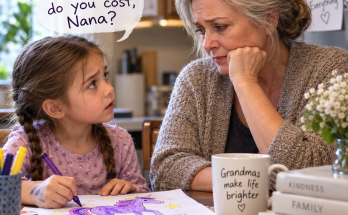
My granddaughter returned to the same kitchen table where she had asked how much I cost.
She noticed nothing unusual.
Children sometimes restore a room simply by using it.
She colored.
Her brother dropped crayons.
Emily answered email.
For twenty minutes, the house belonged to us again.
Then the mail arrived.
Among ordinary envelopes sat one from the state.
Thomas’s unclaimed-property packet was being formally transferred to me.
The original safe-deposit contents.
I had already seen copies.
But receiving the actual packet felt different.
Thomas’s handwriting.
His paper.
His folded notes.
His planning.
At the bottom was something investigators had not emphasized because it did not relate directly to the case.
A small envelope.
Margaret—Personal.
I opened it alone.
Inside was a note.
Not about fraud.
Not about Martin.
Not Samuel.
Thomas had written it during the weeks he was investigating.
If this turns out to be nothing, burn this and mock me.
I laughed.
Then continued.
If it turns out to be something, I need you to know that keeping it from you was not because I thought you were weak.
It was because once you know something is wrong, you cannot pretend not to know.
That is one of the things I love about you.
I sat down.
For eleven years, I had occasionally wondered whether Thomas died with secrets between us.
Now I knew he had.
But the secret itself contained trust.
He knew exactly who I was.
Once you know something is wrong, you cannot pretend not to know.
My granddaughter’s question had activated the same instinct.
A strange phrase.
Nana money.
Something wrong.
I followed it.
Not because I was heroic.
Because unresolved inconsistency has always bothered me.
Thomas knew that.
The final lines read:
If I get this sorted, dinner Saturday. Your choice. No spreadsheets.
I pressed the note to my chest.
Dinner Saturday never happened.
Some losses remain ordinary even after crime enters the story.
That may be the cruelest part.
The life we lost was not dramatic.
It was dinner.
Bad dancing.
Checked stoves.
Medication organizers.
A man reading the newspaper.
Ordinary life.
Exactly what criminals kept trying to turn into cover.
The next week, Martin entered a revised plea.
He admitted his role in the fraud.
Admitted helping Samuel gain unlawful access to our home.
Admitted concealing information after Thomas died.
He denied intending physical harm.
Prosecutors did not require me to accept his description emotionally.
The factual record would show what he did.
Patricia followed.
Her plea included unauthorized record access, forgery, conspiracy, and facilitating the break-in.
Adam entered a cooperation plea.
Linda negotiated separately.
She admitted fraud, falsification, obstruction, and participation in the concealment and escape planning.
Evidence remained insufficient to charge her as part of the physical attack on Emily.
That distinction frustrated Emily.
Then she surprised me.
“I can live with what can be proved.”
I looked at her.
“You sound like me.”
“Terrifying.”
We laughed.
Diane and Evelyn were not charged with the central conspiracy.
Both cooperated with child-protection investigators.
Evelyn entered counseling.
Diane apologized to me.
Not dramatically.
She called.
“I believed the papers.”
“I understand.”
“That doesn’t make what I did right.”
“No.”
“I thought you were using those children.”
“I know.”
“I’m sorry.”
“Thank you.”
She waited.
Perhaps expecting forgiveness.
I did not offer what I did not yet feel.
Apology received.
Relationship undecided.
That too was a boundary.
Months began passing.
Legal cases moved slower than discovery.
Derek received his sentence first.
Long enough that my granddaughter would be an adult before release became realistic.
The judge emphasized planning, abuse of trust, financial exploitation, and the deliberate attempt to convert family relationships into tools.
Emily attended.
I did too.
Derek spoke briefly.
No new explanation.
No request for forgiveness.
That was probably wise.
Samuel’s sentencing came later.
Longer.
Thomas’s death carried its own weight.
The judge called his conduct a calculated invasion of a home and a reckless disregard for life that became fatal.
Martin and Patricia received substantial sentences as well, though different from Samuel and Derek.
Adam received reduced punishment due to cooperation.
Linda’s sentence reflected both her involvement and assistance after arrest.
No outcome felt clean.
But accountability rarely feels like celebration.
It feels like paperwork finally matching reality.
The money recovery process took even longer.
Properties seized.
Accounts frozen.
Insurance payouts clawed back.
Fraudulent loans canceled.
Restitution calculated.
My accidental-death policy voided.
The property under my identity transferred into receivership.
Tax records corrected.
Each correction removed one fictional version of me from a database.
That became unexpectedly meaningful.
Margaret Wallace no longer owner.
Margaret Wallace no longer paid caregiver.
Margaret Wallace no longer policyholder.
Margaret Wallace no longer borrower.
One by one, paperwork stopped lying.
Then came the question of my house.
Sell or stay.
I chose stay.
Not forever necessarily.
But for now.
I repaired the basement.
Replaced the smoke detectors.
Changed every lock.
Installed new security.
Changed the garage code.
Then I did something symbolic despite normally disliking symbolic gestures.
I moved Thomas’s workshop cabinet.
Behind it was the space where Martin hid Adam’s archive.
I painted the wall myself.
My granddaughter helped.
Badly.
Paint landed on the floor.
Her shirt.
My elbow.
We laughed.
A year earlier I would have corrected her brush technique.
I let it be messy.
When we finished, she asked:
“Can I put my picture here?”
“What picture?”
She returned with the purple unicorn.
The original one.
The one from the day everything began.
I had kept it.
She taped it to the newly painted wall.
Under it, in careful letters, she had added:
NANA COSTS LOVE.
I read it.
“That is better than not for sale.”
She nodded seriously.
“Because you said people don’t cost money.”
“Right.”
“But they cost taking care.”
I looked at her.
“Where did you learn that?”
“You.”
Children are dangerous that way.
They listen when you think you are merely surviving.
I hugged her.
Then she pulled away.
“Nana?”
“Yes?”
“Do I cost love too?”
“Yes.”
“A lot?”
“An unreasonable amount.”
She grinned.
“That’s okay.”
Yes.
It was.
There were still six parts left in the story of what happened after the crimes became known.
Not danger in the old sense.
Something harder in a different way.
Rebuilding relationships.
Explaining Derek to the children as they grew.
Deciding what parts of the truth belonged to them and when.
Learning whether Emily could trust anyone again.
Learning whether I could help without disappearing into usefulness.
And one unresolved matter remained.
Restitution investigators discovered a final account.
Not hidden by Derek.
Not Martin.
Not Samuel.
Opened eleven years earlier.
Two days after Thomas died.
The account contained money transferred from the first fraudulent companies.
It had never been touched.
The beneficiary was me.
Martin denied opening it.
Patricia denied it.
Samuel had never mentioned it.
The signature card carried Thomas’s name.
Not forged.
His real signature.
And suddenly, after everything we had learned, a new question appeared.
Had Thomas done more than collect evidence?
Had he secretly moved the criminals’ money somewhere they could never recover it?
Click here to continue reading: PART 25: Thomas’s Secret Account Looked Like Stolen Money Left for Me, Until His Bank Records Revealed Why He Moved It After His Death
My Granddaughter Asked a Simple Question at My Kitchen Table, and Suddenly Four Years of Family Favors Looked Completely Different
Part 24 of 30