The account should not have existed.
That was the first thing Rachel said after reviewing the records.
Thomas died on a Thursday morning.
The account had been opened the following Saturday.
Yet the signature card carried his genuine signature, not a copy Patricia had practiced or a scan Martin had manipulated.
It was unmistakably Thomas.
The long downward stroke in the T.
The narrow W.
The tiny upward hook he always left at the end of Wallace because, as he once joked, his hand wanted to continue even after his name had finished.
“How can a dead man open a bank account?” Emily asked.
“He didn’t,” Rachel said.
“Then why does it say Saturday?”
“That is what we need to determine.”
The account sat at a regional bank Thomas and I had rarely used.
Initial deposit: $62,400.
Within three months, two additional transfers arrived.
Twenty-eight thousand.
Then seventeen thousand five hundred.
Total: $107,900.
No withdrawals.
No debit card.
No checks.
No online activity.
The money remained untouched for eleven years, accumulating modest interest.
The beneficiary designation named me.
Not our estate.
Me personally.
I stared at the statement.
“Where did the money come from?”
Investigators had already traced it.
Two fraudulent commercial accounts tied to Martin and Patricia.
One shell company connected to the earliest insurance scheme.
Money that should never have existed.
Money belonging, ultimately, to insurers and victims.
Not Thomas.
Not me.
“So he stole stolen money?” Emily asked.
“Maybe,” the investigator said.
That word mattered.
Maybe.
The first deposit had been initiated before Thomas died.
Three days before.
The bank processed it after his death.
That explained part of the mystery.
Thomas had opened the account earlier.
The bank’s system reflected the funding date, not the date he signed the opening paperwork.
The genuine signature was no ghost.
Still, another question remained.
Why?
The investigator placed Thomas’s safe-deposit papers beside the account records.
One handwritten note referenced a number.
6214.
The final four digits of the mystery account.
Beside it Thomas had written:
Hold here. If they reverse it, good. If they don’t, proof.
I read the sentence twice.
“Proof.”
Rachel nodded.
“He may not have intended to keep the money.”
The bank records supported that.
Thomas had contacted the bank’s fraud department two days before he died.
The call log survived.
No recording.
Only a note entered by an employee.
Customer reports questionable incoming commercial transfer. Requests account remain restricted pending review.
Restricted.
Thomas had deliberately opened an account that could receive money but not easily release it.
A trap.
Not for people.
For funds.
He was trying to create a clean record showing where fraudulent money originated and where it moved.
The following day, he sent himself an email.
Subject: Martin.
The email said:
If Martin reverses transfer, he knows I found it.
If he leaves it, I have the trail.
Thomas had moved money from one fraudulent company into an account under his own control, then waited to see who reacted.
An engineer running an experiment.
That was painfully like him.
“He baited them,” Emily whispered.
“Yes.”
The first transfer triggered immediate alarm.
Martin noticed.
Patricia noticed.
Samuel became involved.
The timeline tightened.
The transfer occurred Monday.
Thomas confronted Martin Tuesday.
Martin and Samuel stood outside my house Wednesday.
Samuel entered our house early Thursday morning.
Thomas died hours later.
The sequence was no longer abstract.
Thomas’s test had forced the scheme into motion.
That realization hurt in a complicated way.
If he had not moved the money, would he have lived?
Maybe.
If he had ignored the fraud, would he have lived?
Probably.
But that question was unfair to Thomas.
The responsibility did not belong to the person who noticed wrongdoing.
It belonged to the people who responded by harming him.
I had spent years telling children never to blame themselves for reporting cruelty.
Now I needed to apply the lesson to my husband.
“What about the second and third deposits?” I asked.
Those arrived after Thomas died.
That was stranger.
Investigators traced authorization.
The transfers had been scheduled by Thomas before his death.
Automatic.
One from each fraudulent account he had identified.
He had created a timed sweep.
If the source accounts remained open, portions would move automatically.
If the criminals noticed, they could stop them.
Apparently they did not notice quickly enough.
Or they feared reversing the transfers would create more records.
Thomas had built a financial alarm system.
And because he died, it continued operating without him.
The final transfer arrived three months later.
Then nothing.
Martin eventually discovered the account.
But by then law enforcement scrutiny would have been dangerous.
So he left the money untouched.
“Did he know I was the beneficiary?”
Rachel asked.
Investigators confronted Martin.
His answer came later that afternoon.
Yes.
He knew.
Why not steal it back?
Because after Thomas died, Martin was terrified that touching the account would tie him directly to Thomas.
So he let it sit.
He hoped I would never discover it.
I almost laughed.
All these years criminals had been using dormant identities because nobody monitored them.
Meanwhile their own money sat dormant because they were afraid of a widow noticing it.
“What happens now?” Emily asked.
The money would be frozen while ownership was sorted out.
Insurers might seek restitution.
Other victims could have claims.
Taxes needed review.
I felt relief.
I did not want it.
Not one dollar.
But Rachel warned me not to make declarations yet.
“Returning money improperly can create new problems.”
“I don’t want to return it improperly.”
“Good.”
“I want it to go wherever it legally belongs.”
“That we can do.”
The account contained something more valuable than money.
Transaction metadata.
Routing numbers.
Source accounts.
Internal reference codes.
Those records reached farther back than Adam’s archive.
They identified two early shell companies investigators had not previously connected to the network.
One company remained active.
Dormant, but active.
It owned a small commercial building three towns away.
No fire.
No fraudulent claim.
Just property.
Purchased with criminal proceeds.
The second company had been dissolved years ago after transferring assets elsewhere.
Investigators followed the chain.
Another account.
Another property.
Then another.
Thomas’s trap had preserved the earliest structure of the conspiracy.
It became a map backward.
By evening, prosecutors estimated they could recover significantly more money for victims.
Helen’s stolen equity.
Insurance losses.
Fraudulent reimbursements.
Potential tax corrections.
Thomas had spent his final week creating the evidence that might finally return something.
Not to us.
To everyone.
I sat alone in my kitchen after the children slept.
Thomas’s note lay in front of me.
Hold here. If they reverse it, good. If they don’t, proof.
I imagined him writing it.
Glasses low on his nose.
Pen tapping.
Half irritated, half fascinated by the puzzle.
That was how he approached problems.
He could turn fear into structure.
Maybe that was what I had been doing too.
Lists.
Files.
Questions.
Evidence.
Not because we were unusually brave.
Because organization gives fear edges.
A shapeless threat becomes something you can name.
The following morning, my granddaughter found me at the table.
“What are you reading?”
“Something Grandpa wrote.”
“Your husband?”
“Yes.”
She climbed onto the chair beside me.
“I never met him.”
“No.”
“Was he nice?”
“Mostly.”
She smiled.
“What means mostly?”
“He snored.”
“That’s not mean.”
“It was if you were trying to sleep.”
She giggled.
Then looked at Thomas’s handwriting.
“Is that cursive?”
“Yes.”
“I can’t read it.”
“That may save you years of old paperwork.”
She leaned against me.
“Did Grandpa know about the Nana money?”
The question surprised me.
“Not your Nana money.”
“He knew bad money?”
I considered.
“Yes.”
“And he tried to stop it?”
“Yes.”
She looked satisfied.
“So he was helping you.”
Eleven years later.
Yes.
“He was.”
Her simple framing did something evidence could not.
For weeks I had been learning what Thomas discovered.
What he feared.
What he hid.
Now I could also see what he left.
Not merely suspicion.
Help.
That afternoon, the government petitioned to seize the remaining active shell-company assets.
Martin’s attorneys contested some portions.
Not because Martin claimed moral ownership.
Because ownership structure affected restitution calculations and sentencing.
Even collapse had paperwork.
The process uncovered another document.
A corporate resolution bearing Thomas’s signature.
This one was forged.
It granted him a controlling interest in one fraudulent company.
Why frame a dead man as owner?
Rachel understood immediately.
“If the scheme was ever discovered, Martin had prepared Thomas as a founder.”
My stomach turned.
Even before Thomas threatened to report them, they had begun making him responsible on paper.
The same method later used against me.
The pattern was older than Derek.
Use someone respectable.
Attach documents.
Create benefits.
Then, if trouble arrives, point to the paperwork.
Thomas discovered fraud partly because the criminals had already begun framing him.
That answered one unresolved question.
Why his identity?
Not random.
Martin had access.
Thomas had clean credit.
Professional reputation.
Then Thomas became suspicious.
The perfect cover became a threat.
After he died, Martin and Patricia continued using his dormant identity because a dead man cannot contradict records.
Until I did.
Not for him.
With him.
His records spoke.
The irony would have pleased Thomas.
That evening, Rachel brought a preliminary restitution chart.
It was enormous.
I did not understand half the numbers.
But one line caught my eye.
Unpaid childcare services: not legally recoverable from benefit fraud as direct victim loss.
I stared at it.
Emily noticed.
“Mom?”
“It’s fine.”
“No.”
She read.
Her face tightened.
“They stole reimbursement based on your work and you get nothing?”
“I was never expecting payment.”
“That isn’t the point.”
She sounded exactly like I had when this began.
No.
It was not.
The legal system could correct stolen identity.
Reverse fraudulent taxes.
Recover property.
But it could not invoice six years of care I had freely given.
Nor should it.
The care itself had been real.
My choice had been real.
What Derek stole was not wages.
He stole the right to define what my gift meant.
The law could not calculate that.
My granddaughter could.
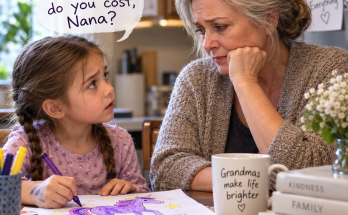
Nana costs love.
The next week, the old account was formally frozen into the restitution process.
I signed papers acknowledging I made no personal claim beyond correcting any tax or legal harm.
Rachel asked if I was certain.
“Yes.”
Thomas had called the money proof.
That was what it should remain.
Proof transformed into repair.
Then investigators uncovered one final message from Martin dating to the week after Thomas died.
Sent to Patricia.
T’s account stays untouched. Margaret knows nothing.
Patricia replied:
Keep it that way.
Martin:
She trusts me.
Three words.
Again.
Trust as a resource.
But beneath Patricia’s message, another response appeared.
Not from Martin.
From Samuel.
For now.
That phrase had governed eleven years.
For now, Margaret knows nothing.
For now, the account stays hidden.
For now, no one asks.
For now, children grow.
Marriages happen.
Fraud expands.
For now becomes years when nobody interrupts it.
Until a six-year-old asks one question at a kitchen table.
That night, Emily came to me carrying two folders.
One was the final divorce petition.
The other was a lease.
“I found an apartment.”
“Do you like it?”
“Yes.”
“Good schools?”
“Yes.”
“Close to work?”
“Twelve minutes.”
“Close to me?”
She smiled.
“Seven.”
“Too close.”
“I knew you’d say that.”
The apartment had three bedrooms.
A balcony.
A small courtyard.
No memories of Derek.
She had decided not to wait for the marital house to sell.
“I need somewhere that feels chosen.”
I understood.
“When do you move?”
“Next month.”
Then she hesitated.
“I need to ask something.”
“What?”
“When I move, I don’t want you doing everything.”
I laughed.
“I am capable of carrying boxes.”
“That’s not what I mean.”
I knew.
She continued.
“I don’t want you becoming automatic childcare again.”
That surprised me.
“You need help.”
“Yes.”
“But?”
“But I want to ask.”
Simple.
Powerful.
“I want schedules. I want you to say no. I want backup childcare. I want after-school care two days a week.”
“That costs money.”
“Yes.”
I heard Derek’s old philosophy inside the concern.
Why pay when Nana is free?
Emily heard it too.
“That is exactly why.”
I looked at her.
“You think paying someone else proves you respect me?”
“No.”
“Good.”
“I think having options means your yes stays a yes instead of becoming an expectation.”
That was different.
I nodded.
“Then yes.”
“To what?”
“To the arrangement.”
She smiled.
“See? I asked.”
We both laughed.
Weeks later, the children helped pack their new rooms.
My granddaughter carried a box labeled ART.
Her brother carried one toy truck and announced he was moving.
The rest of us did the work.
That evening, sitting amid cardboard, Emily received final notice.
The divorce would be uncontested.
Derek had signed.
No claim to property beyond what restitution courts allowed.
No custody litigation beyond future supervised-contact procedures.
She read it slowly.
“So that part is ending.”
“Yes.”
She looked around her new apartment.
“I thought I’d feel happier.”
“Endings are often quieter than anticipation.”
“I feel tired.”
“That sounds appropriate.”
Then her daughter ran in holding two keys.
“Mommy! Which one is mine?”
Emily laughed.
“You do not get a key yet.”
“Nana has keys.”
“Nana is sixty-seven.”
“I can wait.”
I said, “Excellent plan.”
The child pointed at me.
“Do you have our key?”
Emily looked at me.
A small question.
Old pattern.
Automatic access.
She reached into the box, removed a spare, and held it out.
I did not take it.
“Do you want me to have it?”
“Yes.”
“For emergencies?”
“And visits.”
“Not surprise cleaning?”
“Absolutely not.”
“Then I accept.”
The difference was tiny.
The difference was everything.
Click here to continue reading: PART 26: Emily’s New Home Forced Us to Relearn What Helping Each Other Meant, While My Granddaughter Began Asking Questions About Her Father
My Granddaughter Asked a Simple Question at My Kitchen Table, and Suddenly Four Years of Family Favors Looked Completely Different
Part 25 of 30