The second anniversary passed without anyone mentioning it until breakfast.
My granddaughter was eight now.
She sat at my kitchen table with one sock on, her hair half braided, and a piece of toast balanced dangerously close to her elbow.
Her brother, who had recently discovered the pleasure of contradicting everyone, was explaining that Tuesday was actually Wednesday.
“It’s Tuesday,” I said.
“No.”
I pointed to the calendar.
He studied it.
“That calendar is wrong.”
My granddaughter rolled her eyes.
“He’s four, Nana.”
“As opposed to you, ancient scholar.”
“I’m eight.”
“My mistake.”
She grinned.
The kitchen looked ordinary.
That was still capable of surprising me.
For a long time I had believed ordinary meant nothing bad was happening.
Now I understood ordinary was something people built.
Breakfast.
Calendars.
Missing socks.
A child refusing the crust.
A grandmother checking the stove twice.
None of it was automatic.
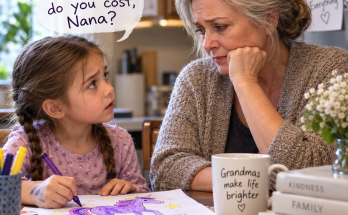
Two years earlier, at this same table, she had looked up from a purple unicorn and asked how much I cost.
That question had led to forty-eight false reimbursement claims, forged signatures, secret accounts, Linda Mercer, Martin, Patricia, Samuel, Adam, stolen identities, fraudulent properties, the planned attack on Emily, the truth about Thomas’s death, and the collapse of a criminal network that had hidden itself inside ordinary family routines.
Today she was asking whether she could take glitter glue to school.
“No.”
“Why?”
“Because last time you came home with glitter in your hair, your shoes, your backpack, and somehow your lunchbox.”
“That means I’m good at glitter.”
“It means glitter is a biological weapon.”
She laughed.
Emily arrived seven minutes later, carrying her laptop bag and apologizing because traffic had stalled.
“You don’t need to apologize.”
“I’m late.”
“Three minutes.”
“I said eight.”
“And it is eight-oh-three. Civilization survives.”
That was another change.
We no longer treated every inconvenience as evidence that someone had failed.
Emily kissed both children.
Then she turned to me.
“You’re still okay for pickup?”
“Yes.”
“Until six?”
“Yes.”
“And if Jonathan gets out early, he’ll call you before coming.”
“Excellent.”
She smiled.
The structure sounded almost comically formal to outsiders.
To us it was respect.
Plans stated.
Assumptions removed.
Permission preserved.
Emily and Jonathan had been together nearly a year.
He had not moved into her apartment.
They were not engaged.
No dramatic merging of households.
Their relationship advanced slowly enough that my granddaughter once complained:
“Are you ever going to get married or are you just going to eat dinner forever?”
Jonathan answered:
“We’re currently very committed to dinner.”
I liked him more after that.
Not because he was the opposite of Derek.
That comparison had gradually become less useful.
Jonathan deserved to be evaluated as Jonathan.
Emily deserved a relationship that was not defined by contrast with the man who hurt her.
And the children deserved adults who were not constantly using their father as the measuring stick for everyone else.
After Emily left that morning, I finished the braid.
My granddaughter inspected herself in the hallway mirror.
“You made this side crooked.”
“I’m a grandmother, not a structural engineer.”
“Grandpa was an engineer.”
“Yes.”
“Would he make braids straight?”
“No.”
“How do you know?”
“Because he once wrapped a Christmas present using electrical tape.”
She laughed so hard she had to sit down.
Stories about Thomas had changed too.
For the first year, almost every mention of him connected to the investigation.
Thomas discovered.
Thomas recorded.
Thomas was threatened.
Thomas died.
I had begun deliberately telling different stories.
Thomas burning hamburgers.
Thomas getting lost despite refusing directions.
Thomas singing the wrong lyrics.
Thomas building a bookshelf so sturdy that three movers complained about it.
A person should not become only the worst thing that happened to them.
Neither should a family.
After school that afternoon, my granddaughter asked to go into the basement.
“Why?”
“I need my old art box.”
“What old art box?”
“The one from before Mommy moved.”
We searched.
The basement no longer frightened me.
The repaired wall was visible if you knew where to look.
I knew.
I always would.
But knowledge was different from ownership.
The room belonged to laundry, storage, paint cans, and my ridiculous collection of holiday decorations again.
We found the art box behind two bins.
She opened it on the floor.
Crayons.
Dried markers.
Construction paper.
Stickers.
Then she pulled out a folded sheet.
Purple.
She unfolded it.
The unicorn.
Not the original one hanging near Thomas’s workshop.
Another drawing from the same period.
On this one, a purple unicorn stood beside three stick figures.
Mommy.
Nana.
Me.
No Derek.
My granddaughter stared.
“When did I make this?”
“A long time ago.”
“Before Daddy went away?”
“Yes.”
She looked at the picture.
“Why isn’t he here?”
“I don’t know.”
“Was I mad at him?”
“Maybe. Or maybe you ran out of room.”
She inspected the page.
“There’s lots of room.”
Children have an inconvenient relationship with evidence.
“Then maybe you were mad.”
She sat cross-legged.
“I don’t remember.”
“That’s okay.”
“I remember him making pancakes.”
“Yes.”
“And carrying me upstairs when I fell asleep.”
“Yes.”
“And being mad because I drew on the wall.”
“That happened.”
“I don’t remember the bad stuff.”
Her voice had changed.
Quiet.
“You weren’t supposed to know most of it.”
“Mom says he tried to hurt her.”
“Yes.”
“Did he try to hurt you?”
I sat beside her.
“Yes.”
“How?”
There are moments when the truth is not whether you answer.
It is how much.
“He put something dangerous in my house.”
“Like a bomb?”
“No.”
That was important.
“It could have made me sick.”
“Why?”
“He wanted people to believe something happened here that wasn’t his fault.”
She frowned.
“Like lying with stuff?”
That was remarkably accurate.
“Yes.”
She looked at the repaired wall.
“Was it here?”
“Yes.”
Her eyes widened.
I worried I had said too much.
Then she asked:
“Did you fix it?”
“The police removed it. Then I fixed the wall.”
“Can I see?”
I showed her the patch.
She touched the paint.
“That’s it?”
“That’s it.”
She seemed almost offended.
Children expect evil to leave more impressive scars.
“It looks normal.”
“It is normal now.”
That sentence mattered.
Not untouched.
Not unchanged.
Normal now.
She returned to the art box.
A few minutes later she asked:
“Nana, what did we lose?”
I did not understand.
“What do you mean?”
“When Daddy did everything.”
I sat back.
Where had that question come from?
“Why are you asking?”
“Our teacher talked about floods. She said families can lose houses and pictures and things you can’t buy again.”
She looked at me.
“So what did we lose?”
I could have said money.
We did.
Time.
We did.
Trust.
Certainly.
Thomas.
But he had died years before Derek entered our family, though Derek’s network had helped conceal the truth.
I thought carefully.
“We lost some things.”
“Like what?”
“Your mom lost the marriage she thought she had.”
She nodded.
“I lost some trust in people I had known for years.”
“Grandpa?”
“We learned the truth about how he died. That gave us answers, but it also gave us new grief.”
She picked at a crayon wrapper.
“What did I lose?”
The hardest question.
“Some time with your dad.”
Her eyes filled slightly.
“Yes.”
“And maybe some feeling that grown-ups always know what they’re doing.”
She laughed.
“I already know they don’t.”
“Then apparently that loss occurred naturally.”
She smiled.
“What else?”
“We lost the version of our family we thought we had.”
“Did we get another one?”
“Yes.”
“Better?”
I refused the easy answer.
“Different.”
She considered.
“Mommy is happier.”
“Yes.”
“You are too.”
“I think so.”
“My brother is annoying.”
“That appears unrelated.”
She smiled again.
Then she asked:
“Did we lose money?”
“Yes.”
“Did we get it back?”
“Some.”
“Did you get Nana money?”
There it was.
Two years later.
I laughed softly.
“No.”
“Why?”
“Because nobody owed me money for loving you.”
“But you watched us.”
“I chose to.”
“Daddy got money.”
“Your father falsely claimed he paid me. That was different.”
She understood more than she had at six.
“So he got paid because you worked?”
“In a way.”
“That’s stealing.”
“Yes.”
She became indignant on my behalf.
“You should get the money.”
“I don’t want it.”
“Why?”
“Because what I gave you was a gift.”
She frowned.
“If somebody steals a gift, it’s still stealing.”
I looked at her.
That child was going to exhaust attorneys someday.
“Yes.”
“But getting money afterward would not change what the gift was.”
She thought.
“So you wanted the choice.”
Exactly.
“Yes.”
She put the purple crayon down.
“Then that’s what he stole.”
I stared at her.
“What?”
“Your choice.”
Eight years old.
There it was.
All the legal language.
All the court orders.
All the financial records.
Reduced to something cleaner.
Your choice.
Derek took care I freely offered and converted it into a transaction I never agreed to.
He used my identity.
My signature.
My house.
My daughter.
My grandchildren.
He repeatedly turned other people’s choices into his resources.
“Yes,” I said.
“That is part of what he stole.”
She nodded, satisfied.
Then she returned to the art box.
Children sometimes ask the question adults spend years trying to formulate, receive an answer, and immediately become interested in stickers.
I envied that.
That evening, Emily came for pickup.
My granddaughter showed her the old drawing.
“Look.”
Emily studied it.
“When did you draw this?”
“Nana says before Daddy went away.”
Emily saw that Derek was absent.
Her eyes met mine.
I shook my head slightly.
Do not interpret.
She understood.
“It’s beautiful.”
“The unicorn’s legs are bad.”
“They’re expressive.”
“That means bad.”
“It means your mother paid too much for college.”
My granddaughter laughed.
After the children left, Emily remained.
“She asked you questions?”
“Yes.”
“How much?”
I told her.
Emily sat quietly.
“Was that too much?”
“No.”
“You’re sure?”
“I think so.”
Then she said:
“She’s going to want everything eventually.”
“Yes.”
“I’m scared of that.”
“So am I.”
“What if knowing changes how she sees herself?”
“It will.”
Emily looked at me.
I continued.
“Everything children learn about their parents changes how they see themselves.”
“That is not comforting.”
“It isn’t supposed to be.”
She sighed.
“What do we do?”
“Tell the truth in portions she can carry.”
“And when she can carry all of it?”
“Give her all of it.”
That was why I kept writing the family history.
Not a confession.
Not a prosecution brief.
A record.
I had reached nearly two hundred pages.
Rachel reviewed sections involving legal facts.
Emily corrected memories.
Carol contributed stories from Derek’s childhood.
Not excuses.
Context.
I included those too.
The children deserved a father who existed in full historical dimension.
Not a monster invented after conviction.
Not a victim invented by nostalgia.
A person who made choices.
Some loving.
Some selfish.
Some criminal.
Some nearly fatal.
Truth does not become kinder by becoming simpler.
A month later, Derek requested permission to send his daughter a longer letter for her ninth birthday.
The supervisor sent it to Emily first.
It was appropriate until the last paragraph.
I hope someday you understand I was not always the person who did those terrible things.
Emily stared.
“What do you think?”
“About the sentence?”
“Yes.”
“It is true and misleading.”
“Exactly.”
Derek had not always been committing those acts.
But he remained the same continuous person.
The sentence subtly invited his daughter to divide him into good Daddy and criminal Daddy.
Maybe that division helped him.
It should not be imposed on her.
Emily asked the supervisor to return it for revision.
Derek changed the sentence.
I hope someday you understand that the good memories you have with me were real, even though I also made choices that hurt our family.
Better.
Not comfortable.
Better.
My granddaughter received the letter.
She read it alone.
Then placed it in her desk.
No discussion.
That was her right too.
Not every emotion needed family processing.
Sometimes privacy is healthy.
The following spring, she had a school project called My Family Tree.
I braced myself.
She did not.
She put Emily.
Derek.
Her brother.
Me.
Thomas.
Carol.
Then Jonathan in a dotted circle labeled MOM’S BOYFRIEND.
Jonathan laughed for ten minutes.
She asked whether Linda belonged.
“No.”
“Martin?”
“No.”
“Mrs. Patterson?”
“Not technically.”
“She brings food.”
“That is a strong argument.”
She added Mrs. Patterson under FRIEND FAMILY.
I approved.
Then she asked:
“Can families have people who did bad things?”
“Yes.”
“Do you erase them?”
“No.”
That answer came easily.
“You tell the truth about where they belong.”
She wrote Derek’s name.
No decoration.
No erasure.
Just his place.
That night I looked at the tree after everyone left.
Thomas’s name on one branch.
Derek’s on another.
Me between generations.
My granddaughter had drawn lines connecting people who would never sit together.
Some dead.
Some imprisoned.
Some separated.
Some chosen.
Some biological.
Some honorary.
A family tree does not certify goodness.
It records relationship.
What we do with those relationships remains choice.
I finally understood why I had resisted describing the ending as getting my family back.
We did not get it back.
That family no longer existed.
We built another.
Not from nothing.
From what remained true.
Emily loved her children.
The children loved both parents in complicated ways.
I loved them.
Carol loved them.
Thomas had loved us.
Mrs. Patterson showed up.
Jonathan was slowly earning a place.
Truth remained.
Choice remained.
That was enough material.
The following Tuesday, my granddaughter arrived after school carrying the family tree.
“Teacher gave me an A.”
“Excellent.”
“She said my family is complicated.”
“Rude.”
“She said everybody’s is.”
“Less rude.”
She put her backpack down.
Then pointed at the kitchen table.
“Can I color?”
“Of course.”
She took out a blank page.
“What are you drawing?”
“Unicorn.”
“Purple?”
She looked offended.
“Obviously.”
I made tea.
She colored.
For a moment the room aligned with memory so perfectly that I could almost see her six-year-old self sitting there.
Smaller hand.
Same concentration.
Same purple crayon.
Then she looked up.
“Nana?”
My body reacted before my mind did.
“Yes?”
“How much do you cost?”
I stared.
She held the serious expression for exactly two seconds.
Then burst into laughter.
“You’re not funny.”
“I’m very funny.”
“I nearly had a heart attack.”
“You said Grandpa had heart problems.”
“That does not improve the joke.”
She laughed harder.
Then she reached across the table and squeezed my hand.
“I know the answer now.”
“What is it?”
“You don’t cost.”
I waited.
She corrected herself.
“You choose.”
That was better.
Much better.
Click here to continue reading: PART 30: On the Morning My Granddaughter Finally Read the First Page of Our Family History, She Gave Me the Answer I Had Needed All Along
My Granddaughter Asked a Simple Question at My Kitchen Table, and Suddenly Four Years of Family Favors Looked Completely Different
Part 29 of 30