I knew I had been left out before anyone admitted it. The proof was sitting in my kitchen in the form of a casserole dish I had not been asked to bring anywhere.
It was Thursday afternoon, and I was standing at the counter trimming the browned edges from a roast when my phone rang. Sarah’s name appeared on the screen. I wiped my hands on a towel before answering, expecting one of the ordinary requests that had become part of our family routine.
“Hi, Mom,” she said.
Her voice had that careful brightness I had learned to recognize. It was the tone she used when she wanted something but did not want to begin by asking for it.
“Hello, Sarah. Everything all right?”
“Yes. I was just checking on you.”
I smiled despite myself. “That’s unusual.”
There was a pause.
“What do you mean?”
“Usually you check on me because one of the twins needs something.”
She laughed, but the laugh was short. “They’re fine.”
I turned off the burner beneath the roast.
“Good. How is the reunion planning going?”
Another pause.
That was when I knew.
Not because she had said anything cruel. She had not. She simply became very quiet, and silence can sometimes be more honest than words.
“The reunion is coming together,” she said eventually.
“I heard there would be quite a crowd.”
“Probably.”
“Where is it being held?”
“At my parents’ place.”
I leaned against the counter.
Sarah’s parents lived almost three hours away. Their family gatherings were usually noisy affairs, with folding tables scattered across the lawn, children running between parked cars, and enough food to feed a small town. I had attended several over the years. I had brought pies. I had paid for groceries. Once, when rain ruined the outdoor arrangements, I had covered the cost of renting a community hall.
This time, no one had mentioned a date to me.
“Saturday?” I asked.
“Yes.”
“You never told me.”
She exhaled.
“I thought David had.”
I looked through the kitchen window toward the backyard.
“David hasn’t said anything.”
“I’m sorry.”
There was something about the way she said it that made the apology feel less like regret and more like a conclusion.
I picked up the towel again.
“So I’m not invited.”
“Mom, it’s complicated.”
That phrase had become a small warning in our family. Whenever something was called complicated, it usually meant someone had already made a decision and wanted everyone else to accept it without asking too many questions.
“What’s complicated about inviting me?”
“It’s my family’s reunion.”
I stared at the refrigerator.
“I’m aware of that.”
“There are already so many people.”
“How many?”
“More than fifty.”
I almost laughed.
“Sarah, I’ve been to gatherings with your family before. Fifty people isn’t exactly a natural disaster.”
“That’s not what I mean.”
“Then what do you mean?”
She did not answer.
I waited.
Finally she said, “Some people were uncomfortable with the idea.”
I felt something small and cold settle beneath my ribs.
“Some people?”
“My parents. A few relatives.”
“Because of me?”
“It’s not really about you.”
I looked down at the roast I had been preparing for dinner.
That was the moment I understood that it was entirely about me.
I had spent five years telling myself that my son’s marriage had simply become complicated after his father died. David had changed gradually. Sarah had become more controlling. Their children had grown older. Their business had struggled and then stabilized. Through all of it, I had kept finding explanations for things that hurt.
Grief makes people distant.
Work makes people distracted.
Children make people busy.
Money makes people anxious.
Family makes people complicated.
I had used every explanation except the simplest one.
Sometimes people become accustomed to receiving from you, and eventually they stop seeing you as a person who can be hurt.
“Mom?” Sarah said.
“Yes.”
“Are you upset?”
I looked out the window again.
“No.”
That was a lie.
But it was an old kind of lie, the kind women learn to tell because saying the truth often creates more work than swallowing it.
Sarah continued, “David thought you might understand.”
I closed my eyes.
“Did he?”
“I think so.”
“Did he know I wasn't invited?”
“Yes.”
The answer came too quickly.
I opened my eyes.
“Then he could have told me himself.”
“He didn’t want to hurt you.”
I let out a quiet breath.
“Not telling me was supposed to hurt less?”
She did not respond.
After we ended the call, I stood in the kitchen for several minutes with the towel still in my hand.
The house was very quiet.
My husband had been gone for five years, and there were days when I still expected to hear him moving around upstairs. He had been the kind of man who believed silence should be filled with something useful, even if that something was simply making coffee or fixing a loose hinge.
After he died, the house changed.
Not physically.
The walls were the same. The oak floors still creaked in the same places. His workbench still carried the shallow scratches from years of tools being dragged across it.
But the house stopped feeling like a place where I was expected.
For a long time, David became the person who filled that absence.
At least, that was how I had thought of it.
I helped him with the children. I watched the twins on Tuesdays. I kept boxes of their winter clothes in my garage. When their business had a bad year, I quietly transferred money into their account. When their refrigerator died, I paid for a replacement. When Sarah complained about being overwhelmed, I came over and cleaned their kitchen while she took the children to soccer.
I never made a list.
I never asked for repayment.
I never said, You owe me.
That was partly because I loved them.
It was also because I had confused being useful with being close.
The next morning, I drove to the bank.
I had made an appointment two weeks earlier, before the reunion conversation, though at the time I had no idea how important that appointment would become.
The cottage had been on my mind for months.
It was not large. Two bedrooms, one bathroom, a narrow kitchen, and a porch overlooking three acres of wooded land. The place had been neglected for years, which was probably why the price was within my reach.
I had visited it alone.
I had walked through rooms that smelled faintly of cedar and old dust.
I had opened the windows and listened to the wind moving through the trees.
For the first time in years, I had imagined waking up somewhere without immediately thinking about what someone else needed.
I had not told David.
I had not told Sarah.
I had not told anyone except Emma.
Emma was my daughter and David’s younger sister. She lived several states away, but she had always understood the difference between asking for help and expecting it.
When I called her that Friday evening, she answered on the second ring.
“How did it go?”
“I signed the papers.”
There was a pause.
“You bought it?”
“Yes.”
“The cottage?”
“Yes.”
She laughed softly.
“Mom, you actually did it.”
I looked through the living room window at the dark street.
“I think I needed to.”
“Does David know?”
“No.”
“Sarah?”
“No.”
“Good.”
I smiled.
“You sound very pleased.”
“I am.”
Emma became quiet.
Then she asked, “Did you ever tell me why you wanted it?”
I considered the question.
“I wanted somewhere that was mine.”
“You already have a house.”
“I know.”
“Then why another one?”
I looked around the room.
Because this house contained too many expectations.
Because every room seemed to have become assigned to someone else.
Because the garage was filled with boxes that belonged to David.
Because Tuesdays meant babysitting.
Because Fridays meant grocery runs.
Because every time the phone rang, I wondered what emergency had arrived.
Because I had begun measuring my own days according to everyone else’s needs.
“I wanted a place where nobody needed anything from me,” I said.
Emma was silent for a moment.
“Then you should go.”
“I haven't even told them.”
“You don't have to ask permission.”
I smiled.
“That sounds very simple.”
“It is simple.”
“Families aren't.”
“No,” she said. “But that doesn't mean you have to make your life complicated for them.”
The cottage became mine the following week.
I moved slowly.
A few books.
Two chairs.
My sewing basket.
My husband’s old coffee grinder.
A small table that had belonged to my mother.
I did not move everything. I did not need to.
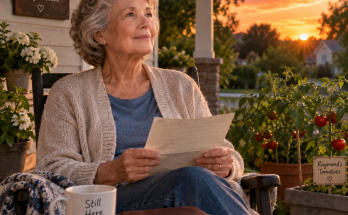
The first evening, I sat on the porch with a mug of coffee and listened to insects humming in the grass.
There were no children shouting.
No television.
No phone ringing.
No one asking whether I could pick something up on the way over.
I should have felt guilty.
Instead, I felt calm.
That was when I realized how tired I had been.
The reunion happened two days later.
I did not attend.
I did not send an angry message.
I did not ask David why he had allowed it.
I simply stayed at the cottage.
Around noon, my phone began buzzing.
Photos appeared in the family group chat.
A long table.
A barbecue.
Children running through the yard.
Sarah standing beside her parents.
David near the grill.
I stared at the photographs for a long time.
Then I noticed something.
There were more than fifty people in those pictures.
And not one of them seemed to notice I was missing.
I set the phone face down.
About an hour later, David called.
I almost didn't answer.
“Mom?”
“Hello.”
“I heard you weren't feeling well.”
I looked toward the trees.
“I wasn't invited.”
He went quiet.
“Sarah said—”
“Don't blame Sarah.”
“I’m not.”
“You knew.”
“Yes.”
“Why didn't you tell me?”
He sighed.
“I didn't want a fight.”
“So you chose silence.”
“Mom, please.”
I closed my eyes.
“I would have preferred the truth.”
“I know.”
“No, David. I don't think you do.”
He didn't answer.
I could hear voices behind him.
The reunion was still going.
Someone laughed.
A child shouted.
Life continued without me.
Finally David said, “Can we talk next week?”
“Yes.”
“Thank you.”
We ended the call.
I sat on the porch until sunset.
Then I made a decision.
I wasn't going to chase my place back into anyone's family.
If I belonged somewhere, I wanted it to be because someone wanted me there—not because I was useful.
The next morning, I unpacked the last box.
On top was a framed photograph of my husband.
I placed it on the mantel.
Then I looked around the room.
For the first time, the cottage did not feel like an escape.
It felt like a beginning.
And I had no idea that before I could enjoy that beginning, my family would come looking for what they believed I had bought for them.
Click here to continue reading: PART 2: The Cottage Was Supposed to Be My Quiet Place, Until One Conversation Revealed That My Family Had Already Given It a Future
The Invitation Never Came, and the Empty Place at the Family Table Told Me More Than Anyone Would Say Aloud
Part 1 of 27