The first Monday after the final hearing felt strangely ordinary.
There were no police cars outside the house.
No unfamiliar vehicles parked across the street.
No reporters waiting near the sidewalk.
Renata complained about her math homework.
She forgot where she'd left her blue sweater.
She argued with me about whether breakfast counted as breakfast if she ate it in the car.
Those small arguments felt like gifts.
I drove her to school with the radio off.
She watched houses pass through the window.
Then she asked, “Do you think people still talk about us?”
“Probably.”
“Do you care?”
I glanced at her.
“Less than I used to.”
She nodded.
At school, the principal had arranged for Renata to enter through a side door.
It was supposed to make things easier.
Instead, she stopped before the entrance.
“What if someone asks?”
“You can say you don't want to talk.”
“What if they don't listen?”
“Then you come find me.”
She studied my face.
“You'll come?”
“Every time.”
She finally walked inside.
I waited until the door closed.
Then I sat in the car for several minutes.
There was no emergency.
No crisis.
Nothing to solve.
And yet I couldn't make myself drive away.
The habit of vigilance had settled into my bones.
It took time to teach your body that danger had ended.
By afternoon, Renata came home carrying a folded notice from school.
“What is that?”
“Nothing.”
She put it on the kitchen counter.
I opened it.
The school was announcing a new safety program for students.
Counselors.
Anonymous reporting.
Training for staff.
A review of outside programs involving children.
I read the page twice.
Renata watched me.
“Is that because of us?”
“Partly.”
“Does that mean they believe me?”
“They believed you long before this.”
She shook her head.
“No.”
“What do you mean?”
“They believed the evidence.”
I stopped.
She was right.
Adults often said they believed children, but belief became meaningful when it changed what they did.
A frightened child could tell the truth.
The truth still needed someone willing to act.
Renata picked up the notice.
“There was something else.”
“What?”
“They're asking students to write about a person who helped them.”
“You don't have to.”
“I want to.”
“Who are you writing about?”
She looked embarrassed.
“You.”
I smiled.
“You don't have to write about me.”
“I know.”
She folded the paper.
“I want to.”
That evening, I found her at the dining table.
Her pencil moved slowly.
She erased more than she wrote.
Finally she pushed the page toward me.
“Don't read it yet.”
“Okay.”
She went upstairs.
I left the page untouched.
Later, she returned.
“You can.”
The first sentence said:
“My mother listened when everyone else wanted me to stop talking.”
I read the rest quietly.
She didn't describe the investigation.
She didn't describe the hidden rooms.
She didn't mention the names.
She wrote about a bathroom door.
A gray blanket.
A cold hand.
And a phone call.
At the end she wrote:
“She didn't know what happened, but she knew something was wrong.”
I looked at her.
“This is good.”
“It sounds sad.”
“It sounds honest.”
She took the paper back.
“That's what I wanted.”
The next morning, she handed it to her teacher.
Nothing dramatic happened.
There was no applause.
No announcement.
She simply went to class.
That mattered.
Life was becoming ordinary again.
Then, three weeks later, Detective Alvarez called.
I almost didn't answer.
When I saw her name, my stomach tightened.
“Hello?”
“I'm sorry to call unexpectedly.”
“What happened?”
“Nothing dangerous.”
I waited.
“There was a development with one of the archived records.”
“What kind?”
“A family contacted us.”
“About what?”
“A name.”
She gave it to me.
I didn't recognize it.
“Why are you calling me?”
“Because they believe the person listed under that name may be related to your father.”
I felt the old tension return.
“Who?”
“A woman.”
“Is she alive?”
“Yes.”
“Where?”
“She lives in another state.”
“What does she want?”
“She says she has something that belonged to your father.”
I sat down.
“What?”
“We don't know.”
“Then why tell me?”
“Because she mentioned the archive.”
I closed my eyes.
“Is this connected to the network?”
“Not necessarily.”
That distinction mattered.
The investigation had ended.
The convictions stood.
The children were safe.
The remaining questions were historical.
Not immediate.
Still, I agreed to meet her.
The woman arrived two days later.
Her name was Clara.
She was in her sixties.
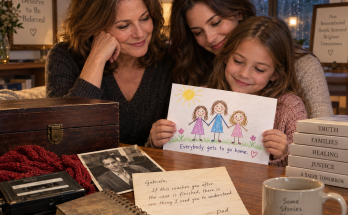
She carried a small wooden box.
When she placed it on the table, I recognized the wood immediately.
My father had owned it.
“Where did you get that?”
“He gave it to me.”
“When?”
“Before he died.”
“Why?”
“He asked me to keep it until you were ready.”
I stared at the box.
“You knew about the archive?”
“Not everything.”
“What did you know?”
“That your father was afraid.”
“Of the organization?”
“Yes.”
“Of my uncle?”
“Yes.”
“Of Margaret?”
Clara nodded.
She opened the box.
Inside was a cassette recorder.
An old photograph.
And a letter.
My father's handwriting covered the envelope.
I didn't open it.
Not yet.
Clara watched me.
“He told me not to give you this unless the children were safe.”
“They are.”
“I know.”
“Then why didn't he give it to me himself?”
“He thought you would refuse to believe him.”
“That sounds like him.”
Clara smiled sadly.
“He regretted that.”
The letter contained no secret organization.
No hidden criminal.
No new threat.
It was simply my father's explanation.
He wrote that he had spent years believing fear could be managed through silence.
He admitted that he had confused protecting his family with controlling what his family knew.
He apologized.
Not for what the organization had done.
For what his silence had cost me.
I read the letter twice.
Then I folded it.
Clara asked whether I wanted the recorder.
“Yes.”
The recording was only twelve minutes.
My father's voice sounded younger than I remembered.
He described the first time he saw the altered records.
He named people.
He described the decision to preserve evidence rather than destroy it.
And then he said something I had never heard from him.
“If Gabriela ever finds this, tell her I wasn't trying to make her carry my fight.”
I stopped the recording.
Renata was standing in the doorway.
“Was that Grandpa?”
“Yes.”
“What did he say?”
I looked at her.
“He said he didn't want me to carry his fight.”
“Are you?”
“No.”
She smiled.
“Good.”
That night, I put the box away.
Not in a hidden place.
Not beneath a floorboard.
Not behind a locked cabinet.
I placed it on a shelf beside family photographs.
For the first time, a secret became simply part of history.
Click here to continue reading: PART 22: The Archive Was Finally Opened to the Families, and Renata Discovered That Her Own Name Was Only One Piece of a Larger Story
The Bus Arrived Late, and One Small Detail Made Me Realize My Daughter Had Come Home Carrying Something No Child Should Have
Part 21 of 27