Months passed.
The archive became part of a formal historical investigation.
Families were invited to submit questions.
Records were reviewed carefully.
Names were restored.
Incorrect dates were corrected.
False identities were documented rather than repeated.
The process was slow.
Sometimes painfully slow.
But it was transparent.
That mattered.
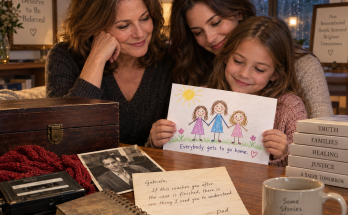
I attended one meeting with Sofia and Daniela.
A researcher placed a box on the table.
“These are the records associated with Elena.”
Sofia touched the lid.
She didn't open it immediately.
Daniela reached for her hand.
“You don't have to.”
“I know.”
Sofia smiled.
“I want to.”
Inside were photographs.
School papers.
Letters.
Medical records.
A photograph of Elena at sixteen.
Sofia began crying.
Not loudly.
Just enough that Daniela leaned against her.
I looked away.
Some moments belonged entirely to families.
Later, the researcher asked whether we wanted to see the original list.
I did.
Renata's name was there.
So was mine.
My father's.
My grandfather's.
But beneath our names was a note I had never seen.
“Family retains documentary evidence.”
The phrase explained why they had watched us.
They weren't simply afraid of what my father knew.
They were afraid that he had left something behind.
He had.
He had left the archive.
He had left the property documents.
He had left copies of the photographs.
Most importantly, he had left a daughter who finally understood what they meant.
Renata came with me to one of the later meetings.
She was older now.
Still young.
Still unmistakably herself.
A researcher asked whether she wanted to see the photograph from the camp.
She said no.
The researcher respected that.
That was another difference.
No one forced her to revisit anything.
She could choose.
On the way home, she asked:
“Do people ever get tired of talking about it?”
“Yes.”
“Me too.”
“Then we don't have to.”
She looked out the window.
“Good.”
A week later, Daniela called.
She had received a letter.
Her grandmother had left something for her.
A red scarf.
Daniela wanted to know whether Renata remembered it.
Renata did.
The scarf had been in the hidden room.
It had been one of the clues that first connected Daniela to the older records.
Daniela brought it over.
She unfolded it on our kitchen table.
The fabric was faded.
One corner was torn.
“I thought this belonged to someone else,” she said.
“It probably did.”
She turned it over.
There was writing inside the seam.
A name.
Elena.
Daniela stared.
“My grandmother.”
Sofia touched the fabric.
“She must have hidden it.”
“Why?”
“Because it was proof.”
Proof of what?
The researcher later explained that Elena had used the scarf to mark a specific box in the archive.
The box contained records from the first year the identity program had been abused.
That discovery filled another gap.
The system hadn't appeared overnight.
It had changed gradually.
One compromise became another.
One frightened employee became another.
One altered document became hundreds.
The people involved had eventually convinced themselves that what they were doing was normal.
The evidence showed otherwise.
Renata listened when I explained this.
“So it started small?”
“In some ways.”
“Then how did it become so big?”
“People kept deciding the next wrong thing was easier than stopping.”
She considered that.
“That sounds dangerous.”
“It is.”
“Because one lie makes the next one easier?”
“Yes.”
She nodded.
Then she said:
“That's why telling the truth early matters.”
I smiled.
“Exactly.”
The school eventually invited me to speak to parents.
I didn't want to.
I told them I wasn't an expert.
They said they didn't want an expert.
They wanted someone who had lived through the moment when an ordinary explanation stopped making sense.
I agreed.
I stood in a small auditorium.
No cameras.
No reporters.
Just parents and teachers.
I told them about the missing backpack.
The damp hair.
The blanket.
The fear of the bathroom.
I didn't describe the worst parts.
I didn't need to.
The lesson was simpler.
Listen when a child behaves differently.
Don't force a child to tell a perfect story.
Don't let an institution's reputation become more important than a child's safety.
And when something feels wrong, document it.
Ask questions.
Seek help.
I told them that fear can make children speak indirectly.
Sometimes a child won't say, “Someone hurt me.”
They might say, “I don't want to go in that room.”
They might say, “Don't close the door.”
They might say, “They told me not to tell.”
Those sentences matter.
Afterward, a father approached me.
His daughter had recently returned from an overnight program.
She had become unusually quiet.
He had assumed she was tired.
Now he wanted to listen more carefully.
I told him to take her seriously.
Not because something terrible had necessarily happened.
Because she deserved to be heard regardless.
That distinction mattered.
We didn't need to turn every fear into a crime.
We needed to stop teaching children that adults automatically knew better than they did.
That evening, Renata asked what I had talked about.
“Listening.”
“To kids?”
“Yes.”
She smiled.
“Good.”
She had begun writing again.
Not about the camp.
Stories.
Funny ones.
She wrote about a girl who accidentally adopted a stray chicken.
Another about a teacher who forgot his own birthday.
Another about a family whose dog stole socks.
I loved those stories.
They meant her imagination was no longer trapped inside the worst thing that had happened to her.
One afternoon she handed me a new story.
“What do you think?”
I read it.
The main character was a girl who found a locked room.
But this time the girl didn't open it.
She walked away.
She found an adult.
She told someone.
Then the story ended with the door being opened safely by people who knew what they were doing.
I looked at Renata.
“You changed the ending.”
“I wanted to.”
“Why?”
“Because the girl doesn't have to solve everything herself.”
I hugged her.
She laughed.
“Mom, you're crushing me.”
“Sorry.”
“You're not.”
She leaned against me.
The past remained.
It always would.
But it no longer controlled every room in the house.
And that was a kind of recovery too.
Not forgetting.
Not pretending.
Simply allowing something else to occupy the space.
Click here to continue reading: PART 23: One Final Visit to the Retreat House Forced Gabriela to Face the Place Where Everything Began Without Letting It Decide What Happened Next
The Bus Arrived Late, and One Small Detail Made Me Realize My Daughter Had Come Home Carrying Something No Child Should Have
Part 22 of 27