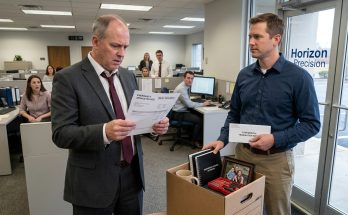
Arthur Wynn refused to return to Horizon.
He also refused to speak at the airport.
Detective Ortiz arranged for him to be brought to the county administration building, where he agreed to provide an interview with counsel present.
Samuel wanted to go.
Ortiz allowed him.
She allowed me too, but only after explaining that Arthur had specifically requested my presence.
That made me suspicious enough to accept.
Richard remained at Horizon under police supervision.
Nadia stayed with the digital evidence.
Walter and Mason remained with the Meridian machine.
Cho’s team began independently securing the substituted Calder part.
Claire volunteered to stay near HR records.
By 9:06, Samuel and I were sitting in a plain conference room across from Arthur Wynn.
I had seen him at company events dozens of times.
Seventy years old, expensive suits, calm voice, the kind of man who remembered employees’ names just often enough to seem attentive.
Tonight he looked smaller.
His collar was open.
His hands trembled slightly when he lifted a paper cup.
His attorney sat beside him.
Ortiz placed a recorder on the table.
Arthur looked at Samuel first.
“I made mistakes.”
Samuel gave him nothing.
“Start with Martin.”
Arthur looked at me.
“Martin Vale joined Horizon because of Calder.”
That confirmed what we already suspected.
Samuel said, “Explain.”
“Four years ago, Calder had a material problem.”
“We know.”
Arthur’s eyes shifted.
“You know about VLT?”
“Yes.”
His face fell.
“Then you know enough to understand why this matters.”
I leaned forward.
“No. We know pieces. You’re going to connect them.”
Arthur studied me.
Then nodded.
“VLT Industrial Testing was owned by one of my investment funds. I wasn’t involved day to day.”
Samuel made a disgusted sound.
Arthur ignored him.
“Calder brought aluminum lots to VLT for verification. Some failed process criteria.”
“Heat treatment?” I asked.
“Yes.”
“What should have happened?”
“Quarantine. Reprocessing where permitted. Destruction otherwise.”
“What did happen?”
Arthur looked down.
“Certificates were changed.”
“By VLT?”
“By people at VLT under pressure from Calder.”
“Did you know?”
“Not initially.”
“When did you learn?”
“Before Meridian investigated.”
Cho had said Martin led that investigation.
I asked, “And what did you do?”
Arthur took a long breath.
“I tried to contain it.”
Samuel laughed bitterly.
“Contain it.”
“If the issue became public, VLT collapsed. My fund took the loss. Calder lost contracts. There were lawsuits.”
“And unsafe material could enter aircraft.”
Arthur’s jaw tightened.
“I was told the risk was theoretical.”
“That phrase should embarrass you more than it does.”
His attorney started to object.
Arthur raised a hand.
“He’s right.”
That surprised me.
“What was Martin’s role?”
“He was consulting for Meridian’s compliance group.”
“Did he discover the falsified certificates?”
“Yes.”
“And?”
Arthur rubbed his face.
“He came to me.”
“Why?”
“Money.”
Samuel stared.
Arthur continued.
“Martin understood the investigation could ruin several companies. He offered a solution.”
I already disliked the word.
“What solution?”
“He would narrow the investigation, certify destruction of identified stock, and close the matter as a documentation failure rather than systemic fraud.”
“In exchange?”
“Payments.”
“How much?”
Arthur looked toward his attorney.
The attorney said nothing.
“Three million initially.”
Samuel’s face hardened.
“And later?”
“More.”
Martin had not been corrupted after coming to Horizon.
He had arrived already practiced.
“What happened to the material?” I asked.
“Some was destroyed.”
“Some.”
Arthur closed his eyes.
“Calder retained several lots.”
“Including CX-0914.”
“Yes.”
“And Martin knew.”
“Yes.”
“Then why was piece 117 certified destroyed?”
“Because Martin signed the destruction records.”
I thought of the serial number inside our machine.
A surviving physical contradiction to Martin’s signature.
Samuel asked, “Why join Horizon?”
Arthur looked at him.
“Because years later Calder wanted you.”
“Horizon.”
“Yes.”
“Why?”
“Your aerospace capability. Your workforce. Your facility.”
Samuel’s expression remained cold.
“They could have made a normal offer.”
“They did.”
“And I rejected it.”
“Yes.”
Arthur’s fingers tightened around the cup.
“Martin believed you would.”
“So you placed him here.”
“No.”
“Arthur.”
“I introduced him.”
“That is placing him here.”
Arthur looked away.
Samuel continued.
“You were on the compensation committee. You approved his background exceptions.”
“Yes.”
“You concealed his Meridian consulting history.”
“Yes.”
“Why?”
“To keep questions from being raised.”
The room went quiet.
Ortiz asked, “When did the plan become criminal?”
Arthur looked almost offended by the wording.
Then seemed to realize how ridiculous that reaction was.
“There wasn’t one moment.”
“There usually isn’t,” Ortiz said. “Pick the first crime you knowingly assisted.”
Arthur swallowed.
“The altered background file.”
“Then?”
“Information sharing.”
“What information?”
“Horizon financials. Strategy. Board sentiment.”
“Did you provide them to Calder?”
“Some.”
Samuel’s hands flattened on the table.
“Everything I discussed in board meetings?”
“Not everything.”
“Enough.”
“Yes.”
I asked, “When did Meridian enter the plan?”
“About eight months ago.”
Before Horizon publicly announced pursuit of the program.
“How did Calder know we were bidding?”
Arthur did not answer.
Samuel’s voice became quieter.
“You told them.”
Arthur nodded.
“And they realized winning Meridian would make Horizon harder to acquire.”
“Yes.”
“So the plan became to prevent the award.”
“At first.”
“At first?”
“They tried normal competitive pressure. Pricing. Supplier interference. Recruiting.”
“And when that failed?”
Arthur looked at me.
“Martin proposed operational disruption.”
The phrase from the documents.
“What did that mean originally?”
“A missed readiness milestone. Delayed qualification. Something embarrassing enough to weaken confidence.”
“Not destroying a machine?”
“No.”
“Not framing me?”
“No.”
“Not kidnapping Tyler?”
“No.”
Arthur became more animated.
“That was Martin. He escalated everything.”
Convenient.
I watched his face.
“You expect us to believe you remained involved while Martin moved from corporate pressure to sabotage, but you somehow didn’t know?”
“I knew pieces.”
“Which pieces?”
“I knew Tyler was feeding information.”
“Did you recruit him?”
“No.”
“Richard?”
“I knew Martin was cultivating Richard.”
“For the acquisition.”
“Yes.”
“Did you know Richard would fire me?”
Arthur hesitated.
That was enough.
“You knew.”
“I knew Martin wanted you removed.”
“Why?”
“Because you were interfering with the schedule.”
“What schedule?”
“The qualification disruption.”
Samuel looked at me.
Arthur continued.
“You kept closing vulnerabilities. You added backups. You insisted on independent verification. You kept documenting machine baselines.”
I almost laughed.
“So competent engineering became inconvenient.”
“To Martin, yes.”
“And the fake board instruction?”
Arthur looked down.
“My board credentials were used.”
“By you?”
Silence.
“Arthur.”
“Yes.”
Samuel stood.
Ortiz told him to sit.
He did, but barely.
“You used your board authority to order Ethan’s termination?”
Arthur nodded.
“Martin drafted the request. I authenticated it.”
“Why?”
“He said Ethan needed to be off-site before the machine fault.”
“And you accepted that?”
“I thought it would be a controlled failure.”
I stared at him.
“You knowingly helped fire me so someone could damage a machine after I left.”
“Yes.”
“And when the evidence blamed me?”
“I didn’t know that part.”
Maybe true.
Maybe not.
Ortiz asked, “Why did you leave your house tonight?”
Arthur’s expression changed.
“Martin called me.”
“When?”
“About six-thirty.”
“What did he say?”
“That Samuel had found the Calder documents.”
“He told you to run.”
“He told me police would interpret everything as conspiracy.”
“They might have a reason.”
Arthur ignored that.
“He said we needed to meet at the airport.”
“Did you?”
“No.”
“Why?”
“He wasn’t there.”
“What was?”
“A bag.”
Ortiz leaned forward.
“What bag?”
“In Hangar Twelve.”
“What was inside?”
“Cash. Passport. Documents.”
“For you?”
“Yes.”
“How much cash?”
“Two hundred thousand.”
“And the passport?”
“Mine.”
Samuel looked sick.
Martin had prepared an escape package.
“What documents?” I asked.
Arthur hesitated.
“Acquisition agreements.”
“With Calder?”
“Yes.”
“Signed?”
“Some.”
“By whom?”
“Martin. Calder executives. Me.”
Samuel stared.
“You signed an agreement to sell a company you don’t own.”
“To support a board transaction.”
“Without telling the board.”
Arthur looked away.
Ortiz asked, “Where is the bag now?”
“Police have it.”
“What happened after you found it?”
“I realized Martin was setting me up.”
I almost laughed.
Everyone discovered morality when the frame pointed toward them.
“How?” I asked.
“There was another document.”
“What?”
“A confession.”
“Yours?”
“Yes.”
“Signed?”
“No.”
Arthur looked genuinely frightened.
“It said I directed everything. Tyler. Richard. Ethan’s termination. The machine sabotage. Even the old Calder material.”
“Martin intended police to find you with it.”
“Yes.”
“And now?”
Arthur stared at me.
“Now I think he intended all of us to carry parts of his crimes.”
That fit.
Martin had constructed layered responsibility.
Richard looked guilty because he was guilty of some things.
Arthur looked guilty because he was guilty of others.
Tyler had physically carried out sabotage.
My credentials tied me to everything.
Each person’s real misconduct made the false additions believable.
A good frame was not built from pure fiction.
It was built from truth, then extended.
I asked, “Where is Martin going?”
Arthur shook his head.
“I don’t know.”
“Where would he go if this collapsed?”
“I don’t know.”
“What assets does he control?”
“No idea.”
“What does he care about?”
Arthur thought.
“Control.”
“That’s not useful.”
“He hates uncertainty.”
Better.
People who hated uncertainty created contingencies.
“How many?”
“What?”
“How many fallback plans did he have?”
Arthur gave a tired smile.
“Always three.”
My mind went back through the day.
Primary plan: machine fails, I get blamed, qualification collapses.
Secondary: hidden routine destroys machine and old evidence.
Third?
We had not found it yet.
I sat straighter.
“What was Martin’s third contingency for Meridian?”
Arthur looked confused.
“I don’t know.”
“Yes, you do.”
“I don’t.”
“You’ve worked with him for years. If technical disruption failed and destroying the machine failed, what came next?”
Arthur’s face slowly changed.
Samuel saw it.
“What?”
Arthur whispered, “Customer confidence.”
“How?”
“He said once that programs don’t fail because of machines. They fail because decision-makers stop trusting suppliers.”
I looked at Ortiz.
“What could make Meridian lose trust even after a successful qualification?”
The answer came from Samuel.
“Fraud.”
False certifications.
Stolen material.
Compromised test parts.
If Martin could prove—or fabricate—that Horizon had knowingly used bad aerospace stock, Meridian would walk away regardless of machine performance.
The substituted Calder part suddenly had another purpose.
Not merely destruction evidence.
If discovered under the wrong circumstances, it could be presented as Horizon knowingly machining prohibited material.
Martin had positioned us to look complicit.
My phone rang.
Nadia.
I answered.
“What did you find?”
Her voice was tight.
“The Meridian material certificates.”
“What about them?”
“Tyler was right. Several were altered.”
“How many?”
“Eight.”
“Can you trace who changed them?”
“That’s why I’m calling.”
I closed my eyes.
“Whose credentials?”
“Yours.”
Of course.
“But that isn’t the worst part.”
“What is?”
“The altered certificates were already transmitted externally.”
“To Meridian?”
“No.”
“Then where?”
“A federal reporting portal.”
Ortiz heard that.
She stood.
“What report?”
Nadia continued.
“Anonymous safety complaint. Filed seventeen minutes ago.”
My stomach dropped.
“What does it allege?”
“That Horizon knowingly falsified aerospace material certifications, substituted quarantined Calder stock, and attempted to conceal the evidence during Meridian qualification.”
Samuel stared at me.
Martin’s third contingency.
Not machine failure.
Not destruction.
Investigation.
If he could not make Horizon fail technically, he would make it impossible for Meridian to trust anything we produced.
Nadia added one final detail.
“The complaint names a responsible engineer.”
I already knew.
“Me.”
“Yes.”
Ortiz’s phone began ringing at the same moment.
She answered.
Her face tightened.
Then she covered the microphone and looked at us.
“Federal investigators are on their way to Horizon.”
Arthur lowered his head.
Samuel remained completely still.
I looked at the clock.
9:47.
Martin had lost the machine.
He had lost Arthur.
Police had found his warehouse.
Tyler had called us twice.
Yet he was still dictating the next move.
I gathered the documents in front of me.
Samuel said, “Where are you going?”
“Back to Horizon.”
Ortiz immediately said, “No one leaves yet.”
I looked at her.
“Then call your people there.”
“Why?”
“Because Martin just accused us of hiding evidence.”
I held up the folder from Arthur’s interview.
“So we do the one thing he doesn’t expect.”
“What?”
“We stop defending Horizon.”
Samuel frowned.
I looked at him.
“We open everything.”
Every log.
Every certificate.
Every altered record.
Every cloned badge.
Every board communication.
Every mistake.
Every crime.
Richard’s.
Arthur’s.
Tyler’s.
Martin’s.
And, if necessary, Horizon’s own failures.
Martin’s plan depended on confusion, partial truths, and everyone protecting themselves.
The only way through it was to remove the shadows he kept using.
Samuel understood.
“That could destroy the company.”
“Yes.”
He stared at me.
“And if we don’t?”
“Martin does it for us.”
Samuel looked at Arthur, then Ortiz, then the evidence spread across the table.
Finally he nodded.
“Open everything.”
At that exact moment, Ortiz received a message.
She read it once.
Then again.
“What now?” I asked.
Her eyes lifted to mine.
“Tyler Brooks just walked into a state police station.”
Relief hit the room.
Then Ortiz kept speaking.
“He’s alive.”
Samuel exhaled.
“But he says Martin Vale didn’t kidnap him.”
Nobody moved.
I stared at her.
“Then who did?”
Ortiz looked at the message again.
“Tyler says the person directing Martin is still inside Horizon.”
Click here to continue reading: PART 9: Tyler Returned Alive With One Missing Hour, and His Story Exposed a Second Command Structure Hidden Beneath Martin’s Entire Operation
Five Minutes After Losing My Job, the Machine Only I Truly Understood Failed at the Worst Possible Moment
Part 8 of 24