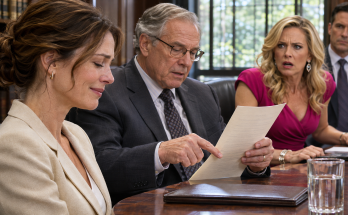
Tammy was the first person to break the silence.
“How much?”
Arthur looked at her.
“I'm sorry?”
“How much money is in this foundation?”
Richard stopped turning the pages in front of him.
I moved my hand away from my handbag.
Arthur took a separate financial statement from the folder and placed it on the table.
“The foundation holds several categories of assets, including investment accounts, income-producing properties, and interests in certain business ventures.”
Tammy leaned forward.
“I asked how much.”
Arthur glanced at the statement.
“The most recent comprehensive valuation placed its assets at approximately twenty-eight million dollars.”
I stared at him.
Twenty-eight million.
For a moment, the number didn't mean anything to me.
It was too large to connect with anything familiar.
Tammy pushed her chair backward.
“That's impossible.”
Richard picked up the financial statement.
Arthur remained seated.
“The valuation is subject to changes in market conditions, of course. But that is the most recent documented figure.”
Tammy looked from Arthur to Richard.
Then she looked at me.
Her face had changed completely.
“You're giving her twenty-eight million dollars?”
“No.”
Arthur answered without raising his voice.
“Your sister has been appointed to administer a charitable foundation. Those assets are not becoming her personal property.”
“That's the same thing.”
“It is not.”
Tammy stood.
She walked toward the window and then returned to the table.
“Clayton told me everything was taken care of.”
Arthur folded his hands.
“It was.”
“Then why am I hearing about this now?”
“I cannot tell you why Clayton chose not to discuss certain arrangements with you.”
Tammy pointed toward me.
“But he discussed them with her?”
“No.”
I answered before Arthur could.
“He didn't.”
She looked at me as though I had insulted her.
“Don't pretend you're innocent.”
I felt my face become warm.
Fourteen years earlier, I might have apologized simply to stop an argument.
I might have offered to leave.
Instead, I remained in my chair.
Richard quietly asked Tammy to sit down.
She ignored him.
“Twenty-eight million dollars doesn't just disappear without somebody noticing.”
“The money hasn't disappeared,” Arthur said.
He began explaining that Clayton had gradually transferred resources to the foundation over five years.
Some of those transfers involved property.
Others involved investments and distributions from his business interests.
They had been documented as they occurred.
The foundation had its own financial records, reporting obligations, and governing documents.
It was separate from Clayton's personal estate.
Richard asked to examine the transfer records.
Arthur agreed to provide them.
Tammy stared at the folders.
“Was I supposed to know about these?”
Arthur chose his words carefully.
“That depends on the nature and ownership of the particular assets. Your attorney will need to review the relevant records.”
Richard nodded.
For the first time that morning, he appeared genuinely concerned.
Not angry.
Concerned.
I didn't know enough about charitable organizations to follow everything they were discussing.
But I understood one thing.
Clayton had made arrangements long before the morning of his death.
This wasn't a spontaneous decision scribbled on a piece of paper while he was lying in a hospital bed.
It had taken years.
I raised my hand slightly.
“Arthur?”
He turned toward me.
“Why me?”
Tammy laughed bitterly.
“That's a wonderful question.”
Arthur ignored her.
“He explained his reasons in a private letter. I'll give it to you after we've finished reviewing the documents.”
“A letter?”
“Yes.”
I looked down at the table.
Clayton had written me a letter.
After fourteen years of living separate lives, he had still believed there was something he needed to tell me.
I wasn't sure I wanted to hear it.
Tammy finally returned to her chair.
“What about the house?”
Arthur opened another section of the will.
“The residence is addressed separately.”
“And the rest of his money?”
He explained that Clayton had made substantial provisions for her.
She would retain the residence, subject to the applicable legal and administrative requirements.
She would receive specified investment assets, personal property, vehicles, and the remaining benefits designated for her under his arrangements.
Richard began making notes again.
Tammy listened impatiently.
Every few seconds, she interrupted to ask whether something was included.
The furniture.
The jewelry.
The investment account she knew about.
The vacation property.
Arthur answered each question.
She wasn't being left homeless.
She wasn't being left penniless.
From everything I heard, she was being provided with a level of financial security that most people could hardly imagine.
Yet she looked as though someone had emptied her pockets.
“How much is left for me?”
Arthur explained that a final figure would require completion of the estate inventory, settlement of liabilities, and review of the relevant ownership documents.
Tammy slammed her palm against the table.
“I don't want another explanation. I want a number.”
The glasses of water trembled.
I flinched.
Richard looked embarrassed.
“Tammy, please.”
She leaned back and crossed her arms.
Arthur waited until the room became quiet again.
He then returned to the foundation documents.
He explained that accepting the appointment would involve responsibilities I needed to understand before making any decision.
There would be professional advisers.
An accountant.
An independent governing board.
Existing commitments that had to be honored.
Restrictions on how the money could be spent.
Regular financial reviews.
I couldn't simply write checks to myself or distribute the resources however I pleased.
Everything would have to serve the foundation's established charitable purposes.
“What happens if I say no?”
Arthur looked at me carefully.
“An alternative appointment procedure would apply.”
Tammy suddenly became interested.
“Then say no.”
I turned toward her.
She leaned forward.
“Marlene, you don't know anything about managing twenty-eight million dollars.”
“I haven't said I do.”
“You worked in a dental office.”
“Yes.”
“You hand out canned food twice a week.”
I nodded.
She spread her hands.
“Exactly.”
I looked at the table.
For years, Tammy had been able to reduce my entire life to a few sentences designed to make it sound insignificant.
I had allowed those sentences to influence how I saw myself.
Sitting there, I realized I didn't feel particularly small.
I had worked honestly.
I had paid my bills.
I had helped people.
There was nothing about those things that required an apology.
Arthur removed another page from the folder.
“Clayton anticipated that Marlene might have concerns about the appointment.”
“Obviously,” Tammy said.
“He arranged for professional assistance and a formal transition period. He did not expect her to perform every administrative function personally.”
I looked at him.
“Did he really think I would accept?”
“He hoped you would.”
That answer hurt more than I expected.
Clayton had spent years choosing things without considering how they affected me.
Now he had left me a decision I couldn't make without considering him.
I reached for my water.
My hand was trembling slightly.
Richard noticed.
“Mrs. Dobbs, you may wish to obtain independent legal advice before accepting anything.”
“I think I will.”
Arthur nodded approvingly.
“That would be appropriate.”
Tammy looked frustrated.
“You're actually considering this?”
“I'm considering learning what it means.”
She shook her head.
“This is ridiculous.”
I didn't answer.
Arthur explained that I wouldn't need to make a final decision that morning.
I could review the governing documents.
Meet the professional advisers.
Ask questions about the obligations.
Take reasonable time to understand what Clayton had arranged.
I was grateful.
I had learned long ago that signing something simply to escape an uncomfortable room could lead to years of regret.
Richard requested copies of several additional records.
Arthur made a note.
Then he closed the main folder.
“That concludes the principal matters for today's meeting.”
Tammy remained seated.
She seemed unwilling to accept that there wasn't another page somewhere that would change everything back.
“What if we contest it?”
Richard turned toward her.
“We need to examine the documents before discussing possible proceedings.”
She looked directly at Arthur.
“I'm not letting this happen.”
Arthur didn't react.
“You have the right to seek advice concerning your interests.”
Tammy collected her handbag.
Then she stood and looked at me.
“You've been waiting fourteen years for something like this.”
I felt the familiar sting of her accusation.
“No, Tammy.”
She laughed.
“Don't insult my intelligence.”
I could have reminded her that I hadn't requested the meeting.
I could have mentioned every Christmas she hadn't invited me to, every family gathering I had avoided, every humiliation I had quietly swallowed.
None of those things would have changed what she wanted to believe.
So I said nothing else.
Richard gathered his documents and followed her into the hallway.
The door closed.
For a moment, Arthur and I sat alone.
I could still hear Tammy speaking near the reception desk.
Then her voice faded.
Arthur removed his glasses again.
“I'm sorry that was difficult.”
I smiled weakly.
“I'm accustomed to difficult conversations with my sister.”
He didn't smile back.
Instead, he reached into his briefcase.
He took out a cream-colored envelope.
My name was written across the front.
Marlene.
Not Mrs. Dobbs.
Not my former wife.
Just Marlene.
I recognized Clayton's handwriting immediately.
The capital M leaned slightly to the right.
He had written my name that way on birthday cards, grocery lists, and the little notes he used to leave beside the coffee pot.
I accepted the envelope.
It was heavier than I expected.
“Did he write this himself?”
“Yes.”
“When?”
“Several weeks before the final documents were executed.”
I ran my thumb along the sealed edge.
“Did you read it?”
“No. Clayton instructed me to deliver it to you privately.”
I put it inside my handbag beside the red notebook.
Arthur watched me for a moment.
“He understood that this appointment might create difficulties for you.”
“Then why did he do it?”
Arthur glanced at the foundation documents.
“I believe he wanted you to have the opportunity to decide whether something meaningful could come from what he built.”
I looked toward the window.
The rain had become lighter.
“Clayton could have called me.”
“Yes.”
“He could have explained this while he was alive.”
Arthur nodded.
“He could have.”
I appreciated that he didn't try to defend Clayton.
There was no explanation that could return the years we had lost.
No carefully written document could make the betrayal disappear.
And twenty-eight million dollars, even if it had been mine personally, wouldn't have changed what happened in my kitchen that Tuesday evening.
I stood.
Arthur handed me a folder containing preliminary copies of the relevant documents.
I thanked him.
Then I walked toward the elevator.
Tammy and Richard were gone.
Outside, the pavement was wet, and the air smelled of rain.
I sat in my car without starting the engine.
The cream-colored envelope rested on the passenger seat.
I looked at it.
Then I looked away.
For fourteen years, I had imagined what I might say if Clayton ever offered me a sincere apology.
Now he was dead.
Whatever was inside that envelope, I wouldn't be able to ask him a single question.
I drove home.
Helen's car was parked outside her house.
I considered stopping there.
Instead, I went directly inside my own.
I placed the folder on the kitchen table.
Then I removed the red notebook and the envelope from my handbag.
I sat between the two objects for a long time.
One contained the promises Clayton had made when we were young.
The other contained whatever he had wanted to say when he knew his life was ending.
Finally, I opened the envelope.
Click here to continue reading: PART 6: The Letter Clayton Left Inside a Sealed Envelope Finally Explained Why He Had Remembered Our Old Kitchen Table After All Those Years
My Younger Sister Thought Being Clayton’s Widow Made Her the Most Important Woman in the Room, but His Lawyer Had Other Instructions
Part 5 of 10