I had never been comfortable with silence during an argument.
I tended to fill it.
Sometimes with another question.
Sometimes with an explanation nobody had requested.
Sometimes with a sentence I later wished I hadn't said.
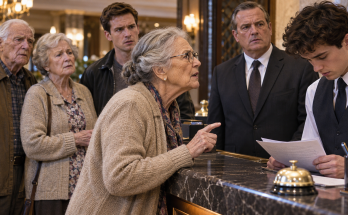
Standing near that reception desk, I felt the old impulse returning.
The manager wasn't giving us the answer I wanted.
The clerk was occupied with his papers.
Evelyn had asked for the young man's name.
And I was tempted to start talking again.
I wanted to tell everyone exactly how unfair the situation was.
I wanted to explain how old my parents were.
I wanted to remind the hotel that another couple's generosity shouldn't determine whether elderly guests received a decent room.
All of those things felt important.
But then I realized I was about to do what I had been doing from the beginning.
I was preparing a speech instead of waiting for the facts.
That realization stopped me.
I knew my parents' room had been placed beside the ice machine.
I knew a comparison had been made involving another couple's tip.
I knew Evelyn had heard enough to challenge the explanation.
But I didn't know who had first made the arrangement.
I didn't know whether the clerk had any authority to change rooms.
I didn't know what the manager had approved.
And I didn't know what anyone had said before the decision was made.
There were gaps.
Large ones.
I had been so focused on the unfair result that I had nearly forgotten how little I knew about the process.
That didn't make the result acceptable.
It simply meant the next answer mattered.
I looked toward Evelyn.
She had asked a question that could be answered without speculation.
The clerk's name.
It was a small request compared with everything else that needed explaining.
But it was also a sensible place to begin.
Once you know who handled a matter, you can ask what that person did.
You can distinguish one employee's decision from another's.
You can avoid blaming somebody who had no control over the situation.
And you can make sure the person with responsibility doesn't disappear behind a general apology.
I respected that.
More than I had expected to.
I had been worried Evelyn's involvement would turn a difficult conversation into a bigger confrontation.
Instead, her question had shown me something useful.
She wasn't asking anyone to guess.
She was asking someone to identify himself.
The manager's reaction remained troubling.
I couldn't forget how he had become still when Evelyn challenged the explanation about the tip.
It was such a small detail.
Yet I kept returning to it.
He had been expected to answer the complaint.
Then Evelyn had repeated the essential meaning of what we'd heard.
And suddenly he hadn't seemed nearly as comfortable.
I wanted to know why.
Perhaps he understood that the explanation sounded bad.
Perhaps he had not expected anyone else to hear it.
Perhaps he was simply uncertain how to respond.
I couldn't choose one of those possibilities and call it the truth.
That was the difficult part.
When you're angry, the explanation that makes the other person look worst often feels like the most convincing one.
I was aware of that in myself.
I didn't like it.
I wanted the hotel held responsible for what it had actually done.
Not for every ugly motive I could imagine.
I thought about the other couple.
I knew almost nothing about them.
They had apparently offered a better tip.
That didn't tell me whether they knew my parents would be disadvantaged.
It didn't tell me whether they had asked for a change.
It didn't tell me whether they had expected anything in return.
I couldn't fairly blame them for details I hadn't heard.
The responsibility I was questioning belonged to the people who handled the rooms.
That was where the explanation needed to come from.
I returned my attention to the clerk.
His papers were still the detail I remembered most.
It was almost absurd.
We were discussing a decision that had affected two elderly guests.
And I was watching somebody look at paper.
But the contrast stayed with me.
The issue felt enormous to me.
To the person behind the desk, it seemed possible to continue with an ordinary task.
I didn't know whether that appearance was deliberate.
I only knew how it felt from where I stood.
Dismissive.
That was the word that came to mind.
I didn't say it aloud.
I wasn't certain it was fair.
But I felt it.
I wondered how my parents were experiencing all this.
I had been so occupied with trying to correct the situation that I hadn't found a way to remove them from the discomfort of watching it unfold.
They had to stand there while other people discussed whether they had received less consideration because another couple had tipped more.
There was something wrong with that.
Not because the facts should be hidden from them.
But because they should never have been placed in that position.
I wanted the hotel to recognize that.
I wanted somebody to understand that a room assignment could affect more than a night's sleep.
It could make guests wonder whether they were welcome.
Whether they were valued.
Whether they would be treated differently if they had more money to offer.
I couldn't know whether my parents were thinking those exact things.
I was.
And I couldn't stop.
The ice machine had become the simplest symbol of the entire problem.
It made noise.
It disturbed the peace I had wanted for my parents.
And it reminded me that somebody had made a choice about where they belonged.
I would have preferred never to think about that machine again.
But it remained central to the complaint.
Not because the machine had done anything wrong.
Because it marked the room they had received.
The room they had been expected to accept.
I looked toward the manager once more.
I still wanted him to acknowledge the decision.
I wanted a clear answer about who had authorized it.
I wanted the reason stated without an attempt to make unfair treatment sound routine.
But I had finally accepted that wanting those answers didn't mean I already possessed them.
That distinction changed how I listened.
I stopped trying to complete other people's sentences in my head.
I stopped imagining what the clerk might say.
I stopped assuming Evelyn knew more than she had actually revealed.
I waited for the questions already asked to be answered.
The manager remained the person who needed to explain the hotel's actions.
The clerk remained the young employee Evelyn had addressed.
And my parents remained the guests whose room assignment had started the entire discussion.
Those were the facts I could stand behind.
Everything else required an answer.
I didn't know whether we were about to receive one.
But I understood that if I wanted the truth, I had to leave room for it to be spoken.
Click here to continue reading: PART 7: While Everyone Focused on the Clerk, I Kept Thinking About My Father and the Piano That Had Made This Hotel Visit More Than a Room Dispute
I Had Brought My Elderly Parents to a Hotel Where One Small Room Change Told Me How Little Respect They Were Given
Part 6 of 8