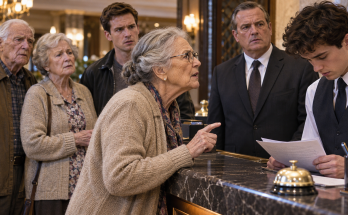
The clerk kept looking down.
That was what I remembered most clearly.
Not his expression.
Not anything he said.
Just the way the papers in front of him suddenly seemed more important than the woman asking for his name.
Evelyn had directed a simple question toward him.
She wanted to know who she was speaking to.
And I stood there waiting.
I had expected an answer.
A name.
Perhaps an explanation.
Something that would tell us we were finally getting somewhere.
Instead, the moment stretched.
The manager was still nearby.
I looked toward him, wondering whether he would say something.
I had spent the earlier part of the disagreement trying to get him to account for the room assignment.
Now I was watching him avoid the question of why another couple's larger tip had mattered.
I didn't know whether he had made the decision himself.
I didn't know whether the clerk had followed an instruction.
Those were important distinctions.
But neither one changed where my parents had been placed.
They were still in the room beside the ice machine.
The other couple had apparently been favored.
And the explanation we had heard concerned money.
That was all I could establish.
I kept reminding myself not to turn suspicion into certainty.
I was angry enough already.
I didn't need to make the situation worse by accusing somebody of something I couldn't prove.
Evelyn's question seemed reasonable to me.
The clerk had been working at the reception desk.
He was someone who might have known how the arrangements had been handled.
Asking his name wasn't an accusation.
It was a beginning.
I watched the papers again.
They were ordinary papers.
Nothing about them should have mattered to me.
Yet I found myself remembering how quickly the young man's attention had shifted toward them.
I wondered whether he hoped the manager would answer for him.
I wondered whether he was waiting for Evelyn to move on.
I couldn't tell.
The worst part of a situation like that is how much you start guessing when nobody explains anything.
You fill the silence yourself.
You imagine conversations you never heard.
You assign motives to faces.
I didn't want to do that.
I wanted facts.
The room.
The decision.
The reason.
The person responsible.
Four simple things.
Somehow, even those seemed difficult to put together.
I thought about my parents.
They had lived eighty years without expecting strangers to treat them as important people.
They were not asking for that now.
What troubled me was the idea that they had been expected to accept worse treatment because they were less profitable to somebody.
I couldn't know whether that was how the hotel staff had thought about them.
But the explanation about the tip had made the possibility impossible to ignore.
I looked toward Evelyn.
She had not become involved because of the ice machine itself.
At least, that wasn't what her question had focused on.
She had reacted to the reason offered for the room arrangement.
That was the part I had nearly failed to challenge.
I felt ashamed when I admitted it to myself.
I had almost reduced the entire matter to noise.
A mechanical hum.
Ice dropping.
A door too close to a machine.
Those details were real.
They mattered because my parents needed a comfortable place to stay.
But the larger problem was the choice behind them.
Someone had apparently decided that the other couple's money should influence which guests received better treatment.
I didn't want to hear that explained away as ordinary hospitality.
Hospitality was supposed to be about welcoming people.
Not measuring their worth against the generosity of somebody standing beside them.
Still, I held back.
I didn't want to speak over Evelyn.
She had asked the question.
She deserved an answer.
And the clerk deserved a chance to give one.
I reminded myself of that too.
I had no wish to humiliate a young employee simply because he happened to be standing behind a desk.
If he had been told what to do by somebody else, that mattered.
If he had made the decision himself, that mattered too.
But until he answered, I didn't know which was true.
The manager's silence didn't help.
I kept hoping he would explain.
Perhaps he could identify who had handled the room assignments.
Perhaps he could clarify whether the tip had actually influenced the decision.
Perhaps he could admit that the arrangement had been wrong.
Any one of those things would have moved the conversation forward.
Instead, I was left watching people who seemed reluctant to speak.
I looked at my parents again.
I wanted the discussion to end without hurting them any further.
There was something painful about having to defend the dignity of people who had spent their lives trying not to inconvenience others.
But I also knew that dignity wasn't something a hotel could take away merely by assigning the wrong room.
My parents remained the same people.
The poor decision belonged to whoever had made it.
I wished I had understood that from the beginning.
I had been treating the situation as though my parents' embarrassment was the thing I needed to conceal.
It wasn't.
The decision needed explaining.
Not hiding.
I turned back toward the reception desk.
Evelyn was still the person whose question hung over the conversation.
The young clerk's attention remained on his work.
I couldn't tell whether he had found an answer.
And I wasn't prepared to invent one for him.
What I knew was enough.
A simple request for a name had become difficult.
The manager had gone quiet after the mention of the better tip.
And I was finally beginning to understand why Evelyn's interruption mattered.
She had made it harder for everyone to pretend that the room assignment was merely an inconvenience.
Someone had to answer for how it happened.
Click here to continue reading: PART 6: I Wanted the Manager to Admit Why My Parents Had Been Moved, but I Began to Understand How Much of the Truth I Still Did Not Know
I Had Brought My Elderly Parents to a Hotel Where One Small Room Change Told Me How Little Respect They Were Given
Part 5 of 8