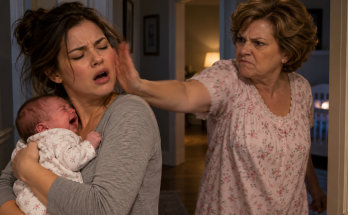
I used to think the worst thing a husband could do to his wife was leave her when she needed him most.
I was wrong.
Sometimes, he stayed in the house, wore his wedding ring, called himself a good father, and made sure you understood that your place in his life had become an inconvenience.
I learned that six days after giving birth to my daughter, Lily.
That evening began with a pot of soup, a sleeping baby, and my husband reaching for my car keys as if nothing about our lives had changed.
Emmett stood near the kitchen island in a navy jacket I had helped him choose months earlier.
He checked his reflection in the dark window above the sink and adjusted his collar.
I was still wearing the loose cotton shirt I had slept in the night before.
My hospital bracelet remained around my wrist because I kept forgetting to take it off.
Lily was tucked against my chest, her cheek resting near the collar of my shirt.
She had been home for less than a week, and I was still learning how to move without waking her.
Everything in the house seemed to require two hands.
The laundry basket was full.
A bottle sat beside the sink.
There were folded receiving blankets on the counter because I had run out of energy halfway through putting them away.
I had been warming soup that a neighbor left on our porch when Emmett walked into the kitchen.
He smelled of aftershave.
I remember that because I had barely had time to brush my teeth that morning.
“Maya is having everyone over tonight,” he said.
I looked up from the stove.
“Tonight?”
“Mom is leaving for Palm Beach tomorrow, so they want to get together before she goes.”
He spoke as though he were giving me a small update about the weather.
I glanced at Lily.
She had finally fallen asleep after an hour of feeding and fussing.
I had been looking forward to an ordinary evening with my husband, even if ordinary meant eating dinner in shifts and taking turns holding the baby.
For a moment, I assumed we were going together.
I began thinking about what I could wear that would not press against my still-sore body.
Then Emmett picked up my car keys.
“Should I get Lily’s bag ready?” I asked.
He paused.
It was a small pause, but I noticed it.
“No, I don’t think you should come.”
I stared at him.
“What do you mean?”
“It would be simpler if you stayed here.”
He said it gently enough that I almost wondered whether I had misunderstood him.
I shifted Lily higher against my chest.
“Why?”
“She’s too little to be taken into a crowded house. You need rest, and Maya has a lot of people coming.”
I waited for him to suggest that we stay home together.
He did not.
“I thought we were all invited.”
“We are, technically.”
Technically.
That word stayed with me.
I had spent the last six days measuring my life in small necessities.
How long Lily slept.
How much she ate.
Whether I had remembered to drink water.
Whether the ache in my body was normal or something I should mention to the doctor.
I had not expected my marriage to become another thing I needed to figure out while holding a newborn.
“Then why are you going without us?”
Emmett looked down at his phone.
“Because I can go for a few hours, see my family, and come home. You can stay here with Lily where she’s comfortable.”
“Our family,” I said.
He raised his eyes.
“What?”
“You said your family. Lily and I are your family, too.”
He let out a quiet breath.
Not a sigh of concern.
The kind of breath a person gives when a conversation is taking longer than expected.
“Nora, please don’t turn this into an argument.”
I had not raised my voice.
I had not accused him of anything.
I had asked a question while standing beside a pot of soup.
Still, I felt the familiar pressure to soften my words and make the moment easier for him.
I had become good at that during our marriage.
If Emmett was irritated, I tried to be less demanding.
If his mother made a cutting remark, I told myself she had not meant it that way.
If family plans changed without anyone asking me, I found a reason to accept them.
I told myself that marriage required compromise.
Looking back, I can see how often compromise meant that I was the only person expected to give something up.
“Your SUV is still at the dealership,” I said.
He nodded toward the keys in his hand.
“I’ll take your Accord.”
I looked at him, then toward the front door.
My car was parked outside with Lily’s infant seat base secured in the back.
Her diaper bag was in the passenger footwell.
I had put it there because I was still carrying the bag everywhere, even when I had no plans to leave the house.
“You’re taking my car and leaving us here?”
“Just for the evening.”
“How am I supposed to get anywhere if I need something?”
“You have everything you need here.”
He said it so quickly that I knew he had not considered the question before answering.
I looked at the soup.
The steam had stopped rising.
“Emmett, I just had a baby.”
“I know that.”
His answer came with a little edge.
Of course he knew.
He had been at the hospital.
He had held Lily for photographs.
He had told visitors that becoming a father was the best thing that had ever happened to him.
But knowing that I had given birth and understanding what the days afterward required were apparently two different things.
“I’ll be back later,” he said.
“Can we talk about this first?”
“There’s nothing to talk about. It’s dinner.”
He slipped his phone into his pocket and walked toward the door.
I wanted him to stop.
I wanted him to turn around and look at me long enough to notice that I was trying not to cry.
Instead, he opened the door.
“Get some sleep while she’s sleeping,” he said.
Then he left.
I heard his shoes on the front steps.
The car door opened.
The engine started.
I stood beside the kitchen island with Lily against me and listened as my car rolled away from the house.
For several seconds, I did not move.
I had imagined many things about the first week of motherhood.
I had imagined being tired.
I had imagined being frightened by how small Lily looked in her bassinet.
I had imagined that Emmett and I would have disagreements about feeding schedules, visitors, and whose turn it was to get up at night.
I had not imagined standing alone in my kitchen while my husband took away the only car I could use to transport our daughter.
I told myself he would come home and realize how thoughtless he had been.
I told myself his mother was leaving town, so perhaps he felt obligated to attend.
I told myself that I was exhausted and probably taking the whole thing too personally.
Then my phone vibrated.
A message from Emmett’s mother appeared on the screen.
I opened it.
She had written that her son needed an evening without the burden of dealing with me.
I read it once.
Then I read it again, hoping that exhaustion had somehow changed the meaning of the words.
It had not.
A second notification appeared from the family group chat.
Maya had posted a photograph of the dining room.
The table was set beneath warm pendant lights, with polished glasses and folded napkins at every place.
Emmett sat beside his mother.
Seven people were gathered around the table.
Everyone looked comfortable.
Everyone looked welcome.
I counted the chairs before I understood why I was counting them.
There was no place set for me.
I looked at the photograph until my phone screen dimmed.
Then I pressed the side button and watched the image disappear.
Lily stirred against my chest.
I placed a hand over her back and felt the small movement of her breathing.
She had no idea that the people in that photograph had made a decision about where she and I belonged.
I did.
And for the first time, I stopped trying to make that decision sound kinder than it was.
I carried Lily upstairs.
The house was quiet in a way I had never noticed before.
Usually, I could hear Emmett moving from room to room, taking calls, opening drawers, or asking where I had put something.
That evening, every sound seemed to belong to me.
The soft click of the nursery door.
The floorboard near the landing.
The faint hum of the monitor on the dresser.
I lowered Lily into her bassinet and kept one hand against her stomach until she settled.
Then I stood there looking at her.
She was so small that the blanket seemed to swallow her.
I had spent months imagining the moment I would bring her home.
I thought about her first night in the nursery, the first time she would open her eyes and look at me, the first time Emmett would carry her downstairs while I made breakfast.
I had imagined us becoming a family.
I had not imagined having to defend my daughter’s place in one.
My phone lay on the dresser.
I picked it up again.
His mother’s message was still there.
I could have answered her.
I could have asked what she meant, or reminded her that I was recovering from childbirth, or told her that her son had taken the car with the infant seat base inside it.
I could have sent a photograph of the empty place at the table and asked whether she had noticed.
But I knew how that conversation would go.
She would say she was only being honest.
She would tell me I was too sensitive.
She would remind me that Emmett had worked hard and deserved time with his family.
And somehow, by the end, I would be apologizing for making her son feel bad.
I had been through enough versions of that conversation to recognize where it led.
So I put the phone down.
I went to the closet and pulled out a small overnight bag.
For a moment, I simply held it by the handles.
Leaving had not crossed my mind when Emmett walked out the door.
I had thought about being angry.
I had thought about calling him later and telling him that I expected an apology.
I had even thought about making a list of everything I needed him to do differently when he returned.
But the message from his mother had made something painfully clear.
This was not a misunderstanding between two tired new parents.
At least, not to the people who had decided that I should be excluded.
I opened the dresser and took out two changes of clothes.
I packed diapers, wipes, and the small container of formula we kept for emergencies.
I added Lily’s spare clothes and the yellow blanket she had used at the hospital.
That blanket had become my favorite thing in the house.
It was soft from washing, with a corner that curled slightly no matter how carefully I folded it.
I had wrapped Lily in it the first night she came home.
When she cried, I would hold her against my chest and rub the edge between my fingers.
I folded it carefully and placed it on top of the other things.
My hands were shaking.
I stopped to steady them against the dresser.
I had not planned to leave my husband six days after giving birth.
I had not planned to pack a bag while my daughter slept in the next room.
I had not planned to call my father and admit that I needed him to come get me.
But I also had not planned to spend the first week of Lily’s life learning how easily the people around Emmett could treat us as though we were in the way.
I checked the nursery again.
Lily was asleep.
I could hear the small, uneven sounds she made when she breathed through her nose.
I leaned over and touched her cheek.
“It’s all right,” I whispered.
I did not know whether I was speaking to her or to myself.
Downstairs, I set the bag near the front door.
Then I called my father.
He answered before the second ring finished.
“Nora?”
I had prepared a whole explanation.
I was going to tell him about the dinner, about the car, about his wife’s message, and about the photograph with seven places at the table.
I was going to explain why I had reached the point of packing a bag.
Instead, I heard his voice and lost the words I had practiced.
“Dad, I need you to come get me.”
There was a brief silence.
It was not the silence of someone trying to decide whether my problem was serious enough.
It was the silence of someone listening carefully.
“Tell me one thing first,” he said. “Is Lily safe?”
“Yes.”
“And are you safe?”
I looked toward the stairs.
“Yes.”
“Then stay where you are. I’m sending Harrison.”
That was all.
No lecture.
No questions about what I might have done to upset Emmett.
No suggestion that I should wait until everyone had calmed down.
My father had heard what I needed and had acted on it.
I ended the call and stood in the hallway with the phone still in my hand.
For the first time that evening, I cried.
Not loudly.
I pressed my fingers against my mouth and let the tears fall because I did not have the energy to keep pretending I was fine.
I cried for the woman who had spent so much time trying to be easy to live with.
I cried because my daughter was six days old and I was already thinking about which adults would protect her when it mattered.
I cried because my father had not asked me to prove that I deserved help.
When I finished, I washed my face.
Then I checked Lily’s diaper, changed her into a clean sleeper, and settled her into the carrier.
I had learned enough in the hospital to secure the straps, but I still checked them twice.
I was not going to rush anything involving her safety.
A little while later, headlights moved across the living-room wall.
I looked through the window.
A black Cadillac Escalade had pulled into the driveway.
It was larger than most vehicles on our street, with dark windows and a clean, polished finish.
For a moment, I could only watch it sitting beneath the porch light.
The driver’s door opened.
Harrison stepped out wearing a charcoal coat.
I knew him almost as well as I knew some of my relatives.
He had worked for my father since I was a teenager, long before I married Emmett.
He had driven me to school events when my father was caught in meetings, waited outside buildings while I finished appointments, and appeared at the house whenever my father needed someone he trusted to handle something important.
Seeing him on my doorstep made my composure falter again.
He came to the door and waited until I opened it.
“Your father asked me to bring you this,” he said.
He held out a cream-colored envelope.
My full name was written across the front.
I looked at the handwriting.
I recognized it immediately.
“Is Dad all right?” I asked.
“He’s waiting for you at home.”
Harrison did not ask why I was leaving.
He did not look past me into the house.
He simply took the overnight bag when I offered it and carried it toward the vehicle.
I slipped the envelope into my own bag without opening it.
Outside, Harrison had already begun preparing the back seat.
He had brought another infant seat.
I watched him check the straps and the angle, then secure the base before he helped me settle Lily into it.
He tested the connection with both hands.
I appreciated that he did not rush.
I had been surrounded by people telling me what was easier for everyone else.
Harrison was the first person that evening to take the time to make sure something was right for Lily.
When the seat was secure, he stepped back and let me check it myself.
I ran my hand over the buckle and adjusted the blanket near her feet.
Lily opened her eyes briefly, then closed them again.
I looked at the house.
The kitchen light was still on.
The soup was probably cold by now.
The hospital bracelet remained around my wrist, and I had not even changed out of the clothes I had been wearing when Emmett left.
I had spent years thinking of that house as the place where my life was supposed to happen.
Now I was standing outside it with one bag and my newborn daughter.
I did not know what would happen to my marriage.
I did not know what Emmett would say when he returned.
I only knew that I did not want Lily’s first lessons about family to come from a house where her mother had been told she was the problem.
Harrison opened the passenger door for me.
I took one last look at the porch.
Then I climbed into the Escalade.
Before I left, I went back into the kitchen.
Harrison was outside, checking that the bag had not shifted in the back.
I had already put Lily in the car seat, but I could not bring myself to leave without writing something for Emmett.
Not a long letter.
Not a list of every careless thing he had said or done during the past week.
I wanted him to know where we were and why.
I took a sheet of paper from the drawer beside the refrigerator.
For a few seconds, I held the pen without writing.
I was afraid that if I let myself explain everything, I would start defending my decision before I had even made it.
So I kept the note simple.
Lily and I were safe.
We were going to stay with my family.
If Emmett wanted to understand why I had left, he needed to think about why he had treated his mother as family while leaving his wife and daughter behind.
I read it once.
Then I placed the paper on the kitchen island, directly beneath the light.
I did not want him to miss it when he walked through the door.
My house key was still in my pocket.
I took it out and placed it on top of the note.
The small metal sound against the counter was barely audible.
Still, I stood there for another moment looking at it.
I had used that key every day since we moved into the house.
I had carried groceries through the front door with it between my fingers.
I had come home from the hospital with it in my bag.
I had unlocked the door while holding Lily in one arm and trying to keep the diaper bag from sliding off my shoulder.
Now I was leaving it behind.
I walked out before I could change my mind.
Harrison closed the door behind me and made sure the vehicle was ready.
I settled into the seat and turned toward Lily.
Her face was visible through the small opening in her blanket.
I touched her hand.
She curled her fingers around mine for a moment.
That was enough to make me look away and swallow hard.
The Escalade pulled out of the driveway.
We passed the neighboring houses, then turned onto the road lined with old oak trees.
I watched their branches move past the windows.
The streets were familiar, but I felt as though I were seeing them from a different life.
I had driven those roads countless times.
I had gone to appointments, bought groceries, met friends for lunch, and returned home with bags in the trunk.
I had never imagined that leaving my house with my daughter would feel like both a failure and a relief.
Harrison drove without asking questions.
After a few minutes, he glanced at me through the mirror.
“Are you comfortable back there?”
“Yes. Thank you.”
“If you need anything, just tell me.”
I nodded.
I did not trust myself to say more.
The iron gates of my childhood home came into view.
I had not lived there for years, but I recognized every part of the entrance.
The stone pillars.
The long drive.
The trees that stood beyond the gate, their trunks dark against the evening sky.
Harrison entered the property and drove toward the house.
A light was burning upstairs.
I recognized the window before we reached the front steps.
It belonged to my old bedroom.
For reasons I could not explain, that small light made my throat tighten.
I had left that room as a young woman who believed she was beginning an independent life.
I had returned as a mother who was not sure what her marriage had become.
Harrison parked and came around to help me.
I took Lily from the seat only after checking that she was settled and warm.
He carried the bag inside while I followed with the baby.
The house was quiet.
There were lights on in the entrance hall, and everything looked as familiar as it had when I was growing up.
The staircase rose in front of me.
The same railing.
The same landing.
The same floor that used to creak near the turn.
I had thought I would feel embarrassed coming back.
Instead, I felt tired enough to let myself be helped.
Upstairs, someone had prepared the room next to my old bedroom as a nursery.
A crib stood near the window.
Fresh white flowers sat on the dresser.
There were clean sheets, folded blankets, and enough space beside the crib for me to move around without bumping into furniture.
I stopped in the doorway.
I had not asked anyone to prepare this room.
I had not told my father that I was planning to come home.
Yet everything Lily needed seemed to have been considered.
I looked at the crib, then at the small lamp beside it.
Someone had turned it on before we arrived.
I had spent the evening being told that I should stay out of the way because a newborn made things difficult.
Here, someone had rearranged a room so that my newborn daughter could be comfortable.
The difference was so simple that it hurt.
I placed Lily in the crib while I unpacked the few things I had brought.
The yellow hospital blanket went over the back of the chair.
I set the diapers beside the dresser and put her clothes in the top drawer.
There was no need to ask where anything belonged.
The room had been prepared for us.
When Lily was settled, I finally remembered the envelope.
I took it from the overnight bag and sat on the edge of the bed.
My name was still visible across the front.
I turned it over and opened it carefully.
Inside was a brass key and a handwritten note.
The key rested in my palm.
It was heavier than I expected, cool against my skin, with a simple shape that made me think of old doors and rooms that had been locked for years.
I looked at it, trying to understand why my father had sent it.
Then I unfolded the note.
He had written that my room was ready and that nothing else needed to be decided that night.
I read the words twice.
They were not dramatic.
He had not promised to fix my marriage.
He had not told me what to do about Emmett.
He had not asked me to explain the message from my mother-in-law or justify why I had left.
He had given me a place to rest.
I set the note on the bedside table and held the key for another moment.
I did not know what it opened.
I did not know why my father had chosen to send it with Harrison instead of simply telling me to come home.
But I knew he had wanted me to have it before I arrived.
I slipped the key into the pocket of my bag.
Then I checked Lily again.
She was asleep, her small hands resting near her face.
I pulled the chair closer to the crib and sat beside her.
For the first time since Emmett had taken my car, I did not feel that I needed to prepare an explanation for someone.
I did not have to prove that I was tired.
I did not have to persuade anyone that six days after giving birth was a reasonable time to expect help.
I did not have to convince anyone that my daughter belonged with me.
I could simply sit there.
So I did.
Emmett came home expecting to find the house as he had left it.
He expected the kitchen lights to be on, the baby things to be scattered around the living room, and me upstairs with Lily.
He expected to walk through the door, put his phone on the counter, and ask whether I had managed to get any sleep.
Instead, he found the note.
I was not there to see his face when he read it, but Maya told me later what happened.
At first, he thought I had gone to bed.
He walked into the kitchen and called my name.
No answer.
He went upstairs and looked into the bedroom.
The bed was empty.
He checked the nursery.
The bassinet was empty, too.
Then he came downstairs and noticed the paper beneath the kitchen light.
My key lay on top of it.
He picked up the key first.
Then he read the note.
According to Maya, he read it a second time without speaking.
His mother was standing behind him.
She had apparently come back to our house with him after dinner, expecting to see me and perhaps make another remark about how I should have handled the evening.
Instead, she saw the note in his hand.
“What does it say?” she asked.
Emmett did not answer immediately.
He kept looking at the paper.
Maya stood near the doorway, watching him.
I imagine the three of them in that kitchen, with the empty spaces where Lily’s things had been and the overhead light shining on a key I had carried for years.
Emmett had left believing that I would be waiting for him.
He had returned to find that I had made a decision without asking him to approve it.
That alone would have been difficult for him to understand.
But the note mentioned my family.
And he had never taken much interest in who my father was beyond the fact that I loved him and had grown up in a comfortable home.
He knew I had spent my childhood in Greenwich.
He knew my father had employees.
He knew I had been raised with certain advantages.
But I had never made a habit of discussing the details of my father’s life.
I had wanted my marriage to stand on its own.
I had wanted Emmett to know me as Nora, his wife, rather than as someone’s daughter.
I had never thought that keeping those parts of my life separate would become important.
That evening, Emmett picked up his phone and called me.
I was sitting beside Lily’s crib when it began to vibrate.
The room was dim except for the small lamp on the dresser.
I looked at the screen.
His name appeared.
For several seconds, I watched it ring.
I did not want to answer while I was still crying.
I also did not want to spend the night wondering what he would say if I ignored him.
So I picked up.
“Where are you?”
His voice sounded sharp.
Not frightened.
Not apologetic.
He sounded like a man who had discovered that something had been moved without his permission.
“Lily and I are safe.”
“That isn’t what I asked.”
“I’m at my family’s house.”
“Why would you leave without talking to me?”
I looked toward the crib.
“Because I had already tried talking to you.”
He went quiet for a moment.
“This was one dinner, Nora.”
I closed my eyes.
There it was.
The same argument, only now he was making it after I had packed a bag and left the house.
“One dinner,” I repeated.
“Yes. My mother is leaving tomorrow. It wasn’t supposed to become a whole situation.”
I had heard that tone before.
The tone that made every consequence sound unreasonable and every complaint sound bigger than the thing that caused it.
“You took my car,” I said.
“I needed a car.”
“You left me at home with our six-day-old daughter.”
“She needs to be home right now. We talked about how crowded Maya’s house would be.”
“No, Emmett. You talked. I listened.”
He exhaled.
“Can we not do this over the phone?”
“You can call me when you’re ready to talk about what actually happened.”
“I’m trying to talk to you now.”
“You’re trying to convince me that I shouldn’t be upset.”
He did not answer.
I could hear movement in the background.
A voice I recognized as his mother’s came faintly through the phone, asking something I could not make out.
Emmett covered the receiver for a moment.
Then he returned.
“Who drove you?”
I looked at the brass key on the bedside table.
“My father’s driver.”
There was a pause.
“Your father’s driver?”
“Yes.”
Another silence followed.
I could almost picture him looking around our kitchen, trying to fit that information into the version of me he thought he understood.
He had known about my father’s home.
He had known that Harrison worked for him.
But he had never seemed to consider that the life I had grown up in might have a structure and resources beyond what he had seen during family visits.
“Your dad has a driver?” he asked.
I did not know why that was the detail that interested him.
Not the fact that I had left.
Not the fact that our daughter was sleeping in another house.
Not the note on the counter.
The driver.
“Yes, Emmett.”
I kept my voice low because Lily had stirred.
“I’m going to take care of her now. We can speak another time.”
“Nora, wait.”
I ended the call.
My hand shook afterward, but I did not call him back.
I placed the phone facedown on the bedside table.
Then I picked up Lily and held her against my shoulder until she settled.
I could still hear Emmett’s voice in my mind.
He had asked who drove me.
He had not asked whether I had enough diapers.
He had not asked whether Lily was sleeping.
He had not asked whether I was in pain.
I had spent years believing that if I explained myself carefully enough, he would eventually understand what I needed.
That night, I began to accept that understanding was not the same as agreement, and that he might never offer either one simply because I asked.
At our house, the conversation continued after I hung up.
Maya later told me that Emmett lowered his phone and looked at his mother.
His mother wanted to know where I had gone.
He told them I was staying with my family.
Then he said the man who had picked me up worked for my father.
That was when the questions began.
Maya asked whether he meant Harrison.
Emmett said yes.
His mother apparently stared at him.
She had known I came from a comfortable background, but she had never treated that as a reason to be careful with me.
She had treated me as someone who should be grateful to be included in her family’s plans.
Now, standing in our kitchen, she had to consider that there were parts of my life she had never bothered to understand.
Emmett picked up his phone again.
He looked at the number saved in his contacts under my father’s name.
He had stored it years earlier, after our wedding.
He had never needed to call it very often.
For a moment, he hesitated.
Then he pressed the number.
A man answered.
“Kensington residence.”
Emmett straightened.
Maya told me later that his expression changed when he heard the greeting.
He asked for Nora Davis.
The man on the other end replied that Miss Kensington and her daughter were resting.
Emmett did not speak.
Not immediately.
He had called looking for his wife.
The person answering the phone had used a name Emmett knew, but had not expected to hear connected to me in that way.
Kensington.
My father’s name.
My name, too, in the house where I had grown up.
And for the first time that evening, Emmett had to face the possibility that the woman he had left behind in his kitchen was not someone he could define simply by her place in his family.
I was still sitting beside Lily’s crib when Harrison came to the doorway.
He did not interrupt at first.
He waited until I looked up.
“Your father asked me to let you know that he’s home,” he said. “He’ll see you whenever you’re ready.”
I glanced at the note on the bedside table.
Then at the brass key.
I was not ready to explain everything that had happened.
But I was ready to stop pretending that nothing had.
Harrison left me beside Lily’s crib and went downstairs.
I sat there for a while, listening to the quiet house.
The brass key remained on the bedside table.
I kept looking at it, wondering what my father had wanted me to understand by sending it.
I could have gone downstairs and asked him.
Instead, I stayed with Lily until she woke.
She made a small sound, turned her head, and began moving her hands beneath the blanket.
I lifted her carefully and held her against my chest.
Her warmth settled me more than any explanation could have.
A few minutes later, there was a gentle knock at the door.
My father stood in the hallway.
He had changed out of his evening clothes, but he still wore the watch I remembered from my childhood.
His hair had gone grayer since I had last lived under his roof.
His expression had not changed much.
He looked at me first, then at Lily.
“May I come in?”
I nodded.
He entered slowly, as though he did not want to disturb the room.
He looked at the crib, the flowers, and the bag I had brought with me.
Then he pulled the chair closer to the bed.
“How are you feeling?”
I almost gave him the answer I had been giving everyone.
Fine.
Tired, but fine.
Adjusting.
Those were the words I had learned to use whenever I did not want to admit how much I was struggling.
But my father was sitting beside me, waiting for an honest answer.
“I’m not sure,” I said.
He nodded.
“That makes sense.”
I looked down at Lily.
“I didn’t know where else to go.”
“You came home.”
His voice was quiet.
For some reason, those three words made my eyes fill again.
I had been married long enough to believe that going back to my childhood home meant admitting I had failed.
I had imagined that if my marriage ever reached a difficult point, I would handle it privately.
I would talk to Emmett.
We would work things out.
If we couldn’t, I would find another way.
I had never considered that the person I would need most might be the father I had spent years assuring that I was perfectly capable of handling my own life.
“I’m sorry I came so suddenly,” I told him.
He looked genuinely puzzled.
“Why are you apologizing?”
“I know you weren’t expecting us.”
“I wasn’t expecting you tonight,” he said. “That doesn’t mean I wasn’t prepared to help you.”
I pressed my lips together.
He reached over and adjusted the edge of Lily’s blanket.
“Does she have everything she needs?”
“Yes.”
“And you?”
I looked toward the bag.
“I brought some things.”
“That wasn’t what I asked.”
I gave a small, embarrassed laugh.
It was the first time that evening I had laughed at all.
“I don’t know.”
“Then we’ll figure it out.”
He did not ask what Emmett had said.
He did not ask why I had left the house.
He did not ask whether I had considered the effect my decision might have on my marriage.
He simply sat beside me while Lily slept.
Eventually, I told him about the dinner.
I explained how Emmett had picked up my keys and announced that I would be staying home.
I told him about the crowded house, the baby, and the way my husband had acted as though I was making a problem out of an ordinary family gathering.
Then I told him about the message from Emmett’s mother.
My father listened without interrupting.
When I repeated her words, I could barely get through the sentence.
He looked toward the window.
For a moment, his face became very still.
“Did Emmett know she sent that?”
“I don’t know.”
“Did you tell him?”
“He called after I left.”
“And what did he say?”
I looked down at my hands.
“He wanted to know why I had gone.”
My father waited.
“He said it was only one dinner.”
My father leaned back in the chair.
I could tell he was choosing his next words carefully.
“Your husband may think the disagreement was about a dinner,” he said. “But you seem to be telling me it was about something else.”
I nodded.
“It was about being left out of my own family.”
He looked at Lily.
“And hers.”
I could not answer.
That was the part I had been trying not to think about.
Lily was too young to understand what had happened.
She would never remember the photograph or the empty place at Maya’s table.
But I would remember.
I would remember standing in the kitchen with my hospital bracelet still around my wrist, trying to understand why my husband could not see that I needed him.
I would remember how quickly his mother had decided that I was the obstacle.
And I would remember that my father had sent a car without making me explain why I deserved one.
“Dad,” I said, “I don’t want you to think I expect you to solve everything.”
“I don’t.”
“I don’t want this to become a fight between you and Emmett.”
“Neither do I.”
He paused.
“But I won’t tell you to go back to a place where you don’t feel supported just because leaving makes other people uncomfortable.”
I looked at him.
He did not sound angry.
That made his words harder to dismiss.
I had expected him to defend me because he was my father.
Instead, he was treating me like an adult who had made a difficult decision and needed room to understand it.
“I don’t know what happens now,” I admitted.
“You don’t need to know tonight.”
He rose and checked the door to make sure it was partly open.
“Get some rest. We’ll talk when you’re ready.”
Before he left, I pointed toward the bedside table.
“What is the key for?”
He glanced at it.
For a moment, I thought he might explain.
Instead, he gave me a small smile.
“Keep it somewhere safe.”
“Dad.”
“You’ve had a difficult evening. There is no reason to make it more complicated before you’ve slept.”
He left me with that answer.
I was not entirely satisfied.
But I was too tired to follow him downstairs.
I placed the brass key inside the small drawer beside the bed.
Then I settled Lily into her crib and stretched out on the mattress.
For the first time in days, I did not set an alarm to remind myself to check something.
I did not listen for Emmett’s footsteps.
I did not wonder whether I would be expected to apologize in the morning.
I slept.
Not for long stretches.
Lily woke twice, and I fed her and changed her before settling back into bed.
But each time I opened my eyes, I was still in the room my father had prepared for us.
The flowers were on the dresser.
The yellow blanket hung over the chair.
The brass key was in the drawer.
And no one was asking me to make myself smaller so that someone else could have a peaceful evening.
I woke to sunlight on the nursery wall.
For a few seconds, I forgot where I was.
Then Lily made a small noise from her crib, and I remembered the previous evening.
I sat up carefully.
My body still ached, and my shoulders felt stiff from holding the baby through the night.
But I was not afraid to get out of bed.
There was a clean robe hanging on the back of the door.
Someone had left a glass of water on the bedside table.
I drank it before picking up Lily.
The ordinary kindness of those things affected me more than I expected.
I had not asked anyone to prepare them.
Someone had simply thought about what I might need.
Downstairs, I could hear dishes being moved in the kitchen.
My father was already awake.
I changed Lily, wrapped her in a clean blanket, and carried her down.
He was standing beside the counter with a cup of coffee.
When he saw me, he put it down.
“Good morning.”
“Morning.”
He looked at Lily.
“How was the night?”
“Better than I expected.”
“Good.”
He did not ask whether I had spoken to Emmett.
I appreciated that.
We sat together for breakfast.
I ate slowly while Lily rested against me.
My father had arranged for the nursery to have the things we needed, but he did not behave as though I had become a project that required his supervision.
He talked about ordinary things.
The weather.
A delivery that had arrived late.
A tree near the driveway that needed attention.
I found myself listening to him as if I had not heard anyone speak casually in years.
Then my phone vibrated.
Emmett’s name appeared on the screen.
I turned it over without opening the message.
My father noticed, but he said nothing.
A moment later, the phone vibrated again.
I finally looked.
Emmett had asked when I planned to return home.
There was no question about Lily.
No apology.
No mention of his mother’s message.
Just a request for a time.
I stared at the screen.
I could feel the old habit returning.
I wanted to explain that I needed a little space.
I wanted to reassure him that I was not trying to punish him.
I wanted to tell him that I loved him and that I hoped we could resolve the situation.
I had spent so much of our marriage making sure he never had to sit too long with discomfort.
I was tempted to do it again.
Instead, I put the phone down.
I finished my breakfast.
Then I took Lily upstairs and changed her.
By the time I returned to the sitting room, another message had arrived.
This one asked whether I intended to keep his daughter away from him.
I read it twice.
The words were so different from what had actually happened that I wondered whether we had been part of the same evening.
I had not told Emmett he could not see Lily.
I had not said he could not call.
I had simply left a house where I felt unwanted and gone somewhere I could recover.
I called him.
He answered quickly.
“Finally.”
I stood near the window.
“Don’t speak to me like that.”
“I’ve been trying to reach you.”
“I answered your call last night.”
“And then you hung up.”
“Because you weren’t listening.”
He exhaled sharply.
“I’m trying to understand what you want from me.”
I looked down at Lily, who was lying in my arms with her eyes open.
“I wanted you to ask me whether I wanted to go to dinner with you.”
“I explained why you shouldn’t come.”
“You explained why it was easier for everyone if I stayed home.”
“Because Lily is six days old.”
“And I am her mother.”
He fell silent.
I continued before I could lose my nerve.
“I needed you to think about what that meant for me, too.”
“You were tired, Nora. I thought you would appreciate the chance to rest.”
“If that was what you wanted, you could have stayed with us.”
“I wanted to see my mother before she left.”
“And I wanted to spend an evening with my husband.”
Neither of us spoke for a moment.
I could hear him moving around the house.
I imagined him standing beside the kitchen island, looking at the place where I had left my key.
“Your mother sent me a message,” I said.
“What message?”
I told him.
There was a pause.
“She was upset,” he said at last.
I closed my eyes.
That was his defense.
Not that the message was cruel.
Not that his mother had crossed a line.
She was upset.
As though her feelings explained everything and mine needed no explanation at all.
“Did you know she felt that way?”
“I don’t know what she meant by it.”
“You were sitting beside her at dinner.”
“That doesn’t mean I agree with everything she says.”
“Then why haven’t you said that?”
He did not answer.
I heard a chair scrape across the floor.
“Nora, I can’t fix every problem between you and my mother.”
“I didn’t ask you to.”
“You seem to expect me to take sides.”
“I expected you to remember that I was your wife.”
My voice broke on the last word.
I stopped and took a breath.
Lily moved in my arms.
I adjusted her gently, giving myself a moment before speaking again.
“I am not asking you to stop loving your mother,” I said. “I’m asking you to stop acting like loving her means you have to leave me out.”
He remained quiet.
Then he asked whether I was coming home that day.
“No.”
“How long are you planning to stay there?”
“I don’t know yet.”
“You can’t just leave every time we have a disagreement.”
“This wasn’t an ordinary disagreement.”
He started to respond, but I interrupted him.
“I am not making decisions about our whole marriage this morning. I am taking care of Lily and recovering. We can talk when you are ready to discuss what happened without pretending it was nothing.”
I ended the call before the conversation could turn into another argument.
My hands were trembling.
I sat down on the chair near the window.
I had not shouted.
I had not threatened him.
I had not asked my father to call him or tell him what kind of husband he should be.
I had simply said no.
It felt unfamiliar.
That afternoon, my father came upstairs and asked whether I wanted to sit with him for a while.
I carried Lily into the sitting room.
He was reading something at his desk, but he put it aside when I entered.
“Has Emmett called?”
“Yes.”
“Did you speak?”
“Yes.”
He waited.
“He wants me to come home.”
“And do you want to?”
I looked at Lily.
“I don’t know what I want to do about my marriage. I know I don’t want to return just because he is uncomfortable with me being here.”
My father nodded.
“That is a reasonable distinction.”
I studied his face.
“You aren’t going to tell me what to do?”
“No.”
“Not even if you think I’m making a mistake?”
“Especially then.”
I laughed softly.
He leaned forward and rested his hands on the desk.
“You have to live with the decision, Nora. If I make it for you, you’ll spend your time wondering whether you would have chosen differently.”
I had not expected that answer.
I had imagined that being back in my father’s house would mean surrendering some of my independence.
Instead, he was giving me room to use it.
I looked at the phone beside me.
Emmett had not sent another message.
For once, I did not feel the need to fill the silence.
The next two days passed quietly.
I stayed in my childhood bedroom with Lily.
I learned where my father kept the extra towels and which drawer held the small things I needed for the baby.
I spent time in the nursery, feeding Lily in the chair beside her crib and watching the light change across the window.
The yellow hospital blanket became part of the room.
I folded it over the back of the chair each morning and reached for it whenever Lily needed comforting.
At home with Emmett, I had begun to associate every ordinary task with something I had failed to finish.
A bottle needed washing.
A basket of clothes needed folding.
A message needed answering.
Someone needed to be reassured.
Here, things could wait.
My father never asked me to explain why I needed the extra time.
He came upstairs when he wanted to see Lily.
He brought me tea when I was feeding her.
He checked that I had eaten, then left me alone when I said I wanted to rest.
He did not treat his kindness as a debt I would eventually have to repay.
That was new to me.
I had grown up with a father who worked hard and took his responsibilities seriously.
He had provided for me, but he had also expected me to learn how to manage my own life.
When I married Emmett, my father had been happy for me.
He had not tried to interfere in our decisions.
He had let me build a home with my husband without constantly reminding me that I could return to his.
I had interpreted that distance as trust.
Now I understood that it had also been respect.
He had trusted me to make my own choices.
And when one of those choices left me hurt and exhausted, he had not used it as a reason to criticize me.
On the third morning, I opened the bedside drawer to look for a hair tie.
The brass key was still inside.
I picked it up and turned it over in my fingers.
It had no label.
There was nothing attached to it that might explain where it belonged.
I had asked my father about it once, and he had told me to keep it safe.
I was beginning to wonder whether he had sent it simply because he knew I would ask questions.
That evening, I found him in the sitting room.
He was looking through a folder of papers.
I sat opposite him with Lily in my arms.
“Dad, can I ask you something?”
He closed the folder.
“Of course.”
“The key you gave me.”
He looked at me.
“What about it?”
“What does it open?”
He was quiet for a moment.
Then he leaned back in his chair.
“Have you had time to think about what you want to do next?”
I knew he was not answering my question.
I also knew he was asking something important.
“I want to take care of Lily,” I said. “I want to recover. I want to understand whether Emmett can see what happened without turning it into an argument about how I reacted.”
My father listened.
“And after that?”
“I don’t know.”
“That is an honest answer.”
I looked down at the baby.
“I don’t want to make a decision just because I’m hurt.”
“Then don’t.”
He spoke without hesitation.
“You don’t have to decide everything at once.”
I waited.
He glanced toward the window, then back at me.
“The key is connected to a place that belongs to you.”
I looked at him.
“Belongs to me how?”
“It is something I arranged for you to have access to.”
I felt my fingers tighten around Lily’s blanket.
“Why?”
“Because you are my daughter, and because I wanted you to have somewhere you could turn if you ever needed it.”
I stared at him.
“Did you think something like this would happen?”
“No.”
His answer was immediate.
“I hoped you would never need it.”
He paused before continuing.
“But I also know that life does not always go the way we expect.”
I looked at the key again.
I had spent years trying to prove that I could build a life without relying on my father’s resources.
I had not wanted anyone to think I had married Emmett because of my family.
I had wanted to be chosen for myself.
I had wanted our home to be ours.
Now I was sitting in my father’s house, holding a key he had prepared long before I knew I might need it.
“Why didn’t you tell me about it before?”
“Because it wasn’t something you needed to think about while everything was going well.”
I considered that.
It was not a complete explanation, but it was not an unreasonable one.
He had not sent the key to frighten me or persuade me to leave my husband.
He had sent it with a simple note telling me that my room was ready.
The rest could wait.
“Do I need to decide anything about it now?” I asked.
“No.”
He looked at Lily.
“You need to decide what is best for you and your daughter. The key will still be there tomorrow.”
I placed it on the table between us.
For a while, we sat without speaking.
Then I asked him whether he was angry with Emmett.
My father took a breath.
“I am disappointed that you were left feeling you had nowhere to turn in your own home.”
“That isn’t quite the same thing.”
“No.”
He folded his hands.
“But I am not going to make this about my anger. That would only give you another person’s feelings to manage.”
I looked at him.
He had understood something I had not known how to say.
I had spent years managing Emmett’s moods and trying to anticipate his mother’s reactions.
Even after leaving, I had been worrying about how my father might respond.
I had been preparing to calm him down before he had even become upset.
But he was not asking me to take care of him.
He was telling me that I did not have to.
That night, I put the key back in the drawer.
I still did not know what it opened.
But I no longer felt that I needed to find out immediately.
Emmett called again the following afternoon.
I had just finished feeding Lily and was sitting beside the nursery window.
The yellow blanket lay across my knees.
When his name appeared on the screen, I waited until Lily had settled before answering.
“Hello.”
“Can we talk properly now?”
I looked out at the trees beyond the window.
“We can talk.”
“I want you to come home.”
He said it as though that settled the question.
“I need to know what you think has changed,” I replied.
He was silent for a moment.
“Everything has become unnecessarily complicated.”
I closed my eyes.
He still could not say what had happened without making the problem sound like my response to it.
“You left me alone with the baby,” I said.
“You were at your father’s house.”
“Before that, Emmett.”
He did not answer.
I tried again.
“You left me alone with our six-day-old daughter, took the car I needed to travel with her, and went to a dinner where your mother had already decided I didn’t belong.”
“I didn’t know she was going to send you that message.”
“I’m talking about what you did.”
He exhaled.
“I thought you needed rest.”
“Did you ask me?”
“No, but—”
“Did you ask whether I wanted to stay home?”
He stopped.
I looked at the blanket on my lap.
I could remember the exact moment he had taken the keys.
I had been standing in the kitchen with Lily against me.
I had been waiting for him to tell me that he would help me get ready or that he would stay home with us.
Instead, he had explained why my absence would make the evening easier.
“Did you ask me whether I wanted to be left behind?” I said.
“No.”
His answer was quieter this time.
I had not expected him to admit it.
For a moment, I thought we might finally be able to speak honestly.
Then he added, “But I didn’t think it would matter so much.”
I felt something inside me go still.
That was the answer.
Not that he had been confused.
Not that he had thought carefully about my needs and made the wrong choice.
He had simply not considered that my feelings would matter enough to change his plans.
“I need you to understand something,” I said.
He did not interrupt.
“I am not staying away to punish you. I’m staying here because I need to recover, and because I don’t want to return to a situation where I have to explain why I deserve to be included.”
“I never said you didn’t deserve to be included.”
“You didn’t have to say it.”
The words came out more firmly than I expected.
“You showed me when you took the car and left.”
He was quiet.
I could hear a faint sound in the background, perhaps a door closing.
Then he asked whether my father had been talking to me about our marriage.
“No.”
“Has he told you not to come home?”
“No.”
“Then why are you still there?”
I looked at Lily.
“Because I chose to be here.”
He said nothing.
I could feel him struggling with that answer.
I had spent years believing that if I made a decision he disliked, I needed to offer enough reasons to persuade him it was reasonable.
I had thought that was what being considerate meant.
But I was not asking him to agree that I should stay.
I was telling him where I was.
“Your father has made this into something bigger than it needed to be,” Emmett said.
I sat up straighter.
“My father sent a car because I asked him to.”
“He could have called me.”
“Why?”
“So we could have worked it out.”
I stared at the phone.
“You could have worked it out with me before you left.”
He did not respond.
I continued.
“You could have told your mother that I was your wife and Lily was your daughter. You could have made sure we had a way to travel if we needed to. You could have asked me what I wanted.”
Each sentence brought me back to the kitchen.
The keys in his hand.
The soup cooling on the stove.
The photograph of seven people around a table.
“I needed you to remember that we are a family,” I said. “Not something you can set aside when another plan is more convenient.”
He was silent for a long time.
Then he said he had been under pressure.
I asked him what kind.
He mentioned his mother’s departure, the family gathering, and the fact that he had been tired.
I listened.
I did not tell him that his reasons were meaningless.
I knew he had his own pressures.
But none of them explained why he had not considered me.
When he finished, I asked the question I had been holding back.
“If I had done the same thing to you, what would you have thought?”
“What do you mean?”
“If I had taken your car, gone to spend the evening with my family, and told you to stay home because your presence would make things difficult, how would you have felt?”
He did not answer.
“Imagine that I had left you with Lily, taken away the car you needed, and sent you a message saying I needed a peaceful night without you.”
“I wouldn’t have said that.”
“But what if I had?”
He went quiet again.
I waited.
I did not fill the silence with excuses for him.
I did not tell him what he should say.
Finally, he admitted that he would have been upset.
I looked at the window.
“Then you understand more than you think.”
He began to speak, but I stopped him gently.
“I am not asking you to make a decision about our whole future today. I am asking you to stop treating what happened as though it was nothing.”
“I don’t think it was nothing.”
“Then tell me what you think it was.”
He had no immediate answer.
I could hear him breathing on the other end of the call.
I knew he wanted me to tell him what words would make the conversation easier.
I knew he wanted a path back to normal.
But normal was the very thing I had begun to question.
I could not return to the same pattern simply because he was ready to move on.
“I need some time,” I said.
“How much time?”
“I don’t know.”
“Nora, I can’t keep doing this indefinitely.”
I felt the familiar urge to reassure him.
Instead, I spoke carefully.
“You don’t have to like my decision. But I am not going to set a deadline for recovering from something you still haven’t fully acknowledged.”
He fell silent.
I told him I would speak with him again when we could have a conversation without turning my need for space into an accusation against him.
Then I ended the call.
I stayed by the window for a while.
Lily slept beside me, her fingers curled against the blanket.
The house was quiet.
I had not solved my marriage.
I had not decided whether I would return to Emmett.
But I had stopped asking permission to take care of myself.
That evening, I went downstairs with Lily and found my father waiting in the sitting room.
The brass key was in my pocket.
He glanced at it, then at me.
“Have you decided what you need for now?”
I sat beside him.
“Yes,” I said. “I need a little more time.”
He nodded.
“Then take it.”
For the first time since leaving my house, I believed I was allowed to do exactly that.
I stayed in my childhood bedroom until the afternoon light moved across the floor and reached the brass key on my dresser.
I had taken it out of the cream envelope that morning.
It lay beside my hospital bracelet, the one I had kept after Lily was born, though I still couldn’t explain why I hadn’t thrown it away.
The bracelet was small enough to fit around two fingers.
Lily’s name was printed on it, along with the date and time of her birth.
I touched the plastic band, then looked at the key again.
For years, I had thought of my father’s house as a place I could visit but never really return to.
I had built my own life with Emmett.
I had chosen our house, bought our furniture, and learned which floorboard creaked outside the bedroom.
I had imagined Lily growing up there.
Now I was sitting in the room where I had once done my homework, listening to my daughter breathe in the nursery next door.
The house had not changed as much as I had.
The old oak tree outside my window still cast its shadow over the same patch of lawn.
The white curtains still moved when the heating came on.
My father had kept the little wooden horse on the bookshelf, even though one of its legs had been repaired twice.
I picked it up and ran my thumb over the uneven joint.
When I was twelve, I had broken it and hidden the pieces under my bed.
My father had found them while changing the sheets.
He had repaired it himself and put it back where it belonged without asking me to explain.
I hadn’t understood then how much kindness could exist in a person who didn’t demand a confession before offering help.
I understood it now.
A soft knock came at my door.
“Can I come in?”
It was my father.
“Of course.”
He stepped inside carrying two cups of tea.
He put one on the dresser, far enough from the key that neither of us would knock it onto the floor.
“How’s Lily?”
“Sleeping.”
“And you?”
I looked at the cup.
“I’m trying.”
He pulled the chair beside the window closer to the bed.
He didn’t sit until I nodded.
For a while, we listened to the faint sound of the nursery monitor.
Then he looked at the key.
“Have you figured out what it opens?”
“No.”
“You don’t have to figure it out today.”
“Why didn’t you tell me about it before?”
He considered the question.
“Because I hoped you’d never need it.”
That answer was familiar now, but it still hurt in a way I couldn’t name.
“You made arrangements for me without telling me.”
“I made sure there was a place you could go if you ever needed one.”
“That’s different?”
“To me, it is.”
He folded his hands around his tea.
“I didn’t want you growing up thinking you needed to be rescued. I wanted you to know that you had somewhere to turn if you ever chose to leave a situation that wasn’t good for you.”
I looked toward the nursery door.
“I didn’t think I’d ever have to make that choice.”
“Neither did I.”
He didn’t say that Emmett was a bad husband.
He didn’t tell me to file for divorce.
He didn’t ask me to prove that I had suffered enough to justify staying in his house.
He let the truth sit between us without dressing it up.
After a moment, he stood.
“There’s something else you should know.”
My stomach tightened.
“What?”
“Emmett called again this morning.”
I stared at him.
“What did he want?”
“He asked whether you were willing to speak to him.”
“And what did you tell him?”
“That was your decision to make.”
I let out a breath.
“Did he ask about Lily?”
“Yes.”
The answer should have comforted me.
Instead, it reminded me how little I knew about what Emmett had been thinking since I left.
“Did you tell him where we are?”
“I told him you were safe.”
“Did he ask who you were?”
My father gave me a small, tired smile.
“He already knew.”
I remembered the words from the phone call.
Kensington residence.
Miss Kensington and her daughter are resting, sir.
Emmett had asked for Nora Davis and heard a name he hadn’t expected.
I had known that moment would come eventually.
I hadn’t expected it to come through a receptionist answering a telephone.
“Was he angry?”
“Confused, mostly. Then he asked whether he could come here.”
My fingers curled around the edge of the blanket.
“What did you say?”
“I told him I wouldn’t arrange a visit without your permission.”
I looked up at him.
“Thank you.”
“You don’t owe me thanks for that.”
He paused at the door.
“Nora, you don’t have to decide what your marriage means while you’re still trying to understand what happened to you.”
Then he left me with my tea.
I heard his footsteps move down the hall.
I picked up the cup, but it had already cooled.
For a long time, I sat without drinking it.
I kept thinking about the name.
Kensington.
It had been mine before Davis.
It belonged to the part of my life I had set aside when I married Emmett, not because anyone had demanded it, but because I wanted to be known for the life I was building rather than the family I had been born into.
I had never hidden my father.
Emmett knew his name.
He knew I had grown up in Greenwich.
He had met my father more than once, though our visits had been infrequent and usually brief.
But Emmett had never asked much about the house or the family arrangements.
He had never been interested in the history behind the old gate or why Harrison had worked for my father for so many years.
I had assumed it didn’t matter.
I had wanted my marriage to stand on its own.
Now I wondered whether I had mistaken privacy for distance.
My phone lay face down on the bed.
I turned it over.
There were three missed calls from Emmett and a message from Maya.
The message was longer than I expected.
“Nora, I know you probably don’t want to hear from me. I need to tell you that I didn’t know you were leaving until Emmett found your note. I thought you were staying home because you were tired. I should have asked why you weren’t coming. I’m sorry.”
I read it twice.
Maya hadn’t sent me the message to excuse herself.
At least, I hoped she hadn’t.
She had watched her brother take the car and leave his wife and newborn behind.
She had seen the empty place at the table.
She had been part of the evening, even if she hadn’t written the message from Emmett’s mother.
I typed a reply, then erased it.
I tried again.
“I appreciate you saying that. I wasn’t staying home because I was tired. I was told it would be easier for everyone if I wasn’t there.”
I stared at the words before sending them.
Maya replied several minutes later.
“I know that now.”
I didn’t answer.
There was nothing I could say that would make the evening disappear.
A little later, Harrison brought Lily into the bedroom.
He carried her as carefully as if she were made of glass, though I knew he had held plenty of babies before.
“Your father thought you might want her.”
“I always want her.”
He smiled and placed her in my arms.
Lily’s cheek rested against my chest.
Her tiny hand opened and closed near the collar of my shirt.
I adjusted the yellow hospital blanket around her legs.
She had slept through most of the drive to the house, and she seemed determined to make up for every minute she had missed.
Harrison lingered near the door.
“Your father asked me to tell you that the car is ready whenever you want it.”
“Thank you.”
“And he said you don’t need to go anywhere.”
I looked up.
Harrison’s expression remained respectful, but there was warmth in his eyes.
“He said you can stay here as long as you like.”
I looked down at Lily.
“That’s what I’m going to do.”
He nodded once and left us alone.
For the first time since leaving my house, I felt the difference between being somewhere because I had nowhere else to go and being somewhere because I was allowed to stay.
It was a small difference.
It changed the way I breathed.
That evening, I took Lily downstairs.
My father had asked the kitchen staff to prepare something simple, and we ate at the smaller table near the windows rather than in the formal dining room.
The food was warm.
The lights were low.
Nobody asked me to explain myself.
My father asked whether Lily had slept well.
I told him she had been awake at three in the morning and had then decided that five was a reasonable time to begin the day.
He laughed.
It was the first time I had heard him laugh since I arrived.
After dinner, I carried Lily back upstairs.
I had just settled into the chair beside her crib when my phone rang.
Emmett.
I let it ring once.
Twice.
Then I answered.
“Hello.”
“Nora.”
His voice sounded different from the last time we had spoken.
Quieter.
Less certain.
“Are you with Lily?”
“Yes.”
“Is she okay?”
“She’s fine.”
I heard him breathe out.
“Can I talk to you?”
“You are talking to me.”
“I mean properly. Not like this.”
I shifted Lily against my shoulder.
“What do you want to talk about, Emmett?”
There was a pause.
“Your family.”
I closed my eyes.
“Which part?”
“Your father. The house. The name.”
I looked toward the dresser, where the brass key still lay beside the cream envelope.
“What about them?”
“Why didn’t you tell me?”
I almost laughed, but there was no humor in it.
“Tell you what?”
“That your family lives like this. That Harrison is your father’s driver. That the house is called the Kensington residence.”
“You knew my father’s name.”
“That’s not the same thing.”
“No, it isn’t.”
He went quiet.
I could picture him in our kitchen, standing beside the island where I had left my note.
I wondered whether he had moved the house key.
I wondered whether he had read my words more than once.
Then I remembered the message from his mother.
He deserves one peaceful night away from you.
I had spent that night wondering what kind of wife had become a burden in her own home.
Now Emmett wanted to talk about my name.
“I never lied to you,” I said.
“I didn’t say you did.”
“You asked why I didn’t tell you about my family. I told you about my father. I told you where I grew up. I never claimed I had no family or that I had no place to go.”
“You didn’t tell me how much this meant.”
I looked at Lily’s sleeping face.
“I didn’t know I would need to explain it to you.”
He was silent again.
Then he said, “When I called the house, they called you Miss Kensington.”
“Yes.”
“And they called Lily your daughter.”
“She is my daughter.”
“You know what I mean.”
“I do.”
My voice was steady, though my hands had tightened around the blanket.
“I took your name when we married. That doesn’t erase the name I was born with.”
“I understand that.”
“Do you?”
He didn’t answer immediately.
I continued before he could turn the conversation toward something easier.
“Emmett, I didn’t leave because my father has a big house. I didn’t leave because Harrison drives a black Escalade. I didn’t leave because I wanted you to discover something about my family.”
“Then why did you leave?”
The question came out with more pain than anger.
I looked at the crib.
“Because you took our car and left me home with our six-day-old daughter. Because you told me it would be easier for everyone if we weren’t there. Because your mother told me you deserved a peaceful night away from me, and you didn’t correct her or ask her to stop.”
“I didn’t see that message until later.”
“That doesn’t change what you did.”
“I know.”
The words surprised me.
He had said them without arguing.
Without telling me I was tired or emotional.
Without saying that his mother had meant well.
For a moment, I didn’t know what to do with the silence.
Then he spoke again.
“When I got home, I saw your note and your key on the island. I thought you had gone to a friend’s house. I called you, and you told me Harrison had picked you up.”
“Yes.”
“I didn’t know what to think.”
“You could have thought about what happened before you left.”
He exhaled slowly.
“I thought you were upset.”
“I was upset.”
“I thought you’d calm down.”
“I did calm down, Emmett. I packed a bag. I made sure Lily had everything she needed. I called my father. I left you a note telling you we were safe.”
I waited a moment.
“That wasn’t a tantrum. It was a decision.”
He didn’t interrupt.
“I had spent six days trying to recover from giving birth. I was learning how to feed Lily, how to sleep when she slept, how to stand up without hurting. I was trying to understand my own body again.”
My throat tightened.
“And on the night you decided you needed a break, you made me feel like I was the thing you needed a break from.”
“I didn’t mean it that way.”
“I know you may not have meant it that way. But that is how you treated me.”
He was quiet for so long that I checked the phone to make sure the call hadn’t ended.
Then he said, “I watched the driveway camera.”
I stopped moving.
“What?”
“That night. At Maya’s house, my phone lit up with a notification from the camera. I opened it because I thought someone had come to the house.”
I remembered the title of the evening, the way it had seemed so ordinary until it wasn’t.
“What did you see?”
“Harrison’s Escalade pulling into the driveway.”
I said nothing.
“I watched him get out. He came around to your side and helped you with the bag. Then he opened the back door and checked the baby seat.”
Emmett’s voice became rough.
“I watched you stand there holding Lily. You looked at the house for a moment before you got into the car.”
I could see it in my mind.
The porch light.
The bag in Harrison’s hand.
The kitchen window glowing behind me.
I hadn’t known the camera was recording.
I hadn’t thought about who might be watching.
“I saw the name on the car,” he continued. “The company name on the side wasn’t visible, but the notification showed the vehicle description and the address it was headed toward after it left our driveway. Then I called the number I had saved for your father.”
He stopped.
I waited.
“When the receptionist answered, I heard the name. Kensington residence. Then I asked for you, and she called you Miss Kensington.”
His voice fell almost to a whisper.
“I realized there was a whole part of your life I had never understood.”
“That is true.”
“I should have asked you about it before.”
“Maybe.”
“But that doesn’t excuse what I did.”
“No, it doesn’t.”
He took a breath.
“My mother asked whose car it was when the notification came through. Maya saw the name on my phone. Everyone at the table went quiet. I think they all realized at the same time that you hadn’t gone to a friend’s house.”
I pictured the dinner table.
The plates.
The empty place that had never been set for me.
The people who had been comfortable with my absence until they learned I had somewhere else to go.
“What did your mother say?” I asked.
“She asked why you had gone to the Kensington house.”
“And what did you tell her?”
“I told her I didn’t know.”
I let the silence stretch.
Then I said, “Did you tell her why I left?”
He didn’t answer.
That was answer enough.
I closed my eyes.
“Emmett, you still haven’t told me that you explained what happened.”
“I didn’t.”
“Why?”
“Because I didn’t know how to explain it.”
“You could have told her the truth.”
He said nothing.
“You could have told her that you left your wife and your newborn daughter at home because you wanted one peaceful night. You could have told her that you took the car and left me without a way to go anywhere. You could have told her that I had every reason to be hurt.”
“I know.”
“And you could have told her that her message was cruel.”
His breath caught.
“I should have.”
“Yes.”
I looked at Lily.
Her mouth moved slightly in her sleep, and she settled deeper against my shoulder.
I lowered my voice.
“That is what I need you to understand. My father can give me a room, a driver, a place to stay. He cannot make you treat me like your wife.”
“I know.”
“And I don’t want to come back because you are frightened by the house I went to.”
“I’m not frightened of your house.”
“Then don’t make this about the house.”
He was silent.
For once, I didn’t rush to fill the space.
I had spent too much of my life making other people comfortable with things that hurt me.
I wasn’t going to do it now.
Finally, Emmett said, “Can I come and see you and Lily?”
I looked toward the door.
My father had not asked me what I planned to do with my marriage.
He had not tried to keep Emmett away.
He had simply given me the room to decide.
“Not tonight,” I said.
“Tomorrow?”
“I don’t know.”
“Please, Nora.”
His voice cracked on my name.
“I want to see my daughter.”
“You can see her. But I need you to understand that seeing Lily is not the same as fixing what happened between us.”
“I understand.”
“Do you?”
“I am trying to.”
That was the first answer I believed.
It wasn’t enough to bring me home.
It wasn’t enough to make the message from his mother disappear.
But it was honest.
“I’ll talk to you again,” I said. “When I’m ready.”
“All right.”
“And Emmett?”
“Yes?”
“Don’t tell your mother when I’m coming back. Don’t tell Maya. Don’t tell anyone that this is settled because we spoke on the phone.”
“I won’t.”
“I mean it.”
“I understand.”
I ended the call.
My hand shook a little as I set the phone down.
Lily stirred, and I held her closer until she settled again.
The nursery was quiet.
Beyond the window, the old oak branches moved in the evening wind.
I stayed beside the crib until my breathing slowed.
Then I went to the dresser and picked up the brass key.
It was warm from the room.
I turned it between my fingers, studying the small teeth and the worn place near its bow.
I still didn’t know exactly what it opened.
I no longer needed to know that night.
The key had done what my father intended it to do.
It had reminded me that I could leave a place where I was being treated as a burden without losing every other place where I belonged.
I put it back beside the cream envelope.
Then I sat down and wrote a few lines in the notebook my father had left on the bedside table.
Not a list of reasons to leave Emmett.
Not a list of reasons to forgive him.
Just the things I needed to remember.
I had been hurt.
I was allowed to say so.
I did not have to make a decision before I was ready.
And Lily deserved a home where love was not measured by how little space she and I took up.
I closed the notebook.
The next morning, I would wake up with a newborn daughter and the same unanswered questions.
Emmett would still be my husband.
His mother would still be his mother.
Our house would still be waiting, with my note on the kitchen island and the key where I had left it.
Nothing had been solved by one phone call.
But something had changed.
For the first time, I wasn’t waiting for Emmett to decide whether my hurt was reasonable.
I knew it was.
I switched off the bedside lamp and lay down beside Lily’s crib.
The yellow hospital blanket was folded over the chair.
The brass key rested on the dresser.
And for the first time in six days, I slept without wondering whether I had asked for too much simply by needing someone to care for me.