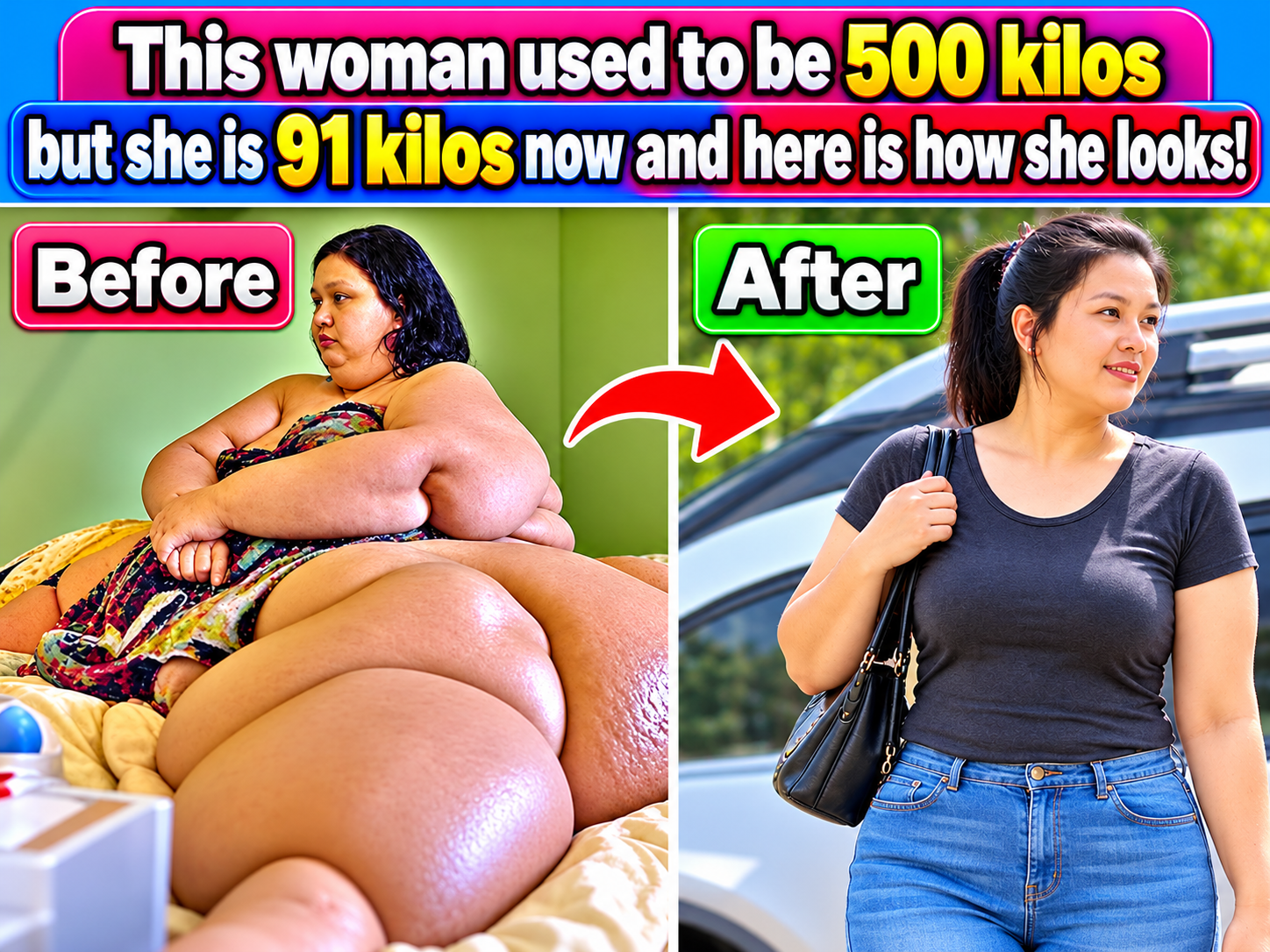
STORY TITLE: The Remarkable Journey of Mayra Lisbeth Rosales Mayra Lisbeth Rosales and the Remarkable Transformation That Changed Her Life
PART 1 TITLE: Trapped Between a Failing Body and a Secret That Could Destroy Everything She Had Left
In the Rio Grande Valley of Texas, Mayra Lisbeth Rosales had reached a point where even the simplest movement demanded help. Her world had narrowed to the room where she spent most of her days, the bed that supported her enormous frame, and the people who came in and out to care for her. She could hear ordinary life continuing beyond her walls, but taking part in it had become almost impossible.
At her heaviest, Mayra weighed more than 1,000 pounds. Her body was carrying a burden that threatened her life, and the swelling in her legs made an already difficult condition worse. Standing without assistance was out of the question. Walking was beyond her reach. Even changing position required careful attention and help from another person.
People who had never met her often saw only the number attached to her name. They did not see the years behind it, the medical complications, the dependence, or the private embarrassment of needing assistance with tasks that other adults performed without thinking.
Mayra knew what her condition had taken from her. She had lost independence, privacy, and the freedom to make ordinary decisions about where she wanted to go. Her family had become part of the machinery that kept her daily life functioning. Every visit, every meal, every adjustment to her position reminded her how much she depended on others.
There were days when she could hear activity outside and imagine herself participating. A family gathering, a short trip, a simple walk through a store—these were not extraordinary ambitions. They were ordinary experiences that had become distant possibilities.
But her physical condition was only one part of the trouble surrounding her. A tragedy within her family would soon bring police officers, investigators, and reporters into a life that had already become painfully restricted.
In March 2008, her two-year-old nephew, Eliseo Gonzalez Jr., suffered fatal injuries. The little boy was taken for medical attention, but the injuries were too severe. His death left his family facing questions that no one could answer without confronting the possibility that someone close to him had caused the harm.
Mayra became the center of the investigation.
At first, her account suggested that the boy had been injured in an accident involving her body. Given her extraordinary weight and limited mobility, investigators examined whether she could have fallen onto him. The explanation attracted immediate attention, and the case quickly became more than a local tragedy.
Police questioned the circumstances surrounding Eliseo’s injuries. Medical findings raised serious concerns that the child had suffered blows to the head rather than the injuries expected from the accident Mayra described. The difference was crucial. If the injuries had been deliberately inflicted, the investigation could no longer be treated as a terrible misunderstanding.
Mayra was accused of causing the child’s death. The charge was devastating, and the circumstances made the case difficult for authorities to handle. Her condition was so severe that transporting her or holding her in an ordinary jail facility presented major medical and logistical problems.
Her bedroom became the setting for legal proceedings that would normally take place inside a courtroom. Officers and legal representatives had to work around the reality that she could not simply stand, walk through a doorway, and attend a hearing.
The public attention was relentless. News reports focused on her size, the unusual arrangements required by her condition, and the disturbing allegation involving the toddler. The nickname attached to her in the media reduced an extraordinarily complicated human situation to a sensational label.
For Mayra, the accusation carried a weight that no scale could measure. She was facing the possibility of spending the rest of her life in prison for the death of a child she had known as family.
Yet the investigation contained a question that would eventually change everything: why did the account she had given investigators fail to match the medical evidence?
The answer was connected to someone much closer to the child than the public initially understood.
Jamie Lee Rosales, Mayra’s sister and Eliseo’s mother, was also under scrutiny. Authorities had examined the family’s circumstances, including concerns about the child’s safety. The investigation did not end with Mayra’s accusation, and the medical findings continued to challenge the first version of events.
Mayra was caught between two terrible realities. A little boy had died, and the truth about what happened could destroy the lives of everyone involved. She had already become a suspect, but the story surrounding the child’s final hours was not as simple as the first reports suggested.
Her own health made the situation even more frightening. She understood that her body was in serious danger. The years of immobility had left her dependent on medical attention and daily assistance. She could not assume that she would have decades ahead of her to repair the damage.
The thought of prison was terrifying. The thought of dying before she could put her life in order was equally real.
What happened next would force Mayra to make a decision that placed her own future against the truth about her sister.
END PART 1
PART 2 TITLE: The Confession That Changed the Investigation and Forced Mayra to Confront the Life She Was Losing
The case against Mayra Rosales was built around a disturbing explanation for a child’s death. She had initially claimed responsibility, but the medical evidence did not support the account investigators were examining. As the investigation continued, the possibility that she was protecting another person became increasingly important.
The child at the center of the tragedy was her nephew, Eliseo. He was only two years old. His death had left his family shattered, and the questions surrounding his injuries could not be dismissed simply because the first confession appeared to provide an answer.
Mayra eventually revealed that her earlier account was false. She had not accidentally crushed the child. She had taken responsibility to protect her sister, Jamie, who was the boy’s mother.
The admission changed the direction of the case. Instead of allowing the original accusation to stand, Mayra began cooperating with her attorney and helping establish what had actually happened. A recording of Jamie confessing to the killing became an important part of the effort to expose the truth.
The decision was not a simple reversal. Mayra had to accept that protecting her sister had placed her own freedom in jeopardy. She had also allowed investigators and the public to believe an account that did not reflect the real circumstances of Eliseo’s death.
Her reasons were deeply personal. She believed her own life might be nearing its end because of her physical condition. In that state of mind, sacrificing her future may have seemed less frightening than exposing someone she loved.
But a false confession could not bring Eliseo back. Nor could it undo the injuries he had suffered. The longer Mayra remained silent, the greater the chance that the wrong person would be held responsible while the truth remained hidden.
Eventually, the charges against Mayra were dropped. Her name was cleared, and the investigation shifted toward Jamie. Jamie later admitted responsibility and was sentenced to fifteen years in prison.
The legal outcome did not erase the family tragedy. Eliseo was still gone, and Mayra had to live with the knowledge that her decision to protect her sister had nearly cost her everything.
There was also the question of the other children in the family. With Jamie imprisoned, Mayra began thinking about the children who had lost their mother to the criminal justice system. She wanted to help care for them, but her physical condition made that ambition painfully difficult.
She could not simply promise to take responsibility for children and then manage the demands of daily life from a bed. Caring for young people required movement, attention, stamina, and the ability to respond quickly when something went wrong.
Mayra was forced to look directly at the limitations of her body. The children needed someone who could be present in their lives. She wanted to become that person, but wanting it was not enough.
For years, she had lived in a condition that left her unable to participate fully in family life. Now, the possibility of taking responsibility for her sister’s children gave her a reason to consider a future she had nearly stopped imagining.
The legal case had ended for her, but the personal consequences were only beginning.
She had survived the accusation. She had also survived a period in which her health had deteriorated to an alarming degree. Yet she was still confined by the same physical limitations that had existed before the investigation.
The scale of the problem was unmistakable. Her weight had climbed beyond 1,000 pounds, and the swelling in her legs added another serious complication. Medical attention was no longer something she could postpone while hoping that circumstances might improve.
Her body required specialized treatment. Ordinary weight-loss advice was not appropriate for someone in her condition. She needed physicians who understood the risks of extreme obesity, the complications of prolonged immobility, and the medical procedures that might eventually make substantial weight reduction possible.
Mayra’s case reached Dr. Younan Nowzaradan, a Houston surgeon known for treating patients with severe obesity. His work involved far more than performing an operation. Before surgery could become a realistic option, Mayra would have to demonstrate that her body could tolerate treatment and that she could follow a demanding medical plan.
The first challenge was immediate. She was too heavy for the surgical intervention she ultimately needed. Attempting a major operation without preparation would carry serious risks.
The plan therefore began with supervised weight reduction. Her food intake had to be controlled, her medical condition monitored, and her body prepared for procedures that could gradually improve her mobility.
Hospitalization became part of that process. Mayra was placed on a strict diet of approximately 1,000 calories a day under medical supervision. The restrictions were demanding, but they were not arbitrary. Her body needed a significant change before the next stage of treatment could be considered.
The first results were dramatic. During the initial ten days, she lost about 100 pounds. The number represented an important medical response, but it did not mean the danger had disappeared.
She still had an enormous amount of weight to lose. Her legs remained severely affected by swelling, and her mobility was limited. The road ahead would involve repeated treatment, adjustments, and procedures rather than one operation that could solve everything.
Mayra also had to confront the emotional side of changing her relationship with food. For years, eating had become part of a pattern that accompanied her restricted life. Now every meal had to serve a different purpose. Portions, ingredients, and preparation mattered in ways she could no longer ignore.
Her progress depended on consistency when there was no immediate reward. A day of following the diet might not produce a visible transformation. A week of effort could still leave her unable to stand independently.
Yet the goal was no longer simply to reduce a number. She wanted to be able to move, to leave the room without a complicated arrangement, and to have a meaningful role in the lives of the children she hoped to help.
For the first time in years, Mayra had a medical plan and a reason to follow it.
But the treatment would demand something she had rarely been able to exercise in the past: patience with a body that could not change overnight.
END PART 2
PART 3 TITLE: Eleven Operations, Hundreds of Pounds Lost, and the Difficult Road Back to a Life Beyond Her Bedroom
The early weight loss gave Mayra something she had not experienced in a long time: evidence that her condition could change. But the initial reduction was only the beginning. Her doctors knew that the remaining weight, the swelling in her legs, and the complications associated with years of immobility would require a much longer treatment process.
Her first major procedures took place in 2012. Rather than immediately moving to the operation she ultimately needed, the medical team began addressing some of the physical problems that made treatment difficult. The enormous amount of tissue and fluid affecting her legs presented a particular challenge.
Mayra had developed severe lymphedema, a condition in which lymphatic fluid accumulates in body tissues and causes swelling. In her case, the swelling had become so extensive that her legs were difficult to distinguish beneath the enlarged tissue. It was not simply excess weight. It was a medical complication that demanded specialized attention.
The first operations focused on reducing the burden of that condition and removing problematic tissue. Each procedure required preparation and recovery. There was no guarantee that one successful operation would lead immediately to another.
Mayra had to accept that progress would come in stages. Her body had spent years under extraordinary strain, and the medical team could not treat it as though it were a healthy body recovering from a routine procedure.
As treatment continued, her weight began falling substantially. The changes were significant enough to make the next stage of surgery possible. Eventually, she underwent a gastric procedure designed to help control how much food she could consume and support further weight reduction.
The operation was an important turning point, but it did not replace the daily work. Surgery could alter the physical conditions affecting her appetite and weight. It could not make healthy habits automatic, remove every medical complication, or restore the strength she had lost during years in bed.
That work belonged to Mayra.
Her meals became carefully measured. Foods high in protein were emphasized, while greasy meals and excessive carbohydrates were restricted. Vegetables became a regular part of her diet, and portions were controlled.
The difference was not merely in what appeared on her plate. She was learning to approach food differently. Eating could no longer be an automatic response to every difficult moment. It had to become a deliberate choice connected to her health.
She also began physical therapy. At first, even a few steps represented a considerable achievement. Her muscles had been weakened by years of inactivity, and her body had to relearn movements that most people performed without conscious effort.
Therapy was tiring. Standing required concentration, and walking demanded support. The distance between her bed and the end of a hallway could feel enormous.
But she kept working.
Her progress was measured in small achievements. Two or three steps became more. Eventually, she reported being able to walk approximately half the length of a hallway, reaching around thirty-six steps with assistance.
For someone who had once been unable to leave her bed independently, that distance meant something far greater than its measurement suggested.
It meant she could begin imagining a future outside a medical facility. It meant that her body was responding to treatment and that the possibility of independence was no longer entirely theoretical.
There were still painful reminders of what remained unfinished. Her legs continued to carry excess tissue, and the changes in her body did not happen evenly. Weight reduction left loose skin, and the earlier swelling had created additional problems.
The process was physically demanding and emotionally complicated. Mayra had to live with a body that was changing while still carrying the marks of the condition that had nearly killed her.
Her husband, Bernie, remained an important part of her emotional life. He had spent years caring for her, and their relationship had endured the restrictions imposed by her condition.
Yet they were not always able to be together. Reports during her treatment described how his immigration circumstances prevented him from visiting her at the nursing home. Their communication continued through nightly conversations, allowing them to maintain a connection despite the physical distance.
For Mayra, those conversations mattered. She was working toward a future in which she could return home and participate in ordinary married life again. The hope of seeing her husband without the barriers created by her medical condition helped give meaning to the long recovery.
Her family responsibilities remained equally important. The children connected to the tragedy that had brought her name into national headlines were still part of the larger story. She had wanted to become more capable of caring for them, and every improvement in her mobility brought that possibility closer.
But the physical transformation was attracting attention far beyond her family.
Television producers and journalists wanted to document the woman who had once weighed more than 1,000 pounds. Her story had already been presented in the TLC documentary Half-Ton Killer? The public had first encountered her through the shocking circumstances of the criminal investigation. Now, the same audience was watching a different struggle.
Mayra appeared in interviews to discuss her medical treatment and the extraordinary amount of weight she had lost. She explained how her daily life had changed and how she was learning to live with a body that could move again.
By December 2013, she reported losing more than 800 pounds and weighing approximately 200 pounds. The difference was extraordinary. She had gone from being almost completely confined to a bed to being able to stand and walk.
The transformation also changed the way she viewed her future.
Previously, ordinary activities had seemed impossible. Now she could think about leaving the nursing home, traveling, and joining family members at events. She spoke about experiences such as riding a Ferris wheel and visiting California or Las Vegas.
These were not extravagant ambitions. They were reminders of the ordinary life she had missed.
Her treatment continued through multiple procedures. By 2015, reports described a series of operations that included gastric treatment and extensive removal of excess skin. By 2019, her surgeon had performed eleven procedures, including a lap-band operation and additional surgeries related to her weight and lymphedema.
The numbers told only part of the story. Her physical transformation had required repeated medical intervention, a controlled diet, and sustained effort over several years.
There were also limitations that remained. The swelling and tissue affecting her legs still required attention, and she continued to work toward further improvement.
Mayra did not present her recovery as something that had happened easily. She acknowledged that the journey had been difficult and that maintaining her progress required a different relationship with food and daily life.
One of the most significant changes was how she described eating. Food had once dominated her routine. Now, she explained, it was something she needed to sustain her body rather than the center around which her life revolved.
That shift was important because her recovery could not depend on surgery alone.
The woman who had once been unable to move without assistance had begun rebuilding her independence through repeated decisions. Each meal, each therapy session, and each medical appointment became part of a larger effort.
She had also become an example for other people struggling with severe weight problems. One woman, Olivia Cruz, later explained that seeing Mayra’s transformation encouraged her to seek help for her own condition. Cruz had weighed approximately 570 pounds at her heaviest and eventually lost more than 300 pounds.
Mayra’s experience had become meaningful beyond her own recovery. Someone who had once been defined by helplessness was now helping another person believe that change might be possible.
Still, there was an important difference between being admired for a transformation and living with its consequences. Mayra had not simply exchanged one body for another. She had spent years confronting illness, family tragedy, public judgment, and the uncertainty of whether she would survive.
The past had not disappeared. It had become something she carried into a very different life.
And although the photographs showed how dramatically her body had changed, they could not reveal everything she had endured to reach that point.
END PART 3
PART 4 TITLE: Beyond the Extraordinary Transformation, the Family Tragedy and the Final Chapter of Mayra’s Remarkable Life
By October 2019, Mayra Rosales had become a very different woman from the person the public had first encountered more than a decade earlier.
The transformation was difficult to comprehend without comparing the photographs. At her heaviest, she had weighed more than 1,000 pounds. Years later, she had lost approximately 800 pounds through medical treatment, operations, dietary changes, and physical rehabilitation.
She was no longer the woman who had spent nearly every hour in bed, dependent on others for basic movement. She could stand and walk, take part in activities, and discuss plans that once seemed completely beyond her reach.
Yet she understood that the journey was not a simple story of before and after.
Her medical condition had involved more than excess weight. Lymphedema had caused serious swelling in her legs, and the physical effects of prolonged immobility had required extensive treatment. Even after losing hundreds of pounds, she continued to face medical challenges.
The eleven operations performed by Dr. Younan Nowzaradan represented years of treatment rather than one miraculous intervention. Her progress had depended on a combination of surgical care, changes in eating habits, and a willingness to keep working when the results were slow.
She also had a different understanding of food.
In interviews, Mayra described how her attitude had changed. Eating was no longer something around which she organized her entire day. It had become a necessary part of maintaining her health.
That distinction reflected a deeper adjustment. Her recovery had required her to reconsider habits that had become part of her daily existence. She had learned that a medical procedure could create an opportunity, but she still had to make choices that supported the change.
Her story had also reached people who were dealing with their own struggles.
Olivia Cruz was one example. After seeing Mayra’s transformation, Cruz sought medical help and began working toward a healthier life. She eventually lost more than 300 pounds. Her experience demonstrated how one person’s public recovery could encourage another person to seek treatment.
Mayra was no longer simply being discussed because of her size. People were listening to what she had learned.
She encouraged those facing similar challenges not to give up hope. Her message came from experience rather than theory. She knew what it meant to feel trapped by a body that seemed impossible to change, and she understood that progress could begin with a decision to seek professional help.
But there was another part of her life that no amount of weight loss could repair.
The death of her nephew Eliseo remained a permanent family tragedy. He had been only two years old when he suffered the fatal injuries in 2008. Mayra had initially taken responsibility, falsely claiming that she had caused his death.
She later revealed that she had been protecting her sister, Jamie Lee Rosales. The charges against Mayra were dropped after the truth emerged, and Jamie was ultimately sentenced to fifteen years in prison.
The legal outcome had cleared Mayra’s name, but it did not restore the family to what it had been before the tragedy.
Eliseo could not return. His siblings had lost their brother, and their mother was imprisoned. Mayra had wanted to help care for the children, but the years of extreme physical illness had made that responsibility difficult.
Her decision to lose weight had therefore been connected to something much larger than appearance. She wanted the ability to take part in family life and to become more useful to the people she loved.
The case also left a complicated emotional legacy. Mayra had loved her sister enough to accept blame for something she had not done. Later, when the truth became public, she spoke about forgiveness and said she did not hold resentment toward Jamie.
That did not mean the tragedy was insignificant or that the harm could be undone. It meant that Mayra had chosen not to let anger define every remaining part of her life.
Her marriage and family relationships also remained important. During her earlier treatment, she had spoken about wanting to return home to her husband, Bernie, and regain the independence that had been taken from her by years of immobility.
The possibility of traveling, joining family gatherings, and participating in ordinary activities had become a symbol of what recovery meant.
For a woman who had once been unable to walk across a room, the ability to leave home and experience the outside world carried enormous significance.
Her public identity changed as well. The media had once attached a sensational label to her name because of the criminal case. Later reports increasingly focused on her weight loss, her medical treatment, and her efforts to encourage others.
The difference mattered. Mayra was more than the accusation that had nearly defined her, and she was more than the number of pounds she had lost.
She was a woman who had lived through a devastating family event, a serious medical crisis, and years of treatment. Her life contained decisions that were difficult to understand from the outside, and her transformation did not erase the complicated circumstances that had shaped her.
Then, years after her extraordinary weight-loss journey had attracted international attention, another chapter began.
Mayra Lizbeth Rosales died on February 16, 2024, at McAllen Medical Center in Texas. She was forty-three years old. Her death was reported in an obituary published by The Monitor, which identified the date and place of her passing. The public notice did not provide a specific cause of death.
The news brought an end to the life of a woman whose story had been followed by people around the world.
For those who remembered the images of her at more than 1,000 pounds, the transformation remained astonishing. She had lost hundreds of pounds, undergone numerous operations, and regained abilities that once appeared permanently beyond her reach.
But the meaning of her story cannot be measured by the difference between two numbers.
Her journey began in a period when her body had become a source of constant danger. A family tragedy then placed her at the center of a criminal investigation, and her decision to protect her sister nearly cost her freedom. When the truth emerged, she faced another difficult choice: whether to accept that her own health might prevent her from having the future she wanted.
She chose to fight for change.
The medical journey that followed was long and demanding. It involved hospitalization, strict dietary restrictions, operations, physical therapy, and years of adjustment. There were no shortcuts that could replace the work required to rebuild her health.
Her progress also gave hope to people who saw themselves in her earlier struggles. She became an example of how professional medical support and sustained effort could create possibilities that had once seemed unimaginable.
Her death in 2024 means that her story should not be presented as though the transformation guaranteed a long or uncomplicated life. It did not. The medical challenges she faced were serious, and the public record does not establish that her earlier weight problems caused her eventual death.
What remains is the documented journey of a woman who experienced extraordinary hardship, made difficult choices, and worked for years to regain her independence.
Mayra Rosales was once known primarily for her size and the shocking accusation surrounding her nephew’s death. Later, she became known for losing more than 800 pounds and reclaiming abilities she had almost lost forever.
Neither description tells the whole story.
The more complete picture includes the family tragedy, the false confession, the truth that eventually emerged, the medical team that helped her, the difficult discipline of recovery, and the ordinary experiences she once hoped to enjoy again.
Her life was not a perfect story of triumph, and its ending was not the one anyone could have guaranteed. But her transformation remains a remarkable chapter in the history of extreme weight-loss treatment and a deeply personal account of what it can mean to fight for another chance.
In the end, Mayra’s journey was about more than becoming lighter. It was about trying to regain control of a life that had become painfully small, finding a reason to keep going, and discovering that even after years of hardship, change could still be possible.
END PART 4
PART 5 TITLE: The Woman Behind the Headlines and the Private Battles That Her Extraordinary Transformation Could Never Fully Reveal
The world had seen Mayra Rosales change physically, but the photographs could never capture the full experience of living through that transformation. Behind every remarkable image was a woman who had spent years confronting limitations that most people would never understand. Her recovery had become public knowledge, yet much of the emotional work remained private.
When people discussed her weight loss, they often concentrated on the numbers. Losing hundreds of pounds was an achievement that attracted attention, but the more meaningful changes were found in the ordinary details of her daily life. Being able to stand, move around, and participate in activities without depending entirely on another person represented a different kind of success.
For years, Mayra’s physical condition had determined nearly every decision. She could not simply decide to leave the house. Even a medical appointment required considerable planning, assistance, and specialized arrangements. Her world had become restricted by a body that needed constant support.
The process of recovering her independence changed that relationship. Movement was no longer something she could only imagine. It became an ability she could gradually rebuild through physical therapy and medical treatment.
However, progress did not mean that every day became easier. Her body had undergone enormous changes, and the consequences of extreme obesity did not disappear when the weight came off. Swelling, excess tissue, and the effects of prolonged immobility continued to complicate her recovery.
There was also the emotional adjustment of seeing herself differently. A person who had spent years being recognized for an extraordinary physical condition could not simply erase that identity overnight. The photographs taken during her transformation preserved images of two very different stages of her life, but Mayra had experienced every difficult moment between them.
She had to learn how to live in a body that was changing, how to accept its limitations, and how to appreciate improvements that might have seemed insignificant to someone who had never experienced her earlier condition.
The first steps she managed to take had been especially meaningful. They were not impressive distances by ordinary standards, but they represented the return of an ability she had almost lost. Each step required effort, balance, and concentration.
Her medical team had helped create the opportunity for that progress, but the daily work belonged to her. She had to follow the treatment recommendations, attend rehabilitation sessions, and make decisions about food that supported her recovery.
One of the biggest changes involved her relationship with eating. Previously, food had occupied a central place in her routine. During treatment, she learned to approach meals with greater attention to portions and nutritional value.
Her dietary restrictions were not simply temporary rules imposed by doctors. They were part of the long-term changes necessary to protect the progress she had made.
This was particularly important because her transformation involved more than surgery. The procedures performed by Dr. Younan Nowzaradan had helped address serious medical problems and support weight reduction, but they could not independently guarantee lasting results.
Mayra needed to maintain new habits after leaving the most intensive stages of treatment. That meant continuing to make choices even when there was no immediate medical emergency reminding her why those choices mattered.
The difference between her earlier life and her later routine was therefore not limited to physical appearance. She had begun rebuilding a sense of responsibility for her own health.
The change also influenced the way she thought about the future. Earlier in her life, even imagining a short trip had been difficult. Later, she could discuss traveling and experiencing places that had once seemed inaccessible.
She had mentioned wanting to visit California and Las Vegas. She also spoke about enjoying simple attractions, including the possibility of riding a Ferris wheel.
Those plans revealed something important about her priorities. She was not describing an extravagant lifestyle. She wanted experiences that many people took for granted.
A short outing could represent freedom. A family gathering could become an opportunity to participate rather than remain physically separated from everyone else. Even the prospect of walking around a public place carried a meaning that went beyond exercise.
Her husband, Bernie, had also been part of those hopes. Their relationship had existed through years when her medical condition created enormous practical difficulties. During her treatment, his immigration circumstances reportedly prevented him from visiting her at the nursing home.
Their nightly conversations became one way to maintain their connection. Although they could not always share the same physical space, communication allowed them to remain involved in each other’s lives.
For Mayra, returning home and enjoying a more independent relationship with her husband represented an important part of recovery. Her ambitions were connected to companionship, privacy, and the ordinary routines of married life.
But the family tragedy that had brought her name into the headlines remained part of her history.
The death of Eliseo Gonzalez Jr. had changed the family permanently. Mayra’s initial false confession, made to protect her sister, Jamie Lee Rosales, had placed her in an extremely dangerous legal position.
When she eventually revealed the truth, the investigation changed direction. The charges against Mayra were dropped, and Jamie was sentenced to fifteen years in prison.
That outcome resolved the central legal question surrounding Mayra’s responsibility, but it did not remove the grief associated with the child’s death.
Mayra still had to live with the memory of what had happened and the knowledge that her decision to accept blame had nearly destroyed her own future. It was an experience that could not be explained by physical measurements or medical statistics.
Her desire to help care for the children in the family gave her another reason to pursue independence. She wanted to become someone who could contribute more actively to their lives.
The physical transformation therefore carried a personal meaning that extended beyond her own comfort. It was connected to the possibility of being present for people who needed support.
Yet she could not change the past. She could not undo the tragedy, restore the family as it had been, or recover the years that had passed while she was severely ill.
What she could do was continue working toward a healthier future.
As the years passed, the public became increasingly familiar with her weight-loss story. The woman once described through a sensational criminal investigation was now being discussed as someone who had achieved an extraordinary medical transformation.
But the attention brought its own limitations. The public often wanted a simple conclusion: a woman became extremely obese, underwent surgery, lost hundreds of pounds, and began a new life.
The actual experience was more complicated.
Her recovery involved medical risks, emotional adjustments, family difficulties, and the responsibility of maintaining progress. There was no single moment when every problem disappeared.
Mayra’s story deserved to be understood in those terms. The transformation was remarkable, but the person behind it remained more complicated than any headline could communicate.
END PART 5
PART 6 TITLE: Eight Hundred Pounds Gone, Yet the Hardest Lessons of Recovery Were Still Waiting Beyond the Operating Room
By the time Mayra’s transformation became widely recognized, the difference between her former condition and her later appearance was extraordinary. She had lost more than 800 pounds, and reports described her weight falling from over 1,000 pounds to approximately 200 pounds during her recovery.
The figures were remarkable, but they also created an expectation that her medical problems had been solved. People looking at the photographs could easily assume that the hardest part was over.
For Mayra, however, recovery was not a destination reached simply because the scale displayed a smaller number.
Her body had experienced years of extreme strain. The consequences included severe swelling, reduced mobility, and extensive tissue changes. Even after losing enormous amounts of weight, she continued to need medical attention.
One of the most challenging complications had been lymphedema. The condition had contributed to the extraordinary enlargement of her legs, making movement and everyday care difficult.
Reducing body weight did not automatically eliminate the problem. The accumulated tissue and changes caused by years of swelling required additional treatment.
This was one reason her medical journey involved so many procedures. Her treatment was not limited to a single weight-loss operation. The doctors also needed to address complications that had made her condition especially severe.
The eleven procedures associated with her treatment represented years of medical intervention. Each operation addressed a particular need, and each recovery period brought its own challenges.
Mayra had to be prepared for the possibility that a successful procedure might still leave other problems unresolved.
The gastric procedure helped support weight reduction, while later operations addressed excess skin and other physical complications. These procedures were important, but they were not substitutes for long-term care.
Her doctors also had to consider the physical consequences of removing large amounts of tissue. A body that had undergone such dramatic changes needed careful monitoring and rehabilitation.
The excess skin left behind after major weight loss could affect comfort, movement, and personal hygiene. It could also create difficulties that were not obvious in photographs.
For Mayra, these changes were reminders that losing weight was only one stage of a much larger process.
Physical therapy remained important because her muscles had been weakened by years of immobility. Regaining strength required repeated practice. She could not expect her body to become fully capable simply because the excess weight had decreased.
The early walking achievements had been encouraging, but maintaining and improving mobility demanded continued effort.
Every movement represented a combination of strength, balance, and confidence. The ability to walk a short distance did not mean she could immediately return to every activity she had missed.
There were also psychological challenges. When someone spends years dependent on caregivers, independence can feel unfamiliar even after physical improvement begins.
Mayra had to adjust to making more decisions for herself and accepting the responsibility that came with greater mobility.
The relationship between health and daily habits became especially important. Her earlier dietary pattern had contributed to a condition that placed her life at risk. After surgery, she could no longer approach eating in the same way.
She had to pay attention to portion sizes, food choices, and nutritional needs. Her meals became part of a structured approach to maintaining her health.
This was not always easy. Food habits are connected to routine, comfort, and emotional experiences. Changing them requires more than knowing which foods are healthier.
Mayra had to make the new approach part of her everyday life.
Her progress also depended on the medical professionals who supported her. Dr. Nowzaradan’s treatment program involved strict expectations because the risks associated with extreme obesity were serious.
The purpose of the program was not to produce dramatic television moments. It was to create conditions in which patients could undergo treatment more safely and work toward meaningful improvements.
Mayra’s early hospitalization and supervised calorie restriction had demonstrated how quickly her body could respond under medical supervision. But those initial results did not remove the need for long-term discipline.
The difference between short-term weight loss and sustained recovery was especially important in her case.
A person can lose a substantial amount of weight and still face serious medical complications. Mayra’s experience illustrated why comprehensive treatment must consider mobility, tissue problems, nutrition, and overall physical condition.
Her public story also influenced people who were struggling with severe obesity themselves.
Olivia Cruz later spoke about being inspired by Mayra’s transformation. At her heaviest, Cruz weighed approximately 570 pounds. She eventually lost more than 300 pounds after seeking help.
The connection between their stories was significant. Mayra’s experience had become an example that another person could look at when deciding whether to pursue treatment.
But Mayra’s influence did not mean that every patient would experience the same results. Extreme obesity involves different medical circumstances, and treatment must be adapted to the individual.
Her story showed what could happen when serious medical care and sustained personal effort came together, not that one procedure offered a universal solution.
Meanwhile, Mayra continued to live with the consequences of her earlier experiences.
The family tragedy involving Eliseo remained part of her history. Her false confession and later cooperation with investigators had changed the course of the criminal case, but the emotional impact of losing a child within the family could not simply be removed.
Her sister Jamie’s imprisonment also meant that family responsibilities had changed. Mayra had wanted to help care for the children, and her improved mobility gave her a better chance of participating in their lives.
That hope was one of the most personal reasons behind her determination.
The public might have celebrated the number of pounds she lost, but her own ambitions were more ordinary. She wanted to move freely, spend time with her husband, and experience the outside world without every activity becoming a medical challenge.
The ability to make those choices was a measure of progress that no photograph could fully communicate.
By 2019, her transformation had already become a long-running subject of public interest. Yet her medical history made it clear that she would need to continue caring for herself.
The work did not end when the cameras stopped recording. Nor did it end when the number on the scale became dramatically smaller.
Her body had survived an extraordinary period of medical danger, but it remained a body that had undergone enormous changes.
Mayra’s recovery was therefore a continuing process rather than a final victory.
END PART 6
PART 7 TITLE: The Family Wounds That Remained After the Cameras Left and the Meaning of a Second Chance at Life
There was one part of Mayra Rosales’s journey that no surgical procedure could change. It was the family tragedy that had taken place years before her transformation became a source of public inspiration.
Eliseo Gonzalez Jr. had been only two years old when he died from severe injuries in March 2008. His death had brought investigators into the family and placed Mayra under suspicion.
The original explanation she gave authorities was that she had accidentally fallen onto the child. Because of her extraordinary weight, the claim attracted immediate attention.
But medical findings raised questions about whether the injuries could have happened in the way she described.
The investigation continued, and Mayra eventually admitted that she had not been telling the truth. She had falsely accepted responsibility to protect her sister, Jamie Lee Rosales.
The revelation was a turning point. Her cooperation helped establish that Jamie had been responsible for the child’s death. Mayra’s charges were dropped, while Jamie ultimately received a fifteen-year prison sentence.
For Mayra, the legal outcome brought relief, but relief was not the same as peace.
She had spent time facing the possibility of being held responsible for a death she had not caused. The experience had exposed her to public judgment and the possibility of imprisonment at a time when her health was already dangerously compromised.
It also forced her to confront the consequences of trying to protect someone by taking blame for an act she had not committed.
There was no easy way to reconcile the decision with what followed. She had wanted to protect her sister, but the false confession had created a situation in which the truth became even more difficult to establish.
Eventually, she chose to reveal what had happened.
That choice changed her legal future, but it could not restore the family.
Eliseo’s death remained permanent. His siblings had to grow up with the loss of their brother and the imprisonment of their mother. The circumstances were painful and complicated, and Mayra could not make them disappear.
Her hope of helping care for the children became connected to her desire to regain physical independence.
For years, her condition had prevented her from taking on responsibilities that required movement and stamina. She could not easily provide the kind of daily support a child might need.
As her health improved, she began to see the possibility of contributing more actively.
The transformation was therefore connected to love and responsibility as much as personal survival.
Mayra wanted a future in which she could do more than receive help. She wanted to become someone who could give support to others.
Her relationship with Jamie remained complicated by the circumstances of the tragedy. Mayra had publicly expressed forgiveness, but forgiveness did not change the seriousness of what had happened.
It was possible to care about a family member while still acknowledging the terrible consequences of that person’s actions.
The public often wanted to turn their relationship into a simple story of loyalty or betrayal. But the real circumstances involved grief, difficult choices, criminal responsibility, and the emotional consequences of a family being permanently changed.
Mayra’s decision to protect Jamie had almost cost her freedom. Her later decision to tell the truth showed that she eventually recognized the importance of allowing the investigation to reflect what had actually happened.
That experience remained one of the most consequential parts of her life.
While the criminal case had attracted widespread attention, her medical condition had also been progressing toward a crisis.
At her heaviest, she had weighed more than 1,000 pounds. Her ability to move had become severely restricted, and her body required specialized care.
The treatment that followed gave her another opportunity to participate in family life. Hospitalization, strict dietary changes, surgery, and rehabilitation gradually changed what her body could do.
The transformation was not just about becoming smaller. It was about regaining abilities that had been lost.
A short walk became possible. A trip outside became something she could consider. The thought of enjoying a public attraction was no longer completely unrealistic.
Her husband Bernie was part of the future she hoped to build. During her treatment, the separation caused by his immigration circumstances had made their relationship more difficult.
Their nightly conversations offered a connection during a period when physical presence was not possible.
For Mayra, the possibility of returning to a more ordinary married life mattered deeply. She wanted to share experiences with him that had previously been beyond her physical capabilities.
She also wanted to experience the world without requiring an elaborate medical arrangement every time she left her room.
The importance of those ambitions was easy to overlook. People watching her transformation might have focused on her weight, but her own hopes were centered on things that required no special attention from the public.
She wanted to walk, travel, spend time with family, and make choices without depending entirely on caregivers.
Those goals represented a different kind of freedom.
Her public appearances and interviews also changed the way others understood her. The earlier coverage had concentrated on her unusual physical condition and the accusation involving Eliseo.
Later, the emphasis shifted toward her medical recovery and the discipline required to lose so much weight.
The transformation made her a recognizable example for people facing similar problems. Her story demonstrated that seeking specialized medical help could create opportunities even in extremely difficult circumstances.
Olivia Cruz’s experience illustrated that influence. Seeing Mayra’s progress helped encourage Cruz to pursue treatment and work toward her own weight-loss goals.
It was a meaningful connection, but Mayra’s story was not a promise that every patient would have the same medical outcome.
Her experience involved specific conditions, extensive procedures, and years of care. It was important to understand the achievement without turning it into an unrealistic expectation.
By 2019, Mayra had already undergone eleven procedures associated with her treatment and had lost hundreds of pounds.
The physical difference was extraordinary, but the past continued to exist alongside the progress.
She could not erase the years spent in bed, the fear of losing her life, or the tragedy involving her nephew.
She could only continue forward.
The woman who had once been defined by circumstances beyond her control had regained a measure of independence. That was perhaps the most important change of all.
END PART 7
PART 8 TITLE: February 2024, the Final Goodbye to Mayra Rosales and the Legacy of a Life That Refused to Be Defined by One Number
By the time Mayra Rosales entered the final years of her life, her story had already passed through several extraordinary chapters. She had survived a medical crisis, endured a devastating family tragedy, faced a criminal investigation, and undergone a transformation that attracted international attention.
Her name had become associated with one of the most dramatic weight-loss journeys reported in the United States.
Yet the story was never as simple as the photographs suggested.
At her heaviest, Mayra weighed more than 1,000 pounds. Her physical condition had become so severe that she could no longer manage ordinary movement independently. She needed assistance with daily activities, and the medical risks associated with her weight and immobility were substantial.
Her treatment required a specialized team and a carefully planned approach.
Dr. Younan Nowzaradan became an important figure in her recovery. His treatment included supervised dietary changes, surgical procedures, and a long process of addressing the complications associated with her condition.
The early stages were particularly demanding. Mayra had to lose weight before major surgery could be considered safely.
Her initial hospital diet produced a dramatic reduction, but that was only the beginning. She subsequently underwent procedures to address her medical complications, including severe lymphedema and excess tissue.
The gastric treatment helped support further weight reduction, while later procedures addressed the physical consequences of losing such an enormous amount of weight.
Over the years, her total weight loss exceeded 800 pounds.
The achievement was extraordinary, but the real significance appeared in the abilities she regained.
She could stand. She could walk. She could imagine traveling and participating in activities that had once seemed impossible.
For someone who had spent years confined to a bed, those changes represented a profound improvement in daily life.
Her recovery also required a different approach to food. Meals became more controlled, portions were carefully considered, and maintaining her progress required continued attention.
She had learned that surgery could create an opportunity, but it could not replace personal responsibility.
That lesson became part of the message she shared with others.
Her transformation encouraged people such as Olivia Cruz to seek treatment for their own weight-related struggles. Cruz eventually lost more than 300 pounds, showing how Mayra’s public journey could have an influence beyond her own life.
But Mayra’s history also included experiences that no medical achievement could resolve.
The death of her nephew Eliseo remained a defining tragedy. Her original false confession had placed her in danger of being prosecuted for his death, but she later revealed the truth and helped redirect the investigation toward Jamie Lee Rosales.
The charges against Mayra were dropped, and Jamie was sentenced to fifteen years in prison.
The outcome brought legal clarity, but the family loss remained.
Mayra had wanted to help care for the children, and her medical transformation was partly connected to her desire to become more independent and useful to the people she loved.
Her relationship with Bernie was another part of her hopes for the future. The separation during her treatment had made ordinary companionship difficult, and she had looked forward to returning home and sharing more of life with him.
The years of medical treatment had changed her body, but they had also changed what she considered important.
Freedom was no longer an abstract idea. It meant being able to leave a room, walk through a public place, visit relatives, and enjoy experiences without needing constant assistance.
Those were the things she had once wanted most.
By 2019, her transformation had become widely documented, and her story continued to attract attention. She had gone from being a woman whose life was severely restricted by her weight to someone who could speak publicly about the medical treatment and lifestyle changes that had helped her.
However, the public record does not establish that every medical problem had been resolved.
The history of severe obesity, lymphedema, and multiple operations meant that continued medical attention remained important. Losing hundreds of pounds did not guarantee that her body would never experience further complications.
Her story should therefore not be understood as a promise of permanent health or an uncomplicated future.
It was an account of substantial progress made under difficult circumstances.
Then came February 2024.
Mayra Rosales died on February 16, 2024, at McAllen Medical Center in Texas. She was forty-three years old.
The news marked the end of a life that had been followed by the public for many years. Her death was reported in her obituary, but a specific cause of death was not publicly established in the information available about her passing.
It would be wrong to claim that her earlier medical condition directly caused her death without reliable evidence.
What can be said is that her life had involved extraordinary physical challenges and a lengthy medical journey.
For those who had followed her story, the news brought back memories of the woman who had once been unable to move independently and the remarkable transformation that followed.
Her death also encouraged a different way of looking at the photographs that had made her famous.
The earlier images showed the severity of her condition. The later ones showed the results of years of treatment and effort. Between those images was a long period of medical procedures, difficult adjustments, and personal decisions.
That was where the real story existed.
It was in the days when she had to follow a strict diet despite wanting something familiar. It was in the difficult physical therapy sessions when a few steps required enormous effort. It was in the hospital rooms where each procedure carried uncertainty.
It was also in the private conversations with her husband, the hopes she had for her family, and the emotional consequences of the tragedy involving Eliseo.
Her life contained both remarkable progress and painful experiences.
She was not simply a woman who lost an extraordinary amount of weight. She was someone whose circumstances had placed her under intense public scrutiny and whose personal choices had become part of a complicated legal case.
She eventually cleared her name, pursued medical treatment, and worked toward a more independent life.
Those achievements remain part of her legacy.
Her story also offers an important reminder about extreme obesity. It is a serious medical condition that can affect mobility, physical health, emotional well-being, and independence. People experiencing it need appropriate medical assessment and individualized treatment rather than judgment or simplistic advice.
Mayra’s experience demonstrated how complex treatment can become when a person’s condition has progressed to an extreme stage.
Her eleven operations were not a shortcut. They were part of a long medical process that required professional supervision and sustained changes in daily habits.
The results were extraordinary, but the journey also showed why recovery should be measured through more than weight alone.
The ability to move, participate in family life, and make ordinary decisions about one’s day can matter just as much as a number on the scale.
Mayra had once hoped to enjoy experiences that other people rarely think twice about. Her progress brought some of those possibilities closer.
Although her life ended at forty-three, the documented transformation remains a significant part of her story.
The family tragedy, the false confession, the eventual revelation, the medical treatment, and the remarkable weight loss all belong to the same complicated life.
None of those chapters should be used to erase the others.
Her journey was not perfect, and its ending was not a simple victory. But it showed how much can change when someone receives specialized medical support and continues working toward a different future.
Mayra Rosales will be remembered for losing more than 800 pounds, but her life cannot be reduced to that achievement.
She was a wife, a sister, an aunt, and a woman who endured circumstances that changed nearly every part of her existence. She faced public judgment, personal loss, and years of physical difficulty.
Her story began with a body that had become a prison. It continued through a tragedy that nearly cost her freedom. And it included a transformation that allowed her to reclaim abilities she had once believed were gone forever.
The photographs may preserve the difference between the beginning and the later years, but they cannot capture every sacrifice, every fear, or every small victory along the way.
That is why her story deserves to be remembered as more than an extraordinary weight-loss case.
It is the story of Mayra Lisbeth Rosales, a woman whose life was marked by hardship, determination, family responsibility, and the pursuit of a second chance.
END PART 8
PART 9 TITLE: Beyond the Headlines, the Untold Human Cost of a Transformation That Changed How the World Remembered Mayra Rosales
Mayra Rosales’s story did not end with the final photograph of her transformation. Even after her death in February 2024, the questions surrounding her extraordinary life remained connected to the experiences that had shaped her long before the cameras arrived. Her physical recovery had attracted worldwide attention, but the most important parts of her journey were not always visible.
People remembered the woman who had once weighed more than 1,000 pounds and later lost over 800 pounds. They remembered the medical procedures, the hospital treatment, and the remarkable difference in her appearance. Yet the numbers could not explain what it meant to spend years depending on others for almost everything.
For Mayra, independence had once seemed like something belonging to another person. She could not simply get out of bed, walk into another room, or decide to visit someone without considering the assistance her body required. Even ordinary activities involved planning and the cooperation of other people.
That dependence affected more than her physical comfort. It changed the way she experienced relationships. Family members and caregivers became essential to her daily routine, and the simplest decisions could require additional arrangements.
When she began treatment, the goal was not simply to change her appearance. Her doctors needed to address a dangerous medical condition that had already taken away much of her independence.
The first stages of recovery demonstrated how serious the situation had become. Her body required close medical supervision, and the possibility of major surgery depended on reducing her weight and stabilizing her condition.
Her initial hospital treatment brought dramatic results. Losing approximately 100 pounds during the first ten days demonstrated that her body could respond to carefully supervised dietary restrictions. But the early success did not mean that the medical danger had disappeared.
There were still major complications to address. Her legs were severely affected by lymphedema, and the physical consequences of prolonged immobility remained substantial.
The medical team approached those problems through multiple stages of treatment. Procedures to reduce problematic tissue, gastric intervention, and later operations all played a role in her recovery.
Each procedure required a period of preparation and healing. There were no guarantees that the next stage would be easier than the previous one.
Mayra had to accept that recovery would take time. She could not expect to lose hundreds of pounds and immediately regain every ability she had lost.
Physical therapy became one of the clearest examples of that reality. At first, movement was exhausting. Standing and walking required concentration, assistance, and repeated effort.
When she eventually managed to walk approximately thirty-six steps along a hallway, the distance was modest by ordinary standards. For her, however, it represented a significant change in what her body could accomplish.
Those steps were a reminder that the medical treatment was producing more than a different appearance. It was giving her the possibility of participating in life again.
The road remained difficult, but her goals became more concrete. She wanted to travel, enjoy family gatherings, and experience activities that had once been impossible.
She also wanted to return to a more independent life with her husband, Bernie. Their relationship had endured years of physical separation and the complications created by her treatment.
During her time in medical care, his immigration circumstances reportedly prevented him from visiting her at the nursing home. Their nightly conversations helped preserve their connection.
The prospect of sharing ordinary experiences again became part of her motivation. She wanted to spend time with him without every activity being controlled by her medical condition.
Yet her recovery was never separated from the family tragedy that had brought her into the public eye.
The death of her nephew, Eliseo Gonzalez Jr., remained one of the most painful events associated with her life. The little boy had died in March 2008, and the circumstances surrounding his injuries had led investigators to question Mayra.
Her original account had been false. She had claimed responsibility to protect her sister, Jamie Lee Rosales, but later revealed the truth.
That decision changed the investigation. The charges against Mayra were dropped, and Jamie ultimately received a fifteen-year prison sentence.
The legal case ended differently from how it had begun, but the family consequences remained.
Mayra had wanted to help care for the children affected by the tragedy. Her physical condition had made that difficult, and her desire to become more independent was partly connected to that responsibility.
Her transformation therefore had a personal purpose beyond survival. She wanted to become someone who could contribute rather than someone who needed constant assistance.
As the years passed, her public identity gradually changed. Earlier reports had focused on the disturbing circumstances of the criminal investigation and her extraordinary weight.
Later attention concentrated on the medical transformation and the discipline required to achieve it.
She had lost more than 800 pounds, undergone eleven procedures associated with her treatment, and regained the ability to stand and walk.
The transformation inspired other people, including Olivia Cruz, who later pursued her own treatment after seeing Mayra’s progress.
But Mayra’s story was never a simple formula that others could follow and expect identical results. Her medical circumstances were complex, and her treatment required individualized professional care.
The lessons were found in the importance of seeking appropriate medical support, following treatment recommendations, and understanding that lasting change requires sustained attention.
By the final years of her life, Mayra had become an example of how extraordinary medical progress could change someone’s daily possibilities.
Her death on February 16, 2024, at McAllen Medical Center brought her personal journey to an end.
She was forty-three years old.
The publicly reported information about her passing did not establish a specific cause of death. Her earlier health problems should not be treated as proof of what caused her final illness or death.
What remained was the record of a woman who had experienced extraordinary hardship and undergone a remarkable transformation.
The public could remember the photographs, but the deeper meaning of her life was found in the choices and struggles behind them.
END PART 9
PART 10 TITLE: The Meaning of Independence After Years of Dependence and the Ordinary Dreams Mayra Fought to Experience Again
For much of Mayra Rosales’s life, independence had been measured in ways most people rarely considered. It was not simply about having a job, choosing where to live, or deciding how to spend an afternoon. It was about being able to move without requiring someone else to organize every part of the process.
At her heaviest, she had been unable to manage ordinary movement independently. Her body required constant assistance, and the physical limitations affected nearly every aspect of her daily routine.
A short journey outside her home could become a complicated medical undertaking. The arrangements required to move her safely were substantial, and her health made ordinary transportation difficult.
That reality had gradually restricted her world.
When she entered treatment, one of the most important changes was the possibility of recovering physical abilities that had once seemed permanently lost.
The first stages were uncomfortable and demanding. Her doctors needed to reduce her weight before considering major surgical procedures, and the restrictions on her food intake required a dramatic change in her routine.
Her early weight loss was encouraging, but it also demonstrated how much medical supervision her condition required.
The treatment continued through procedures that addressed the complications affecting her body. Her severe lymphedema required attention, and the excess tissue in her legs made recovery more complicated.
Gastric treatment later supported further weight reduction. As her weight decreased, her doctors could address additional physical problems through other operations.
The transformation took years rather than weeks.
Physical rehabilitation became increasingly important as the weight came off. Her body needed to regain strength, and her muscles had to adapt to movements that had once been impossible.
The first steps were particularly meaningful because they represented a return to something she had lost.
Walking approximately thirty-six steps along a hallway was a major achievement. It showed that she could begin moving through an environment without remaining completely confined to her bed.
The distance was small, but the possibilities behind it were much larger.
She could begin considering activities that required leaving the house. She could imagine joining family members outside the medical setting and experiencing places she had previously only discussed.
Her interest in traveling to California and Las Vegas reflected those ambitions. She also expressed interest in riding a Ferris wheel, an activity that symbolized the freedom she wanted to regain.
The attraction was not important because of its size or excitement. It represented something ordinary that had once been inaccessible.
Her marriage was another part of that future.
Bernie had remained connected to her during a period when her treatment and his immigration circumstances created physical separation. Their nightly conversations helped maintain their relationship while she continued receiving care.
Mayra wanted the opportunity to share more of everyday life with him. She wanted to spend time together without every plan being limited by the condition that had controlled her earlier years.
Her recovery also changed how she thought about family responsibility.
The tragedy involving her nephew Eliseo had left a lasting impact. His death in March 2008 had led to a criminal investigation in which Mayra initially accepted blame.
She later revealed that she had been protecting her sister, Jamie. The charges against Mayra were dropped, and Jamie received a fifteen-year prison sentence.
The case had been emotionally devastating, but it also made Mayra think about the children affected by their mother’s imprisonment.
She wanted to be more capable of helping them. That desire became one of the reasons she wanted to regain independence.
Her improved mobility offered the possibility of taking on a more active role, although her medical limitations and family circumstances remained complicated.
The transformation was therefore connected to a broader understanding of what she wanted from life.
It was not enough to survive. She wanted to participate.
This distinction helps explain why her recovery was so meaningful. The medical team could measure her weight, evaluate her mobility, and assess her physical condition. But the personal value of those improvements appeared in the experiences she hoped to enjoy.
Being able to walk outside meant more than completing a rehabilitation exercise. It meant having another choice.
Being able to attend a family gathering meant more than appearing in a photograph. It meant participating in a shared experience.
Even the possibility of choosing when to leave a room represented a kind of independence she had once lost.
Her relationship with food also changed as her treatment progressed. She learned to follow controlled portions and prioritize healthier meals.
This was particularly important because her recovery required long-term attention. Surgery could help create the conditions for weight loss, but maintaining the results depended on continuing the habits she had developed.
Her story also became an encouragement for other people facing severe obesity.
Olivia Cruz was one of those who found motivation in Mayra’s progress. Cruz later lost more than 300 pounds after seeking treatment for her own condition.
The connection demonstrated how one person’s experience could encourage another to seek professional help.
Nevertheless, Mayra’s results should be understood within the context of her own medical circumstances. The treatment involved multiple operations and years of care, not a single procedure that could guarantee the same outcome for everyone.
By 2019, the public had already witnessed the scale of her physical transformation.
She had lost more than 800 pounds and undergone eleven procedures associated with her treatment.
Her independence had improved, but the consequences of her earlier condition remained part of her life.
Her death in February 2024 brought that journey to an end.
The public record identified February 16 as the date she died at McAllen Medical Center in Texas. She was forty-three years old, and no specific cause of death was established in the publicly reported information.
Her final chapter should not erase what she achieved during her earlier years.
Nor should her transformation be used to suggest that all her medical challenges had disappeared.
The most honest way to remember her is to recognize both the remarkable progress and the difficult reality that remained.
Mayra had wanted a life in which ordinary experiences were possible again. Her recovery allowed her to move closer to that goal.
END PART 10
PART 11 TITLE: When a Public Transformation Becomes a Personal Legacy and the Lessons Hidden Behind Mayra Rosales’s Extraordinary Journey
The photographs of Mayra Rosales created a powerful contrast. One showed a woman whose body had become so large that ordinary movement was almost impossible. Another showed a dramatically different appearance after years of medical treatment.
Between those images was a story that could not be explained by weight loss alone.
Mayra’s experience involved a medical crisis, a family tragedy, an investigation that threatened her freedom, and a long process of rebuilding her physical independence.
The public often encountered these events separately. Some people knew her through the criminal case involving her nephew. Others discovered her through reports about her weight-loss transformation.
But both chapters belonged to the same person.
The events of March 2008 had placed her in an extremely difficult position. After her two-year-old nephew, Eliseo Gonzalez Jr., died from severe injuries, Mayra initially told investigators that she had accidentally fallen onto him.
The medical findings raised serious questions about that explanation.
Eventually, Mayra admitted that she had lied to protect her sister, Jamie Lee Rosales. Her cooperation changed the direction of the case, and the charges against her were dropped.
Jamie was ultimately sentenced to fifteen years in prison.
The legal outcome was important because it established that Mayra was not responsible for the death. However, the emotional consequences of the tragedy continued to affect the family.
Mayra had wanted to help care for the children, and her own medical condition made that difficult.
Her weight had reached an extraordinary level. She had become almost completely dependent on others, and her health required specialized intervention.
The decision to seek treatment therefore became a turning point.
She was introduced to a medical program that required strict dietary changes and careful preparation for surgery.
The initial hospital treatment demonstrated that substantial weight reduction was possible. She lost approximately 100 pounds during the first ten days under medical supervision.
But the early results were only one part of the process.
Her doctors also needed to address the severe lymphedema affecting her legs. The accumulated swelling and tissue created additional problems that could not be solved through dietary changes alone.
Multiple operations followed.
The gastric procedure supported further weight reduction, while later procedures addressed the excess tissue and other physical complications created by years of extreme obesity.
By 2019, reports described eleven procedures associated with her treatment.
The overall weight loss exceeded 800 pounds.
Yet the most meaningful results were not found in the surgical record. They were found in the abilities she gradually regained.
She began standing and walking again. Physical therapy helped her rebuild strength, and the short distances she managed became important milestones.
Her body had to adjust to a completely different level of movement.
She also had to adjust psychologically. Years of dependence had shaped her expectations about what was possible, and recovering independence required her to reconsider those expectations.
Her hopes for the future were simple but meaningful.
She wanted to travel, enjoy family activities, and spend more time with Bernie. Their relationship had endured the difficulties created by her treatment and his immigration circumstances.
The nightly conversations during their separation helped maintain their connection.
She wanted a future in which their relationship could involve more shared experiences and fewer medical limitations.
Her family responsibilities remained another important motivation.
She had hoped to help care for the children affected by Jamie’s imprisonment. Becoming more mobile gave her a greater opportunity to participate, although it could not undo the circumstances that had separated the family.
Mayra’s recovery also became a source of encouragement for other people.
Olivia Cruz later described how seeing Mayra’s transformation motivated her to seek treatment. Cruz eventually lost more than 300 pounds.
That influence gave Mayra’s story a wider significance.
Her experience showed that people facing severe medical challenges could sometimes regain abilities they had thought were permanently lost.
But it also demonstrated why extreme obesity requires appropriate medical care.
A patient with severe complications cannot safely rely on general advice or assume that one operation will resolve every problem.
Mayra’s treatment involved physicians, hospital care, dietary supervision, and rehabilitation. Each part contributed to the progress she made.
Her relationship with food also changed. She learned that meals had to support her health rather than control her daily routine.
Maintaining those changes required continued attention.
Her body had undergone enormous physical changes, and the effects of years of immobility did not simply disappear.
Even after losing hundreds of pounds, she continued to have medical challenges.
That reality makes her story more complicated than a conventional transformation narrative.
Her recovery was remarkable, but it was not proof that every consequence of her earlier condition had been reversed.
When news of her death appeared in February 2024, the public was reminded that the woman behind the transformation had lived a much more complicated life than the photographs suggested.
Mayra died on February 16, 2024, at McAllen Medical Center in Texas. She was forty-three years old.
The publicly available reporting did not establish a specific cause of death.
Her passing marked the end of her life, but it did not erase the significance of the years she had spent working toward independence.
For people who remembered her earlier condition, the transformation remained extraordinary.
For those who remembered the criminal investigation, her eventual decision to reveal the truth remained an important part of her story.
And for those who had been inspired by her recovery, her experience offered a reminder that medical treatment and sustained effort could create possibilities that once seemed unreachable.
Mayra’s legacy is therefore found in several different places.
It exists in the medical history of her treatment, in the family tragedy that changed her life, in the people who found encouragement through her transformation, and in the ordinary abilities she worked so hard to regain.
END PART 11
PART 12 TITLE: The Final Meaning of Mayra Rosales’s Remarkable Journey and Why Her Story Deserves to Be Remembered Beyond the Numbers
When people first heard about Mayra Rosales, the details seemed almost impossible to imagine. Her weight had exceeded 1,000 pounds, and her body had become so severely restricted that she could no longer manage ordinary movement independently.
Her name became associated with an extraordinary medical condition and a disturbing family tragedy.
But the woman behind those headlines had a life that extended far beyond the descriptions used in television reports.
She had family relationships, personal hopes, and responsibilities that remained important even when her physical condition made everyday life extremely difficult.
The first major turning point came in 2008, when her nephew Eliseo Gonzalez Jr. died at the age of two.
The circumstances surrounding his injuries led investigators to examine Mayra’s initial explanation. She had claimed that she accidentally fell onto him, but medical evidence raised serious questions.
Eventually, she admitted that she had falsely accepted responsibility to protect her sister, Jamie Lee Rosales.
Her decision to tell the truth changed the legal case. The charges against Mayra were dropped, and Jamie ultimately received a fifteen-year prison sentence.
The outcome cleared Mayra of responsibility for the child’s death, but the tragedy remained part of her family’s history.
She had also faced the frightening possibility of spending years in prison while dealing with an extremely serious medical condition.
Her health was deteriorating, and she needed treatment that could address the dangers associated with her weight and immobility.
That treatment eventually brought her to Dr. Younan Nowzaradan in Houston.
The process began with medical supervision and a strict dietary plan. Before major surgery could be considered, she needed to lose enough weight to reduce the risks associated with operating on her condition.
Her early response was dramatic. She lost approximately 100 pounds during the first ten days of supervised treatment.
However, the complications affecting her legs required additional attention.
Severe lymphedema had created substantial swelling and tissue problems, making her recovery more difficult.
The medical team used multiple procedures to address those complications and support further treatment.
Gastric intervention helped her continue losing weight, while later operations addressed excess tissue and the physical consequences of her dramatic reduction.
The process continued for years.
By 2019, reports described eleven procedures associated with her medical journey.
Her weight loss eventually exceeded 800 pounds, taking her from a condition of extreme dependence toward a much more independent physical life.
The achievement was remarkable, but it was not simply a story about becoming thinner.
It was a story about learning to move again.
Physical therapy helped her rebuild strength after years of immobility. Her first steps were difficult, but each improvement created another possibility.
She could begin imagining a future outside the room where she had spent so much of her life.
She wanted to travel, visit places she had never experienced, and enjoy ordinary attractions such as a Ferris wheel.
She wanted to spend more time with her husband, Bernie, and experience a more independent married life.
Their relationship had endured difficult circumstances during her treatment, including periods of separation caused by his immigration situation.
Their nightly conversations had helped them maintain their connection.
Her hopes also involved her family.
After the death of Eliseo and Jamie’s imprisonment, Mayra had wanted to become more capable of helping care for the children.
Her physical transformation gave her a better opportunity to participate in family life.
The changes were not limited to movement.
She also developed a different relationship with food. Her meals became more controlled, and she learned to consider nutrition and portion sizes as part of maintaining her health.
The treatment had shown her that medical procedures could create opportunities, but long-term progress depended on continued attention.
Her story eventually inspired other people, including Olivia Cruz, who pursued treatment after seeing Mayra’s transformation and later lost more than 300 pounds.
That influence became another part of her public legacy.
Still, her experience was unique, and the results could not be guaranteed for everyone. Her condition required extensive medical supervision, multiple procedures, and years of rehabilitation.
Her transformation did not mean that every medical complication had disappeared.
The effects of extreme obesity and prolonged immobility remained important parts of her medical history.
Then, on February 16, 2024, Mayra Rosales died at McAllen Medical Center in Texas.
She was forty-three years old.
The public reporting about her death did not establish a specific cause, and it would be inaccurate to connect her passing to a particular medical condition without reliable evidence.
Her death marked the end of a life that had been followed through some of its most difficult and extraordinary moments.
It also brought a different perspective to the story that had once attracted so much attention.
Mayra’s life should not be remembered only through the most shocking details.
The tragedy involving Eliseo was real and devastating. The false confession and subsequent revelation were consequential. Her medical condition was serious, and the transformation required years of difficult work.
Each part deserves to be understood without turning her life into a simplified story of either scandal or triumph.
She had made a choice to protect her sister, later chose to reveal the truth, and then pursued medical treatment when her own health had become dangerously compromised.
Those decisions shaped the course of her life.
Her transformation also demonstrated the importance of dignity when discussing people living with extreme obesity.
A person’s weight does not describe their entire identity, and sensational headlines rarely communicate the full reality of a medical condition.
Mayra’s story showed how much a person’s life can be affected by physical limitations and how important specialized treatment can become.
It also showed that progress is not always measured by the most dramatic results.
Sometimes it is measured by the ability to take another step, attend a family gathering, or make a decision without needing someone else to arrange every detail.
For Mayra, those ordinary experiences had once seemed distant.
Her journey brought some of them closer.
Although she died in 2024, the documented story of her transformation continues to remind people that change can remain possible even after years of hardship.
Her life was not defined by a single number, a criminal investigation, or a series of surgical procedures.
It was a complicated human story involving family, responsibility, loss, medical treatment, and the desire to regain independence.
The most meaningful way to remember Mayra Lisbeth Rosales is to look beyond the photographs and understand the person whose life they represented.
She was a woman who experienced extraordinary suffering, made difficult decisions, and fought for a chance to live differently.
Her journey did not have a perfect ending, but it contained moments of courage, progress, and regained freedom that deserve recognition.
And perhaps that is the most important part of her story: not how much weight she lost, but how determined she was to reclaim the ordinary parts of life that had once been taken away from her.
END PART 12
PART 13 TITLE: The Medical Struggles Behind the Miraculous Numbers and the Physical Price of Rebuilding a Life
Mayra Rosales had already achieved something that few people could imagine. After spending years trapped by a body that could barely move, she had lost more than 800 pounds and regained abilities that once seemed permanently out of reach. Yet the photographs showing her transformation concealed another reality: the physical damage caused by years of extreme obesity could not simply disappear with the weight.
Her recovery had been extraordinary, but it had never been a straightforward journey from illness to perfect health. Every improvement had required medical attention, and every stage brought new challenges that demanded patience.
When Mayra first entered treatment, her condition was far beyond what ordinary weight-loss advice could address. Her weight had exceeded 1,000 pounds, and her mobility was severely restricted. Even basic activities required assistance, while the swelling affecting her legs created additional medical complications.
Her doctors could not approach the situation as a routine weight-management problem. They needed to consider the risks associated with her size, her reduced mobility, and the condition of her tissues before deciding which procedures could be performed safely.
The first stage involved reducing her weight under medical supervision. Her restricted diet was demanding, but the early results demonstrated that significant progress was possible.
During the first ten days of hospitalization, Mayra reportedly lost approximately 100 pounds. The reduction was dramatic, although it did not mean that the underlying complications had been resolved.
Her legs remained a major concern. Years of severe swelling had contributed to extensive lymphedema, leaving her with physical problems that could not be corrected through dietary changes alone.
The medical team therefore needed to address more than the number displayed on the scale. They had to consider the accumulated tissue, the difficulty of movement, and the risks associated with performing major operations on someone whose body had been under such extraordinary strain.
Procedures to reduce problematic tissue became part of her treatment. These operations were important steps, but they also required careful recovery periods.
Mayra could not rush from one procedure to another simply because she wanted faster results. Her body needed time to heal, and the doctors needed to evaluate her condition before deciding what should happen next.
The gastric procedure eventually provided another important tool for weight reduction. It changed the physical circumstances surrounding food intake and helped support the continuing effort to lose weight.
However, surgery did not remove the need for daily discipline. Mayra still had to follow dietary recommendations and make decisions that supported her long-term health.
Her meals became more structured. Portion sizes mattered, nutritional choices required attention, and the old habits that had contributed to her condition needed to be replaced.
For someone who had lived with a particular eating routine for years, changing those patterns was not an automatic process. It required repeated decisions, including on days when progress felt slow.
Her doctors understood that the operation was only one component of treatment. The results would depend partly on what happened after she left the hospital and returned to her daily routine.
Physical rehabilitation presented another major challenge. Mayra’s muscles had weakened after years of limited movement, and reducing her weight did not immediately restore the strength needed to walk independently.
At first, standing and taking a few steps required considerable effort. She needed assistance, and even small movements could leave her exhausted.
The progress was gradual. She worked toward greater mobility, eventually managing approximately thirty-six steps along a hallway.
That achievement became one of the most memorable milestones of her recovery. It demonstrated that she was no longer completely confined to her bed and that her physical abilities could improve.
But the distance was only a beginning.
Walking farther required continued practice. Her body had to rebuild strength, and she needed to develop greater confidence in her movements.
The effects of lymphedema and the remaining excess tissue continued to complicate the process. Even after losing hundreds of pounds, she still had medical issues requiring attention.
This was one of the reasons her treatment extended across multiple years.
By 2019, reports described eleven procedures associated with her recovery, including gastric treatment and operations addressing excess tissue.
The number demonstrated the complexity of her medical journey. It was not a single operation followed by a simple recovery. Each procedure addressed a different part of a larger problem.
Her transformation also required adjustments to the way she understood her own body.
After losing such an enormous amount of weight, she had to adapt to physical changes that would have been difficult for anyone to experience. Her appearance was different, her mobility had improved, and the way she interacted with the world was changing.
Yet she could not forget the years when even a short movement had been impossible.
Those memories were part of what made the progress meaningful. She knew exactly what it meant to depend on others for something as basic as changing position.
Her goals were therefore practical. She wanted to walk more comfortably, travel, spend time with family, and enjoy experiences without needing every detail arranged around her physical limitations.
Her husband, Bernie, remained part of those hopes. Their relationship had endured difficult circumstances, including periods when his immigration situation prevented him from visiting her during treatment.
Their nightly conversations helped preserve their connection.
She wanted to return to a more independent life in which they could share ordinary experiences rather than communicate mainly through the restrictions imposed by her medical situation.
The family responsibilities connected to Jamie and the children also remained important. Mayra had wanted to become more capable of helping others after years in which she had needed constant assistance herself.
That ambition gave her progress another meaning.
The woman who had once been unable to walk independently was now working toward a life in which she could contribute more actively to her family.
Her transformation also influenced people outside her immediate circle. Olivia Cruz later described finding encouragement in Mayra’s story and eventually losing more than 300 pounds herself.
That connection demonstrated how a public recovery could encourage another person to seek medical assistance.
Still, Mayra’s experience was not a guarantee of identical results for others. Her medical circumstances were unusually complex, and the treatment required specialized professional care.
Her story was remarkable precisely because it involved far more than a dramatic reduction in weight.
It involved years of addressing complications, rebuilding physical abilities, and learning how to live differently.
END PART 13
PART 14 TITLE: The Dreams That Became Possible Again and the Family Responsibilities That Gave Mayra a Reason to Keep Fighting
Before Mayra Rosales began her medical transformation, her future had become difficult to imagine. Her physical condition restricted nearly every part of daily life, and even ordinary plans required arrangements that most people would never consider.
She could not simply decide to visit a relative or spend an afternoon outside. Her weight, mobility limitations, and medical needs made those activities extremely difficult.
The world beyond her room continued moving, but she had little opportunity to participate.
That was one of the most painful consequences of her condition. She had not simply lost the ability to walk comfortably. She had lost access to experiences that gave everyday life its variety.
Family gatherings, shopping trips, travel, and simple outdoor activities had become distant possibilities.
When she began treatment, Mayra needed to find a reason to continue through the difficult medical process. Losing weight was necessary for her health, but the personal goals behind that effort were equally important.
She wanted to regain control of her daily routine.
Her early treatment showed that her body could respond to medical intervention. The strict hospital diet produced substantial initial weight loss, and subsequent procedures helped address the complications associated with her extreme condition.
But the most meaningful changes appeared as her mobility improved.
The first steps were difficult. Her muscles had weakened after years of immobility, and standing required assistance. She could not expect to move normally simply because her weight had decreased.
Physical therapy became a way to rebuild the strength she had lost.
At one stage, she managed approximately thirty-six steps along a hallway. That distance became a meaningful achievement because it represented something she had once been unable to do.
Every additional movement brought her closer to the possibility of leaving the medical environment and participating more actively in ordinary life.
Her ambitions included traveling to places she had previously been unable to visit. California and Las Vegas were among the destinations she had mentioned.
She also spoke about the possibility of riding a Ferris wheel.
To someone unfamiliar with her condition, these plans might have seemed like simple recreational ideas. For Mayra, they represented a future in which her physical condition would no longer determine every decision.
She wanted to experience the world rather than remain confined to a room.
Her marriage was an important part of that future.
Bernie had remained emotionally connected to her throughout her treatment. Their relationship had faced practical difficulties, particularly when his immigration circumstances prevented him from visiting her at the nursing home.
The distance was difficult, but their nightly conversations helped them remain involved in each other’s lives.
Mayra wanted to share more experiences with him once her health improved. She hoped to return to a life where ordinary companionship would not be limited by medical arrangements.
The desire to be more present for her family was equally important.
Her sister Jamie had been sentenced to fifteen years in prison following the investigation into the death of Eliseo Gonzalez Jr. The boy’s death had permanently changed the family, and the circumstances surrounding the case remained part of Mayra’s history.
Mayra had initially taken responsibility for Eliseo’s death in an attempt to protect Jamie. She later revealed the truth, and the charges against her were dropped.
The revelation had changed the investigation, but it had not removed the emotional consequences.
Eliseo’s siblings had lost their brother, and their mother was imprisoned. Mayra had wanted to help care for the children, but her physical condition had made that responsibility difficult.
The prospect of regaining mobility gave her a greater opportunity to participate.
Her recovery was therefore tied to the idea of becoming useful to the people she loved.
For years, she had been the person who needed help. Now she wanted to become someone who could offer support.
That change in perspective was significant. Independence was no longer simply a personal achievement. It was a way to take a more active role in family life.
Her treatment continued to demand discipline.
The gastric procedure helped her reduce her weight, but she still needed to control her portions and follow healthier eating habits.
Her doctors had emphasized that surgery could not replace long-term changes.
The new routine required attention even after the most dramatic weight-loss results had been achieved.
She also needed to continue addressing the physical consequences of her earlier condition. Severe lymphedema and excess tissue had created problems that remained important after the weight reduction.
The eleven procedures associated with her treatment reflected how many different medical challenges needed to be addressed.
By 2019, she had lost more than 800 pounds and experienced a dramatic improvement in her ability to move.
The transformation attracted international attention, and people began seeing her as an example of what sustained medical treatment could accomplish.
One person influenced by her story was Olivia Cruz. Cruz later pursued treatment and lost more than 300 pounds.
Mayra’s experience had become an encouragement for someone who was facing her own difficult medical circumstances.
However, the connection between their stories did not mean that every patient would have the same results. Their conditions and treatment needs were individual.
Mayra’s recovery was built through years of specialized care, operations, rehabilitation, and changes in daily habits.
Her story also remained connected to the painful events that had taken place in her family.
The death of Eliseo could not be reversed, and Jamie’s imprisonment could not restore what had been lost.
Mayra had to continue living with those realities while working toward a different future.
Her hopes were never simply about becoming famous for a transformation. They were about having the ability to experience ordinary life again.
The woman who once needed assistance for nearly every movement had begun reclaiming some of the choices she had lost.
That was the future she had fought for.
END PART 14
PART 15 TITLE: The Last Years of Mayra Rosales and the Questions That Remained Beyond Her Extraordinary Public Transformation
By the end of the 2010s, Mayra Rosales had already experienced a transformation that had changed the direction of her life. Her name had become internationally recognized, and her weight loss had turned an intensely personal medical journey into a widely discussed story.
But public recognition did not mean that her private challenges had disappeared.
The woman who had once weighed more than 1,000 pounds had lost over 800 pounds, yet the physical consequences of her earlier condition remained important.
Her treatment had involved multiple operations, including gastric intervention and procedures addressing severe lymphedema and excess tissue.
By 2019, reports described eleven procedures associated with her recovery.
The number reflected the complexity of her medical history. Her doctors had not simply removed weight and sent her home. They had worked through several interconnected medical problems over a period of years.
Her early hospitalization had provided the foundation for the transformation.
The strict diet produced an initial reduction of approximately 100 pounds in ten days, but further progress required sustained treatment and careful supervision.
As her weight decreased, additional surgical options became possible.
Her mobility gradually improved as well.
The first attempts at walking had required assistance and considerable effort. Physical therapy helped her rebuild strength, and the approximately thirty-six steps she eventually managed along a hallway represented a significant milestone.
For Mayra, those steps were connected to the possibility of living beyond the restrictions that had once controlled her.
She had wanted to travel, visit relatives, and experience activities that most people considered ordinary.
Her hopes included visiting California and Las Vegas and perhaps riding a Ferris wheel.
These ambitions were part of a larger desire to regain independence.
She also wanted to share more of life with her husband, Bernie. Their relationship had endured periods of separation because of his immigration circumstances, and their nightly conversations had helped them maintain their connection.
The prospect of returning to a more independent married life remained important to her.
Her family responsibilities were another part of her motivation.
The death of her nephew Eliseo had changed the family forever. The investigation into his death had initially placed Mayra under suspicion, but she eventually revealed that she had falsely confessed to protect her sister, Jamie.
The charges against Mayra were dropped, and Jamie was sentenced to fifteen years in prison.
Mayra’s decision to tell the truth had changed the course of the case, although the family consequences remained.
She had wanted to help care for the children affected by the tragedy. Regaining mobility gave her a better opportunity to take part in family life.
Her recovery also changed her relationship with food.
After years of living with habits that had contributed to her extreme condition, she needed to follow a more structured approach to eating.
Portion control and healthier choices became important parts of maintaining her progress.
She had learned that surgery could create a new opportunity, but maintaining the results required continued attention.
That lesson became one of the most important aspects of her public message.
Her transformation also influenced Olivia Cruz, who later pursued treatment and lost more than 300 pounds.
The connection showed that Mayra’s experience had become meaningful to people who were facing similar challenges.
Still, her own medical circumstances remained unique.
The number of operations, the severity of her lymphedema, and the years of immobility made her recovery particularly complicated.
There was no reason to assume that every medical consequence had disappeared after the dramatic weight reduction.
Her story therefore remained more complicated than the simple description of a woman who had lost hundreds of pounds.
As time passed, the public record offered fewer details about her personal life than it had during the most widely documented years of her treatment.
That absence should not be filled with imagined events.
There is no need to invent new operations, conversations, family reunions, or dramatic medical emergencies to make her story meaningful.
The documented experiences already reveal the seriousness of what she endured.
Her transformation involved a woman who had become almost completely dependent on others and later regained the ability to stand and walk.
It involved a family tragedy that placed her at the center of a criminal investigation and a decision to reveal the truth despite the consequences.
It involved years of treatment under medical supervision and the discipline required to change daily habits.
Those experiences were substantial enough to stand on their own.
Then came February 2024.
Mayra Rosales died on February 16 at McAllen Medical Center in Texas.
She was forty-three years old.
Her death was reported publicly, but the available information did not establish a specific cause.
The distinction matters because her medical history should not be used to make unsupported claims about what happened during her final illness.
Her death brought an end to the journey that had attracted so much attention, but it did not erase the medical progress she had made.
For people who remembered the beginning of her story, the difference was extraordinary.
She had once been unable to move independently. Later, she had regained abilities that gave her greater freedom and allowed her to imagine a different future.
Her life also remained connected to the people who had been affected by her experience.
Her family had endured the loss of Eliseo, the consequences of Jamie’s imprisonment, and the difficult circumstances surrounding Mayra’s health.
Her husband had shared the emotional challenges of a long medical journey.
Other people had found encouragement in the transformation she achieved.
Those connections were part of her story just as much as the operations and weight loss.
Mayra’s final years should therefore be remembered without turning them into a fictionalized account of events that were never documented.
The truth is already powerful enough: she survived a period of extraordinary physical danger, worked toward independence, and became an example for people who believed their own circumstances might never change.
END PART 15
PART 16 TITLE: What Remains After the Final Goodbye and the Enduring Human Story Behind Mayra Rosales’s Remarkable Transformation
The story of Mayra Rosales leaves behind an unusual contrast. At one point in her life, her physical condition had become so severe that even basic movement required assistance. Years later, she had lost more than 800 pounds and regained the ability to stand and walk.
The transformation was extraordinary, but its significance becomes clearer when viewed through the events that surrounded it.
Mayra had not begun her journey with a simple desire to change her appearance. Her health had deteriorated to a dangerous level, and the physical limitations were affecting nearly every part of her existence.
At her heaviest, she weighed more than 1,000 pounds.
Her mobility was severely restricted, and she needed assistance with everyday activities. The swelling affecting her legs had developed into a serious complication, making her medical condition even more difficult to manage.
Her treatment required specialized care.
The first stage involved supervised dietary restrictions and reducing her weight enough to make further medical intervention possible.
The initial response was dramatic. She lost approximately 100 pounds during the first ten days of hospitalization.
But the early results were only the beginning of a much longer process.
Her doctors needed to address the lymphedema affecting her legs, the excess tissue, and the other complications created by years of extreme obesity.
Gastric treatment later supported further weight reduction, while additional operations addressed physical problems that remained even after substantial weight loss.
By 2019, reports described eleven procedures associated with her treatment.
The weight loss exceeded 800 pounds.
Yet the most important changes appeared in the things she could do.
She began rebuilding her ability to move through physical therapy. Standing and walking were difficult at first, but she eventually managed approximately thirty-six steps along a hallway.
For someone who had spent years confined to a bed, that achievement represented a profound change.
It gave her the possibility of participating in ordinary activities again.
She wanted to travel and experience places such as California and Las Vegas. She also expressed interest in riding a Ferris wheel.
These ambitions were simple, but they represented the independence she had been working toward.
Her husband, Bernie, remained part of her hopes for the future. Their relationship had endured difficult circumstances during her treatment, including separation caused by his immigration situation.
Their nightly conversations helped maintain their connection, and Mayra wanted the opportunity to share more everyday experiences with him.
Her family responsibilities were equally important.
The death of her nephew Eliseo Gonzalez Jr. in March 2008 had created a tragedy that permanently changed the family.
Mayra initially accepted responsibility for his death, claiming that she had accidentally fallen onto him. However, the medical findings raised questions about that account.
She eventually admitted that her confession had been false and that she had been trying to protect her sister, Jamie Lee Rosales.
The charges against Mayra were dropped, and Jamie ultimately received a fifteen-year prison sentence.
The legal case had ended for Mayra, but the emotional consequences remained.
She had wanted to help care for the children affected by the tragedy. Her medical condition had made that difficult, and regaining independence became one way of moving closer to that goal.
Her recovery also influenced other people.
Olivia Cruz later explained that seeing Mayra’s transformation encouraged her to seek treatment. Cruz eventually lost more than 300 pounds.
That connection demonstrated how one person’s experience could help another person consider a different future.
However, Mayra’s journey was not a universal treatment plan. Her condition required extensive medical supervision, multiple procedures, and years of rehabilitation.
Her experience showed the importance of professional care rather than suggesting that dramatic weight loss could be achieved through one simple intervention.
She also had to change her relationship with food.
Her daily meals became more controlled, and she learned to prioritize healthier choices. The medical procedures had created opportunities, but maintaining her progress required continued effort.
The transformation was therefore a combination of medical intervention and personal responsibility.
It also required patience.
There were no guarantees that every procedure would solve the next problem. There was no promise that the physical consequences of extreme obesity would disappear completely.
Her recovery was a long process involving both progress and continuing medical challenges.
By the time her death was reported, Mayra had already become an important figure in discussions about extreme weight-loss treatment.
On February 16, 2024, she died at McAllen Medical Center in Texas.
She was forty-three years old.
The publicly available information did not establish a specific cause of death.
Her passing brought an end to the life of a woman whose medical transformation had been followed by people around the world.
It also reminds us that extraordinary weight loss should never be treated as proof that someone has become completely free of medical problems.
Mayra’s earlier condition had been serious, and her recovery had required extensive treatment. Her death should not be attributed to a particular cause without reliable evidence.
What remains clear is the remarkable distance between the circumstances in which her journey began and the abilities she regained.
She had moved from near-total dependence toward greater independence.
She had faced an investigation that threatened her freedom and eventually revealed the truth.
She had undergone years of medical treatment and worked to rebuild her physical strength.
She had also inspired people who were struggling with their own health challenges.
Those achievements do not erase the painful parts of her history. Eliseo’s death remains a tragedy, and the consequences for the family cannot be undone.
But those events do not erase the progress Mayra made either.
Her story deserves to be understood as a human life rather than a collection of sensational details.
She was more than the woman who weighed over 1,000 pounds. She was more than the person involved in a widely reported criminal investigation. She was more than the extraordinary photographs taken after her weight loss.
She was a woman who wanted to regain control of her life, participate in her family’s future, and experience ordinary activities that had once become impossible.
Her journey showed how difficult meaningful medical recovery can be, especially when a condition has progressed to an extreme stage.
It also demonstrated why compassion matters when discussing people whose physical struggles become public entertainment.
Behind the headlines was someone who experienced fear, dependence, determination, family responsibility, and hope.
Her life ended in 2024, but the documented transformation remains a remarkable chapter.
The final measure of Mayra Rosales’s story is not simply how much weight she lost.
It is the fact that she spent years fighting to recover abilities that had once seemed beyond her reach.
And that is the part of her journey worth remembering: a complicated life, an extraordinary transformation, and a woman who continued searching for a second chance even after the odds had become overwhelming.
END PART 16
PART 17 TITLE: The Life Behind the Extraordinary Photographs and the Personal Struggles That Continued Long After Mayra Regained Her Mobility
The photographs of Mayra Rosales told a dramatic story, but they could not show what happened when the cameras were gone. They captured the enormous difference between her earlier physical condition and the woman she became after years of medical treatment. What they could not capture were the daily decisions, private difficulties, and emotional adjustments that accompanied such a profound transformation.
At her heaviest, Mayra had weighed more than 1,000 pounds. Her mobility had become severely restricted, and even ordinary activities required assistance. Her body had reached a condition in which medical treatment was no longer something she could postpone.
The problem affected nearly every part of her existence. She could not simply decide to walk outside, visit relatives, or participate in a family gathering without considering the practical difficulties created by her condition.
For years, her daily routine had been shaped by dependence. Other people had to help with activities that most adults performed independently, and her physical limitations made privacy difficult to maintain.
That reality became one of the strongest reasons for pursuing treatment. Mayra wanted to regain control over her life, not merely change the way she looked.
The medical process began with a demanding period of supervised weight reduction. Her doctors needed to make her condition safer before considering major surgical intervention.
The first results were remarkable. During the initial ten days of hospitalization, she lost approximately 100 pounds under a strict dietary plan.
However, the early reduction did not solve the serious problems affecting her body. Her legs remained severely swollen, and the lymphedema required additional treatment.
The medical team had to consider the accumulated tissue, the limitations caused by years of immobility, and the risks of operating on someone whose body had experienced such extreme strain.
Mayra eventually underwent multiple procedures to address those complications. Gastric treatment helped support further weight reduction, while other operations addressed the physical consequences of her condition.
Her recovery required patience. Each operation had to be followed by an appropriate period of healing, and the next stage depended on how her body responded.
There was also the difficult work of changing her daily habits.
Her meals became more controlled, and she had to pay attention to portion sizes and nutritional choices. The purpose was not simply to lose weight quickly. It was to establish a routine that could support her health after the intensive medical treatment ended.
This required a different relationship with food.
For years, eating had been part of a daily pattern that accompanied her restricted life. Now she needed to make deliberate decisions about what she consumed and how much she ate.
The adjustment was particularly important because surgery could not guarantee that the results would last without continued attention.
Physical therapy brought another kind of challenge.
Her muscles had weakened after years of limited movement, and she could not immediately walk normally after losing weight. Standing required effort, and the first steps involved assistance.
When she eventually managed approximately thirty-six steps along a hallway, the achievement became a meaningful milestone.
Those steps demonstrated that her body could do something it had not been able to accomplish for years.
But walking that distance did not mean that every physical limitation had disappeared. She still needed to rebuild strength and address the complications associated with her earlier condition.
The process also changed her expectations.
Instead of thinking about recovery as one dramatic event, she had to recognize the importance of small improvements. Every additional movement and every successful rehabilitation session contributed to a larger goal.
Her ambitions were connected to experiences she had previously missed.
She wanted to travel to places such as California and Las Vegas. She also expressed interest in riding a Ferris wheel, an activity that symbolized the freedom she hoped to regain.
These were ordinary dreams, but they represented an enormous change in what she could imagine doing.
Her husband, Bernie, remained part of that future.
Their relationship had endured difficult circumstances during her medical treatment. His immigration situation reportedly prevented him from visiting her at the nursing home, and the separation created additional emotional strain.
Their nightly conversations helped them maintain their connection.
Mayra wanted to return to a life in which they could share more experiences together without the restrictions created by her physical condition.
She also wanted to become more involved in family responsibilities.
The death of her nephew Eliseo Gonzalez Jr. had permanently changed the family. The circumstances surrounding his death had placed Mayra at the center of a criminal investigation in 2008.
Her original confession had been false. She later revealed that she had accepted responsibility to protect her sister, Jamie Lee Rosales.
The charges against Mayra were dropped, and Jamie ultimately received a fifteen-year prison sentence.
Although the legal case had reached its outcome, the emotional consequences remained.
Mayra had hoped to help care for the children affected by the tragedy. Her earlier physical condition had made that difficult, and the possibility of regaining independence gave her a better opportunity to contribute.
The transformation therefore involved more than personal survival. It was connected to the people she wanted to support.
By 2019, she had lost more than 800 pounds and undergone eleven procedures associated with her treatment.
Her story had inspired other people, including Olivia Cruz, who later pursued treatment and lost more than 300 pounds.
That influence became another part of Mayra’s public legacy.
Yet the photographs still could not tell the entire story. They showed the physical difference, but they could not measure the years of effort or the complicated circumstances surrounding her life.
Her journey continued to be defined by both remarkable progress and the medical challenges that remained.
END PART 17
PART 18 TITLE: The People Who Found Hope in Mayra’s Journey and the Difficult Reality of Turning Inspiration Into Lasting Change
When Mayra Rosales began losing weight, her progress attracted attention because the physical difference was extraordinary. A woman who had once been almost completely unable to move was gradually regaining independence.
But the influence of her transformation extended beyond the people who followed her medical treatment.
Her story reached individuals who were dealing with their own struggles and who wondered whether meaningful change was still possible.
One of those people was Olivia Cruz.
Cruz had experienced severe weight problems herself and later explained that Mayra’s transformation encouraged her to seek help. At her heaviest, Cruz weighed approximately 570 pounds.
After pursuing treatment, she eventually lost more than 300 pounds.
The connection between their experiences was important because it showed how a public medical journey could influence someone else’s decisions.
Mayra had once occupied a position in which she could barely move without assistance. Seeing her regain mobility helped another person consider the possibility of seeking medical care.
However, inspiration was only the beginning.
Cruz still had to face her own medical circumstances, make changes, and follow a treatment plan appropriate to her needs. Her results were not guaranteed by simply watching Mayra’s story.
The same principle applied to anyone who encountered Mayra’s transformation.
Extreme obesity is a complex medical condition, and the treatment required depends on an individual’s health, complications, and physical circumstances.
Mayra’s recovery involved multiple procedures, medical supervision, and years of rehabilitation. Her experience could encourage others, but it could not serve as a universal prescription.
Her own treatment had begun under serious circumstances.
At more than 1,000 pounds, she had reached a condition in which her mobility was severely restricted. Her legs were affected by extensive swelling, and she needed specialized medical attention.
The first hospital treatment involved a strict dietary plan designed to reduce her weight before further procedures could be considered.
The initial results were dramatic. Approximately 100 pounds disappeared during the first ten days of supervised treatment.
But her doctors knew that the problem involved more than body weight.
Severe lymphedema had created additional complications, and the accumulated tissue affecting her legs required surgical attention.
Her treatment therefore developed through several stages.
Gastric intervention helped support continued weight reduction, while additional procedures addressed the physical problems left behind by her earlier condition.
The number of operations eventually reached eleven, according to reports published during the years following her transformation.
Each procedure represented another part of a complicated medical process.
Mayra also had to learn how to maintain the changes after surgery.
Her meals became more structured, and she needed to pay attention to portion sizes and nutritional choices. The daily routine that followed her medical treatment was just as important as the procedures themselves.
Physical therapy also remained essential.
Her muscles had weakened through years of immobility, and regaining movement required repeated practice. Standing and walking were not automatic abilities that returned as soon as the weight decreased.
Her first steps were difficult, but she eventually managed approximately thirty-six steps along a hallway.
The achievement became a symbol of progress because it represented the return of an ability that had once seemed lost.
The significance of those steps extended beyond physical exercise.
They offered a glimpse of a different future.
Mayra could begin imagining activities that had previously been impossible. Traveling, attending family gatherings, and spending time outside her home became more realistic ambitions.
She wanted to visit California and Las Vegas, and she had mentioned the possibility of riding a Ferris wheel.
Her husband Bernie was also part of those plans.
Their relationship had endured the practical and emotional difficulties created by her medical treatment. His immigration circumstances had reportedly prevented him from visiting her at the nursing home.
Their nightly conversations helped them remain connected despite the separation.
Mayra hoped to regain enough independence to enjoy more ordinary married life.
Her family responsibilities were equally important.
The death of Eliseo in 2008 had created a lasting tragedy. Mayra’s initial false confession had nearly placed her in legal jeopardy, but she eventually revealed that she had been protecting Jamie.
The charges against Mayra were dropped, and Jamie was sentenced to fifteen years in prison.
The family circumstances that followed remained complicated.
Mayra had wanted to help care for the children affected by the tragedy, and her physical transformation gave her a better opportunity to participate in their lives.
Her desire to become more independent was connected to that responsibility.
The transformation also changed how people perceived her.
Earlier coverage had concentrated on her size and the criminal case. Later attention focused on her medical recovery and the remarkable weight loss.
The shift was important because it allowed the public to see another part of her life.
She was no longer being discussed only because of an accusation or an extraordinary medical condition. She was also being recognized for the effort required to regain mobility.
But her story was not a perfect narrative of recovery.
The consequences of extreme obesity did not disappear completely, and her medical history remained complicated.
Her death in February 2024 also reminded the public that a dramatic transformation does not guarantee an uncomplicated future.
Mayra died at McAllen Medical Center on February 16, 2024, at forty-three years old. The publicly reported information did not establish a specific cause of death.
Her passing did not erase the influence her journey had on people such as Olivia Cruz.
The encouragement others found in her experience remained part of the story.
Mayra’s transformation demonstrated that seeking appropriate medical treatment could create possibilities that once seemed impossible.
It also showed that progress required more than inspiration. It required professional care, patience, and sustained effort.
END PART 18
PART 19 TITLE: The Final Public Record of a Remarkable Life and the Truth About What Her Transformation Could and Could Not Change
As the years passed, Mayra Rosales’s story became increasingly familiar to people who followed extraordinary medical transformations. Her name was associated with a woman who had once weighed more than 1,000 pounds and later lost over 800 pounds.
The numbers were striking, but the public record contained a more complicated story.
Her physical condition had affected her mobility, independence, and ability to participate in everyday activities. She had spent years requiring assistance, and her medical needs had become increasingly difficult to manage.
The treatment that followed involved several stages.
Her doctors first needed to reduce her weight under medical supervision. The early dietary restrictions produced a dramatic result, with approximately 100 pounds lost during the first ten days of hospitalization.
That reduction helped create an opportunity for further treatment, but it did not eliminate the complications affecting her body.
Severe lymphedema remained a major concern.
Her legs had experienced extensive swelling, and the accumulated tissue required medical attention beyond ordinary weight management.
The procedures that followed addressed different aspects of her condition.
Gastric treatment supported additional weight loss, while other operations focused on problematic tissue and the physical consequences of years of extreme obesity.
Her treatment eventually involved eleven procedures.
The process also required substantial lifestyle changes.
Mayra had to develop a more controlled approach to eating and follow the recommendations of her medical team. The importance of portion control and nutritional choices continued even after the most dramatic stages of weight reduction.
Her physical rehabilitation was equally important.
Years of immobility had weakened her muscles, and she needed to rebuild strength through repeated exercises.
Her first attempts at walking required assistance. Eventually, she managed approximately thirty-six steps along a hallway.
That achievement represented a turning point in her recovery.
She could begin thinking about movement as something she might regain rather than something permanently beyond her reach.
Her hopes for the future included traveling and participating in activities she had previously been unable to enjoy.
She mentioned destinations such as California and Las Vegas, along with the possibility of riding a Ferris wheel.
Those ambitions were closely connected to her desire for independence.
Her marriage also remained part of her personal hopes.
Bernie had stayed connected to her during treatment, although his immigration circumstances reportedly prevented him from visiting her at the nursing home.
Their nightly conversations helped preserve their relationship during that difficult period.
Mayra wanted to share more of ordinary life with him once her physical condition improved.
Her family history, however, remained complicated.
In March 2008, her nephew Eliseo Gonzalez Jr. died at the age of two. The investigation initially focused on Mayra after she claimed that she had accidentally fallen onto him.
Medical findings raised questions about the explanation.
Mayra later revealed that her confession had been false and that she had been attempting to protect her sister, Jamie Lee Rosales.
The charges against Mayra were dropped, and Jamie ultimately received a fifteen-year prison sentence.
The legal outcome changed the course of the case, but the family loss remained permanent.
Mayra had hoped to help care for the children affected by the tragedy. Her medical transformation gave her a greater opportunity to participate in family life, although it could not undo what had happened.
Her experience also influenced other people.
Olivia Cruz later explained that seeing Mayra’s progress encouraged her to seek treatment. Cruz eventually lost more than 300 pounds.
That connection demonstrated the wider influence of Mayra’s story.
Still, her experience should not be presented as proof that everyone with severe obesity will achieve the same results.
Her medical circumstances were unusual, and the treatment involved multiple operations, specialized supervision, and years of rehabilitation.
The public record also does not establish that her physical condition was completely resolved.
Although she had lost more than 800 pounds, the complications associated with her earlier condition remained part of her medical history.
This distinction became especially important when news of her death appeared.
On February 16, 2024, Mayra Rosales died at McAllen Medical Center in Texas.
She was forty-three years old.
Her death was reported publicly, but the available information did not establish a specific cause.
It would be inaccurate to assign a medical explanation that has not been confirmed.
The final public record therefore leaves some questions unanswered.
But those unanswered questions do not diminish the documented achievements of her earlier years.
She had gone from a condition of extreme dependence to a life in which she could stand and walk again.
She had faced a criminal investigation and eventually revealed the truth about the circumstances surrounding her nephew’s death.
She had undergone years of medical treatment and worked to change habits that had become part of her daily routine.
She had also become an encouragement to other people struggling with their own health problems.
The transformation could not erase every difficulty, but it changed what was possible for her.
Her story also provides an important reminder about the way the public discusses people with serious medical conditions.
A dramatic physical appearance can attract attention, but it does not explain the person’s relationships, history, or emotional experiences.
Mayra was not simply a weight-loss statistic.
She was a woman whose life involved family responsibility, a devastating tragedy, medical complications, and the desire to regain independence.
Her death marked the end of her personal journey, but the lessons connected to her treatment and recovery remain meaningful.
END PART 19
PART 20 TITLE: Beyond the Final Photograph, the Lasting Legacy of Mayra Rosales and the Second Chance She Fought So Hard to Find
There is a reason Mayra Rosales’s story remained in the public imagination long after the most dramatic stages of her transformation. It was not only because of the extraordinary amount of weight she lost. It was because her life contained experiences that were difficult to separate from one another: physical suffering, family tragedy, legal uncertainty, medical treatment, and the determination to regain independence.
At her heaviest, Mayra weighed more than 1,000 pounds. Her body had become so restricted that ordinary movement was extremely difficult, and she depended on other people for much of her daily care.
Her condition had affected nearly every part of her life.
She could not easily leave her room, participate in family activities, or enjoy the ordinary experiences that many people rarely think about.
The situation had become medically dangerous, and she needed specialized treatment.
Her recovery began with a strict, supervised dietary plan. The initial results were dramatic, with approximately 100 pounds lost during the first ten days of hospitalization.
But the medical challenges were more complicated than weight alone.
Severe lymphedema had affected her legs, and the physical consequences of prolonged immobility required additional attention.
Her treatment involved multiple operations, including gastric intervention and procedures addressing excess tissue and other complications.
Over the years, reports described eleven procedures associated with her medical journey.
The overall weight loss exceeded 800 pounds.
Yet the most meaningful part of the transformation was the return of abilities she had nearly lost.
She began standing and walking again through physical therapy. Her progress was gradual, but eventually she managed approximately thirty-six steps along a hallway.
For Mayra, those steps represented an opportunity to participate in life again.
She wanted to travel, visit family, and enjoy activities that had once been impossible.
California and Las Vegas were among the destinations she had mentioned, and she had expressed interest in riding a Ferris wheel.
These were ordinary experiences, but they represented something extraordinary in her circumstances.
Her husband Bernie was part of the future she hoped to enjoy.
Their relationship had endured the difficulties created by her medical treatment and his immigration circumstances. Their nightly conversations helped them remain connected during periods of separation.
She wanted to share more of everyday life with him and experience a relationship that was less restricted by her physical condition.
Her family responsibilities were another important part of her motivation.
The death of her nephew Eliseo Gonzalez Jr. in March 2008 had permanently changed the family.
Mayra had initially taken responsibility for his death in an attempt to protect her sister, Jamie Lee Rosales.
However, she later revealed that her confession was false. The charges against her were dropped, while Jamie ultimately received a fifteen-year prison sentence.
The investigation had been emotionally devastating, and the outcome could not reverse the tragedy.
Mayra had wanted to help care for the children affected by Jamie’s imprisonment. Her improving mobility offered a better opportunity to become involved in their lives.
That hope gave her transformation a personal meaning beyond the medical achievements.
She wanted to move from being someone who needed constant assistance to someone who could provide support to others.
Her recovery also influenced people beyond her family.
Olivia Cruz later described finding encouragement in Mayra’s transformation. Cruz eventually lost more than 300 pounds after seeking treatment.
The connection showed that Mayra’s experience had become meaningful to people facing their own medical challenges.
But her story was not a guarantee that everyone could achieve identical results.
Her treatment had involved extensive medical supervision, multiple operations, and years of rehabilitation.
She had also needed to change her relationship with food and maintain healthier habits after surgery.
The process was demanding, and the physical complications of her earlier condition did not simply disappear.
By 2019, the public had seen the scale of her transformation. She had lost hundreds of pounds and regained a degree of independence that once seemed impossible.
Her life, however, remained more complicated than the photographs suggested.
The family tragedy continued to be part of her history. Her medical challenges also remained important, and the long-term consequences of extreme obesity could not be ignored.
Then, on February 16, 2024, Mayra Rosales died at McAllen Medical Center in Texas.
She was forty-three years old.
The publicly reported information did not establish a specific cause of death.
Her passing brought an end to a journey that had attracted international attention for many years.
It also made the distinction between her remarkable transformation and the reality of her final medical history especially important.
Her death should not be turned into an unsupported conclusion about the consequences of her earlier weight problems.
What can be remembered with confidence is the medical journey she experienced, the extraordinary weight loss she achieved, and the independence she gradually regained.
Her story began with a body that had become a serious obstacle to almost every part of daily life.
It continued through a family tragedy that placed her freedom at risk.
It included a decision to reveal the truth, a demanding medical program, multiple operations, and years of effort to rebuild her mobility.
And it ended with the passing of a woman whose life had been followed by people around the world.
The most meaningful way to understand Mayra is to recognize the person behind the headlines.
She was a wife, a sister, an aunt, and someone who wanted to experience the ordinary parts of life that her medical condition had taken away.
She faced difficult circumstances, made consequential decisions, and worked toward a different future.
Her transformation was extraordinary, but it was not the only important part of her identity.
The loss of her nephew, the consequences of Jamie’s imprisonment, the support of her husband, and the influence she had on people such as Olivia Cruz all formed part of the life she lived.
Her story also reminds us that medical recovery is rarely as simple as a dramatic photograph.
Behind visible progress are years of treatment, difficult choices, professional care, and personal adjustments that cannot always be seen.
Mayra’s journey demonstrated that even when a person has experienced years of severe physical limitations, meaningful improvement can sometimes remain possible.
Her death at forty-three means that her story cannot be described as a perfect or permanent victory.
But it does not erase the extraordinary progress she achieved.
The woman who once struggled to move independently eventually regained the ability to stand and walk. She experienced a transformation that inspired others and changed the way she could participate in daily life.
That achievement deserves to be remembered without exaggeration or invented conclusions.
In the end, Mayra Rosales’s life was about more than losing 800 pounds.
It was about the struggle to regain independence, the importance of family responsibility, the courage to confront difficult truths, and the determination to pursue a second chance.
Her photographs may show the physical difference between two stages of her life, but the real story exists in everything that happened between them.
And although her journey ended in February 2024, the human story behind that transformation remains worth remembering.
END PART 20
PART 21 TITLE: The Hidden Strength Behind Mayra Rosales’s Recovery and the Medical Challenges That Tested Her Determination
For Mayra Rosales, the most difficult part of her transformation was not necessarily the amount of weight she needed to lose. It was learning to live again after years in which her physical condition had determined almost every aspect of her existence. The public could see the dramatic difference in her appearance, but the real challenge involved rebuilding abilities that had gradually disappeared.
At her heaviest, Mayra weighed more than 1,000 pounds. Her body had become so restricted that she could not manage ordinary movement independently. The simplest activities required assistance, and leaving her room involved medical and practical difficulties.
Her condition had developed into a serious health crisis. Severe swelling affected her legs, while years of limited mobility had weakened her physical strength. Her daily routine was shaped by dependence, and the possibility of living independently seemed increasingly distant.
The turning point came when she received specialized medical attention from Dr. Younan Nowzaradan in Houston. His approach required Mayra to understand that treatment would involve several stages rather than one immediate solution.
Before major surgery could be considered, she needed to reduce her weight under medical supervision. The initial dietary restrictions were demanding, but the results were significant.
During her first ten days of hospitalization, Mayra lost approximately 100 pounds. It was a remarkable beginning, although her doctors understood that the most complicated problems had not yet been resolved.
Her legs presented a particular challenge. Severe lymphedema had caused extensive swelling and tissue problems that required treatment beyond ordinary weight management.
The medical team therefore had to consider procedures that could reduce the physical burden affecting her movement. Those operations required careful preparation because her body had already experienced years of extreme strain.
Mayra’s treatment developed gradually. Each operation addressed a particular problem, and recovery between procedures was essential.
She could not simply move from one stage to another because she wanted faster results. Her doctors needed to evaluate her progress and make decisions based on her medical condition.
The gastric procedure eventually helped support further weight reduction. It became another important part of the overall treatment plan.
But surgery alone could not determine the outcome.
Mayra needed to change her eating habits and follow a more controlled routine. Her meals became carefully managed, with attention to portions and healthier food choices.
The adjustment involved more than following instructions. She had to develop a different understanding of the role food played in her daily life.
Previously, eating had been part of a routine that had continued for years. Now it had to become something she approached with greater attention and responsibility.
Maintaining her progress required consistency even when the results were not immediately visible.
Physical rehabilitation presented another difficult test.
After years of immobility, her muscles had weakened significantly. Losing weight did not automatically restore the strength required for walking.
At first, standing required assistance. Every movement demanded concentration, and physical therapy could be exhausting.
The early milestones were small, but they mattered.
Eventually, Mayra managed approximately thirty-six steps along a hallway. That achievement represented an enormous change for someone who had once been almost completely confined to her bed.
The distance was not impressive by ordinary standards, but its meaning was unmistakable. She was beginning to regain control over a part of life that had seemed permanently lost.
There were still obstacles. Her legs remained affected by the earlier complications, and the excess tissue left after weight reduction created additional physical difficulties.
The treatment therefore continued through multiple procedures.
By 2019, reports described eleven operations associated with her medical journey. They included gastric treatment and procedures addressing excess tissue and other complications.
Her weight loss eventually exceeded 800 pounds.
The transformation was remarkable, but the medical challenges did not disappear simply because the scale showed a much smaller number.
Mayra still needed to consider her health carefully. The consequences of prolonged immobility and severe lymphedema remained important parts of her medical history.
Her goals, however, had expanded.
She wanted to travel, visit family, and enjoy activities that had once seemed impossible. California and Las Vegas were among the destinations she had mentioned.
She also hoped to experience ordinary attractions, including riding a Ferris wheel.
Her husband, Bernie, remained connected to those ambitions. Their relationship had endured difficult circumstances, including periods of separation caused by his immigration situation.
Their nightly conversations had helped maintain their emotional connection while she continued receiving treatment.
Mayra wanted a future in which they could share more experiences without the restrictions created by her physical condition.
Her family responsibilities also remained important. The tragedy involving her nephew Eliseo and her sister Jamie had permanently changed the family.
Mayra had initially accepted responsibility for the child’s death to protect Jamie, but she eventually revealed the truth. The charges against her were dropped, and Jamie was sentenced to fifteen years in prison.
Mayra had wanted to help care for the children affected by the tragedy. Regaining independence gave her a better opportunity to participate in family life.
Her recovery therefore involved more than physical improvement. It was connected to the hope of becoming more present for the people she loved.
END PART 21
PART 22 TITLE: The Family She Wanted to Support and the Memories That Remained After Her Most Difficult Years
For Mayra Rosales, family had always been part of the decisions that shaped her life. Even during the years when her physical condition left her almost completely dependent on others, her thoughts were not limited to her own health.
The tragedy involving her nephew Eliseo Gonzalez Jr. had created a permanent change in the family. His death in March 2008 had led to a criminal investigation that placed Mayra at the center of public attention.
The original explanation she provided to investigators was that she had accidentally fallen onto the two-year-old boy. Given her extraordinary weight, the allegation attracted widespread attention.
But medical findings raised serious questions about whether the injuries could have occurred in the way she described.
The investigation continued, and Mayra eventually revealed that her confession had been false. She had accepted responsibility because she was trying to protect her sister, Jamie Lee Rosales.
The revelation changed the direction of the case.
The charges against Mayra were dropped, while Jamie ultimately received a fifteen-year prison sentence.
For Mayra, the outcome brought an end to the immediate legal danger, but it did not resolve the emotional consequences.
Eliseo was gone, and the family had to live with the circumstances surrounding his death. His siblings had lost their brother, while their mother faced imprisonment.
Mayra wanted to help care for the children, but her own health made that difficult.
At the time, she weighed more than 1,000 pounds and could barely move independently. Her condition required substantial assistance, and even basic daily activities were challenging.
She could not simply take responsibility for young children while remaining confined to a bed.
That reality gave her another reason to pursue medical treatment.
Her desire to lose weight was connected to the possibility of becoming more involved in family life. She wanted to regain the physical abilities necessary to offer support rather than remain entirely dependent on others.
The treatment process was demanding.
Her doctors first needed to reduce her weight under medical supervision. A strict dietary plan produced approximately 100 pounds of weight loss during the first ten days of hospitalization.
Although the result was dramatic, the medical team still had to address the severe lymphedema affecting her legs.
Multiple procedures followed, including gastric treatment and operations addressing excess tissue and other physical complications.
The journey eventually involved eleven procedures associated with her recovery.
As her weight decreased, Mayra began working toward greater mobility.
Physical therapy helped her rebuild strength after years of immobility. The first steps were difficult, but she eventually managed approximately thirty-six steps along a hallway.
The achievement was important because it showed that she could begin moving independently again.
Her progress did not mean that every medical complication had disappeared. Her body still required attention, and the physical effects of her earlier condition remained part of her life.
Nevertheless, she could begin imagining a future with more choices.
She wanted to travel, spend time with relatives, and enjoy activities that had once been impossible.
She also hoped to share more ordinary experiences with her husband, Bernie.
Their relationship had endured a difficult period during her treatment. His immigration circumstances reportedly prevented him from visiting her at the nursing home, and their nightly conversations became an important way of maintaining their connection.
For Mayra, the possibility of returning to a more independent married life was deeply meaningful.
Her family responsibilities and her marriage represented different parts of the future she wanted.
The medical transformation eventually became a public story. Reports described her losing more than 800 pounds, and the photographs attracted attention because of the enormous difference between her earlier and later appearance.
But the transformation was not only about appearance.
She had regained the ability to stand and walk. She could consider activities that had once seemed beyond her reach.
Her story also encouraged other people facing serious weight problems.
Olivia Cruz later explained that seeing Mayra’s progress motivated her to seek treatment. Cruz eventually lost more than 300 pounds.
The influence demonstrated how a person’s recovery could help another individual consider a different future.
Still, Mayra’s medical experience was unique. Her treatment involved extensive supervision, multiple operations, and years of rehabilitation.
It was not a simple process that could be reproduced without professional guidance.
Her family history remained complicated even as her health improved.
The death of Eliseo could not be undone, and the consequences of Jamie’s imprisonment remained part of the family’s reality.
Mayra had expressed forgiveness toward her sister, but forgiveness did not change the seriousness of the tragedy.
Her story therefore contained both hope and lasting sadness.
The medical transformation allowed her to regain some independence, but it could not restore everything that had been lost.
END PART 22
PART 23 TITLE: The Final Chapter of a Woman Who Inspired Others While Carrying the Weight of an Unfinished Medical Journey
By the final years of her life, Mayra Rosales had become widely recognized for an extraordinary medical transformation. Her story had reached people who were interested in extreme weight-loss treatment, and her photographs showed a physical difference that few could ignore.
But the public attention did not provide a complete picture of her circumstances.
Her recovery had involved more than losing hundreds of pounds. It had required years of medical intervention and adjustments to a life that had once been controlled by severe physical limitations.
At her heaviest, Mayra weighed more than 1,000 pounds. Her condition had made independent movement extremely difficult, and she needed assistance with many everyday activities.
Her health required specialized care, particularly because of the severe swelling affecting her legs.
The lymphedema created additional medical problems that could not be solved simply by reducing food intake.
Her treatment began with supervised weight reduction. During the first ten days of hospitalization, she reportedly lost approximately 100 pounds.
That early progress helped create the possibility of further treatment.
The medical team eventually performed procedures addressing the tissue problems affecting her legs. Gastric intervention also helped support additional weight reduction.
Other operations followed as her treatment continued.
By 2019, reports described eleven procedures associated with her medical journey.
Her total weight loss exceeded 800 pounds.
The results were extraordinary, but her doctors’ work involved more than the scale.
Mayra needed to rebuild physical strength after years of immobility. Physical therapy became an important part of that process.
Her early walking attempts were difficult. Eventually, she managed approximately thirty-six steps along a hallway.
The achievement represented the return of an ability she had almost lost.
She could begin considering a future in which leaving her home and participating in ordinary activities would be possible.
Her hopes included traveling to California and Las Vegas and enjoying attractions such as a Ferris wheel.
She also wanted to spend more time with her husband, Bernie.
Their relationship had endured the difficulties created by her medical treatment and his immigration circumstances. During periods when he could not visit her at the nursing home, nightly conversations helped them maintain their connection.
Her ambitions were not limited to her marriage.
Mayra wanted to be more involved in family life and help care for the children affected by her sister Jamie’s imprisonment.
The tragedy involving Eliseo had changed the family permanently.
Mayra’s original confession had been false, and she eventually revealed that she had accepted responsibility to protect Jamie.
The charges against Mayra were dropped, while Jamie received a fifteen-year prison sentence.
Although the legal outcome was clear, the family consequences remained.
Her desire to become more independent was connected to the possibility of supporting others rather than always depending on them.
That motivation also helped explain why the transformation mattered beyond physical appearance.
She wanted to regain control over her routine, participate in family activities, and experience places she had previously been unable to visit.
Her changing relationship with food became another important part of recovery.
She learned to control portions and make healthier choices. The medical procedures could support weight loss, but maintaining the results required ongoing attention.
Her experience later influenced Olivia Cruz, who sought treatment after seeing Mayra’s transformation and eventually lost more than 300 pounds.
That connection became part of Mayra’s wider legacy.
However, the progress she achieved did not mean that her medical problems were completely resolved.
The effects of extreme obesity, lymphedema, and years of limited mobility remained important considerations.
Her public story therefore should not be presented as a guarantee of permanent health.
On February 16, 2024, Mayra died at McAllen Medical Center in Texas.
She was forty-three years old.
The publicly reported information did not establish a specific cause of death.
Her passing marked the end of a life that had involved extraordinary physical challenges and a remarkable transformation.
It also left unanswered questions about the final medical circumstances of her death.
Those questions should not be filled with speculation.
What remains documented is the extensive medical treatment she received, the substantial weight loss she achieved, and the progress she made toward regaining independence.
Her story had influenced people who were struggling with similar conditions.
It also showed how important professional medical care could become when obesity reached an extreme level.
The lesson was not that every person could follow the same path and achieve identical results.
It was that meaningful change sometimes requires a combination of medical support, sustained effort, and patience.
Mayra’s life included experiences that could not be measured by medical statistics.
She had faced a devastating family tragedy, made a consequential decision during the investigation, and worked toward a future in which she could become more independent.
Her death did not erase those experiences.
They remained part of the story of a woman whose life had been much more complicated than the public photographs suggested.
END PART 23
PART 24 TITLE: A Life Remembered Beyond the Headlines and the Extraordinary Transformation That Became Mayra Rosales’s Legacy
The story of Mayra Rosales is often remembered through two striking images. One shows a woman whose weight had reached an extraordinary level, leaving her almost completely dependent on others. The other shows a dramatically different appearance after years of medical treatment.
But neither photograph tells the complete story.
Between those two stages were years of medical difficulties, family tragedy, difficult decisions, and the determination to regain a measure of independence.
Mayra’s weight had exceeded 1,000 pounds, and her physical condition had become dangerous. She could not move normally, and her daily life depended on the assistance of other people.
Her body had also developed severe complications, including lymphedema affecting her legs.
The condition required specialized attention, and ordinary weight-loss advice could not address the full extent of her medical problems.
When she entered treatment with Dr. Younan Nowzaradan, the first objective was to reduce her weight under careful supervision.
Her initial hospital diet produced a dramatic result. She lost approximately 100 pounds during the first ten days.
That early achievement helped prepare her for further medical intervention, but the road ahead remained complicated.
Procedures addressing the severe tissue problems in her legs became part of her treatment.
Gastric intervention later supported additional weight reduction, while other operations addressed the excess tissue and complications associated with her earlier condition.
Her medical journey eventually involved eleven procedures.
By 2019, she had lost more than 800 pounds.
The physical difference was extraordinary, but the most meaningful result was her improved mobility.
After years of dependence, she began standing and walking again.
Physical therapy was essential because her muscles had weakened during prolonged immobility. Her first steps required effort and assistance, but she eventually managed approximately thirty-six steps along a hallway.
For Mayra, those steps represented the possibility of a different life.
She wanted to travel, attend family gatherings, and experience activities that had once been impossible.
She had mentioned visiting California and Las Vegas and enjoying the possibility of riding a Ferris wheel.
These ambitions reflected her desire to regain ordinary freedoms.
Her husband, Bernie, remained part of that future. Their relationship had endured difficult circumstances during her treatment, including separation caused by his immigration situation.
Their nightly conversations helped maintain their connection.
Mayra wanted to share more of everyday life with him and enjoy a relationship less restricted by her physical condition.
Her family responsibilities were equally important.
The death of her nephew Eliseo Gonzalez Jr. in March 2008 had changed the family permanently.
The investigation initially placed Mayra under suspicion after she claimed that she had accidentally fallen onto the child.
Medical findings raised questions about that explanation.
She eventually revealed that her confession was false and that she had been attempting to protect her sister, Jamie Lee Rosales.
The charges against Mayra were dropped, while Jamie received a fifteen-year prison sentence.
The legal outcome resolved Mayra’s immediate danger, but the emotional consequences remained.
Eliseo was gone, and the family had to continue living with the loss.
Mayra had wanted to help care for the children affected by the tragedy. Her improving mobility gave her a better opportunity to participate in family life.
That hope was one of the reasons her recovery mattered so much.
Her transformation also became an inspiration to people outside her family.
Olivia Cruz later described how seeing Mayra’s progress encouraged her to seek treatment. Cruz eventually lost more than 300 pounds.
The connection showed that Mayra’s experience could help another person believe that seeking medical support was worthwhile.
Still, her recovery should not be mistaken for a universal solution.
Her medical circumstances were unusually complex, and the process required years of specialized care, multiple operations, dietary changes, and rehabilitation.
The physical consequences of her earlier condition also remained important.
Losing more than 800 pounds did not guarantee that every medical complication had disappeared.
Her story was therefore not a simple account of a complete recovery followed by a perfect life.
It was a record of remarkable progress alongside continuing challenges.
On February 16, 2024, Mayra Rosales died at McAllen Medical Center in Texas.
She was forty-three years old.
The publicly available information did not establish a specific cause of death.
Her passing brought her personal journey to an end, but it did not remove the significance of what she had achieved during her recovery.
She had gone from near-total physical dependence to regaining the ability to stand and walk.
She had faced a criminal investigation, revealed the truth about her false confession, and continued working toward a future that once seemed impossible.
She had also become an example for people who were struggling with their own medical challenges.
Her story deserves to be remembered with care.
The death of Eliseo should not be reduced to a dramatic plot point. It was a real family tragedy with lasting consequences.
Her medical condition should not be treated as a spectacle. It was a serious health crisis that required specialized attention.
And her transformation should not be described as though surgery alone had solved every problem.
The complete story involves a woman who endured years of hardship and worked to reclaim the ordinary abilities that many people take for granted.
Mayra Rosales was more than a number on a scale.
She was a wife, sister, and aunt whose life was shaped by difficult circumstances and important personal decisions.
She experienced a devastating loss, faced public judgment, underwent extensive medical treatment, and inspired others through her recovery.
Her death at forty-three was the final chapter of a complicated life, not a reason to erase the progress she had made.
The photographs preserve the visible transformation, but the meaning of her journey exists in the experiences behind them.
It is found in the first steps she managed after years of immobility, the discipline required to maintain her medical progress, and the hope of participating more fully in the lives of the people she loved.
Her story cannot promise that every difficult circumstance will have a perfect resolution.
It can, however, remind us that a person should never be defined by a single medical condition, a painful event, or the most sensational headline attached to their name.
Mayra’s journey was filled with hardship, determination, family responsibility, and the pursuit of another chance.
And although her life ended in February 2024, the remarkable transformation she achieved remains an important part of her legacy.
END PART 24
PART 25 TITLE: The Price of Reclaiming Independence and the Medical Battles That Continued Beyond Mayra Rosales’s Greatest Transformation
The most remarkable part of Mayra Rosales’s transformation was not the moment her weight dropped below a particular number. It was the gradual return of abilities that had disappeared during years of extreme physical limitation. For someone who had spent so long depending on other people, learning to move independently again represented a change that could not be measured by photographs.
At her heaviest, Mayra weighed more than 1,000 pounds. Her body had become so restricted that even basic movements required assistance. Her daily life was organized around medical needs, and the possibility of participating in ordinary activities seemed increasingly distant.
Her condition had also created serious complications. Severe lymphedema affected her legs, while years of immobility had weakened her muscles. The combination made treatment especially difficult because reducing weight alone would not address every problem.
When she began receiving specialized care from Dr. Younan Nowzaradan, the first priority was to make her condition safer for further treatment. Her doctors needed to reduce her weight before considering major surgical procedures.
The supervised dietary plan was strict. Mayra had to follow carefully controlled meals while her medical condition was monitored.
The early results were dramatic. During the first ten days of hospitalization, she lost approximately 100 pounds.
That progress was encouraging, but the doctors understood that the most difficult medical challenges remained.
Her legs required particular attention. The extensive swelling and accumulated tissue associated with lymphedema had affected her ability to move, and the condition demanded more than ordinary weight reduction.
Surgical treatment became necessary. Procedures addressing the problematic tissue were performed as part of a broader medical plan.
Each operation involved preparation, recovery, and careful evaluation. Her body had experienced years of extraordinary strain, and the doctors needed to consider the risks before moving forward.
Mayra also underwent gastric treatment to support continued weight loss.
The procedure helped change the physical circumstances surrounding food intake, but it did not eliminate the importance of daily habits.
Her meals became more controlled. Portion sizes needed attention, and healthier nutritional choices became part of her routine.
This adjustment was especially important because the long-term results depended on what she did after surgery.
She had to recognize that an operation could create an opportunity, but maintaining the progress required continued responsibility.
Physical rehabilitation became another essential part of her treatment.
Years of limited movement had weakened her muscles, and she needed to rebuild strength gradually. Standing was difficult, and walking required assistance.
The first achievements were small.
Eventually, she managed approximately thirty-six steps along a hallway.
For someone who had once been almost completely confined to her bed, the distance represented a significant improvement.
It meant that she could begin imagining a life beyond the room where she had spent so many years.
But the recovery remained incomplete.
Her legs continued to present challenges, and the excess tissue left after major weight loss created additional physical difficulties.
Further procedures became part of the process.
By 2019, reports described eleven operations associated with her medical journey, including gastric treatment and procedures addressing excess tissue and other complications.
Her total weight loss eventually exceeded 800 pounds.
The result attracted international attention, but the medical history behind it was far more complicated than a dramatic before-and-after comparison.
Mayra had to adjust to a different body while continuing to manage the consequences of her earlier condition.
She needed patience because the improvements did not happen all at once.
Her ambitions became increasingly connected to ordinary experiences.
She wanted to travel to California and Las Vegas, visit relatives, and enjoy activities that had previously been impossible.
She had also expressed interest in riding a Ferris wheel.
These plans reflected the freedom she hoped to regain rather than a desire for extraordinary luxury.
Her husband, Bernie, remained part of that future. Their relationship had endured difficult circumstances during her treatment, including separation connected to his immigration situation.
Their nightly conversations helped them remain emotionally connected.
Mayra hoped to share more ordinary experiences with him once her health allowed greater independence.
Her family responsibilities were another important motivation.
The death of Eliseo Gonzalez Jr. had permanently changed the family, and the legal case involving her sister Jamie remained part of Mayra’s history.
She had initially accepted responsibility for the child’s death to protect Jamie, but later revealed the truth. The charges against Mayra were dropped, and Jamie received a fifteen-year prison sentence.
Mayra wanted to become more capable of supporting the children affected by the tragedy.
Her medical transformation gave her a better opportunity to participate in family life, although it could not undo what had happened.
Her recovery also influenced people outside her family.
Olivia Cruz later explained that seeing Mayra’s progress encouraged her to seek treatment. Cruz eventually lost more than 300 pounds.
That influence became another part of Mayra’s legacy.
Nevertheless, the medical challenges remained real. Losing more than 800 pounds did not mean that every consequence of extreme obesity had disappeared.
Her recovery was remarkable, but it required continued attention.
END PART 25
PART 26 TITLE: A Family Changed Forever and the Difficult Decisions That Shaped Mayra Rosales’s Search for a Different Future
Long before her transformation became an international story, Mayra Rosales had been involved in a family tragedy that would permanently change her life. The death of her two-year-old nephew, Eliseo Gonzalez Jr., in March 2008 brought investigators into the family’s private world and placed Mayra under intense public scrutiny.
The circumstances surrounding the child’s injuries were deeply disturbing. Mayra initially told investigators that she had accidentally fallen onto him.
Because she weighed more than 1,000 pounds, the explanation attracted immediate attention. The public quickly became focused on the possibility that her body had caused the child’s fatal injuries.
However, medical findings raised questions about the account.
Investigators examined whether the injuries were consistent with an accident. As the evidence developed, the original explanation became increasingly difficult to reconcile with the medical findings.
Mayra eventually admitted that her confession was false.
She had accepted responsibility to protect her sister, Jamie Lee Rosales, who was Eliseo’s mother.
The revelation changed the direction of the investigation. The charges against Mayra were dropped, and Jamie ultimately received a fifteen-year prison sentence.
For Mayra, the decision to reveal the truth was consequential. She had placed her own freedom at risk by accepting blame for something she had not done.
The case also exposed the emotional complexity of the family’s circumstances.
Mayra had wanted to protect her sister, but the false confession had created the possibility that the wrong person would be held responsible.
When she eventually changed her account, the investigation could move toward the truth.
The legal outcome did not restore Eliseo’s life.
His death remained a permanent loss, and the family had to face the consequences of what had happened.
Jamie was imprisoned, and the children connected to the family tragedy were left with a future very different from the one they might have expected.
Mayra wanted to help care for them.
However, her own medical condition made that responsibility difficult. At the time, she was almost completely dependent on others and could not move independently.
She understood that wanting to help was not enough.
If she wanted to become more involved in family life, she needed to regain physical abilities that her condition had taken away.
That realization became part of her motivation to seek medical treatment.
Her weight had exceeded 1,000 pounds, and her body was experiencing serious complications. Severe lymphedema affected her legs, while prolonged immobility had weakened her physical strength.
The medical team led by Dr. Younan Nowzaradan needed to address those problems through a carefully planned treatment process.
The first stage involved strict dietary restrictions and supervised weight reduction.
Mayra lost approximately 100 pounds during the first ten days of hospitalization.
The early progress demonstrated that significant change was possible, but it did not eliminate the need for further intervention.
Her legs required specialized treatment, and additional procedures became part of her recovery.
Gastric intervention supported further weight reduction, while other operations addressed excess tissue and physical complications.
Her medical journey eventually involved eleven procedures.
By 2019, reports described a weight loss exceeding 800 pounds.
The physical transformation gave her a greater opportunity to participate in daily life.
Physical therapy helped her rebuild strength after years of immobility. Her first steps were difficult, but she eventually managed approximately thirty-six steps along a hallway.
That achievement was connected to her larger hopes.
She wanted to travel, spend time with family, and enjoy activities that had once seemed impossible.
She also wanted to share more experiences with Bernie.
Their relationship had endured periods of separation because of his immigration circumstances. Their nightly conversations had helped them maintain their connection while she continued receiving medical treatment.
For Mayra, the possibility of returning to a more independent married life was important.
Her desire to support her family also remained part of her motivation.
The transformation could not undo the death of Eliseo or change the legal consequences faced by Jamie.
But it could give Mayra more freedom to participate in the lives of the children.
That possibility represented a personal reason to keep working toward recovery.
Her experience later influenced Olivia Cruz, who found encouragement in Mayra’s progress and eventually lost more than 300 pounds.
The connection demonstrated how her story could help others consider seeking medical assistance.
Still, Mayra’s experience was unique, and her recovery required specialized treatment rather than a simple formula.
Her story contained difficult choices that could not be separated from the medical transformation.
The woman who had once tried to protect her sister by accepting blame later had to confront the truth and rebuild her own future.
That decision remained one of the most consequential moments of her life.
END PART 26
PART 27 TITLE: The Meaning of Her Final Years and the Difference Between a Remarkable Transformation and a Complete Recovery
The later years of Mayra Rosales’s life were shaped by a transformation that had already become widely recognized. She had lost more than 800 pounds, undergone numerous medical procedures, and regained abilities that once seemed permanently beyond her reach.
But the achievement did not mean that every medical problem had disappeared.
Her earlier condition had been extraordinarily severe. At her heaviest, she weighed more than 1,000 pounds, and her mobility had become so restricted that she required substantial assistance.
The consequences extended beyond her weight.
Severe lymphedema affected her legs, and prolonged immobility had weakened her muscles. These complications required medical attention even as her overall weight decreased.
Her treatment under Dr. Younan Nowzaradan involved several stages.
The initial hospital diet produced approximately 100 pounds of weight loss during the first ten days, but further progress required a longer medical process.
Procedures addressing the tissue problems affecting her legs became necessary.
Gastric intervention later helped support additional weight reduction, while other operations addressed the excess tissue remaining after her transformation.
By 2019, reports described eleven procedures associated with her medical treatment.
The results were remarkable, but her recovery still required ongoing attention.
She had to continue managing her eating habits and maintain a structured approach to nutrition.
Her relationship with food had changed substantially.
Meals became more controlled, and she needed to pay attention to portions and healthier choices.
The medical procedures had helped create the opportunity for weight loss, but her daily decisions remained important.
Physical therapy was another continuing part of the recovery process.
Her body had spent years with very limited movement, and regaining strength required repeated effort.
The first steps were difficult, but she eventually managed approximately thirty-six steps along a hallway.
That achievement represented a major improvement in mobility.
It also gave her the possibility of considering activities that had previously been impossible.
She had discussed traveling to California and Las Vegas and enjoying attractions such as a Ferris wheel.
Her hopes were connected to the ordinary experiences she wanted to regain.
Her marriage remained part of that future.
Bernie had stayed emotionally connected to her throughout the medical journey, although his immigration circumstances reportedly prevented him from visiting her at the nursing home.
Their nightly conversations helped preserve their relationship.
Mayra hoped to enjoy a more independent life with him, one in which ordinary activities would not be determined entirely by her physical limitations.
Her family responsibilities remained important as well.
The tragedy involving Eliseo had permanently changed the family, and Jamie’s imprisonment had created additional challenges.
Mayra had initially confessed falsely to protect her sister, but she later revealed the truth. The charges against her were dropped, and Jamie received a fifteen-year sentence.
Mayra had wanted to help care for the children affected by the tragedy.
Her improving mobility offered a better opportunity to participate, but it could not erase the circumstances that had created the need.
Her story also became an example for people outside her family.
Olivia Cruz later found encouragement in Mayra’s transformation and pursued treatment herself, eventually losing more than 300 pounds.
That influence demonstrated the potential of public stories to encourage people to seek appropriate medical support.
However, Mayra’s medical circumstances were unique.
Her recovery involved extensive supervision, multiple operations, and years of rehabilitation.
The results should not be interpreted as a guarantee that every patient will experience the same outcome.
Her story also requires care when discussing the final years of her life.
On February 16, 2024, Mayra died at McAllen Medical Center in Texas. She was forty-three years old.
The publicly reported information did not establish a specific cause of death.
Her earlier medical problems should not be treated as proof of what caused her passing.
The distinction is important because her transformation and her death are separate parts of her medical history.
What remains clear is that she had achieved extraordinary weight loss and regained a degree of independence.
Her story was never a guarantee of perfect health, but it was a record of substantial progress.
The woman who had once been almost completely confined to a bed had worked toward a life in which movement and ordinary experiences became possible again.
That achievement deserves recognition without exaggerating what it meant.
Mayra’s later years were not simply the aftermath of a successful operation.
They were part of an ongoing human experience involving physical changes, family relationships, and the effort to maintain independence.
END PART 27
PART 28 TITLE: The Final Legacy of Mayra Rosales and the Story That Remains After the Headlines, the Medical Battles, and the Goodbye
When the public first learned about Mayra Rosales, her name became connected to an extraordinary physical condition and a disturbing family tragedy. The details attracted attention because they seemed almost impossible to comprehend.
But the complete story was more complicated than the headlines.
Mayra had once weighed more than 1,000 pounds. Her body had become so restricted that she could not manage ordinary movement independently, and her medical condition required extensive assistance.
She had lost much of her freedom.
Simple activities became difficult, and her daily routine was controlled by the limitations of her physical condition.
The medical transformation that followed changed what was possible.
Her treatment began with supervised dietary restrictions designed to reduce her weight before major procedures could be considered.
During the first ten days of hospitalization, she lost approximately 100 pounds.
The early progress was significant, but her doctors still needed to address severe lymphedema and the other complications affecting her body.
Multiple operations followed.
Gastric treatment helped support further weight reduction, while additional procedures addressed the excess tissue and medical problems associated with her earlier condition.
By 2019, reports described eleven procedures associated with her treatment.
Her total weight loss exceeded 800 pounds.
The transformation was extraordinary, but its significance was found in the abilities she regained.
Physical therapy helped her rebuild strength after years of limited movement.
She eventually managed approximately thirty-six steps along a hallway, demonstrating that she could begin moving again after spending so much time confined to her bed.
Her hopes for the future included traveling, visiting relatives, and enjoying activities that had once been impossible.
She had mentioned California and Las Vegas and expressed interest in riding a Ferris wheel.
These were ordinary ambitions, but they represented a kind of independence she had once lost.
Her husband Bernie remained an important part of those hopes.
Their relationship had endured difficult circumstances during her treatment, including periods when his immigration situation prevented him from visiting her at the nursing home.
Their nightly conversations helped maintain their emotional connection.
She wanted a future in which they could share more everyday experiences without the restrictions created by her medical condition.
Her family responsibilities also remained central to her life.
The death of her nephew Eliseo Gonzalez Jr. in March 2008 had permanently changed the family.
Mayra had initially accepted responsibility for his death, claiming that she had accidentally fallen onto him.
Medical findings later raised serious questions about the explanation.
She eventually admitted that her confession was false and that she had been trying to protect her sister, Jamie Lee Rosales.
The charges against Mayra were dropped, and Jamie ultimately received a fifteen-year prison sentence.
The legal case reached an outcome, but the family tragedy remained.
Mayra had wanted to help care for the children affected by the circumstances, and her improving mobility gave her a greater opportunity to participate in family life.
Her recovery therefore represented more than a personal medical achievement.
It was connected to her desire to support the people she loved.
Her transformation also influenced others.
Olivia Cruz later explained that seeing Mayra’s progress encouraged her to seek treatment. Cruz eventually lost more than 300 pounds.
That connection became an important part of Mayra’s wider legacy.
Her experience demonstrated how one person’s recovery could encourage another person to consider professional medical help.
But the medical circumstances were individual, and Mayra’s results should not be presented as a universal promise.
Her treatment involved years of specialized care, multiple operations, dietary changes, and physical rehabilitation.
Even after losing hundreds of pounds, she continued to have medical challenges associated with her earlier condition.
Her recovery was remarkable, but it was not evidence that every consequence had disappeared.
Then came February 2024.
Mayra died on February 16 at McAllen Medical Center in Texas.
She was forty-three years old.
The publicly available information did not establish a specific cause of death.
Her passing marked the end of a life that had been followed by people around the world.
It also brought a final perspective to the photographs that had made her famous.
The earlier images showed the seriousness of her condition. The later photographs showed the extraordinary physical transformation.
But neither image could capture the entire person.
They could not show the fear associated with her medical crisis, the consequences of the family tragedy, or the determination required to regain physical independence.
They could not measure the emotional importance of being able to walk again or the hope of spending more time with her husband and family.
Those experiences were the heart of her journey.
Mayra’s life included mistakes, painful circumstances, difficult decisions, and remarkable achievements.
Her initial false confession had nearly cost her freedom, but she eventually chose to reveal the truth.
Her medical condition had placed her life in danger, but she pursued specialized treatment and worked toward recovery.
Her physical transformation inspired other people, even though it could not guarantee a perfect future.
The most important lesson is that a person should never be reduced to a number, a photograph, or a sensational headline.
Mayra was more than the woman who had weighed over 1,000 pounds. She was more than the person associated with a widely reported criminal investigation.
She was a wife, sister, and aunt who wanted to regain the freedom to participate in everyday life.
Her journey also reminds us that medical recovery is not always a straight line. It can involve years of treatment, repeated setbacks, complicated decisions, and progress that appears small to outsiders but means everything to the person experiencing it.
The ability to take a few steps can represent an extraordinary achievement when someone has spent years unable to walk.
The possibility of attending a family gathering can become deeply meaningful when physical limitations have kept someone isolated.
And the decision to seek help can become the beginning of a future that once seemed impossible.
Mayra’s story ended with her death in 2024, but the documented achievements of her recovery remain part of her legacy.
She experienced extraordinary hardship, pursued medical treatment, and worked to reclaim the independence that had been taken from her.
Her life was not a perfect story of triumph, but it contained moments of determination and meaningful change.
Ultimately, Mayra Rosales deserves to be remembered not only for how much weight she lost, but for the human struggle behind that transformation.
Her journey was about family, responsibility, medical care, and the hope of experiencing life differently.
And although no transformation can erase every painful memory or guarantee an easy ending, her story remains a reminder that even after years of hardship, a new possibility can still emerge.
END PART 28