
Logan didn't respond immediately.
I could hear movement on his end of the call.
A door closing.
Something being set down.
Then he spoke again.
"You realize what this could do to us."
I knew what he meant.
The business might struggle to replace the security.
The repayment demand would require him to confront a debt he had allowed to remain unresolved.
The arrangements he had relied on were changing, and he hadn't prepared for that possibility.
"I know there are consequences," I said.
"Then why are you doing it?"
I looked out the window.
For years, I had believed that the right explanation would eventually make him understand.
I thought that if I chose my words carefully enough, he would hear the hurt beneath them.
But every explanation seemed to lead us back to the same place.
He wanted me to reconsider.
I wanted him to acknowledge what had brought us there.
Neither of us could get past that difference.
"Because I can't continue with the arrangements as they are," I said.
He gave a short, humorless laugh.
"So this is punishment."
"No."
"It certainly feels like it."
"I understand that you don't like it. That doesn't make it punishment."
He fell silent.
I waited for another accusation.
Instead, he asked whether Fiona had prepared everything.
I told him she had.
He wanted to know whether there was any way to reverse the bank notice.
I said I wasn't planning to withdraw it.
He asked whether I would give him more time to repay the family loan.
I told him that the demand set out the terms and that he needed to respond to it.
Each answer seemed to make him more frustrated.
He had called expecting a conversation in which I would explain myself until he found an opening.
I wasn't offering one.
Finally, he said he needed to go.
I told him I understood.
Then the call ended.
I remained at the table for several minutes.
My hands were resting beside the cold coffee.
I felt sad.
Not because I doubted the decision, but because I could hear how far apart we had become.
I had hoped that setting a boundary might lead to an honest conversation.
Instead, it had revealed how much of our relationship depended on my willingness to give way.
That was a painful thing to learn about my own son.
It was also something I could no longer pretend not to know.
Later that morning, Chelsea called.
I considered letting the call go unanswered.
Then I decided to pick up.
"Can we talk?" she asked.
"We're talking now."
She took a breath.
"Logan is under a lot of pressure."
"I understand that."
"The business has obligations. There are employees depending on him."
"I understand that too."
"Then you must know how serious this is."
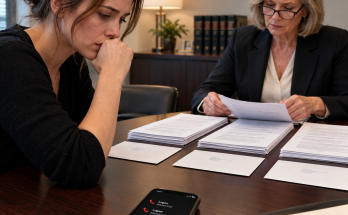
I looked at the papers Fiona had given me, now safely stored in the drawer.
"I do."
Her voice softened.
"Then why won't you help him work through it?"
I could have listed everything I had already done.
I could have reminded her about the money for the house, the support for the business, and the time I had spent trying to keep their problems from becoming emergencies.
But I didn't want to turn the conversation into a competition over who had sacrificed more.
"I've helped for a long time," I said. "Now he needs to make arrangements that don't depend on me."
Chelsea was quiet.
Then she said, "We're family."
I looked down at my hands.
"I know."
"Family is supposed to help each other."
"Yes."
"So how can you do this?"
The question hurt because I had asked myself something similar.
I had wondered whether refusing further support meant I was failing as a father.
I had wondered whether I was being selfish.
I had even wondered whether it would be easier to reverse everything and return to the familiar arrangement.
But being familiar didn't make it healthy.
"Helping each other can't mean that one person is always responsible for the consequences," I said.
Chelsea didn't answer.
I continued before I could lose my nerve.
"I want Logan to succeed. I want both of you to have a good life. But I can't keep putting my own financial security behind decisions I don't control."
She let out a slow breath.
"Nobody is asking you to do that."
I almost laughed.
Not because it was funny.
Because the documents on the table said otherwise.
"I've already done it," I replied. "That's why we're having this conversation."
She said my name.
There was disappointment in her voice.
I recognized it immediately.
For years, I had reacted to that tone as though I had done something wrong.
I would rush to repair the situation.
I would offer a compromise.
I would try to make everyone comfortable again.
This time, I stayed quiet.
After a moment, Chelsea said she couldn't understand how things had reached this point.
Neither could I, not entirely.
I understood the financial decisions.
I understood the missed repayments.
I understood why I had finally withdrawn my support.
What I struggled to understand was how we had arrived at a place where an ordinary request for accountability felt like an act of hostility.
"I think we've both been avoiding some difficult conversations," I said.
She didn't agree.
She didn't disagree either.
Eventually, the call ended.
I spent the afternoon trying to concentrate on ordinary things.
I paid a bill.
I sorted the mail.
I returned a message from a friend.
Each task reminded me that my life had not stopped because Logan was upset with me.
That should have been obvious.
It wasn't.
I had become so accustomed to treating his problems as urgent that I had forgotten my own days were allowed to continue.
Near the end of the afternoon, I took the folder out of the drawer again.
I checked the dates.
I checked the copies.
I made sure everything was in order.
Then I put the folder away.
There was nothing more I needed to do that day.
The next few days were difficult in a quieter way.
Logan didn't call.
Chelsea sent a short message asking whether I had reconsidered.
I replied that my decision remained the same.
She didn't answer.
I tried not to interpret the silence as proof of anything.
People needed time to process changes.
I knew that.
But I also knew how easy it was to mistake silence for acceptance when it was really disappointment waiting for another opportunity to speak.
On the fourth day, Fiona called to check whether I had received any correspondence.
I told her I hadn't.
She reminded me to keep copies of any messages about the arrangements and to forward any formal communication that arrived.
I thanked her.
Before we ended the call, I asked whether I should contact Logan again.
"Has he asked you to discuss a specific proposal?" she asked.
"No."
"Then I wouldn't chase him for a conversation. Let him decide what he wants to do next."
After the call, I sat with that advice for a while.
I had spent years pursuing resolution.
If someone was upset, I wanted to know why.
If a conversation ended badly, I wanted to repair it.
I believed that leaving a problem alone meant allowing it to grow.
Sometimes that was true.
Other times, my constant efforts to repair things had prevented other people from taking responsibility for them.
I was beginning to understand the difference.
That evening, I went through an old drawer and found a small notebook where I had recorded several of the financial arrangements with Logan.
The pages were filled with dates and amounts.
There were notes about transfers, repayments that had been promised, and conversations I had intended to follow up on.
I turned each page slowly.
Some entries brought back clear memories.
Others reminded me of things I had nearly forgotten.
I saw how often I had written that Logan would pay me back when things improved.
The same explanation appeared in different forms across several months.
I had accepted it because I wanted to believe him.
Perhaps he had believed it himself at first.
I couldn't know.
But the notebook made one thing clear.
The problem hadn't appeared overnight.
It had grown through a series of small decisions, each one easier to excuse than the last.
I closed the notebook.
For the first time, I allowed myself to feel disappointed without immediately searching for a way to make the feeling disappear.
I was disappointed in Logan.
I was disappointed in the choices I had made.
And I was disappointed that our relationship had reached a point where paperwork was needed to make a promise matter.
That didn't mean I stopped loving him.
It meant I could no longer use love as a reason to ignore reality.
The following morning, Logan sent a message.
He said he had been looking at his options.
He didn't apologize.
He didn't accuse me.
He simply said he needed to understand what could be done about the bank's requirements and the outstanding loan.
I read the message twice.
It wasn't the conversation I had hoped for.
But it was different from the earlier messages.
For the first time, he was talking about the obligations themselves rather than only about what my decision had done to him.
I replied that I was willing to consider any specific proposal through the appropriate channels.
Then I put the phone down.
I didn't know whether Logan would follow through.
I didn't know whether the business would find replacement security or how quickly the loan could be repaid.
Those questions remained unanswered.
But they were no longer mine to solve for him.
I had reached the limit of what I could do without making his responsibilities my own.
The hardest part was accepting that he might have to struggle before he learned what that meant.
Click here to continue reading: PART 4: I Finally Learned That Loving My Son Did Not Require Me to Carry Every Burden He Refused to Face
The Morning I Stopped Answering Their Calls, I Finally Understood What My Silence Had Been Costing Me
Part 3 of 4

One Comment on “PART 3 – When the Anger Settled, I Had to Face the Difference Between Protecting My Son and Protecting Him From Himself”