I didn't reply to Logan's message.
I told myself I needed time to think, but the truth was less flattering.
I was afraid of what I might say if I answered while I was still hurt.
For most of my life, I had tried to keep conversations with my son calm.
If he became upset, I lowered my voice.
If he accused me of misunderstanding him, I explained myself.
If he insisted that I was making things difficult, I searched for a way to make things easier.
I had become very good at defending decisions I had never wanted to make in the first place.
That morning, I decided not to do it again.
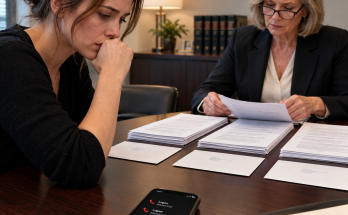
Fiona slid the completed copies into a folder.
"You should keep these somewhere safe," she said.
I accepted the folder and ran my thumb along its edge.
The paper felt heavier than it should have.
"Will the bank contact me directly?"
"If they need anything further from you, they'll reach out. For now, the notice has been delivered."
"And the repayment demand?"
"That has been sent as well."
I nodded.
There were no dramatic speeches.
No declarations about what Logan deserved.
Just documents, dates, and the consequences of decisions made long before that morning.
I thanked Fiona and stood.
She walked me to the door.
"Remember that setting a boundary doesn't require you to argue about it with everyone who dislikes it."
I looked back at her.
"I'll try to remember."
Outside her office, I stood for a moment before walking toward the elevator.
I expected to feel relieved.
Instead, I felt exposed.
For years, I had been able to tell myself that the financial arrangements were temporary.
Logan would repay the loan when business improved.
He would find other security for his credit line.
The family would eventually return to normal.
Now those comforting explanations had been replaced by formal notices.
There was no hiding behind what might happen someday.
The next move belonged to him.
When I reached my car, I checked my phone.
Seven missed calls.
Three messages from Logan.
Two from Chelsea.
I started the engine without opening them.
I needed to get home before I decided what to do.
The drive gave me too much time to remember things.
I remembered the first time Logan had asked me for money after starting his business.
He had been excited.
He had spoken quickly about customers, equipment, and the opportunity he believed would change everything.
I had listened with the pride of a father who wanted to see his son succeed.
When he asked for help, I said yes before he had finished explaining the problem.
I remembered telling myself that a little support could make the difference between failure and success.
There had been no reason to think the arrangement would become what it eventually became.
At least, that was what I told myself.
Looking back, I could see the smaller warnings.
A repayment date that passed without discussion.
A request that arrived before the previous one had been resolved.
An explanation that always began with something unexpected.
I noticed those things.
I simply chose not to give them the importance they deserved.
It was easier to believe that Logan was struggling than to consider that he might also be taking my patience for granted.
That thought hurt more than the money.
By the time I reached home, Chelsea had called again.
I parked in the driveway and sat behind the steering wheel.
Her name disappeared from the screen.
Then a new message arrived.
Please call us. We need to talk about this.
I stared at the words.
There was a time when a message like that would have sent me straight back into problem-solving mode.
I would have called immediately.
I would have asked what had happened and offered to help before I knew the full story.
That was how our conversations usually worked.
They brought me a problem.
I brought them a solution.
And afterward, everyone behaved as though the problem had never belonged to them.
I put the phone in my pocket and went inside.
The house was quiet.
I set Fiona's folder on the dining table and took off my jacket.
For several minutes, I moved through ordinary tasks without thinking.
I washed a cup.
I straightened a chair.
I opened the curtains in the living room.
Small things.
Things that didn't require anyone else's approval.
Then I returned to the table and opened the folder.
I read each document again.
The bank notice was clear about the withdrawal of my pledged securities.
The repayment demand described the money Logan still owed me for the renovations.
The remaining papers recorded the final financial arrangement we had decided to end.
Nothing had been written in anger.
Nothing contained an insult.
The documents simply stated what was changing and what was required next.
I wondered what Logan had expected to happen when he received them.
Perhaps he thought I would eventually give in.
Perhaps he believed I would call him, apologize for causing trouble, and offer another way to solve the problem.
I couldn't know.
But I knew what I had expected from myself for years.
I had expected to keep helping, even when helping meant ignoring my own limits.
That expectation had become so familiar that breaking it felt like betraying someone.
I sat back in my chair.
The realization was uncomfortable.
I had been treating my own promises to other people as more important than the promises they had made to me.
I had convinced myself that a father should be patient.
I had never asked whether patience without accountability was helping anyone.
My phone rang again.
Logan.
I let it ring.
When it stopped, I picked up the folder and placed it in a drawer.
I wasn't hiding it.
I simply didn't need to keep staring at it.
That evening, I made myself dinner.
I ate at the table instead of standing at the counter.
I turned off the television and listened to the clock in the next room.
The silence felt strange, but it wasn't unpleasant.
For once, nobody was waiting for me to fix anything.
I was halfway through washing my plate when I heard the phone vibrate.
Another message.
This one was from Chelsea.
Logan is very upset. Please don't make this worse.
I read it slowly.
Then I placed the phone beside the sink.
The words stayed with me.
Don't make this worse.
They assumed that the problem was the action I had taken.
Not the unpaid loan.
Not the dependence on my assets.
Not the fact that I had finally asked for the agreements to be honored.
The problem was that I had stopped accepting the old arrangement.
I felt anger rise in my chest.
It was brief, but clear.
I dried my hands and sat down.
There were things I wanted to say to Chelsea.
I wanted to ask why she hadn't been concerned when the repayments stopped.
I wanted to ask why my help had been treated as a family duty while my requests were treated as a threat.
Most of all, I wanted to ask whether either of them had considered how I felt before the envelopes arrived.
But I didn't send those questions.
I knew that anger could make a person say something true in a way that distracted everyone from the truth itself.
I didn't want another argument about my tone.
I wanted the actual issue to remain where it belonged.
The next morning, I woke earlier than usual.
For a few seconds, I forgot what had happened.
Then I saw the folder on the table and remembered.
My first instinct was to check my phone.
I resisted it.
I made coffee, opened the curtains, and sat by the window.
The street looked exactly as it always had.
A neighbor carried a bag to his car.
A delivery vehicle passed.
Someone across the road opened a garage door.
Nothing outside had changed.
Only my place in the family had begun to change, and I wasn't yet sure what that would mean.
At eight thirty, the phone rang.
I recognized Logan's number.
I let it ring twice before answering.
"Hello."
He didn't greet me.
"What is going on?"
His voice was tight.
I looked at the coffee cooling beside my hand.
"I assume you've received the notices."
"You know I have."
"Then you know what they say."
There was a pause.
"Why would you do this without talking to me first?"
I closed my eyes briefly.
That question carried the same assumption as his message the previous day.
He believed that I owed him a conversation before I was allowed to change an arrangement involving my own money.
"We've talked about the loan before," I said.
"Not like this."
"No. Not like this."
He exhaled sharply.
"The bank is asking me for replacement security. Do you understand what that means?"
"I understand that the bank wants security for the money it lent you."
"You're putting the entire business at risk."
I held the phone away from my ear for a moment.
Then I brought it back.
"I'm not the one who made the loan."
"You guaranteed it."
"I pledged my assets to support it. That was an arrangement we agreed to, and I've withdrawn my support through the proper process."
He went quiet.
For the first time in our conversation, I heard something other than anger.
Fear, perhaps.
Or surprise.
I couldn't tell.
"You could have warned me," he said.
I looked toward the drawer where I had put the folder.
"I've been asking you to address these arrangements for a long time."
"That's not the same thing."
"No," I said. "It isn't."
He started to speak, then stopped.
I waited.
I had spent years rushing to fill those pauses for him.
This time, I let him decide what to say.
Finally, he asked the question I had been expecting.
"Are you really going to go through with all of this?"
I looked at the cup in front of me.
The coffee had gone cold.
"Yes," I said.
The answer sounded quieter than I expected.
It also sounded final.
Click here to continue reading: PART 3: When the Anger Settled, I Had to Face the Difference Between Protecting My Son and Protecting Him From Himself
The Morning I Stopped Answering Their Calls, I Finally Understood What My Silence Had Been Costing Me
Part 2 of 4