By then, I had stopped expecting the box to make everything clear.
I still wanted answers.
That had not changed.
What had changed was my willingness to admit that wanting an answer did not mean I was entitled to one immediately.
My father was gone.
I could not ask him why he had chosen the shoes.
I could not ask him what he had expected me to feel when I saw the envelope.
I could not ask whether he had considered writing something different.
Those questions would remain questions unless the things he left behind gave me a reason to understand them differently.
I could not force that understanding by staring at the box.
I had tried.
It had not worked.
I looked at Marcus.
"Thank you for bringing this to me."
He gave a small nod.
"I said I would."
"I know."
I meant more than the words themselves.
He had done what he said he would do.
He had brought the box and allowed me to look through it without demanding that I react in a particular way.
I had not made that easy for him.
I had asked questions he could not answer.
I had watched his face for signs that he knew more than he was saying.
I had wanted him to make sense of something that belonged to my father and me.
He had not taken that responsibility from me.
I understood why now.
"I appreciate it," I said.
Marcus rested his hands on the table.
"Your father wanted you to have it."
The sentence had become familiar.
Earlier, I had heard it as the beginning of an explanation.
I had waited for the rest.
I had wanted Marcus to tell me what my father had said, what he had meant, and why he had made the decision.
Now I could hear the sentence without asking it to carry more than it could.
My father wanted me to have the box.
That was what Marcus knew.
It was not a complete explanation of my father's feelings.
It was not proof that our relationship had been better than I remembered.
It was not proof that it had been worse.
It was one fact I could accept without adding anything to it.
I nodded.
"All right."
Marcus seemed to relax slightly.
The conversation had reached a place where neither of us needed to keep defending what we knew.
I looked down at the table.
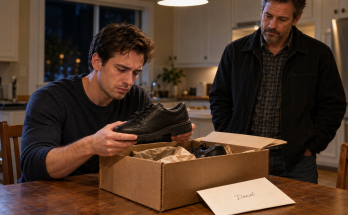
The black shoes were still there.
The envelope was still there.
The box remained open.
I had imagined that receiving something from my father after his death would feel like receiving a final message.
I thought it might settle something between us.
I thought I might read his words and finally understand the things he had been unable to say when he was alive.
I had expected a moment of recognition.
A clear feeling.
Something I could name.
Instead, I had found myself thinking about all the ways a person could misunderstand another person, even after spending years in the same family.
I had mistaken silence for indifference.
Sometimes it might have been.
Other times, I could not be sure.
I had mistaken practical gestures for a lack of feeling.
Perhaps some had been exactly that.
Perhaps others had meant more.
I had spent years treating my interpretation as if it were the same thing as the truth.
It was not.
My memories belonged to me.
My feelings belonged to me.
But my father had been a person outside those memories and feelings, with thoughts I could not fully know.
His letter had not changed that.
The shoes had not changed it either.
They had simply reminded me that there were parts of his life I had never seen clearly.
I was allowed to be disappointed by that.
I was allowed to wish he had made himself easier to understand.
I was allowed to feel grateful that he had left me something.
None of those reactions required me to choose only one.
I moved the envelope slightly so it rested flat beside the shoes.
Then I took my hand away.
I did not need to keep touching it.
I did not need to read the same words again just to prove I was paying attention.
I had already given the letter my attention.
I could return to it when I was ready.
For now, I wanted to remember the evening as it had actually happened.
Marcus had arrived with a cardboard box.
I had opened it.
I had found a pair of black work shoes in my size.
I had found a letter addressed to me in my father's handwriting.
I had asked questions.
Some had been answered.
Others had not.
That was the truth of the evening.
There was no need to turn it into a story with a cleaner ending than the one I had been given.
I looked at Marcus again.
"You can go whenever you're ready," I said.
He studied me briefly.
"Are you sure?"
"Yes."
He stood and straightened his jacket.
I stood too, though I did not know why at first.
Then I understood that I wanted to walk him to the door.
It was a small courtesy.
My father had valued those things.
I had sometimes dismissed his rules about manners as another way of controlling a situation.
I was not sure I had been entirely wrong.
But I also knew that courtesy could be offered without demanding anything in return.
I could do something simply because I wanted to do it.
Marcus followed me toward the door.
Neither of us said much.
There was no need to force a meaningful conversation into the last few steps.
At the door, he turned toward me.
"If you have questions later, you can ask me."
"I will."
I did not promise that I would have answers.
He did not promise that he would.
We said goodbye.
After he left, I stood with my hand on the door for a moment.
The house was quiet again.
I returned to the kitchen.
The box waited on the table, exactly where I had left it.
I pulled out the chair and sat down.
For a moment, I considered closing the box.
Then I decided to leave it open.
I did not make that choice because I expected to discover something extraordinary if I kept looking.
I made it because I was not ready to put the evening away.
The shoes rested beside the envelope.
I looked at them without trying to turn them into a message.
I looked at the letter without asking it to explain every year I had spent wondering what my father thought of me.
I could not speak to him now.
I could not repair the conversations we had missed.
I could not change the times I had wanted him to say something he never said.
But I could be honest about what I knew and what I did not.
I knew he had left me these things.
I knew I had wanted more from him than I had received.
I knew I was still hurt.
I also knew I was still curious.
That curiosity did not erase the hurt.
The hurt did not make the curiosity foolish.
For the first time that evening, I stopped trying to decide which feeling was the correct one.
I let them sit together.
The kitchen light continued to hum above me.
The refrigerator clicked off.
Somewhere outside, a car passed and faded into the distance.
I rested my hands beside the box.
I had no final explanation.
I had no promise that the rest of my father's belongings would answer the questions I carried.
I did not know whether the shoes would ever become useful to me or whether I would keep them as they were.
I did not know whether the letter would make more sense to me tomorrow.
I only knew that I had stopped demanding that everything make sense tonight.
My father had left me a box.
Inside it were things he had chosen.
I could examine them carefully.
I could remember what I knew about him.
I could question the conclusions I had made too quickly.
And I could accept that some parts of him might always remain beyond my understanding.
That did not make the box meaningless.
It did not make it an apology.
It did not make it a solution.
It made it something he had left for me, and something I now had to decide how to carry.
I drew the box a little closer.
Then I sat quietly with the shoes and the letter, allowing the questions to remain unanswered for a while longer.
The End
Read more original stories on Feel Every Story.
I Thought My Father Had Left Me Nothing, Until One Ordinary Box Forced Me to Question Everything I Remembered About Him
Part 20 of 20