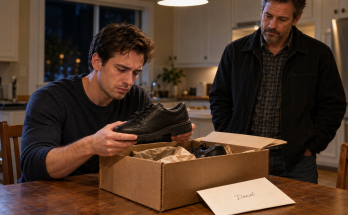
I looked into the box again.
For a few seconds, I did nothing.
The shoes were beside my right hand, and the envelope sat just beyond them.
I had moved both objects several times that evening, as if changing their positions might help me understand them.
It hadn't.
But I was beginning to understand something about myself.
I wanted every object to come with an explanation.
I wanted my father to have written down what he meant, why he had chosen it, and what he expected me to do with it.
I wanted certainty.
The problem was that certainty had never been something my father gave me easily.
I couldn't expect a cardboard box to change that.
So I leaned forward and continued examining what was in front of me.
I moved the remaining packing paper aside and looked carefully at the space beneath it.
I didn't want to rush through the contents.
I also didn't want to sit there for another hour imagining things that might not be true.
There was a difference between being careful and being afraid.
I had spent too much time confusing the two.
Marcus watched me from the opposite side of the table.
He hadn't said much since I asked him to stay.
I was grateful for that.
I didn't need someone to tell me how I should feel about my father.
I needed the room to feel whatever came without having to explain it.
I reached toward the box, then stopped to look at the shoes again.
They were still new enough that I could imagine my father selecting them from a shelf.
I pictured him checking the size.
Perhaps he had compared it with something he remembered.
Perhaps he had known it without checking.
I caught myself inventing details again.
I didn't know how he had chosen them.
I didn't know when he had bought them.
I didn't know what he had thought while placing them in the box.
All I knew was that they were there.
That was where I needed to begin.
I touched the leather briefly, then withdrew my hand.
The material was soft beneath my fingertips.
The shoes felt like something meant to be used rather than displayed.
I wondered whether my father had expected me to wear them.
The question seemed almost silly.
They were shoes.
People bought shoes because they expected someone to wear them.
But the fact that my father had left them for me made even that ordinary explanation feel important.
I had wanted him to show that he cared in ways I could understand.
Now I had something that might have been such a gesture, and I still found myself looking for a hidden meaning.
Maybe I had become so accustomed to disappointment that I no longer knew how to accept a simple act without questioning it.
That possibility made me uncomfortable.
I wasn't ready to decide whether it was true.
I placed the shoes neatly beside each other and returned to the box.
The envelope remained untouched.
I could see my name even from where I sat.
Daniel.
I had always liked the way my father wrote my name when he took his time.
The letters looked deliberate.
There was nothing hurried about them.
I wondered whether he had written it that way because the envelope mattered to him.
Then I reminded myself that his handwriting had always looked much the same.
I couldn't turn a familiar habit into proof of an unfamiliar emotion.
That was another lesson I seemed to be learning repeatedly that evening.
I moved the packing paper to one side and examined the remaining contents without removing anything immediately.
I wanted to notice the arrangement.
The way things had been placed.
The care taken to keep them from shifting.
Those details told me something about the person who had packed the box, even if they couldn't tell me everything about his reasons.
My father had not treated these things as rubbish.
He had not thrown them together without thought.
He had prepared them for someone.
For me.
That fact was enough to hold my attention.
I leaned back slightly and looked at Marcus.
"Did he ever tell you he was preparing something for me?"
Marcus shook his head.
"No."
I waited, but he didn't add anything.
I nodded.
I had asked because I wanted to know whether the box had been part of a longer conversation.
Perhaps my father had discussed it with Marcus.
Perhaps the delivery had been planned for a particular time.
But I couldn't assume either possibility.
Marcus had already told me what he knew.
I needed to stop asking the same question in different forms, hoping it would produce a different answer.
I looked down again.
The kitchen table had become crowded with things that would ordinarily have taken up very little space.
A letter.
A pair of shoes.
A cardboard box.
Nothing about the arrangement looked extraordinary.
Yet I couldn't remember the last time I had paid such close attention to anything.
I had spent years believing that understanding my father meant figuring out why he had acted as he did.
Maybe that had been too narrow a way to approach him.
I couldn't enter his mind.
I couldn't recover every conversation he had avoided or every thought he had kept to himself.
But I could look at what he had left without deciding in advance that I already knew the answer.
I could let an object remain an object until I had a reason to think otherwise.
I could acknowledge that something might matter without pretending to know exactly how much.
That was what I tried to do as I continued looking through the box.
I didn't find an immediate explanation for the shoes.
I didn't suddenly understand why the letter had been written.
And I didn't discover a sentence that made the past feel simple.
What I found instead was a growing awareness of how often I had demanded that every unanswered question become a judgment.
If I couldn't understand my father, I blamed him.
If he didn't explain himself, I assumed the worst.
If something hurt me, I believed the hurt told me everything I needed to know about his intentions.
Sometimes it might have.
But pain could tell me what I had experienced without telling me everything another person had meant.
I had never been very comfortable with that distinction.
Now I was trying to make room for it.
I looked at the envelope again.
I didn't need to read the letter another time.
I knew it was there.
I knew my father had written it.
I knew he had intended me to receive it.
Those facts could stand on their own.
I placed my palm flat on the table and took a slow breath.
For the first time that evening, I felt less pressure to reach a conclusion.
I could keep going without knowing where the next discovery would lead.
I could remain curious without becoming suspicious of everything.
And I could admit that I still missed the father I had wanted, even while trying to understand the father I had actually known.
Both feelings belonged to me.
Neither needed to be hidden.
I turned my attention back to the box.
The next step was simple.
Look carefully.
Don't invent anything.
Don't look away just because the truth might be complicated.
I had spent enough years doing that already.
Click here to continue reading: PART 10: The Letter Could Not Give Me Back the Conversations We Never Had, but It Forced Me to Face the Questions I Had Buried
I Thought My Father Had Left Me Nothing, Until One Ordinary Box Forced Me to Question Everything I Remembered About Him
Part 9 of 20