The next afternoon, I came home early because my last appointment had been canceled.
My mother was in the kitchen, sorting through a stack of mail.
Ethan had not returned from school yet.
The house was quiet.
I set my bag down and walked toward the front hall.
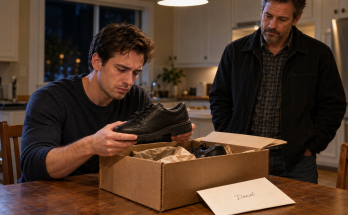
The envelope sat in the same ceramic bowl.
My name was written across the front in plain handwriting.
I stopped beside the narrow table.
There was no new information to see.
Still, I found myself studying the edges, the flap, and the place where the paper folded over itself.
I wondered whether the handwriting belonged to someone I knew.
I wondered whether the envelope had been placed in the bowl while we were out or whether it had been there longer than we realized.
I wondered whether the person who left it expected me to open it immediately.
Then I reached toward it.
My fingers stopped just above the paper.
I remembered the officer's instructions.
I remembered how carefully he had asked us to leave it where it was.
I pulled my hand back.
For a few seconds, I felt foolish.
The envelope was mine to receive, at least in the ordinary sense that my name was written on it. I wanted to know what it contained.
But wanting to know did not make it sensible to ignore the instructions I had been given.
I walked into the kitchen instead.
My mother looked up from the mail.
“You're home early.”
“My appointment was canceled.”
She put a letter aside.
“Would you like something to eat?”
“Maybe later.”
She studied my face.
“Did you go to look at it again?”
I knew she meant the envelope.
“Yes.”
“And?”
“I didn't touch it.”
She nodded.
“Good.”
I pulled out a chair.
“I hate that it's sitting there.”
“I know.”
“It feels as though the whole house has to wait for it.”
My mother sat opposite me.
“The house doesn't have to wait. We have to follow the instructions about one object.”
I looked at her.
It was a small difference in wording, but it changed how the problem felt.
The house was still ours.
The kitchen was still where we ate breakfast.
Ethan still needed help with schoolwork, and my mother still forgot where she put her reading glasses.
The envelope had taken up too much space in my mind.
It did not have to take up every room.
“I think I've been treating it as if it can explain everything,” I said.
My mother folded her hands on the table.
“That's understandable when you don't know what it is.”
“But it might have nothing to do with Ethan's memory.”
“It might.”
“And the barber might have been worried for a completely different reason.”
“He might have been.”
I rubbed my forehead.
“I wish someone could tell me which things belong together.”
My mother reached for her cup.
“Sometimes you only learn that after you know more about each one.”
I did not like the answer, but I could not find a flaw in it.
We made tea.
I told her about the call with the barber, including his explanation that he had wanted to speak privately because other customers were nearby.
She thought that sounded reasonable.
“Did he say Ethan had told him about a room?” she asked.
“He said Ethan had mentioned a place he remembered. He didn't give me a detailed description, and I don't think he wanted to put words in Ethan's mouth either.”
“Then perhaps the two of you agree on more than you realize.”
I thought about that.
Both the barber and I had been trying to avoid telling Ethan what he should remember.
That did not explain why the conversation had worried the barber enough to approach me privately.
But it did mean we were not arguing over what Ethan's memory proved.
We were trying not to claim that it proved anything at all.
When Ethan arrived home, he came through the door talking about a game his class had played.
He dropped his bag beside the stairs and asked whether we had any apples.
My mother told him there were some in the kitchen.
He took one and sat at the table.
Then he noticed that I was looking at him.
“What?”
“Nothing. I'm listening.”
He took another bite.
“You look like you're thinking.”
“I probably am.”
“About the envelope?”
I hesitated.
I did not want to lie, but I also did not want the envelope to become the center of every conversation.
“Yes,” I said. “A little.”
He glanced toward the front hall.
“Do you think it's something bad?”
I pulled out the chair beside him.
“I don't know what's inside, so I can't tell you whether it's good or bad.”
He looked down at the apple.
“Can we open it?”
“Not yet. The police asked us to leave it alone for now.”
“Why?”
“They need to finish checking what they can about it.”
“Will they tell us when we can?”
“I hope so. If they give us different instructions, we'll follow them.”
He nodded.
Then he asked whether he could play outside for a while.
I told him he could, as long as he stayed where I could see him.
He took his apple and went to the back door.
I watched him cross the yard.
He was not thinking about the envelope anymore.
Or at least, he was not thinking about it enough to stop him from wanting to play.
That evening, he asked my mother to help him build a small structure from blocks.
They made a square base and four walls.
Ethan placed a flat piece across the top.
“That's the ceiling,” he said.
My mother looked at it.
“Very sturdy.”
“It's supposed to be a room.”
I heard the word from the kitchen.
I did not go over to ask him what it meant.
I continued preparing dinner, although I found myself listening for a few seconds.
Ethan added a small block to one wall.
“That's the door.”
My mother asked whether he wanted to add a window.
“No. Not this time.”
He kept building.
I did not know whether the structure had anything to do with the room he remembered.
It might have been an ordinary game.
It might have been a way to explore a thought he could not explain.
I decided not to make the choice for him.
After dinner, he left the blocks on the living room floor and went upstairs to read.
My mother helped me clear the table.
Neither of us discussed the structure.
Later, I walked past it on my way to the hallway.
The little room stood on its square base, with one doorway and no windows.
A small space had been left inside for a figure.
I did not touch it.
I turned off the living room light and went to check on Ethan.
He was reading beneath his bedside lamp.
The photograph of his father was still beside his pillow.
“Good night,” I said.
“Good night, Mom.”
I closed the door most of the way.
As I walked downstairs, I realized that I had spent the afternoon wanting to open the envelope, but I had not allowed that urge to decide what I did.
It was not a solution.
It was a boundary.
For now, that was enough.
Click here to continue reading: PART 15: My Son’s Drawing Reminded Me That a Memory Could Be Important Without Explaining Everything
The Barber Said Something About My Nine-Year-Old Son That I Could Not Explain, and Then a Familiar Name Changed Everything
Part 14 of 20