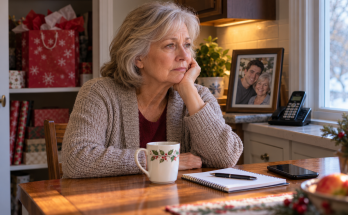
The days after Christmas moved slowly.
I kept the house warm, made simple meals, and put away the things I had left out for the holiday.
The red gift bag stayed beside the kitchen table for another day.
I could not bring myself to open it.
Inside were the gifts I had chosen for Daniel and his family, each wrapped carefully in paper I had bought weeks earlier.
I had written their names on small white tags.
I had even tied a little ribbon around the package meant for Daniel's children.
I remembered standing in the store, trying to decide which things they would enjoy most.
At the time, I had pictured their faces when they opened them.
I had pictured Daniel smiling at me across the room.
I had pictured myself sitting somewhere warm, listening to the people I loved talking over one another.
I had never imagined standing outside his door with snow gathering on my coat.
Now, whenever I looked at the bag, I remembered the sound of the door closing.
I tried not to let that memory take over the entire day.
There were dishes to wash, bills to sort, and laundry to fold.
Life did not stop because my son had hurt me.
But ordinary tasks felt different when I did them alone.
I used to call Daniel while I cooked.
Sometimes he answered, and sometimes he let the phone ring.
If he answered, I asked how everyone was doing.
If he sounded busy, I kept the conversation short.
I had become very good at making myself easy to talk to.
I rarely asked questions that might inconvenience him.
I rarely told him when something had upset me.
I told myself that grown children had their own lives.
I believed a mother should be grateful whenever she was allowed to be part of them.
That belief had followed me for years.
After Richard died, I had leaned on Daniel more than I wanted to admit.
Not because he had done anything special to help me through my grief.
Mostly, I had leaned on the idea that we were still a family.
I thought that if I remained useful, our connection would remain strong.
I could help with a bill.
I could bring food.
I could watch the children when he needed someone.
I could make myself available whenever he called.
And then I could tell myself that I still had a place in his life.
I had never asked whether that place was built on affection or convenience.
I was beginning to understand that the answer mattered.
One afternoon, I took the notebook from the kitchen drawer and sat at the table.
The pages contained the figures I had written down after Christmas.
They were not complete records of fourteen years.
Some payments had been made online.
Some had been written as checks.
Others had been small amounts I had handed Daniel when he said he was short that month.
I could not remember every dollar.
I was not trying to create a perfect account.
I was trying to understand what I had given and why I had given it.
There was a difference between helping someone through a difficult period and quietly taking responsibility for their life.
I had crossed that line so gradually that I had hardly noticed.
I had never expected Daniel to pay me back for every kindness.
I had never believed that buying groceries or helping with a household expense should earn me a place at his table.
But I had expected to be treated like his mother.
I had expected him to open the door and speak to me with basic kindness.
I had expected that bringing Christmas dinner would not be considered an embarrassment.
Those expectations did not seem unreasonable.
Yet I had spent days wondering whether I had somehow asked for too much.
That was the part I found hardest to accept.
I was sixty-eight years old.
I had worked for decades, raised a son, loved a husband, and buried the man I had expected to grow old beside.
I had comforted children who were frightened or sick.
I had sat beside parents who needed someone to explain what was happening.
I had learned to stay calm when other people were upset.
I had spent much of my working life helping people through moments they could not manage alone.
And still, when my own son hurt me, I looked first for a way to blame myself.
I wondered if I should have called before coming.
I wondered if I should have asked whether the family had plans.
I wondered if the dish I brought had been too much trouble.
I wondered if I should have left the gifts in the car and waited for a better time.
Each question gave me another reason to excuse him.
None of them changed what had happened.
Daniel had opened the door.
He had seen his mother standing outside in the snow.
He had heard me explain why I was there.
And he had told me to leave.
I could understand that he might have felt uncomfortable with his guests watching.
I could understand that he might have wanted a quiet evening with his family.
I could even understand that I had arrived at a time that did not suit him.
What I could not understand was why he had needed to make me feel so small.
He could have spoken gently.
He could have invited me inside for a moment and explained that the evening was not a good time.
He could have accepted the food and told me he would call the next day.
He could have shown me that I mattered, even if he could not stay with me.
Instead, he had made me feel like someone who had come to the wrong house.
I closed the notebook.
For a while, I listened to the refrigerator humming in the kitchen.
The house was quiet, but it no longer felt peaceful.
I missed Richard most in moments like that.
He had not been a man who gave long speeches about feelings.
He had been practical.
If something needed fixing, he fixed it.
If a person needed help, he usually found a way to offer it.
He could be stubborn, and he was not always good at saying what he felt.
But he never made me feel ashamed for needing him.
I remembered the way he used to stand at the front door when I returned from work.
He would ask whether I had eaten.
Sometimes he would have dinner ready.
Sometimes he would simply take my bag and tell me to sit down.
Those ordinary gestures had meant more than I understood at the time.
I had thought there would always be more of them.
After he died, I tried to fill the silence with activity.
I stayed busy.
I helped Daniel.
I bought things for the children.
I found reasons to drive across town.
I convinced myself that being needed was a kind of healing.
But I had never allowed myself to ask what I needed.
That evening, I made soup and ate it at the kitchen table.
I did not turn on the television.
I did not call Daniel.
I let myself think about Christmas without immediately trying to soften the memory.
It hurt.
There was no useful lesson that made it hurt less.
I was a mother who had wanted to share a holiday with her son.
He had turned her away.
Both things could be true without one canceling the other.
Before bed, I moved the red gift bag from the kitchen table to the spare room.
I placed it on a shelf beside the wrapping paper.
I did not throw anything away.
I was not ready to make a decision about the gifts.
I simply needed to stop seeing them every time I walked into the kitchen.
Then I returned to the table and looked at the notebook one more time.
I wrote a sentence at the bottom of the page.
I can love Daniel without paying for every opportunity to be near him.
I read it twice.
The words did not make me feel strong.
They made me feel sad.
For years, I had thought love meant giving without keeping score.
I still believed that love should be generous.
But generosity was not supposed to require me to disappear.
I turned off the kitchen light and went upstairs.
For the first time since Christmas Eve, I did not spend the last minutes before sleep wondering what I could do to make Daniel happy with me again.
I wondered what it would mean to be kind to myself.
I did not have an answer yet.
But I had finally begun asking the question.
Click here to continue reading: PART 10: I Had Spent Years Making Things Easy for Daniel, but I Could No Longer Pretend That His Silence Was Something I Had to Repair
I Thought Bringing Christmas Dinner to My Son Would Make Him Happy, Until I Saw the Look on His Face at the Door
Part 9 of 20