By the next morning, I had decided not to make any sudden decisions.
I would not send Daniel an angry message.
I would not demand that he explain himself.
I would not call his house and insist that he listen to me.
I knew how easily a painful conversation could turn into an argument when both people were trying to defend themselves.
I also knew that if I called him first, I might spend the entire conversation reassuring him.
I might tell him that I understood.
I might say that the evening had simply gone badly.
I might even apologize for arriving without warning.
I could already hear myself doing it.
That frightened me more than I wanted to admit.
I had become so accustomed to smoothing things over that I sometimes apologized before anyone asked me to.
I did it at work when someone else had made a mistake.
I did it in stores when I needed help.
I did it with Daniel whenever his voice became impatient.
It was easier to take a little blame than to risk making someone angry.
I had mistaken that habit for patience.
Now I wondered how often it had taught people that they could hurt me without consequence.
I made coffee and opened the curtains.
The snow from Christmas Eve had thinned along the edges of the road.
A few gray piles remained near the curb.
The neighborhood looked ordinary again.
Cars passed.
A delivery truck stopped at a house across the street.
Someone walked a dog along the sidewalk.
The world had moved on from the night that had changed something in me.
I wanted to move on, too.
But moving on did not have to mean pretending nothing had happened.
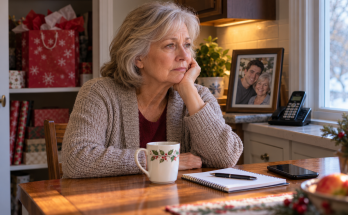
I took my notebook from the drawer and looked at the figures again.
Then I opened a fresh page.
At the top, I wrote, "What I can afford."
I listed the expenses I knew I needed to cover for myself.
My mortgage was gone, but there were still property taxes, insurance, utilities, groceries, and repairs.
There were medical appointments and prescriptions.
There was the car, which was getting older.
There were savings I had set aside for emergencies.
Richard and I had worked hard to give ourselves some security.
After his death, I had tried to protect that security while still helping Daniel.
Sometimes I had told myself that a little help would not matter.
Sometimes it did not.
But a little help repeated for years could become a large part of a person's life.
I had not always considered the total.
I had considered only the next request.
Daniel would tell me something had come up.
I would think about whether I could manage the amount.
If I could, I would help.
Then I would return to my own expenses and make things work.
I had never sat down and asked whether the pattern was sustainable.
I had never asked Daniel to think about what it meant for me.
Perhaps I had been afraid that if I made the cost visible, the kindness would stop being kindness.
Perhaps I had also been afraid that he would say no to the help and still say no to me.
That possibility had been sitting quietly beneath my generosity for a long time.
I wrote down one more sentence.
I am allowed to say no.
The sentence looked simple.
It also looked unfamiliar.
I had said no to plenty of people in my life.
At work, I had followed rules even when someone disliked them.
I had told parents when I could not give them an answer I did not have.
I had refused to promise things I could not guarantee.
I had never believed that being caring meant saying yes to everything.
Somehow, I had forgotten that principle when it came to my own son.
I put the pen down.
Then I went to the spare room and looked at the red gift bag.
I could see one of the white name tags through the opening.
The letters were written in my handwriting.
I remembered taking my time with each name because I wanted the gifts to feel personal.
For a moment, I considered bringing the bag to Daniel's house.
I could leave it on the porch.
I could ring the bell and walk away.
I could tell myself that the children deserved their presents even if their father had treated me badly.
But I knew that was not the real reason I wanted to go.
Part of me wanted another chance at the door.
I wanted Daniel to see the gifts and understand what he had done.
I wanted him to come outside and say that he was sorry.
I wanted him to make the painful memory disappear.
There was nothing wrong with wishing for those things.
But I could not make them happen by placing myself in the same position again.
I closed the spare-room door.
That afternoon, I called my friend Helen.
We had known each other for years, long enough that she could hear when I was trying to sound cheerful.
She asked what I had done over Christmas.
I told her I had stayed home.
She waited.
Helen had always been good at leaving space after a question.
I could have changed the subject.
Instead, I told her what had happened at Daniel's door.
I did not exaggerate.
I did not describe him as a terrible son.
I simply told her that I had brought dinner and gifts, and that he had asked me to leave because he did not want me making things embarrassing in front of his guests.
When I finished, the line was quiet.
Then Helen said, "Margaret, that must have hurt terribly."
I pressed my fingers against the edge of the table.
"Yes," I said. "It did."
I had expected her to defend him.
I had expected her to say that Christmas was stressful or that people sometimes said things they did not mean.
She did not do any of those things.
She did not tell me what to do, either.
She simply let the truth remain where I had placed it.
I found myself breathing more easily.
"I keep wondering if I should have called first," I told her.
"Maybe calling first would have changed the timing," she said. "It would not have changed the way he spoke to you."
I looked down at the notebook.
I had not thought of it that way.
Helen continued.
"You can understand why someone might be busy without agreeing that they should treat you badly."
I did not answer right away.
I wanted to remember those words.
Not because they solved anything, but because they separated two things I had been blending together.
I could understand Daniel's circumstances.
I could still be hurt by his behavior.
I did not need to choose one truth and abandon the other.
When we ended the call, I sat quietly for a few minutes.
I felt grateful that Helen had listened.
I also felt embarrassed that I had needed another person to confirm something so basic.
Then I reminded myself that pain could make simple things difficult to see.
I had spent days examining my own actions.
It was time to examine Daniel's.
Not to punish him.
Not to decide that he no longer mattered.
Only to see what had happened without rushing to protect him from the consequences of his own words.
I thought about the fourteen years of help.
I thought about the times I had changed my plans because he needed something.
I thought about the times I had said I was fine when I was not.
I thought about how rarely I had told him that I was tired, worried, or short of money.
I had wanted to be the mother who never made his life harder.
But perhaps I had made it too easy for him to forget that I had a life of my own.
I could not know exactly what Daniel thought.
I could not decide whether he had taken my help for granted on purpose.
I could not know whether he had felt ashamed of me or merely afraid of what his guests might think.
Those were questions he would have to answer if he ever chose to speak honestly with me.
I could not answer them for him.
For now, I could decide what I would do.
I would not offer more money simply because I was afraid of losing contact.
I would not agree to something I could not afford.
I would not pretend that the Christmas Eve rejection had been harmless.
If Daniel called, I would listen.
I would not begin the conversation by accusing him.
But I would not rush to reassure him that everything was fine.
I deserved to tell the truth, even if my voice shook.
That evening, I made a small dinner and ate it by the window.
I could see the lights in the houses across the street.
Somewhere nearby, a child laughed.
I thought of Daniel's children and hoped they had enjoyed their holiday.
I hoped they had received their gifts and felt loved.
I did not know what they had seen or understood that night.
I would not put adult hurt on their shoulders.
They were children.
They were not responsible for their father's choices.
I could love them without using them as a reason to ignore what had happened between Daniel and me.
That distinction mattered.
Before I went to bed, I placed the notebook back in the drawer.
The list was not a demand for repayment.
It was a reminder that I had responsibilities to myself.
I could continue to love my son.
I could hope that our relationship would improve.
I could leave room for an apology.
But I did not have to spend every day reaching for him while he decided whether he wanted me close.
I had spent years making things easy for Daniel.
Now I needed to make something clear to myself.
My dignity was not a gift I had to earn from my child.
It was something I was allowed to keep.
Click here to continue reading: PART 11: I Wanted to Believe Christmas Had Been a Terrible Mistake, but I Was No Longer Willing to Decide That on Daniel’s Behalf
I Thought Bringing Christmas Dinner to My Son Would Make Him Happy, Until I Saw the Look on His Face at the Door
Part 10 of 20