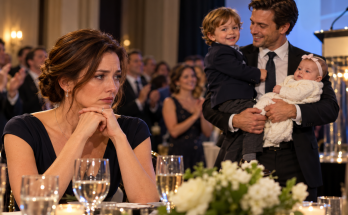
I used to think a lie had to be complicated to work.
I learned otherwise.
Sometimes all it took was a message sent at the right moment and a person who had no reason to believe you would deceive them.
Emma had every reason to trust me.
We had been married long enough to build a life around ordinary expectations.
Work ran late sometimes.
Plans changed.
One of us occasionally had to wait for the other.
Those things happened in a marriage.
They didn't usually mean anything.
I knew that, and I relied on it.
When I told Emma I was delayed, I used the kind of explanation she had heard before.
There was no elaborate story.
I didn't need one.
The truth was bad enough without giving it extra details.
I was not at my desk.
I was not finishing something important.
I was not dealing with a problem that had suddenly appeared at the end of the day.
I was with Caroline.
And I had chosen to remain with her after I knew Emma would be waiting.
I remember checking the time after I sent the message.
I didn't need to.
The restaurant reservation wasn't a secret, and the time hadn't changed.
Still, I looked at the screen as if the numbers might offer me a reason to reconsider.
They didn't.
I put the phone away.
Caroline was talking about something, but I couldn't remember what it was now.
I remember the sound of her voice.
I remember the way she looked at me when I glanced toward my pocket.
I remember thinking that I needed to appear relaxed.
That was another habit I had developed.
I was always trying to look like the person I wanted others to believe I was.
With Emma, I was the husband who worked hard and intended to make things right.
With Caroline, I was the man whose marriage had already ended in every way that mattered.
With myself, I was a person who had made mistakes but still had time to correct them.
I moved between those versions of my life without allowing them to meet.
It took effort, though less than it should have.
The hardest part wasn't inventing new explanations.
It was remembering which version of the truth each person had been given.
Caroline knew I had told her about the separation.
She had no reason, based on what I had said, to think Emma was preparing for an anniversary dinner.
Emma knew I was working late.
She had no reason to imagine that I was spending the evening with another woman.
I kept those two beliefs separate.
I treated them like doors in different rooms, each one closed firmly enough to keep the other side out of sight.
I didn't ask myself what would happen if either door opened.
I assumed I would have time to deal with it.
That assumption had carried me through weeks of avoidance.
It was carrying me through the anniversary, too.
At home, the blue shirt remained where Emma had last seen it.
I knew because I had looked at it earlier.
For a moment, I had considered wearing it.
Not because I intended to go to the restaurant, but because I wanted to preserve the option of changing my mind.
That sounds ridiculous now.
I had imagined that if I changed into the shirt, I might somehow become the man who was supposed to meet his wife.
I could picture the evening as it should have been.
Emma sitting across from me.
The table set for two.
The anniversary acknowledged without either of us having to explain why it mattered.
I could picture myself arriving late and apologizing.
I could picture her accepting the apology.
Then I would have to sit there and look at her.
I would have to answer questions about the money.
I would have to face the distance between what she believed about our marriage and what I had been doing behind her back.
I didn't want that conversation.
So I left the shirt alone.
I chose the easier room, the easier explanation, the easier version of myself.
When I think about that choice, I don't remember feeling torn.
I remember feeling relieved.
That is the detail that embarrasses me most.
I was relieved to avoid the person who had trusted me.
I was relieved to keep the truth away from Caroline.
I was relieved that neither woman had yet forced me to choose between what I wanted and what I had promised.
Relief.
It lasted only because I refused to look at what it was costing someone else.
Caroline had her own understanding of our relationship.
She believed I was leaving a marriage that had already become an empty arrangement.
I had encouraged that belief.
I had described the problems between Emma and me without explaining my part in them.
I had talked about distance.
I had talked about how difficult things had become.
I had spoken as if the marriage were something happening to me rather than something I was actively damaging.
I didn't tell Caroline that Emma was making plans for us.
I didn't tell her about the reservation.
I didn't tell her that I had promised to be there.
Those details would have made my story harder to maintain.
They would have required Caroline to consider what kind of man she was dealing with.
And I wasn't ready to let her see that man.
I wanted her affection without the questions that might come with knowing the whole truth.
I wanted Emma's patience without giving her the information she needed to decide whether she still wanted to offer it.
I wanted the benefits of being trusted by two people while refusing to behave in a way that deserved either person's trust.
At some point, I checked my phone again.
There was no message I needed to answer immediately.
I could have taken that as an opportunity to call Emma.
Instead, I treated the absence of a new message as permission to keep going.
I didn't consider that she might be getting ready.
I didn't picture her checking the time.
I didn't think about what it meant for someone to prepare for a special evening while believing the other person intended to share it.
Or perhaps I did think about those things and pushed them away.
I can no longer separate the two.
Memory has a way of making old decisions seem more reasonable than they were.
I don't want to do that here.
I knew enough to stop.
I simply didn't.
The anniversary was supposed to mean something.
Emma had arranged the dinner because she wanted us to spend time together, away from the ordinary routines that had taken over our lives.
I understood that.
I also understood that the marriage had reached a point where pretending everything was fine would not make it fine.
But I had confused acknowledging a problem with solving it.
I thought if I could get through one more evening without a confrontation, I would be closer to knowing what to do.
That wasn't how it worked.
Each delay made the next conversation harder.
Each new lie gave me another thing to hide.
And every time Emma trusted an answer I gave her, I became more responsible for the distance between us.
I knew that in some distant, abstract way.
I didn't let myself feel it fully.
Feeling it would have meant doing something.
Doing something would have meant losing control over how the story ended.
I wanted to keep that control.
The restaurant mattered to Emma.
I knew she had put thought into choosing it, and I knew she had made the reservation in advance.
She hadn't asked for anything extraordinary.
She had asked me to be there.
That should have been easy.
Instead, I treated the evening as a problem to manage.
I told myself that if Emma became angry enough, she might finally say what I had been avoiding.
Then I could agree that we needed to separate.
I could act as though her reaction had brought the truth into the open.
I could explain the marriage to other people without beginning with my own choices.
I could make myself the person who had been left behind.
The plan depended on Emma reacting to information she didn't have.
It depended on her becoming angry without knowing why I was really absent.
It depended on me keeping her confused long enough to make her responsible for the decision I wanted.
Even then, I understood enough to know the plan wasn't fair.
I went ahead with it anyway.
That was the difference between not knowing better and refusing to do better.
I had plenty of opportunities to tell the truth.
I had plenty of opportunities to stop making things worse.
I used each opportunity to buy myself more time.
By the time I checked the clock again, the evening had moved forward without me.
Emma would have been preparing to leave.
She might have looked at the blue shirt one last time, expecting me to wear it.
She might have wondered whether I would arrive before her or whether she would need to wait.
I couldn't know what she was thinking.
I only knew what I had told her to expect.
I had given her a reason to believe I was working.
I had given Caroline a reason to believe I was free.
And I had given myself a reason to avoid both women whenever their versions of my life threatened to collide.
I put my phone away again.
The night continued.
I had no excuse that could make that choice innocent.
Click here to continue reading: PART 3: I Wanted Emma to Make the Decision I Was Too Cowardly to Make, and I Mistook Her Patience for Permission
I Had Already Lied to My Wife Before the Evening Began, and I Still Believed I Could Control How It Ended
Part 2 of 20