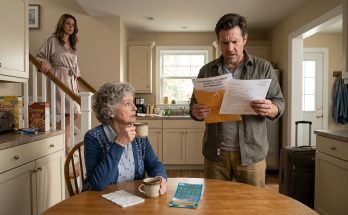
I did not open the envelope immediately.
Andrea seemed surprised by that.
“So you don’t want to know?”
“I want to know exactly enough to be frightened of knowing.”
She gave a nervous laugh.
I understood why. To her, this was one old box her father had left behind. To me, boxes had become a delivery system for the dead.
I carried everything into the yellow kitchen and cleared the table. Andrea sat opposite me, hands wrapped around the coffee I had offered but she had not touched.
“Start with your father,” I said.
“Frank Sloan.”
“I remember him.”
“You do?”
“Barely. Thomas mentioned him when we were first married. He said they’d grown apart after Frank moved west.”
Andrea looked down.
“My father never moved west.”
That landed harder than I expected.
“Where did he go?”
“Twenty minutes away.”
I stared at her.
“He lived here?”
“Until 1987. Then he moved north.”
Thomas had lied.
Not forgotten.
Not simplified.
Lied.
“Why?”
“I think the letters explain some of it.”
“Have you read them?”
“Some.”
“They’re addressed to Thomas.”
“They were in my father’s things.”
Fair.
“Did you read the envelope addressed to me?”
“No.”
“Thank you.”
She nodded.
Frank had served in Vietnam. When he returned, he struggled badly. Nightmares. Drinking. Long stretches without work. His family called it nerves because that was the language people used then.
Thomas had not served. He met Frank in high school, years before the war. They were close enough that Frank wrote to him from overseas.
“Those letters are in the box?”
“Yes.”
I touched the bundle.
The paper had yellowed around the edges.
“What did Thomas hide?”
Andrea shook her head.
“That’s the part I’m not sure about.”
“Your father said Thomas helped him hide something.”
“Yes.”
“Money?”
“No.”
“Property?”
“No.”
“A crime?”
Her face changed.
“I don’t think so.”
That was not reassuring.
“What do you think?”
Andrea reached into the box and removed a small notebook.
Military green.
The elastic holding it closed had lost all tension.
“My father wrote names.”
“What names?”
“Men from his unit.”
I opened it.
Dates.
Initials.
Locations.
Fragments I could not interpret.
Beside several names, Frank had drawn small crosses.
Dead, presumably.
One name appeared repeatedly without a cross.
Michael Avery.
“Who was he?”
“A soldier in Dad’s unit.”
“What happened to him?”
Andrea took a breath.
“He disappeared during an operation.”
“Missing?”
“Yes.”
“Did Frank know what happened?”
“He thought he did.”
There it was.
Not certainty.
Guilt.
Andrea explained that Frank had been carrying something for decades. He believed Michael Avery had been wounded during a chaotic withdrawal. Frank and another soldier tried to reach him, but incoming fire forced them back.
Officially, Avery remained missing.
Frank believed he had abandoned him alive.
I looked at the letters.
“And Thomas hid this?”
“Not the event.”
“What, then?”
“Dad’s account.”
I frowned.
“Why hide it?”
“Because Dad was terrified his version contradicted the official report.”
“In what way?”
“The report said nobody knew where Avery was.”
“But Frank did.”
“He believed he did.”
That distinction mattered.
Trauma was not a camera.
Memory could be precise and still wrong.
“What did Thomas do?”
“He kept the letters.”
“Why?”
“Dad asked him to.”
I leaned back.
That sounded like Thomas.
Custodian of other people’s unbearable things.
“What does this have to do with me?”
Andrea looked at the sealed envelope.
“I hoped you knew.”
“I was not even in Thomas’s life in 1971.”
“I know.”
“Then how can that be addressed to me?”
“I don’t think it was.”
I stared.
She pointed.
“The envelope is old. The writing isn’t.”
I picked it up again.
She was right.
The envelope carried the 1971 postmark.
My name was written in Thomas’s later handwriting.
He had reused an old envelope.
Of course he had.
Thomas saved rubber bands until they fossilized.
Relief moved through me.
Then annoyance.
“So he wrote my name on it later.”
“Yes.”
“When?”
“I don’t know.”
I opened it.
Inside was one sheet.
Thomas’s handwriting.
Evie,
If Frank or his family ever brings you this box, please listen before deciding what it means.
I stopped.
Andrea watched me.
I continued.
Thomas explained that Frank had returned from Vietnam believing he had left Michael Avery to die. For years, Frank wanted Thomas to send his letters to Avery’s family.
Thomas refused.
I looked up.
“He refused?”
Andrea nodded.
“That’s what Dad said.”
“Why?”
“Keep reading.”
Thomas wrote that Frank was drinking heavily, sleeping little and remembering the event differently from month to month. One version placed Avery near a tree line. Another near a drainage ditch. Another had Frank hearing Avery call his name after Frank withdrew.
Thomas feared that delivering those accounts as fact would give Avery’s family pain without truth.
I understood the logic.
I also felt anger rising.
Thomas had decided.
Again.
He decided what another family should know.
The letter continued.
Years later, Frank became sober and asked again. This time Thomas agreed to help him contact the appropriate military office and request records.
They discovered another surviving soldier had reported seeing Avery after Frank believed he had abandoned him.
Avery may have moved.
He may have been evacuated by another group.
He may have died later.
Nobody knew.
Frank’s central belief—that he personally left Avery to die where he lay—was not established fact.
Andrea wiped her eyes.
“My father never forgave himself anyway.”
“I’m sorry.”
“He got better.”
“That matters.”
“He married my mother. Had me. Worked thirty years.”
“That matters too.”
“But every Memorial Day he disappeared into himself.”
I looked down.
Thomas wrote that he and Frank eventually disagreed over whether Avery’s family should receive the letters.
Frank wanted them sent.
Thomas thought they should not be.
Their friendship broke over it.
“So that’s why Frank disappeared,” I said.
Andrea nodded.
“Dad said Thomas betrayed him.”
I swallowed.
“What did Thomas say?”
“Nothing.”
Of course.
I finished the letter.
If Frank gives you these papers, the decision is no longer mine. It probably never should have been.
I closed my eyes.
There.
Thomas had known.
Late.
But known.
The last lines were simpler.
Do not assume my judgment was correct because I am dead. Do not assume Frank’s was correct because he suffered. Ask what can still be known, and let the living decide what belongs to them.
I read that twice.
Then handed the letter to Andrea.
She hesitated.
“He wrote it to you.”
“It concerns your father.”
She read.
Her mouth trembled near the end.
“He never told Dad this.”
“No.”
“That he thought the decision wasn’t his.”
“No.”
“Why not?”
I almost answered for Thomas.
Then stopped.
“I don’t know.”
Andrea folded the paper.
“My father died thinking Thomas still believed he was too unstable to tell the truth.”
“That may have been true at one time.”
“It wasn’t true forever.”
“No.”
She looked angry.
I let her.
Thomas had been dead long enough that I no longer needed to protect him from accurate criticism.
“What do you want to do with the letters?” I asked.
“I thought that was why I came.”
“To ask me?”
“Yes.”
“Why?”
“Because Thomas left them to you.”
“No.”
She frowned.
“He left me a message about them.”
“That’s different.”
“Then who decides?”
“You own the box.”
“Because Dad left it to me.”
“Yes.”
“And Michael Avery’s family?”
“That is the real question.”
Andrea stared at the bundle.
“They may not want this.”
“No.”
“They may be dead.”
“Yes.”
“They may have spent fifty years with their own version.”
“Yes.”
“What would you do?”
There it was.
The request for a decision.
I could feel the old part of me reaching for it.
Research the family.
Call Martin.
Find military records.
Build a plan.
Solve.
Instead I said, “I would not start with the family.”
“Why?”
“Because neither of us knows enough.”
“So where?”
“A veterans’ records specialist. Historian. Someone who understands what these documents mean.”
Andrea nodded slowly.
“Ask first.”
“Yes.”
“But not Avery’s family first.”
“Because we need to know what we’re asking them to receive.”
She looked relieved.
Not because I had solved it.
Because we had found a next question.
We contacted a military historian through a veterans’ archive.
Dr. Samuel Ortiz.
He asked us not to email photographs randomly.
Chain of custody mattered.
Context mattered.
Records mattered.
I liked him immediately.
Three weeks later, Andrea and I sat in his office while he examined copies.
He did not romanticize Frank.
Did not condemn Thomas.
He explained how battlefield reports were assembled under confusion.
How missing-person classifications changed.
How survivor recollections could conflict without anyone lying.
Then he found something.
A declassified after-action report.
Michael Avery had been seen by another soldier approximately forty minutes after Frank’s unit withdrew.
Alive.
Moving.
Frank had not left a helpless man where he believed.
Andrea covered her mouth.
“My father died not knowing this?”
Dr. Ortiz shook his head.
“We cannot say that.”
“What?”
“This report was available through later requests.”
“Thomas knew another soldier saw him.”
“Yes.”
“But not this?”
“Possibly not.”
The report had been amended years after the original search.
Avery remained missing.
No confirmed death location.
No remains identified.
But Frank’s lifelong image of Avery abandoned exactly where he had last seen him was almost certainly wrong.
Andrea cried.
Quietly.
I held her hand.
Afterward, she asked Dr. Ortiz whether Avery had surviving family.
He did.
A niece.
Two nephews.
No surviving parents or siblings.
“Should I contact them?”
Dr. Ortiz did not answer immediately.
Good man.
“That depends what you want to offer.”
“The letters.”
“Originals?”
“I don’t know.”
“Information?”
“I don’t know.”
“An apology?”
Andrea looked down.
“Maybe.”
“For what?”
“My father surviving.”
Dr. Ortiz leaned forward.
“That is not an apology you owe.”
Andrea cried again.
I understood then that this box had never only been Frank’s burden.
Children inherit stories even when nobody tells them clearly.
They inherit moods.
Silences.
Dates that make parents disappear emotionally.
Rooms they are told not to enter.
Andrea had carried Vietnam without ever serving.
We eventually contacted Avery’s niece through the archive.
Not directly.
The archive sent a neutral letter saying documents connected to Michael’s service had been located and asking whether she wanted information.
She did.
Her name was Susan.
She asked for copies first.
Andrea sent them.
Then waited.
For twelve days.
No response.
Andrea called me twice.
I refused to interpret the silence.
On the thirteenth day, Susan called her.
Andrea later told me they spoke for almost two hours.
Susan had grown up hearing Michael described as the family’s missing son.
Her grandmother kept his room almost unchanged until she died.
They had never blamed Frank.
They had never known his name.
Susan did not want his apology.
She wanted his letters.
Not because they explained Michael’s death.
They did not.
Because they showed Michael alive in ordinary moments before he disappeared.
Complaining about coffee.
Losing at cards.
Singing badly.
Borrowing socks.
Frank’s letters contained a person, not merely a missing soldier.
Andrea gave the originals to the family.
She kept digital copies.
No court.
No revelation that changed military history.
No villain.
Just information finally reaching people who chose to receive it.
One evening Andrea came to my cottage after everything was done.
She brought the empty metal box.
“What do I do with this?”
“Why are you asking me?”
“Tradition.”
I laughed.
“Keep it. Throw it away. Plant flowers in it.”
She smiled.
“I might.”
Before leaving, she said, “I used to hate Thomas.”
“You’re allowed.”
“I don’t now.”
“You’re allowed that too.”
“I think he helped Dad.”
“Yes.”
“And hurt him.”
“Yes.”
“And he was trying.”
“Yes.”
She nodded.
“That’s irritating.”
“Extremely.”
After she left, I thought about Thomas.
He had spent much of his life holding other people’s secrets because he believed containment was kindness.
Sometimes it was.
Sometimes it became control.
Near the end, he had begun understanding the difference.
Not perfectly.
Enough to leave me one final instruction that was almost not an instruction.
Ask what can still be known.
Let the living decide what belongs to them.
For once, I did not save the sentence.
I did not write it down.
I simply remembered it.
Click here to continue reading: PART 34: Owen’s Decision About College Challenged the Trust I Built for His Future and Revealed Whether I Truly Meant What I Said About Choice
A Two-Dollar Birthday Joke Left Me Holding a Fortune While My Family Went Back to Dinner Without Looking Twice
Part 33 of 44