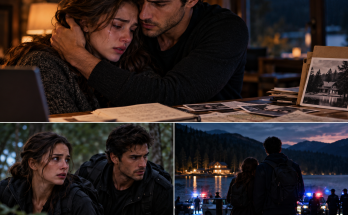
Morales confronted Sarah that afternoon.
This time, there was no long denial.
No claim that she had forgotten.
She closed her eyes and said, “I saw the watch.”
“When?”
“The morning after.”
“On David?”
“Yes.”
“Why didn’t you tell us?”
“Because I knew what it might mean.”
That answer landed exactly where it should.
Not fear.
Meaning.
Sarah understood.
Maybe not with certainty.
But enough.
I did not attend the interview, but Elaine read portions of the transcript later.
Sarah described David returning home around nine that morning.
He had showered elsewhere.
His clothes were different from the ones he wore to the motel.
Voss’s silver watch was on his wrist.
She recognized it because Voss wore it during both meetings she had attended.
Sarah asked where he got it.
David said, “Charles doesn’t need it.”
She asked what that meant.
David told her not to start.
Then he slept for six hours.
“What did you do?” Morales asked.
“I put his clothes in the washer.”
The answer sickened me.
“Which clothes?”
“The ones he came home in.”
“Were they wet?”
“Yes.”
“Saltwater?”
“I assumed.”
“Blood?”
“I didn’t see any.”
“What happened to Voss’s watch?”
“David kept it for a few weeks.”
“Why?”
“He said it was expensive.”
The casual greed was almost incomprehensible.
If David had harmed Voss, he may have taken a dead man’s watch and worn it at family barbecues.
If he had not harmed him, wearing it was still disturbing.
“What happened to it?”
Sarah said David eventually placed it in a safe.
Which safe?
The old warehouse.
That safe had been seized months earlier.
Investigators reopened the inventory.
No watch.
But one evidence photograph showed an empty watch box.
Brand matched Voss’s.
Another missing object.
David’s defense said Voss could have given him the watch as collateral for gambling debt.
No documentation supported that.
Sarah had never heard such an explanation at the time.
Still, without Voss’s body or watch, the evidence remained circumstantial.
The judge allowed testimony about trust transfers and Sarah’s knowledge.
He excluded the photograph comparison from the financial trial pending further foundation.
The missing-person case continued separately.
That separation frustrated me.
Emotion wanted everything combined.
The law insisted on categories.
Fraud here.
Potential homicide there.
Custody elsewhere.
Restitution in another proceeding.
Human lives do not happen in folders.
Courts do.
David’s trial moved toward its end.
The prosecution’s financial evidence was overwhelming.
Bank records showed investor funds diverted.
Trust money moved through shell companies.
False statements.
Forged documents.
The attempted home-equity loan.
The Florida property.
My medical records.
Insurance applications.
Sarah’s testimony.
Michael’s recordings.
David’s attorney shifted almost entirely toward blaming Sarah.
He argued she managed family deception while David focused on failing businesses.
The strategy might have worked better if David’s own emails did not exist.
One read:
Amber doesn’t read statements closely. Keep transfers under amounts that make her ask questions.
Another:
If she pushes back, Sarah handles emotion. I’ll handle paper.
There it was.
Their division of labor.
Sarah handled me.
David handled documents.
One weapon emotional.
One administrative.
Together they were effective.
During closing arguments, I sat behind the prosecutor.
He did not describe me as foolish.
I appreciated that more than I expected.
He said trust was not negligence.
Family relationships routinely depend on access and honesty.
Fraud succeeds not because victims are stupid, but because perpetrators exploit ordinary assumptions.
A daughter may enter her mother’s home.
A son-in-law may know financial information.
A grandmother may pay for soccer camp without demanding forensic accounting.
The crime lay in turning those normal acts into tools.
David’s attorney responded that generosity created ambiguity.
Maybe payments were gifts.
Maybe Michael intended loans.
Maybe Sarah believed future inheritance justified transfers.
Maybe Voss authorized investments.
Maybe I had agreed to more than I remembered.
Maybe.
Maybe.
Maybe.
That word had been our family’s hiding place for years.
Maybe Sarah misunderstood.
Maybe David meant well.
Maybe next quarter would improve.
Maybe one more loan.
Maybe one more rescue.
Evidence finally replaced maybe.
The jury deliberated for eleven hours across two days.
I did not attend the waiting room the second morning.
Instead, I took Leo to school.
He had a spelling test.
Life continued with absurd normality.
At ten thirty, Elaine called.
“Verdict.”
My hands went cold.
Martha drove me.
The courtroom filled quickly.
David entered.
He looked at no one.
The jury foreperson stood.
Count after count.
Guilty.
Wire fraud.
Bank fraud.
Identity theft conspiracy.
Investor fraud.
Falsified loan documents.
Misappropriation connected to trust assets.
Not every count survived.
Some technical charges resulted in not guilty.
But the central case held.
David stared forward.
Sarah was not present.
She had been advised to stay away.
I felt no triumph.
Only an immense tiredness.
Afterward, reporters shouted questions.
I said nothing.
Elaine and I walked to the car.
“You won.”
I looked at her.
“No.”
She corrected herself.
“The state proved the case.”
“That sounds closer.”
What had I won?
My house remained mine.
Some money might return.
Leo was safer.
Truth existed in public record.
Those things mattered.
But Michael was still dead.
Voss was still missing.
Sarah was still facing sentencing.
Leo still went to therapy because his parents used him.
No verdict reversed any of that.
At home, I found a letter from Sarah’s attorney.
She requested another meeting.
I almost refused.
Then I read the final line.
Sarah has located something belonging to Charles Voss.
We met the next morning.
Sarah placed a small key on the conference table.
Not a house key.
A safe-deposit key.
“Where did you get it?”
“David’s old desk.”
“When?”
“Years ago.”
“And you’re mentioning it now?”
“I forgot what it was.”
I stared at her.
She corrected herself.
“No. That’s not true.”
At least she caught herself.
“I knew it belonged to Voss. I told myself it didn’t matter.”
“What bank?”
“I don’t know.”
The key was stamped with a number.
226.
No bank name.
Morales took custody.
Investigators searched financial records.
Voss had rented safe-deposit boxes at two banks.
One closed years earlier.
The other was still active.
Box 226.
A warrant was obtained.
Inside were documents, cash, and a sealed envelope addressed:
IF SOMETHING HAPPENS TO ME—THOMAS BELL.
Bell opened it with investigators present.
Voss had written a confession.
He admitted accepting bribes from David.
Admitted approving improper loans.
Admitted falsifying trust records.
He wrote that he intended to confess and repay what he could.
Then came the final paragraph.
David has become increasingly desperate. He believes Amber’s trust can solve his business problems. Sarah knows more than she admits, but I do not believe she understands how dangerous David has become. If I vanish, look at the boat.
I felt the room change.
The boat.
Not a theory.
Voss himself had identified it before disappearing.
The letter continued.
He listed the marina.
David’s berth.
And one more detail.
There is a weighted emergency anchor in the forward compartment. It does not belong to the boat.
Morales called the current boat owner immediately.
The forward compartment had been remodeled.
But old service photographs existed.
One from four years earlier showed the anchor.
Large.
Black-coated.
Distinctive.
It was no longer on the boat when David sold it.
Investigators searched marina surveillance archives.
Most footage had been overwritten years ago.
But billing photographs survived because the marina documented dock conditions.
One image taken the morning after Voss disappeared showed David’s boat returning.
Something dark lay on the rear deck under a tarp.
Too large to identify.
The image alone proved nothing.
Still, with Voss’s letter, smartwatch data, the watch, the motel footage, and the offshore stop, prosecutors sought permission for a targeted marine search.
Technology had improved.
Sonar teams mapped the area where David’s boat stopped.
For two days, nothing.
On the third, they located a dense object partly buried in sediment.
Divers descended.
They recovered the anchor first.
Black-coated.
Corroded.
A length of chain attached.
At the other end was a sealed marine storage case.
No body.
My stomach twisted when Morales told me.
“What was inside?”
“Clothing.”
“Voss’s?”
“We’re testing.”
“And?”
“A wallet.”
She paused.
“Charles Voss’s identification is inside.”
I closed my eyes.
No remains.
But his possessions had been deliberately weighted offshore.
Then Morales added one more thing.
Inside the case, protected by layers of plastic, was a flash drive.
“Does it work?”
“We don’t know.”
“What’s on it?”
“Technicians are examining it now.”
The next evening, she called.
The drive worked.
Voss had copied records before meeting David.
Trust ledgers.
Loan documents.
Emails.
Audio files.
And one video recorded on his office computer three days before he vanished.
Voss sat alone at his desk.
He looked exhausted.
“If you are seeing this,” he said, “I failed to tell Amber Mitchell what happened to her husband’s trust.”
My chest tightened.
He described the theft.
His own role.
David’s pressure.
Sarah’s participation.
Then he said something unexpected.
“Most of the money is gone, but not all of it.”
I leaned toward the screen.
Voss had moved the remaining trust assets before meeting David.
Not for himself.
To protect them.
“How much?” I whispered.
Morales paused the video.
“According to his records, three hundred eighty-six thousand dollars.”
My breath caught.
Almost four hundred thousand.
“Where?”
She resumed the video.
Voss looked directly into the camera.
“The remaining funds are held under a successor fiduciary arrangement. Only Thomas Bell can identify the final custodian.”
Everyone turned toward Bell.
He looked genuinely stunned.
“I don’t know what he means.”
Voss continued.
“Bell does not know yet. The instructions will reach him if I fail to check in.”
The video ended.
A dead man had built a contingency around another man who never knew he was part of it.
Somewhere, nearly four hundred thousand dollars of Michael’s trust might still exist.
And finding it now depended on a message Charles Voss had arranged to send if he disappeared.
Click here to continue reading: PART 20: The Message Charles Voss Sent After His Disappearance Led Back to Michael’s Final Safeguard, but Recovering It Required a Choice I Could Not Undo
My Daughter Asked Me to Disappear, Then Learned Exactly How Much of Her Life I Had Been Paying For
Part 19 of 39