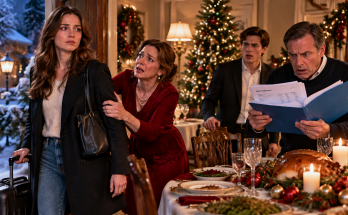
For several seconds, I heard nothing except the ventilation system above us.
Evelyn had just told me that in 1987 I knew Michael’s brother David was the donor used to conceive Jake.
Michael stood beside the table, one hand gripping the back of a chair.
Jake remained between us.
My son.
Michael’s nephew by blood.
The boy we had both raised without knowing any of it.
I looked at my mother.
“Tell me exactly what I knew.”
Evelyn wiped her face.
“Susan—”
“No summaries.”
Her eyes closed.
“No protecting me.”
She nodded.
“Start at the beginning.”
Michael said nothing.
That frightened me.
Anger would have been easier.
In 1986, he and I had been trying to conceive for more than a year.
That part I remembered.
Pregnancy tests lined the bathroom trash.
Appointments.
Temperature charts.
Blood tests.
A physician telling us we were both healthy enough that he could not explain why nothing happened.
Then came the appointment with Thomas Kessler.
Keene.
I remembered him now.
Not clearly.
But enough.
He had introduced himself as a consultant brought in by the fertility clinic.
I had never connected him to the attorney Thomas Keene I met later because his hair was different, his glasses heavier, and everyone around me treated Kessler as though he belonged.
Evelyn said, “He told you Michael’s sperm showed a hereditary instability.”
Michael frowned.
“What instability?”
“None.”
I looked at my mother.
“He lied.”
“Yes.”
“He told us my husband shouldn’t father a child.”
“Yes.”
Michael finally moved.
“He told me my count was low.”
“He told Susan something worse.”
“What?”
My throat tightened.
“That a child conceived naturally might inherit a serious neurological condition.”
Michael’s face emptied.
“I never had one.”
“I know.”
“Did you know then?”
“No.”
He looked away.
I remembered sitting alone in an examination room after Michael had been sent for additional testing.
Keene entered carrying a folder.
He spoke gently.
That was what I remembered most.
The gentleness.
He told me there was an option.
A donor genetically similar to Michael.
Someone whose physical traits would preserve “family continuity.”
Those words had sounded comforting then.
Now they were contaminated.
I looked at Evelyn.
“How did David enter it?”
She swallowed.
“Keene said the clinic had preserved a sample from Michael’s brother before he died.”
Michael closed his eyes.
Jake stared at him.
I forced myself to continue.
“And I agreed.”
“You resisted.”
“That isn’t the same as no.”
“You asked whether Michael knew.”
“What did Keene say?”
“That telling him would only hurt him.”
Michael laughed once, quietly.
Of course.
The strategy never changed.
Withhold truth.
Call it protection.
“You believed that?” he asked.
I looked at him.
“I don’t know.”
Evelyn answered for me.
“You were terrified he would refuse treatment entirely.”
“Treatment?”
“You believed the doctors were preventing a sick child.”
Michael’s jaw tightened.
“So Susan thought using David’s sample was medically necessary.”
“Yes.”
“And I thought the sample was mine.”
“Yes.”
Jake whispered, “Jesus.”
My mother continued.
“You said you couldn’t do it without Michael knowing.”
Relief hit too quickly.
Then Evelyn added, “At first.”
It disappeared.
“What changed?”
“Keene showed you a laboratory report.”
“Fake.”
“Yes.”
“It said what?”
“That Michael carried the condition and David did not.”
Michael stared at the floor.
I remembered the page.
Not words.
A diagram.
Red marks beside Michael’s name.
Green beside David’s.
An arrow.
Probability percentages.
Manufactured science.
Keene had built a lie that looked clinical enough to silence instinct.
I whispered, “I thought I was choosing a healthy child.”
Evelyn nodded.
“And protecting Michael from finding out his brother was the safer donor.”
Michael looked at me.
I could barely meet his eyes.
“That was still wrong.”
“Yes.”
“I should have told you.”
“Yes.”
“I chose not to.”
“Yes.”
The simplicity of his answer hurt more than accusation.
Jake moved closer to us both.
“But she didn’t choose the truth she thought she was hiding.”
Michael looked at him.
Jake continued.
“She thought Dad had a genetic disease.”
“Yes.”
“She thought Uncle David’s sample avoided it.”
“Yes.”
“And Keene created that lie.”
“Yes.”
Jake turned to me.
“You made a choice inside a fraud.”
I shook my head.
“I still made it.”
“So did every person who ever signed a contract based on false information.”
Lily, standing near the doorway, spoke quietly.
“Consent requires knowing what you’re consenting to.”
The sentence landed differently from forgiveness.
I looked at her.
She knew better than anyone what it meant to have a life shaped by consent that never existed.
Michael sat.
“Did Susan know the sample had been taken from David without permission?”
My mother went still.
That was another layer.
“No.”
Michael looked up.
“Was it?”
Evelyn nodded.
His face changed.
“David didn’t donate.”
“No.”
“Then how did they get it?”
Harris answered through the secure connection.
“Medical collection.”
Michael turned toward the screen.
“What does that mean?”
“After David’s boating accident, tissue and reproductive samples were collected while he was unconscious.”
Michael stood.
“He was alive.”
“For several hours.”
“You took sperm from my dying brother?”
Harris lowered his head.
“I did not personally perform it.”
“Stop doing that.”
Harris looked up.
“Doing what?”
“Moving responsibility one inch away from yourself every time.”
The doctor went silent.
Michael’s voice trembled.
“He was nineteen.”
“Yes.”
“He never agreed.”
“No.”
“Did my parents know?”
Harris hesitated.
“Your father did afterward.”
Michael’s face crumpled.
“Robert knew?”
“Yes.”
“Did he allow them to keep it?”
“No.”
“Then why did they?”
“Vollen retained samples against his demand.”
Michael turned away from the screen.
Jake reached for him.
This time Michael stepped into his son’s arms.
I watched them.
Father and son.
Uncle and nephew.
Labels mattered less than love until labels were used to steal truth.
Then they mattered enormously.
Reyes returned to the authorization document.
“There’s a second issue.”
I almost laughed.
“There’s always another issue.”
She pointed to the witness section.
Evelyn’s signature.
“Mrs. Miller, you witnessed Susan’s consent.”
My mother nodded.
“Did you know the laboratory report was false?”
Silence.
My stomach tightened.
“Mom.”
She began crying again.
Not enough.
I wanted words.
“Did you know?”
“Yes.”
Michael closed his eyes.
I stared at her.
The room narrowed.
“You knew.”
“Yes.”
“You knew Michael wasn’t sick.”
“Yes.”
“You knew Keene lied to me.”
“Yes.”
“And you watched me sign.”
“Yes.”
Something inside me went cold.
“Why?”
“William asked me.”
My breath caught.
“What?”
“He said Keene needed Susan to accept David’s sample or they would use another donor.”
“So?”
“William trusted Robert Miller’s lineage more than the alternatives.”
Michael stared.
“My family.”
Evelyn nodded.
“He believed David was the least dangerous choice.”
I laughed, but nothing about it was humor.
“Least dangerous.”
The phrase belonged engraved over every catastrophe in our lives.
Evelyn reached toward me.
I stepped back.
“You could have told me.”
“I know.”
“You could have told Michael.”
“I know.”
“You could have refused to witness it.”
“Yes.”
“Instead you helped them.”
“Yes.”
Her honesty did not reduce my anger.
It sharpened it.
“Was Jake part of the project?”
Evelyn looked at him.
“Not in the way Lily was.”
“That is not an answer.”
“He was observed.”
“We know.”
“They hoped a child from David and Susan would carry Miller compatibility markers and Carter maternal traits.”
“But I wasn’t biologically Carter.”
“No.”
“So Jake failed their model.”
“Yes.”
Jake smiled without humor.
“Best failure of my life.”
Michael gripped his shoulder.
Evelyn continued.
“When the tests showed Jake did not fit the continuity criteria, William insisted the monitoring stop.”
“Did it?”
“For several years.”
“Until 2008.”
“Yes.”
I turned toward Harris.
“Then Keene rediscovered me as a Harris-line subject.”
“He learned the truth of your parentage.”
“How?”
Harris looked at Evelyn.
My mother answered.
“I told William.”
“You had never told him?”
“He knew Leonard might be your father. He did not know for certain.”
“And in 2008?”
“I gave him the old blood records.”
“Why?”
“Because Keene had started asking questions about your family again.”
Every attempt to protect me had fed him information.
I rubbed my forehead.
“Did William give those records to Keene?”
“No.”
“Then who?”
Silence.
Samuel Price, joining remotely, spoke.
“Rachel.”
Everyone turned.
Rachel Voss remained in a separate interview room.
Reyes connected her.
Rachel looked tired.
“I copied them.”
“From where?” I asked.
“William’s private files.”
“When?”
“2007.”
“Why?”
“Keene asked.”
“And that told him Susan was Harris’s biological daughter,” Reyes said.
“Yes.”
Which meant Keene discovered Daniel could not produce the combined Carter-Harris child he wanted.
So he used William’s preserved sample.
The plan adjusted again.
Jake looked at Rachel.
“Did you know about me?”
“Yes.”
“Did you know David was my biological father?”
“Yes.”
He stared.
“And when you worked for Leonard, you said nothing.”
“No.”
“Why?”
“I was still working for Keene.”
“Were you ever not?”
She flinched.
“Eventually.”
“When?”
“After Emily.”
Daniel’s other daughter.
The one born outside the program.
Rachel continued.
“Keene ordered surveillance on her. She was a child with no trust value. No lineage value. No reason to target except leverage.”
“And that bothered you?”
“Yes.”
Jake’s expression hardened.
“Not the rest?”
“It should have.”
“But it didn’t.”
“Not enough.”
Again.
Eventually.
The word might have been carved into all of us.
I turned back to Michael.
He still looked shattered.
I sat beside him.
“I’m sorry.”
He did not respond immediately.
“I should have told you what I believed.”
“Yes.”
“I thought I was protecting you.”
“Yes.”
“That doesn’t excuse it.”
“No.”
I stared at my hands.
“Do you hate me again?”
His expression changed.
“No.”
“Why not?”
“Because I am done building our marriage around one moment and pretending everything else disappears.”
My eyes filled.
He continued.
“You made a choice in 1987 not to tell me.”
“Yes.”
“You made another choice in 2008 with Daniel.”
“Yes.”
“I made eighteen years of choices after that.”
I looked at him.
“We all own what we actually chose.”
Lily smiled faintly.
“That sounds familiar.”
Michael glanced at her.
“I’m learning.”
Jake sat opposite us.
“So what happens now?”
Reyes answered.
“Now we verify every remaining record independently.”
“Including my consent?”
“Yes.”
“How?”
“Medication charts. appointment notes. archived recordings if any exist.”
My stomach tightened.
“Recordings?”
Harris spoke.
“Some consent sessions were taped.”
Of course.
“Where?”
“Prague may have copies.”
European authorities searched the archive index.
One audiovisual item appeared.
1987 — SC-11 CONSENT.
A videotape.
Still sealed.
My pulse hammered.
There it was.
The past no longer dependent on memory.
“Can we see it?”
Reyes said, “Once the court authorizes digitization.”
I thought I would dread it.
Instead, I wanted it desperately.
Not because I expected innocence.
Because uncertainty had become its own prison.
Then Samuel spoke.
“There’s something else in the Prague inventory.”
“What?”
“A second tape.”
Same date.
Same subject code.
Different label.
POST-CONSENT INTERVENTION.
My skin chilled.
“What does that mean?”
Harris looked genuinely alarmed.
“I don’t know.”
Evelyn went pale.
I turned to her.
“You know something.”
“No.”
“Mom.”
“I’ve never seen that phrase.”
Samuel opened a related index line.
It contained one notation.
SUBJECT RESCINDS. KESSLER OVERRIDES.
The room went silent.
I stared.
“Rescinds.”
Reyes read carefully.
“Subject withdraws consent.”
My heart stopped.
Michael looked at me.
Jake straightened.
Evelyn covered her mouth.
I had signed.
But according to the hidden record, I later changed my mind.
And Thomas Keene had gone forward anyway.