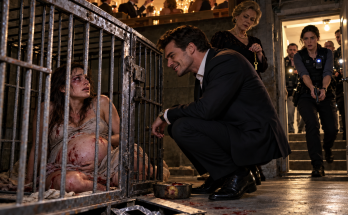
The rebuilt Room Seventeen looked cleaner than the original.
That made it worse.
Modern walls.
Soft recessed lighting.
A glass observation panel.
No rusted restraints.
No stained tile.
Michael Vance had reconstructed the dimensions from photographs and old architectural plans.
He called it archival replication.
I called it unnecessary.
Vivian sat alone in the center.
No restraints.
No weapon.
Her hospital gown showed beneath a long coat.
The bandage at her shoulder was stained through.
She had escaped medical custody less than an hour earlier.
How remained unclear.
Perhaps assistance.
Perhaps negligence.
Perhaps one final example of institutions underestimating an old woman because she looked weak.
Police surrounded the room.
Vivian did not care.
She looked only at me.
“You found Michael.”
“Yes.”
“He always was clever.”
Brenda stood behind me.
“My brother used our family name to continue Keene’s work.”
Vivian glanced at her.
“Your family name has been funding cowardice for generations.”
Brenda flinched.
Then steadied.
“My mother helped Margaret.”
“Yes.”
“She also hid.”
“Yes.”
“Both can be true.”
Vivian smiled faintly.
“Martha has been teaching everyone.”
“No.”
I stepped into the room.
“We’ve simply stopped pretending people are one thing.”
That made her expression change.
Perhaps because she had spent her life insisting what happened to her made everything afterward inevitable.
It did not.
I looked around.
“Where is Rose’s recording?”
Vivian pointed to a cabinet.
Michael said, “Don’t touch anything.”
Police processed it first.
Inside was a reel labeled:
ROSE HIGGINS — 1951.
My grandmother’s voice.
More than seventy years old.
Preserved.
Waiting.
Vivian said, “Play it.”
I studied her.
“Why do you want me to hear this?”
“Because everyone has blamed the Keenes.”
“Your husband’s family earned much of that.”
“Yes.”
“But?”
She looked tired.
“The first betrayal was ours.”
Ours.
Higgins.
Shaw.
Family.
I sat.
Andrew and David entered after police cleared them.
Brenda stayed.
Marcus came too.
Michael stood near the door.
No one left.
I threaded the reel.
Rose’s voice emerged thin but clear.
“My name is Rose Higgins. I am making this because Dr. Elias Keene has begun changing records.”
I closed my eyes.
My grandmother.
Not abstract.
A person.
“He did not begin the memory work.”
Everyone in the room became still.
“He expanded it.”
A pause.
“The first experiments were proposed by my brother.”
My pulse quickened.
Rose had a brother.
Not William.
Someone else.
“His name is Charles Higgins.”
I had never heard the name.
Vivian closed her eyes.
Rose continued.
“Charles served overseas during the war.”
World War II.
“He returned convinced memory could be altered chemically because he saw soldiers forget interrogations after sedation.”
Michael whispered, “No.”
His entire historical model was changing.
Rose said Charles began experimenting informally.
Alcohol.
Sedatives.
Sleep deprivation.
At first on himself.
Then friends.
Then vulnerable patients he met through hospital work.
“What was he?” I asked.
Vivian answered.
“Orderly.”
Not doctor.
Not scientist.
An orderly with an idea.
Rose’s recording continued.
“He brought the idea to Elias Keene because Elias had credentials.”
There it was.
The origin.
Not a grand research institute.
Not a sophisticated theory.
A traumatized veteran with access to vulnerable people and a doctor willing to legitimize him.
Charles Higgins.
Rose’s brother.
My great-uncle.
The first deliberate step.
Rose said she had helped him early.
My stomach tightened.
“I typed notes.”
Her voice shook.
“I thought he was trying to help men sleep.”
Then one patient woke confused and frightened.
Charles became excited.
Not concerned.
Excited.
Rose understood then.
He was not interested in healing trauma.
He was interested in producing forgetting.
Vivian stared at the floor.
“My mother told me Charles was brilliant.”
I looked at her.
“You knew about him?”
“Pieces.”
Rose continued.
Charles introduced Elias to Robert Dalton senior.
Because Robert had money.
Elias had credentials.
Charles had methods.
Three men.
Idea.
Legitimacy.
Funding.
The machinery of harm assembled from ordinary ambitions.
Rose said Robert asked the obvious question.
Could forgetting be controlled?
Could memories be weakened selectively?
Could subjects become more suggestible after chemical disruption?
Charles said yes.
He did not know.
But he said yes.
Because money was listening.
Michael sat down.
“He invented the claim before the evidence.”
Exactly.
The pattern at the center of everything.
Theory first.
People forced to fit later.
Rose said Elias began formalizing protocols.
Charles recruited subjects.
Robert funded equipment.
Then veterans.
Patients.
Staff relatives.
Children.
Margaret.
Vivian.
Generations.
I felt something strange.
Not relief.
Scale.
The story became less supernatural.
Less fated.
It had started with one man lying about certainty.
Everything afterward expanded because other people found the lie useful.
Rose’s voice changed.
“Charles became unstable.”
She described paranoia.
Drinking.
Violence.
He believed the government was stealing his ideas.
He threatened Elias.
Threatened Robert.
Then in 1952, Charles disappeared.
“Where did he go?” Andrew asked.
Vivian laughed weakly.
“No one knows.”
Rose’s recording answered partly.
“I believe Robert paid him to leave.”
A letter indicated money sent to California.
Then nothing.
But Rose had another fear.
“Charles had a son.”
My skin went cold.
Of course.
Another descendant.
Name:
Franklin Higgins.
Born 1946.
A child.
Six years old when Charles disappeared.
I looked at Vivian.
“Who was Franklin?”
Her face was unreadable.
Rose said Franklin was sent to relatives in another state.
She feared Charles had already taught him enough to continue the obsession.
The reel ended.
Michael whispered, “This changes the genealogy.”
Brenda looked at him.
“Please stop hearing family trauma and thinking first about a chart.”
He flinched.
Good.
I looked at Vivian.
“Who became Franklin?”
She did not answer.
“You know.”
“Yes.”
“Tell me.”
She studied me.
Then said, “Frank Heller.”
The room went still.
No.
Frank.
The investigator my mother trusted.
The man who later infiltrated Caldwell.
The man who supposedly opposed the Keenes.
He was Charles Higgins’s son.
My relative.
“What relationship?”
Vivian answered.
“Second cousin to Margaret.”
Frank had been family.
Not close.
Hidden under another name.
I stared.
“Did my mother know?”
“No.”
“Arthur?”
“Eventually.”
“When?”
“1999.”
“Did that change anything?”
“Yes.”
“How?”
“Arthur stopped trusting him.”
Frank’s later position inside Caldwell made new sense.
Arthur kept him close not only because he could monitor Jonathan.
Because Frank himself belonged to the original line of harm.
“What did Frank want?”
“The archive.”
“Why?”
“Same reason Jonathan did.”
“Legacy?”
Vivian nodded.
“But different legacy.”
“How?”
“Frank wanted Charles recognized as the true originator.”
I almost laughed.
Two old men fighting over which predecessor deserved credit for an unethical idea.
Jonathan defending Samuel.
Frank defending Charles.
All while pretending to protect truth.
“Did Frank kill anyone?”
Vivian looked away.
My stomach tightened.
“Who?”
“I don’t know.”
“That means you suspect.”
“Yes.”
“Who?”
“Edward.”
My uncle.
The man who poisoned my mother.
“When did Edward die?”
“1998.”
One year before Arthur discovered Frank’s identity.
“Cause?”
“Stroke.”
Of course.
Another plausible medical death.
“Why would Frank kill Edward?”
“Because Edward knew who he was.”
“Anything else?”
“Edward had Charles’s notebooks.”
“So Frank wanted them.”
“Yes.”
“Did he get them?”
Vivian looked toward Michael’s archive cabinet.
“No.”
“Where are they?”
“Arthur took them first.”
Of course Arthur did.
“Where?”
“I don’t know.”
I almost laughed.
For once, Vivian truly seemed not to.
Then she said, “But Jonathan knew.”
“Jonathan is in custody.”
“He knew before.”
“Did he find them?”
“I don’t know.”
Again.
Uncertainty spreading.
Good.
Reality returning.
I turned to Michael.
“Did Jonathan store anything here besides data?”
Michael hesitated.
“There is one physical archive.”
“Show us.”
Police cleared it.
A small fireproof room.
Inside sat six boxes.
Jonathan’s personal collection.
One labeled:
CHARLES H.
My pulse quickened.
Inside were notebooks.
Original.
Leather-bound.
Charles Higgins.
The man at the beginning.
I opened the first.
His writing was erratic.
Early pages described war.
Night terrors.
Interrogations.
Men given barbiturates.
Memory gaps.
He began experimenting on himself because he wanted to forget.
That mattered.
The first impulse had not been control.
It had been escape.
Then the goal changed.
If forgetting could be induced, it could be useful.
If useful, valuable.
If valuable, fundable.
If fundable, expandable.
Pain became ambition.
By notebook three, human beings were variables.
By notebook five, Charles wrote:
The greatest obstacle is not creating forgetting.
It is preventing recovery.
I stopped.
That sentence had shaped everything.
Samuel later focused on recovery.
Vivian on inheritance.
Jonathan on legacy.
All descendants arguing around Charles’s original problem.
Then a later entry:
Rose resists.
Margaret may be useful when older.
I felt sick.
My mother had been a possibility in his mind before she was even old enough to understand.
Another:
Franklin watches.
Smart boy.
He asks good questions.
Frank.
A child absorbing his father’s worldview.
Then:
If Elias takes credit, I will ensure Franklin knows who began it.
Legacy planted.
The infection transmitted not genetically.
Narratively.
A child taught that family worth depended on owning the origin of an idea.
Jonathan had the same pattern through Samuel.
Frank through Charles.
Vivian through her own role.
Different bloodlines.
Same obsession with meaning.
I closed the notebook.
“There is no inherited curse.”
Michael looked at me.
“No.”
“No inherited memory destiny.”
“No.”
“No special family psychology.”
“No.”
“Just people teaching children stories about what their families mean.”
He nodded.
That felt important.
Not biology.
Culture.
Secrets.
Shame.
Ambition.
Repeated choices.
Vivian sat back.
“You sound disappointed.”
“I’m relieved.”
“Why?”
“Because if this were blood, we could pretend no one had choices.”
Her face changed.
That sentence found her.
I continued.
“You did.”
“Yes.”
“Frank did.”
“Yes.”
“Jonathan did.”
“Yes.”
“Arthur did.”
A pause.
“Yes.”
“My mother did.”
Vivian looked at me.
“Yes.”
“And I do.”
She lowered her eyes.
For once, she did not argue.
Police entered with news.
Frank Heller was gone.
My stomach tightened.
“What?”
“He left custody during a hospital evaluation.”
“How?”
The officer’s expression told me before he spoke.
Inside assistance.
Someone had altered transport authorization.
Who?
Michael’s clinic administrator.
Paid through a foundation account.
Frank had planned an exit too.
“How long ago?”
“Forty minutes.”
“Where would he go?”
No one knew.
Then David found something inside Charles’s notebook.
A folded map.
Oakridge.
Three locations circled.
The old psychiatric institute.
St. Agnes.
And our first Caldwell laundromat in Dayton.
I stared.
The laundromat where I rediscovered Arthur in 1979.
“Why would Charles mark that?”
The notebook date was 1952.
Decades before Caldwell existed.
It wasn’t our laundromat then.
It had been something else.
Michael searched property history.
Before 1974, the building housed a small pharmaceutical warehouse.
Owned by Dalton Chemical Distribution.
Charles had stored compounds there.
Arthur later bought the same building.
Coincidence?
Maybe not.
Marcus looked at the deed history.
“Arthur knew.”
“What?”
“He bought it from a Dalton holding company.”
So the laundromat had been deliberate.
Arthur had turned one site from the old operation into an ordinary business.
Laundry over chemicals.
Work over experiments.
But why?
Another note in Charles’s map:
LOCKER B — PRIMARY FORMULAS.
My stomach tightened.
The original drug formulas.
If Frank wanted Charles recognized, he would want those.
If Arthur left them there—
I called the current property manager.
No answer.
David called security.
Nothing.
The laundromat still belonged to Caldwell.
We had converted part of it into archival storage.
Frank knew.
Of course he did.
I looked at police.
“He’s going to Dayton.”
Vivian laughed softly.
We all turned.
“What?”
“You still think Frank wants documents.”
“What does he want?”
She looked directly at me.
“He wants you.”
I felt cold.
“Why?”
“Because Charles’s notebooks say the Higgins line was the proof.”
“That has already been disproved.”
“Not to Frank.”
“What does he think I prove?”
“That Charles found something before Keene stole the work.”
“What?”
Vivian’s smile was exhausted.
“Resistance.”
“To sedation?”
“Yes.”
“A metabolic variant.”
“Frank won’t care what you call it.”
“He wants the story.”
“Yes.”
Not science.
Story.
Legacy.
“He thinks if he can show I have the trait—”
“He can say Charles discovered it first.”
I almost laughed.
“That is pathetic.”
“Yes.”
Vivian looked older than ever.
“Most family empires are.”
Then my phone vibrated.
Unknown number.
A photograph.
The Dayton laundromat.
Inside, Frank stood beside the old pressing table.
Behind him was someone tied to a chair.
Peter Dalton.
My former boyfriend.
Robert’s son.
Frank’s cousin through the tangled old family lines.
The message:
BRING CHARLES’S NOTEBOOKS.
ALONE.
I stared.
Another hostage.
Another demand for isolation.
The same method.
Frank believed history required me to repeat it.
I typed back:
No.
His response:
THEN PETER DIES.
I looked at Peter’s photograph.
A man who failed me.
A man who lied.
A man who had also been seventeen when the machinery around us closed.
I did not owe him rescue because of romance.
But I would not abandon him to prove independence either.
I looked at Vivian.
“Frank wants Charles recognized.”
“Yes.”
“Then he’ll need an audience.”
Her eyes narrowed.
I turned to Michael.
“You have the research reviewers.”
“Yes.”
“To Brenda.”
“You have the reunion contact list.”
“Yes.”
“To police.”
“You have the evidence.”
The detective frowned.
“What are you planning?”
I picked up Charles Higgins’s notebook.
“Frank wants a family legend.”
Andrew understood first.
“So give him witnesses.”
“No.”
I looked at the notebook.
“We give him something worse.”
“What?”
“Context.”
Frank wanted Charles to be remembered as the brilliant originator.
We would show exactly what Charles was.
A frightened veteran who wanted relief.
Then a man who began hurting others when ambition replaced healing.
No myth.
No genius.
No curse.
A documented sequence of choices.
I put the notebook into an evidence bag.
“Frank thinks recognition will justify everything that followed.”
David asked, “And?”
I looked toward the door.
“We’re going to make sure recognition does the opposite.”
Click here to continue reading: PART 25: Frank Wanted Charles Higgins Remembered as a Pioneer, but Peter Forced Him to Hear What Charles Actually Became
Fifty-Five Years After Prom, Brenda Vance Put an Apron in My Hands and Expected Me to Know My Place
Part 24 of 35