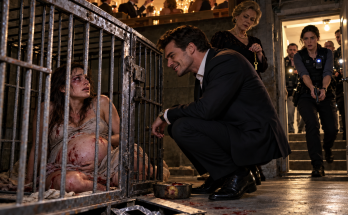
We did not watch the film at the nursing school.
I refused.
Too many people.
Too much noise.
Too many old enemies standing beneath one damaged roof.
Vivian and Harold were taken into custody.
Chloe went with police for medical evaluation and a formal statement.
Richard was detained for questioning.
Daniel volunteered to remain.
For once, the number of people who could follow me home diminished.
I rode with David and Andrew to Caldwell’s secondary storage building.
It stood behind our original laundromat, a low brick structure we had used over the years for obsolete equipment, records, Christmas decorations, and anything Arthur could not bring himself to throw away.
My mother’s cedar bench sat beneath a tarpaulin.
I recognized it immediately.
The lid bore a scratch I had made with scissors when I was nine.
Mother had made me sand it smooth.
I ran my fingers across the scar.
“Mom?”
David stood nearby holding the film canister.
“I’m fine.”
I was not.
But language had begun to feel inadequate for the distance between surviving something and being fine.
The bench smelled faintly of cedar when I opened it.
Inside were old fabric scraps.
A pincushion.
Patterns.
A measuring tape.
Mother’s thimble.
Then a narrow false bottom.
David had already found the release.
Underneath lay three film canisters.
Not one.
JULY 17.
OCTOBER 13.
NOVEMBER 2.
1970.
Andrew looked at me.
“October thirteenth is the day before I was born.”
“Yes.”
I touched the second can.
“And November?”
No one knew.
There was also a letter.
Martha—
If I fail, do not let anyone tell you forgetting means nothing happened.
The body remembers before the mind does.
I kept these because truth may become safer later.
I am sorry I could not make it safe for you now.
Mom
I sat on the floor.
At seventy-three, I cried for my mother as though I had just lost her.
Not the woman who died when I was thirty-two.
The younger woman who had sat at this same bench trying to decide how much truth her daughter could survive.
Andrew lowered himself beside me.
David sat on the other side.
For several minutes, neither touched me.
Then I reached for both their hands.
My sons.
One known.
One stolen.
Both here.
When I could speak, I said, “We watch all three.”
David nodded.
Caldwell still owned an old film projector used for training archives. An employee found it in a locked cabinet.
We set up in the former break room.
A blank white wall became a screen.
The first reel rattled into motion.
The image shook.
Trees.
A gravel drive.
The Dalton lake house.
Date burned into the film.
JUL 17 1970.
My sixteen-year-old self appeared.
I stopped breathing.
I wore shorts and a yellow blouse.
My hair reached halfway down my back.
I was laughing.
That hurt.
I was not dragged there.
Not visibly.
I walked beside Vivian carrying a paper sack.
Then Samuel Keene entered frame.
Older than I remembered.
Forties.
He spoke to the camera.
No sound.
The film was silent.
Daniel had said the earliest sessions were filmed for behavioral observation.
Vivian guided me inside.
The next sequence showed a basement room.
Not the clinic.
Different restraints.
Different table.
I watched myself sit willingly.
Vivian handed me a glass.
I drank.
Andrew’s hand tightened around mine.
Time cut forward.
My posture changed.
Slower.
Keene moved his fingers in front of my face.
I followed them.
Then another man entered.
Arthur.
Twenty-seven.
Dark hair.
Lean.
Wearing a short-sleeved white shirt.
My husband.
Nine years before our supposed first meeting.
He spoke to Keene.
They argued.
Even without sound, it was obvious.
Keene pointed toward me.
Arthur shook his head.
Vivian stepped between them.
Arthur looked toward the camera.
Then directly into it.
He knew he was being filmed.
He covered the lens.
The image went black.
Several seconds later, film returned.
I was alone on the table.
Arthur gone.
Keene stood beside me.
Vivian held a clipboard.
Keene touched my face.
My stomach turned.
Then he leaned down.
Andrew stood.
“Stop it.”
I said, “No.”
“Mom.”
“I need to know.”
The film continued.
Keene’s hand moved beneath the edge of my blouse.
I began struggling.
Vivian grabbed my wrist.
Then the door burst open.
Arthur.
He hit Keene.
Once.
Hard enough to knock him sideways.
Vivian backed away.
Arthur pulled me from the table.
I could barely stand.
He wrapped his shirt around me.
My memory surfaced.
Brown wool had been wrong.
It had been a white shirt.
The smell I remembered was not cigarettes.
It was lake water and machine oil.
Arthur carried me toward the door.
The film ended.
The room remained dark.
Nobody spoke.
I finally said, “He came back.”
Andrew looked at me.
“He had been there before.”
“Yes.”
“He knew what Keene was doing.”
“Yes.”
“But he came back.”
“Yes.”
David switched on the light.
I stared at the wall.
Arthur had lied.
But not in the simplest direction.
He had been involved before the session.
He had also stopped it.
Both could be true.
That was the horror of him.
Not monster.
Not savior.
A man who helped build the room, then carried me out of it.
I picked up the October reel.
“Next.”
David hesitated.
“Mom.”
“Next.”
The second film began.
St. Vincent’s.
A hospital room.
I lay unconscious.
My face swollen.
My mother sat beside me.
Arthur stood in the doorway.
Vivian entered.
Then Robert Dalton.
Peter’s father.
The men argued.
Margaret stood and shoved Robert.
I smiled despite myself.
Of course she did.
The film cut.
A nurse carried an infant.
Andrew.
My son.
I stopped breathing.
He made a sound beside me.
Not a word.
The nurse placed him into Margaret’s arms.
My mother held him.
She kissed his forehead.
Andrew covered his face.
“She held me.”
“Yes.”
“She knew me.”
“Yes.”
For the first time that night, something good emerged from the nightmare.
My mother had held him.
He had not entered the world entirely unwanted.
Margaret carried him toward my bed.
She placed him against my chest.
My eyes opened.
I looked down.
The film had no sound, but I could see my mouth form something.
Again.
Again.
Andrew leaned toward the wall.
“What are you saying?”
David paused the film.
I stood and moved closer.
My sixteen-year-old face stared down at the infant.
My lips shaped two syllables.
Andy.
Andrew.
I had named him.
“You named me.”
His voice broke.
I turned.
“I named you.”
He cried openly.
So did I.
Tommy had not invented the name.
He had preserved it.
I understood suddenly why he chose Andrew Thomas Mercer.
Andrew from me.
Thomas from himself.
A bridge between mothers and fathers who could not safely claim him.
The film resumed.
Arthur entered.
He saw me holding the baby.
His face changed.
He approached slowly.
I looked at him.
Not frightened.
I lifted Andrew toward him.
Arthur sat beside me.
Held him.
Kissed his head.
There was no denying what I saw.
Love.
Guilt.
Fear.
All at once.
Then Robert Dalton entered.
Everything changed.
Arthur stood.
Margaret confronted him.
Vivian took the baby.
My teenage self began crying.
I reached for Andrew.
Robert restrained Arthur.
Another man entered.
Edward Shaw.
My uncle.
He carried documents.
The nurse injected something into my IV.
I went limp.
Margaret screamed.
The image shook as the camera operator moved.
Then Andrew disappeared from frame.
The reel ended.
Andrew stared at the blank wall.
“That’s when they took me.”
“Yes.”
“You saw me.”
“I did.”
“You knew me.”
“For however long they let me.”
The cruelty of that realization hollowed me out.
I had not forgotten giving birth because the event was naturally lost.
They had actively buried it.
Drugged me.
Separated us.
Rewritten the aftermath.
David picked up the final reel.
“November second.”
I nodded.
The projector started.
My mother’s kitchen.
I sat at the table.
Pale.
Thin.
Arthur sat across from me.
Margaret stood near the sink.
There was sound this time.
Weak.
Recorded separately.
Arthur’s voice.
“Martha, do you remember the hospital?”
I shook my head.
“What hospital?”
Margaret closed her eyes.
Arthur looked at her.
He asked me about July.
I said I had been sick.
He asked about Peter.
I smiled.
“I like Peter.”
Arthur’s face tightened.
Then I said, “But I think I loved someone else.”
My seventy-three-year-old heart stopped.
Arthur looked down.
Teenage me continued.
“I dreamed about him.”
“Who?”
“I don’t know.”
“You don’t remember his name?”
“No.”
Arthur began crying.
Silently.
Margaret watched him.
Then she said, “Tell her.”
Arthur shook his head.
“Tell her what you did.”
He whispered, “Not like this.”
“This is exactly when.”
Teenage me looked between them.
“What happened?”
Arthur said, “Nothing.”
My mother slapped him.
Hard.
David inhaled.
I almost laughed.
Mother had deserved that moment.
She pointed at him.
“Do not lie to her while I am standing here.”
Arthur touched his cheek.
Then he looked at me.
“I knew you before.”
I frowned.
“When?”
“This summer.”
“Why don’t I remember?”
“Because people gave you medicine.”
“Who?”
He looked at Margaret.
“Vivian.”
My teenage face changed.
“Aunt Viv?”
“Yes.”
“Why?”
“To test something.”
I laughed nervously.
“That sounds stupid.”
“It was worse than stupid.”
Arthur moved closer.
“I was supposed to watch.”
“Watch what?”
“You.”
“Why?”
“Because I worked for Robert Dalton.”
I smiled.
“Peter’s dad?”
“Yes.”
Then Arthur said it.
“I helped them hide what happened to you.”
My sixteen-year-old self stared.
“What happened?”
He froze.
Margaret said, “Tell her about the baby.”
The room in 2026 went silent.
Teenage me laughed.
“What baby?”
Arthur began crying again.
“Yours.”
My smile disappeared.
“I don’t have a baby.”
“You did.”
“No.”
“Martha—”
“No.”
He reached toward me.
I recoiled.
“No.”
The film captured the exact moment truth became unbearable.
I screamed.
I threw a cup.
Margaret held me.
Arthur stayed where he was.
Then something astonishing happened.
Margaret looked directly into the camera.
“Stop filming.”
The image remained.
She crossed the room.
Her face filled the frame.
“If you keep this, she gets to decide later.”
Then black.
David stopped the projector.
I could not move.
My mother had tried.
She had told me.
Arthur had told me.
I had rejected it.
Not because I was weak.
Because a drugged, traumatized sixteen-year-old mind could not hold the truth they handed it.
Andrew whispered, “You didn’t abandon me.”
I shook my head.
“No.”
“You knew for a moment.”
“Yes.”
“And then?”
“I forgot again.”
Daniel’s phrase returned.
Persistent memory recovery.
Maybe I had remembered in flashes.
Maybe the adults around me kept sanding those flashes down until ordinary life covered them.
Andrew knelt in front of me.
“I spent fifty-five years thinking you chose not to find me.”
I touched his face.
“I didn’t know where to look.”
He leaned his forehead against mine.
Then David said, “There’s another envelope in the can.”
We turned.
Inside the November reel container was a folded page.
Arthur’s handwriting.
If Martha sees this, then I am already out of excuses.
The films prove I knew what was happening before I claimed I did.
They also prove Vivian and Edward were not acting alone.
Robert ordered the cover-up.
Samuel committed the assault.
I helped build the conditions that made both possible.
But there is one person Margaret never identified.
The person who first gave Elias Keene access to the Higgins girls.
The person who introduced Margaret’s mother to the hospital program.
Find Rose Higgins’s employment records.
Rose.
My grandmother.
The story had moved back another generation.
David said, “Where would those records be?”
I knew.
“My mother kept everything.”
Andrew looked toward the cedar bench.
We searched again.
Under the false bottom was a smaller compartment.
Inside lay one brittle envelope.
ROSE HIGGINS.
I opened it.
A payroll card.
Oakridge Psychiatric Institute.
1948.
Supervisor:
DR. ELIAS KEENE.
Next of kin:
WILLIAM HIGGINS.
My grandfather.
But someone had written another name beside it.
Sponsor:
ROBERT DALTON SR.
Peter’s grandfather.
I stared.
The Daltons had not entered my family’s story with Peter.
They had been there before Peter was born.
Before Robert junior.
Before me.
A second paper listed housing assistance payments to Rose Higgins.
Funded by Dalton Charitable Trust.
Then a third.
A birth certificate.
Margaret Higgins.
Father:
William Higgins.
But the original line underneath had been altered.
The hidden surname was still visible.
Dalton.
Andrew whispered, “No.”
I sat perfectly still.
My mother.
Margaret.
Could have been a Dalton.
Which meant Peter and I might not merely have been teenage sweethearts.
We might have been related.
And Robert Dalton may have known before either of us.
Click here to continue reading: PART 12: My Mother’s Altered Birth Certificate Linked Us to the Dalton Family, but Peter’s Father Had Hidden One Final Reason for Separating Us
Fifty-Five Years After Prom, Brenda Vance Put an Apron in My Hands and Expected Me to Know My Place
Part 11 of 35