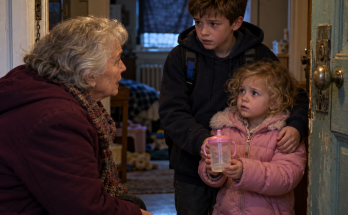
The first knock came at 7:10 on a Tuesday morning, just as I was lifting the lid from my coffee tin. Three careful taps sounded against the front door of the right side of the duplex. Not the impatient hammering of a delivery driver, and not the loose little rhythm children usually make when they want attention. These knocks were measured. Almost apologetic. I set the spoon down and looked through the curtain. Bentley Collins stood on the porch in a red school jacket, backpack strapped over both shoulders, staring at his shoes as if he hoped the boards might swallow him before I answered.
Bentley was ten, thin for his age, with dark hair that always looked as though somebody had combed it with wet fingers. He lived on the left side with his mother, Amber, and his three-year-old sister, Maddie. I knew them the way neighbors often know one another: well enough to exchange groceries in bad weather, not well enough to understand what happened after the curtains closed. Amber worked unpredictable shifts and rarely complained. Bentley usually offered a serious little wave when we crossed paths. Maddie preferred shouting my name from halfway across the yard. Nothing about them had ever given me reason to worry.
I opened the door. “Morning, Bentley.”
“Morning, Miss Arlene.” He adjusted one backpack strap. “Could I use your bathroom?”
The question was strange enough that I hesitated. The duplex had been built by my late husband, Ray, and his brother almost forty years earlier. The two units were nearly identical. Same narrow staircase, same stubborn windows, same tiny downstairs bathroom. If mine worked, theirs ought to work. But Bentley was already blushing, and embarrassing a ten-year-old boy before breakfast seemed unnecessarily cruel. I stepped aside. “Of course.”
He disappeared down the hallway and returned less than two minutes later. His hands were damp from washing them. “Thank you.”
“Everything all right next door?”
He answered too quickly. “Yes, ma’am.”
Then he left.
I watched through the front window as he walked toward the bus stop at the corner of Kilgore Avenue. Something bothered me, though I couldn’t have said what. Maybe it was the backpack. Maybe it was the way he had looked behind him before knocking. Maybe it was simply that I had spent seventy years learning that children are terrible liars precisely because they believe adults are better at believing them than we really are.
The next morning, the knock came at 7:10 again.
Bentley stood in exactly the same place.
“Bathroom?” I asked.
He nodded.
This time I asked whether theirs was broken.
“The toilet’s acting weird.”
“What kind of weird?”
He looked toward his apartment. “Mom knows about it.”
That answer should have satisfied me. Instead, it made the uneasiness sharper. Amber was capable and private. If a toilet needed repair, she would have mentioned it, particularly because my son Doug now handled most of the rental business. Ray had left me the duplex, but after his death Doug gradually took over maintenance, rent collection, and paperwork. He liked efficiency. I liked knowing who lived ten feet beyond my kitchen wall. Those two philosophies had begun colliding more often lately.
Bentley thanked me again and hurried out. On Thursday he returned. Friday too. By Saturday there was no school, yet at 7:10 I heard the same three knocks.
That morning he wasn’t carrying his backpack.
I opened the door without waiting for him to ask. “Come in.”
He gave me a grateful look and headed toward the bathroom. While he was inside, I stepped onto the porch. Amber’s curtains were shut. Her old blue sedan sat in its usual space beside the house. No lights showed through the windows. I nearly walked over and knocked, but Bentley emerged behind me before I could.
“You want some breakfast?” I asked.
“No, thank you.”
“Your mother working?”
He paused.
“Sleeping,” he said.
It was a perfectly ordinary answer. What made it unsettling was the way he whispered it.
On Sunday he arrived at 7:12. He apologized for being late.
I almost laughed. “Bentley, this isn’t an appointment.”
His expression stayed solemn. “I know.”
He went inside. I listened to the faucet run. When he came back, I offered him a cinnamon roll. He stared at it for several seconds before taking it.
“Can I save it?”
“Certainly.”
He wrapped the roll carefully in a paper napkin and slid it into the pocket of his jacket instead of eating it. That was the first detail I wrote down mentally and refused to forget.
Monday morning brought rain. Bentley arrived with damp hair and mud around the soles of his sneakers. He used the bathroom, accepted two pieces of toast, wrapped one in a napkin, and tucked it away.
“For later?” I asked.
He nodded.
“For Maddie?”
His eyes snapped toward mine.
I had guessed.
His face told me so.
Before I could ask another question, he shouldered his backpack. “Bus is coming.”
He hurried outside. I stood at the window expecting to see him climb aboard when the yellow bus rounded the corner. Instead, Bentley walked toward the stop, waited beneath the maple tree until the bus appeared, then stepped behind the trunk.
The bus slowed.
Nobody boarded.
It continued down Kilgore Avenue.
Bentley remained behind the tree until the taillights disappeared.
Then he turned around and walked back toward the duplex.
I moved away from the window before he could see me.
For the rest of that morning, I found excuses not to think about what I had witnessed. I washed laundry. Cleaned a cupboard that did not need cleaning. Reorganized Ray’s old toolbox. At eleven, I heard movement through the shared wall. A chair scraping. Small footsteps. Then a child’s voice.
Maddie.
Bentley had not gone to school.
At noon I carried a casserole to their door.
Nobody answered.
I knocked again.
Silence.
“Bentley? It’s Miss Arlene.”
Something shifted behind the door.
Then his voice came through, strained and cautious. “Mom’s sleeping.”
“I made too much casserole.”
“We already ate.”
“Maddie might like some.”
“She’s sleeping too.”
I stared at the door. “All right. I’ll leave it here.”
I set the covered dish on the porch and returned home.
Twenty minutes later, I checked.
The casserole was gone.
That evening Doug called about Amber’s rent. He had inherited Ray’s habit of getting directly to the point but none of his father’s patience about arriving there.
“She’s behind again.”
“How far?”
“Enough.”
“That isn’t a number.”
“Six weeks.”
I sat at the kitchen table and rubbed the worn edge of Ray’s old placemat. “Have you spoken to her?”
“She doesn’t answer.”
“When did you last see her?”
A pause.
“I don’t know. Why?”
“Bentley’s been coming over.”
“For what?”
“To use my bathroom.”
Doug sighed as if the child’s bladder were a personal attack on his schedule. “Their utilities might be having issues.”
“Might?”
Another silence.
“Doug.”
“I shut their water off.”
The sentence took a moment to settle.
“You did what?”
“They’re behind, Ma. Amber hasn’t returned calls. I gave notices.”
“There are two children in that apartment.”
“And there’s a lease.”
I stood so quickly the chair legs scraped the floor. “Turn it back on.”
“I can’t keep running the property like Dad did.”
“Your father never shut off water on children.”
“He also let people owe him thousands.”
“And somehow we survived.”
Doug exhaled. “I’ll deal with it tomorrow.”
“No. Tonight.”
“I’m not driving across town at eight o’clock because a tenant ignored three notices.”
I looked toward the shared wall. Through it came the faint sound of a child talking.
Not Amber.
Bentley.
His voice rose and fell with the deliberate rhythm of someone reading aloud.
I walked closer until I could distinguish the words only as murmurs. Then came Maddie’s little laugh.
Something tightened inside me.
“Doug,” I said, “when did you last personally see Amber?”
He sounded irritated now. “I told you, I don’t remember.”
“That’s not good enough.”
“Ma, don’t get involved.”
The line went quiet after he hung up.
I remained beside the wall.
Bentley kept reading.
At first I thought it was sweet—a brother entertaining his little sister before bed. Then the reading stopped, and I heard Maddie ask something in the clear, piping voice that traveled easily through old plaster.
“When Mama coming?”
There was a long silence.
Bentley answered so softly I nearly missed it.
“Soon.”
Maddie asked again.
This time his voice trembled.
“Go to sleep. Mama always comes back.”
I stood there with one hand against the wall until my fingers went cold.
The following morning, at exactly 7:10, the three careful knocks came again.
I opened the door.
Bentley was wearing his backpack.
His eyes were ringed with exhaustion.
“Bathroom?” I asked.
He nodded.
I stepped aside, but before he passed me I caught the smell of something on his jacket.
Baby shampoo.
He had been washing Maddie himself.
When he returned from the bathroom, I handed him a paper bag containing two sandwiches, two apples, crackers, and a carton of milk.
He stared at it.
“Miss Arlene, I can’t—”
“Yes, you can.”
“My mom said not to bother people.”
“You aren’t bothering me.”
“She’ll be mad.”
“Then she can come over and be mad at me herself.”
The instant I said it, Bentley’s face changed.
Not much. Just enough.
His lower lip tightened. His gaze dropped.
That was when I knew Amber wasn’t sleeping.
I crouched slightly so we were closer to eye level. “Bentley, where is your mother?”
He clutched the food bag against his chest.
“At work.”
“You told me yesterday she was sleeping.”
“She works nights.”
“You told me Saturday she was sleeping then too.”
His breathing quickened.
I hated doing this to him. I hated watching a child calculate which lie might keep his world intact for another hour.
“Is your mother home?”
He looked at the door.
Then at me.
Then toward the left side of the duplex.
The school bus turned onto Kilgore Avenue in the distance.
Bentley suddenly backed away.
“I have to go.”
“Bentley—”
He ran toward the maple tree.
The bus approached.
Just as before, he hid behind the trunk.
The bus passed without stopping.
But this time Bentley didn’t immediately return to the apartment.
He stood beneath the wet branches with his shoulders shaking.
Then he wiped his face with his sleeve, walked back to the left-side door, unlocked it with a key hanging from his neck, and slipped inside.
A ten-year-old boy had just pretended to leave for school.
And for the first time, I understood that whatever he was hiding depended on everyone believing he was gone.
Click here to continue reading: PART 2: On the Tenth Morning, I Followed Bentley Back Across the Porch and Heard a Three-Year-Old Crying Behind the Locked Door
Every Morning at 7:10, Bentley Knocked on My Door With the Same Polite Request and a Different Excuse
Part 1 of 40