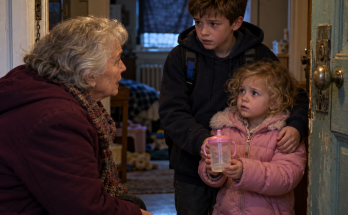
Two years after the doorbell rang at 6:03 in the morning, I woke before sunrise.
Not from fear.
Not from memory.
I simply woke.
The house was still mine.
Different furniture in some rooms.
Different locks.
Different passwords.
The study no longer belonged to David.
I had turned it into a reading room.
The desk where we found the gray laptop was gone.
In its place stood my mother’s old chair from the condo.
Beside it, the rosemary plant sat near a window.
Still alive.
Still crooked.
At 6:03, I was pouring coffee.
The clock changed.
Nothing happened.
I noticed.
Then kept pouring.
That might have been the clearest measure of recovery.
The hour had become an hour again.
My trust had grown modestly despite distributions and the charitable commitment.
The exact number no longer occupied my thoughts.
It remained around the scale my mother left.
More than enough.
The Legal Independence Project had expanded to three states through partner organizations.
It had helped hundreds of people receive independent advice before signing property transfers, guarantees, powers of attorney, family loans, and estate documents.
Some signed anyway.
That was important.
The project was not designed to stop people from helping family.
It was designed to make sure they understood what they were choosing.
My mother would have understood that distinction.
Brenda still lived in her house.
She replaced the roof the previous spring.
Paid for it herself.
She told me that fact three times.
Jason moved out after fourteen months.
He rented a small apartment.
No luxury building.
No rooftop pool.
He complained about the kitchen.
Then admitted he barely cooked.
He remained at the construction supplier.
Renee promoted him again.
His bankruptcy obligations continued.
He paid them.
He no longer called every business idea an opportunity.
Sometimes he called them bad ideas.
That was progress.
He had started seeing someone.
A teacher named Maya.
Before their relationship became serious, he told her about the bankruptcy.
All of it.
He called me afterward.
“She didn’t leave.”
“Congratulations.”
“I thought she might.”
“And?”
“She said debt is less frightening than hidden debt.”
Smart woman.
“Keep her.”
“That sounds controlling.”
I laughed.
He was learning too well.
Brenda’s relationship with Evan became permanent in the way real relationships do.
Not by announcement.
By repetition.
Soccer games.
Birthday cards.
School events.
A forgotten jacket at her house.
A toothbrush in the guest bathroom.
Claire remained part of that arrangement.
So did David.
So, occasionally, did I.
I was not Evan’s stepmother.
Not his aunt.
Not anything easily labeled.
I was Sarah.
That was enough.
He still sent drawings.
His people had become less stick-like.
My mother remained in some of them because Brenda had made her into a family story.
That no longer hurt.
Claire and I never became friends.
We became honest acquaintances.
That was more valuable than forced reconciliation.
Once a year, usually around Evan’s birthday, we had a conversation longer than five minutes.
She rebuilt her career.
Returned every dollar investigators determined came from improper company funds.
Kept what was legitimately hers.
She never asked me for financial help.
I never offered.
That boundary contained no hostility.
David’s legal consequences unfolded more slowly than the early crisis suggested.
Some matters resolved through financial settlements and cooperation.
Others through formal legal processes.
I testified once.
Only once.
I answered questions.
Did not exaggerate.
Did not minimize.
Then left.
I stopped following every development.
By then, David no longer controlled any of the businesses created around my identity.
Bennett Family Holdings was dissolved.
D&M disappeared.
Wren was unwound.
The Cayman account was distributed according to lawful claims.
The townhouse was sold.
The private-lender structures were closed or settled.
The overseas fund invested elsewhere.
North Coast was paid according to its agreement with David and other obligors.
Calder resolved its remaining claims.
The empire vanished into paperwork.
David kept working.
He lived in a rented apartment for a while, then bought a modest condominium with legitimate earnings and properly documented financing.
When I heard, I smiled.
Not because I wanted him comfortable.
Because a loan based on his actual income and actual assets seemed almost revolutionary.
He saw Evan regularly.
He and Claire did not reunite romantically.
At least not as far as I knew.
I did not ask.
He and Brenda repaired part of their relationship.
Slowly.
She never gave him financial authority again.
That was permanent.
Once, Brenda told me David offered to help organize her insurance documents.
She stared at him until he laughed.
Then she hired someone.
Good.
Charles never returned to my life.
The estate dispute ended.
Whatever relationship my mother once had with her brother belonged to them.
I stopped carrying it.
Samuel sent one Christmas card.
I sent one back.
Kessler and Martin became names I occasionally saw in archived legal correspondence.
Nothing more.
Thomas retired from active forensic work.
At his retirement dinner, he told me I had ruined ordinary accounting for him.
“Why?”
“Most clients don’t have hidden Cayman accounts.”
“You should be grateful.”
“I am.”
Daniel remained my attorney.
Despite his repeated threats to escape.
Melissa became a friend in the limited way people sometimes become friends after meeting at the worst moment of someone’s life.
We did not talk about David every time we met.
That was the point.
My own life changed too.
Not spectacularly.
I traveled.
Not to Lisbon.
I deliberately avoided Lisbon for a year because I resented that David’s reservation had made the city feel like his.
Then I realized that was ridiculous.
So I went.
Alone.
I stayed nine days.
Walked until my feet hurt.
Ate badly ordered food because my Portuguese was terrible.
Sat beside the river.
No one knew me.
No one knew my inheritance.
No one knew David.
It was wonderful.
On the fourth day, I thought about his one-way reservation.
Then I looked at mine.
Round trip.
My choice.
I laughed aloud.
A man at the next table looked at me strangely.
I did not care.
I returned home because I wanted to.
That mattered.
I also learned what having enormous wealth could do if I was not careful.
People treated preferences like wisdom.
Advisers nodded too quickly.
Organizations became overly grateful.
Acquaintances appeared with ideas.
Family members sometimes hesitated to discuss money around me.
So I built rules.
No immediate decisions on large requests.
Independent review.
Written proposals.
No loans disguised as gifts.
No gifts disguised as investments.
No investment simply because I knew someone.
No financial authority automatically granted through romance.
And one rule above all:
Urgency created by someone else did not become my emergency automatically.
That rule saved me more than once.
Not from fraud.
From pressure.
A friend’s business.
A distant cousin’s property problem.
A charity with a matching deadline.
Sometimes I said yes.
Sometimes no.
The difference was that the answer came after information.
My mother had not protected one hundred forty million dollars.
Not really.
Money can be lost.
Markets fall.
Properties burn.
Businesses fail.
Taxes exist.
People make bad investments.
No legal structure guarantees permanent wealth.
What she protected was the pause before another person could convert my money into their decision.
Time.
Information.
Consent.
That was her real inheritance.
On the second anniversary of the six-a.m. morning, Brenda asked if I wanted dinner.
I said yes.
Jason came.
Maya too.
Claire brought Evan.
David did not.
Not because he was excluded by me.
He had another commitment with Evan the following day and understood the gathering would be easier without him.
That itself showed change.
No demand to occupy every family space.
We ate outside.
Evan chased a ball across the yard.
Jason burned vegetables on the grill.
Maya mocked him.
Brenda corrected everyone’s plates as though portion size remained her constitutional authority.
For a moment, I watched them.
This was not the family I had before.
My marriage was gone.
My mother was gone.
Secrets had become facts.
Some relationships ended.
Others changed shape.
Yet life had not collapsed.
That was the lie beneath David’s entire system.
If truth comes out, everything ends.
If Sarah says no, everyone loses everything.
If lenders accelerate, life is over.
If Brenda loses control, family breaks.
If Claire tells Sarah, Evan suffers.
If Jason admits failure, he is finished.
If David confesses, he becomes nothing.
None of that had been true.
Truth caused consequences.
It did not end life.
The people who accepted consequences built something afterward.
The people who resisted them longest lost more.
After dinner, Brenda and I sat on the porch.
Evan was drawing at the table.
Jason and Maya argued about whether burned zucchini was edible.
Claire laughed.
“You know,” Brenda said, “I still think about that morning.”
“So do I.”
“I thought I was coming to help save the family.”
“I know.”
She looked down at her hands.
“I was so sure.”
“Yes.”
“I had no idea what I was asking you to give up.”
“You thought it was money.”
She looked at me.
“Yes.”
“So did David.”
“What was it?”
“My right to decide.”
Brenda nodded.
“That was what Eleanor understood.”
“Yes.”
We sat quietly.
Then Brenda said, “I’m glad you said no.”
I smiled.
“So am I.”
She laughed.
“Imagine telling me that morning I’d say that someday.”
“You would have called me selfish.”
“I did call you selfish.”
“You implied it.”
“That counts.”
“Yes.”
She touched my hand.
No apology needed this time.
We had already had that conversation.
Evan came outside carrying a piece of paper.
“This is for you.”
I took it.
A house.
My house, apparently.
He had drawn the rosemary plant as a tree.
“That plant is much smaller.”
“It’s better like this.”
Fair.
There were people standing outside.
Me.
Brenda.
Jason.
Maya.
Claire.
Evan.
My mother, represented by a star because he had recently decided dead relatives became stars.
I did not correct the astronomy.
At the edge of the page was another figure.
David.
Not inside the house.
Not erased.
Just elsewhere.
Children could understand complicated families surprisingly well.
“Where are you?”
I asked.
He pointed.
“That one.”
“You made yourself taller than everyone.”
“I’m going to grow.”
“Reasonable.”
He ran back inside.
I held the drawing.
Brenda looked at it.
“He forgot my glasses.”
“Maybe he thinks you look younger without them.”
“He’s my favorite grandchild.”
“He’s your only grandchild.”
“Still.”
Later, everyone left.
I cleaned the kitchen.
Alone.
I did not mind.
At 10:15, I found something beneath the edge of the refrigerator.
A yellow piece of paper.
For one ridiculous second, my pulse jumped.
Then I pulled it free.
An old sticky note.
Faded.
David’s handwriting.
A phone number.
Nothing else.
Probably left from the days when the study overflowed into the kitchen.
I stared at it.
Two years earlier I would have photographed it.
Called Nina.
Sent it to Daniel.
Asked Thomas to trace the number.
Now I recognized it as an old insurance office number already documented in the case.
I tore it in half.
Then again.
Dropped it in the trash.
Not every surviving scrap deserved investigation.
The next morning, I went to the cemetery again.
No anniversary.
No special date.
I simply wanted to.
I brought no flowers.
Sat on the bench.
“Things are okay,” I told my mother.
That felt like the most important update.
Not perfect.
Not restored.
Okay.
I told her about the Legal Independence Project.
About Brenda and Evan.
Jason’s job.
My Lisbon trip.
The rosemary.
Then I told her something I had resisted saying.
“The money is fine.”
I laughed.
“You would ask.”
She absolutely would.
The trust was fine.
Protected.
Invested.
Used carefully.
Still mine.
But I no longer measured safety by its balance.
I had once thought the climax of the entire disaster would be whether David got the money.
He did not.
Neither did Brenda.
Neither did Jason.
Neither did Claire.
Neither did Martin.
Neither did any lender beyond legitimate traced claims against actual debtors and assets.
No one walked away with the hundred million David planned.
No one turned my mother’s trust into family rescue capital.
No one transformed my inheritance into a jointly controlled company.
No one made my signature appear beneath a decision I did not understand.
The money stayed where ownership placed it.
But the deeper outcome was stranger.
They had come believing money could save everything.
Instead, the refusal to move it forced everyone to confront what money had been hiding.
Jason’s businesses were already failing.
Brenda’s trust had already been abused.
Claire was already living inside a secret.
Evan already had a father whose life was divided.
David’s companies were already overleveraged.
My marriage was already compromised.
My mother already knew enough to be afraid.
My no did not create those facts.
It stopped financing their concealment.
That was why I no longer felt guilty.
Not even a little.
I left the cemetery and drove home.
At the house, sunlight reached across the kitchen floor.
I made tea.
Then sat at the same table.
I remembered that morning with painful clarity.
David standing near the counter.
Brenda rigid in her chair.
The folder.
Jason’s name.
One hundred forty million written at the top.
Ten.
Twenty-five.
Forty.
The plan depended on one thing.
That I would be more afraid of everyone else’s consequences than protective of my own right to understand.
For a while, I was.
Then my mother’s documents slowed me down.
A phone call.
A locked study door.
A drive to Daniel’s office.
One question after another.
Every discovery bought another minute between pressure and consent.
That was enough.
I looked around the kitchen.
Nothing dramatic remained.
No investigators.
No attorneys.
No lender representatives.
No husband waiting to explain why the impossible had become necessary.
Only me.
Tea.
Morning light.
The refrigerator with Evan’s drawing.
The rosemary near the window.
I thought about the phrase people used afterward.
David lost everything.
Jason lost everything.
The businesses lost everything.
It was never literally true.
Jason gained a life without pretending debt was success.
Brenda kept her home and lost blind trust.
Claire kept her son and stopped accepting secrecy as protection.
David lost the empire but remained alive to build a smaller, honest life if he chose.
I lost a marriage and gained knowledge I would never have chosen to learn this way.
Loss was not always emptiness.
Sometimes it was the removal of what could no longer remain.
At 6:03, two years and one day after the morning that changed everything, the doorbell rang.
I froze.
Then laughed at myself.
I walked to the door.
A delivery driver stood outside holding a package.
“Sarah Bennett?”
“Yes.”
“Sign here.”
He handed me the device.
I read the screen.
Just because.
Then signed.
My own name.
My own hand.
My own decision.
The driver thanked me and left.
I closed the door.
For a moment I stood in the hallway holding the package.
Two years earlier, people had arrived at this house before sunrise believing my signature was the last obstacle between them and one hundred forty million dollars.
They had numbers.
Documents.
Debts.
Deadlines.
Family pressure.
A husband who believed he knew what I would do.
They were wrong.
My mother had not made me impossible to persuade.
She had made me difficult to rush.
That was enough.
I carried the package into the kitchen, opened it, and found the gardening gloves I had ordered.
Nothing symbolic.
Just gloves.
I put them on and went outside.
The rosemary needed trimming.
This time I knew exactly what I wanted to cut away.
The End
Read more original stories on Feel Every Story.
At Six in the Morning, My Husband Opened Our Door to a Family Meeting I Had Never Agreed To
Part 35 of 35